Eco-Friendly Laundry and Every Plastic-Free Swap Worth Making

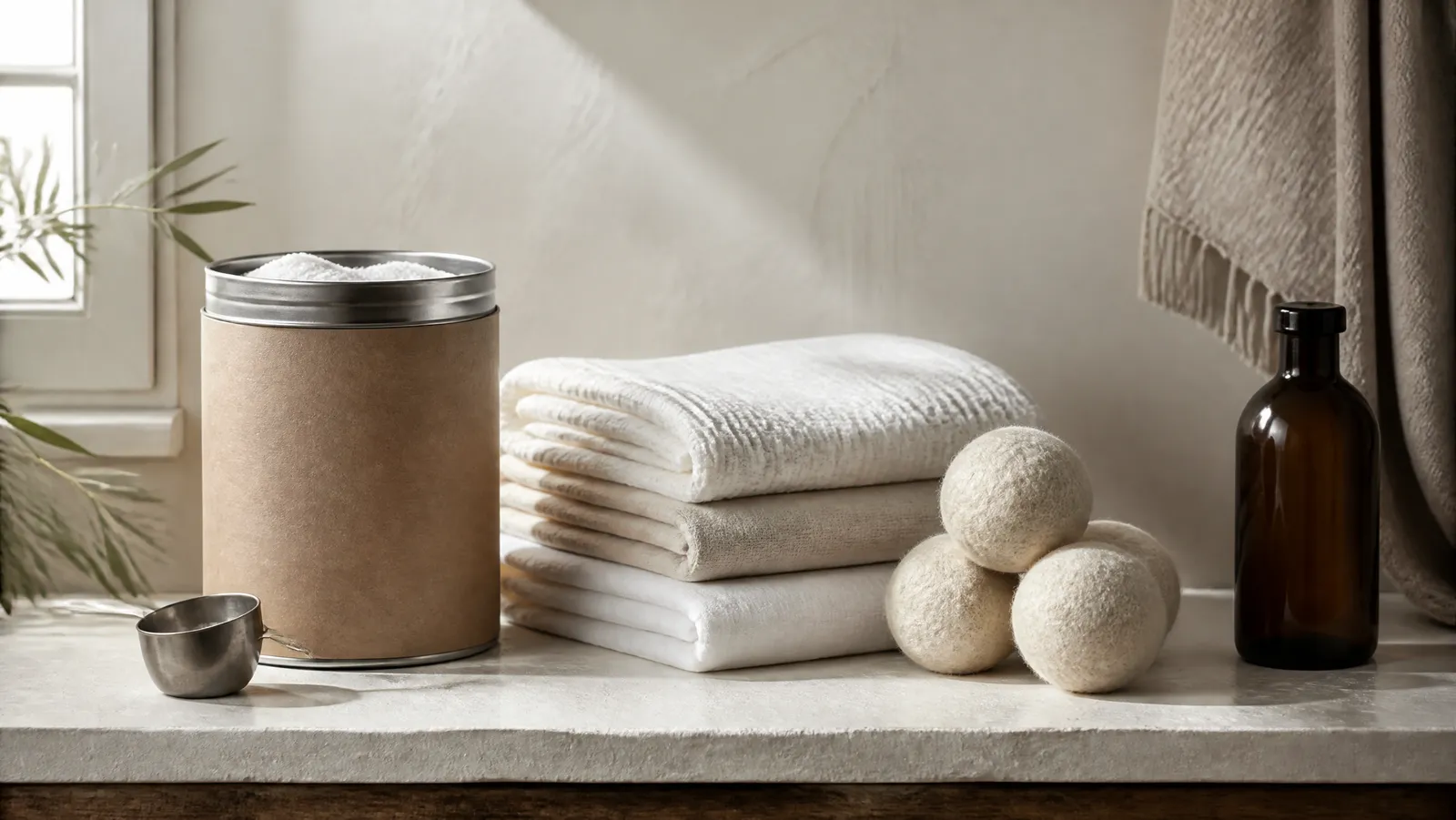
Eco-friendly laundry means taking the repeat purchases out of the room — the plastic detergent jug, the softener bottle, the box of dryer sheets — and cutting what your machine sends down the drain. It is not one purchase. It is a queue of small swaps made as the old thing runs out, and the swaps that last are the ones that clean as well as what they replaced.
Laundry is the most repetitive plastic habit in the house. A jug every six weeks. A box of sheets every month. A bottle of softener that never quite empties. None of it is dramatic on its own, which is exactly why it never gets fixed — no single item feels worth a decision, so the same four containers keep cycling through the cart for years.
This guide maps the whole aisle: what each swap replaces, what it costs in money and effort, and where the green option genuinely underperforms. We did the same walkthrough for the zero waste bathroom, and the method is identical. Change what your hand lands on when the old thing runs out. Do not purge a full shelf in a weekend — that is not lower waste, it is just faster waste.
What Eco-Friendly Laundry Actually Means
Four separate problems hide under one phrase, and most eco-friendly laundry products only solve the first one.
- Packaging. The jug, the film, the box, the pump. This is the visible problem and the easiest to market against.
- Chemistry. What actually goes down the drain: surfactants, optical brighteners, fragrance, softener quats, and — in pods and many sheets — a dissolved polymer we will spend a whole section on.
- Energy. Heating the wash water and running the dryer. According to ENERGY STAR, water heating consumes about 90 percent of the energy it takes to operate a clothes washer.
- Fibers. The synthetic threads your clothes shed into the wastewater every cycle. This one is not a product problem at all. It is a wardrobe problem, and no detergent fixes it.
Hold those four in your head and the marketing gets easier to read. A cardboard box is a packaging answer. A cold-water formula is an energy answer. A wash bag is a fiber answer. Very few products do more than one, and a product that only solves packaging is not automatically the better wash.
Be skeptical of "plastic-free" as a phrase, too. It often means the plastic moved somewhere you cannot see it: a dissolving film, a liner inside the carton, a shipping mailer nobody photographs.
The one principle that holds across all four problems is the same one behind why we stopped using paper towels in favor of dishcloths: the durable thing wins because it deletes a repeat purchase, not because it is virtuous. A sustainable laundry routine is mostly a list of purchases you no longer make.
Start Here If You Only Change One Thing
Wash cold. It is free, it takes ten seconds, and it is the largest single lever in the room.
Because water heating accounts for roughly 90 percent of a washer's operating energy according to ENERGY STAR, moving your everyday loads from warm to cold removes most of the energy footprint of washing without buying anything. Modern detergents are formulated with enzymes that work at tap temperature; the old advice about hot water dates from an era of different chemistry. Keep hot for genuinely soiled bedding, towels after illness, and cloth diapers. Everything else is cold.
The second lever is the dryer. According to the U.S. Department of Energy, a typical electric clothes dryer uses on the order of 782 kilowatt-hours per year, one of the larger single-appliance loads in a home. Air-drying half your loads halves that number without giving up the machine.
The third is the simplest: stop buying fabric softener. It is the one product in the aisle most households can delete outright with no substitute and no downside, for reasons we get to below. Everything after this point is optional and can wait until the current container is empty.
Detergents Without the Plastic Jug
The jug is the anchor of the whole problem. A 150-ounce bottle dosed at three ounces is fifty loads, which for a family of four is roughly six weeks. That is eight or nine jugs a year, per household, forever.
The alternatives split into three real categories:
- Powder in cardboard. The oldest answer and still the cheapest per load. Powders handle whites, mud, and hard water well. They can leave residue in cold water if you overdose or if your machine has a short fill, and they clump in humid laundry rooms.
- Concentrated liquid in glass or aluminum with refills. Closest performance to what you are used to, worst shipping weight. Refill pouches are usually a laminate — check before assuming the system is plastic-free.
- Sheets, strips, and tablets. The lightest to ship and the least storage space. Also the format with the most contested chemistry, which is the next section.
Here is where we stay honest: some green detergents genuinely underperform. Formulas without optical brighteners let whites go grey faster, though brighteners are a visual trick rather than a cleaning agent — you are seeing the absence of the trick, not worse washing. But a few plant-based formulas also struggle with body oils on collars and ground-in mud, and no amount of good intent fixes that. If a detergent leaves gym clothes smelling fine dry and sour when damp, it is not cleaning; it is masking.
Two habits recover most of the gap: dose by your actual load size and water hardness rather than filling the cap, and run an occasional hot maintenance wash on an empty drum. Underdosing is the most common reason a switch to a greener detergent "fails."
When you are ready to pick one, our roundup of the best eco-friendly laundry detergents we tested compares cost per load, cold-water performance, and how each one handles hard water.
Detergent Sheets and the PVA Question
This is the most contested claim in the aisle, and it deserves a straight account rather than a verdict.
Most laundry pods and a large share of laundry sheets rely on polyvinyl alcohol, usually written PVA or PVOH. It is a synthetic polymer — a plastic by chemical definition — engineered to dissolve in water. The argument is not about whether it dissolves. Everyone agrees it does. The argument is about what happens after it dissolves.
The critics' case. A 2021 paper by Rolsky and Kelkar in the International Journal of Environmental Research and Public Health estimated that roughly 75 percent of the PVA from detergent pods is not fully degraded in US wastewater treatment and passes into the environment, which the authors put at about 8,000 metric tons a year nationally. That study is the source of nearly every "pods are plastic" headline you have seen. The paper's own acknowledgements state the work was supported in part by Blueland — a company that sells detergent tablets without PVA film — and credit that company's "sponsorship and critical input," while lead author Charles Rolsky is also affiliated with the nonprofit Plastic Oceans International. The authors state the funder had no role in the study's design, analysis, or decision to publish. That funding does not make the finding wrong, but you should know it exists.
The industry's case. The American Cleaning Institute, the trade body for the detergent industry, disputes the conclusion and says decades of published science support the biodegradability of detergent-grade PVOH under real wastewater treatment conditions. Procter and Gamble, which owns Tide, publishes its own technical review arguing the 2021 study's methods do not reflect how treatment plants actually operate. Again: an interested party, arguing its own book.
Where the regulator landed. In January 2023, Blueland and the Plastic Pollution Coalition petitioned the EPA to require independent testing of PVA and to downgrade its status on the agency's Safer Chemical Ingredients List. According to the Federal Register, the EPA denied that petition on April 27, 2023. A denial is not a finding that PVA is harmless — it is a decision that the petitioners did not meet the statutory bar for compelling new testing.
So: two funded positions, one regulatory non-decision, and no independent, replicated, real-world degradation dataset that settles it. We do not think anyone honest can declare a winner right now. What we can say is that if avoiding synthetic polymer in the wash is your specific goal, powder in a box and tablets without film sidestep the question entirely. We dig into the studies, the funding trails, and whether laundry detergent sheets are actually plastic-free in a dedicated piece.
Laundry Sheets and Strips
Set the chemistry aside for a moment, because the format has real practical merits and real practical failures, and they are easy to test yourself.
What sheets get right. They ship in a flat cardboard sleeve that fits through a letterbox, which removes almost all the weight and volume of liquid detergent. They cannot spill, and they are the only detergent format that travels well — a couple of sheets in a laundry bag is why people who dislike everything else about them still keep a pack for hotels and campsites. Dosing is foolproof: one sheet, one load, no cap to overfill.
What sheets get wrong. Cold, short cycles are their weak point. In hard water and on a rapid 30-minute program, sheets sometimes do not fully dissolve, and you find a gummy strip stuck to a sleeve. The fix is to put the sheet in the empty drum first, under the clothes, rather than in the dispenser drawer. The second problem is capacity: one sheet is calibrated for a normal load, so a stuffed drum of towels needs two, and at that point the cost per load stops being competitive.
On cost. Do the arithmetic yourself rather than trusting the front of the box: divide the total price by the load count on the pack, then compare against your current detergent at your real dose. Sheets frequently lose that comparison against powder and win it against boutique liquid. Subscription pricing is where most of the savings claims come from, not the product.
On performance. Sheets are perfectly adequate on lightly soiled everyday clothes and noticeably weaker on grease, mud, and heavily worn workwear. If your laundry is mostly office clothes and bedding, that limit may never surface. If it is kids' football kit, it will surface immediately.
Our comparison of the best laundry detergent sheets covers dissolution in cold water, real cost per load, and which ones actually clear the grease test.
Drying Without Dryer Sheets
Dryer sheets are a single-use product that coats your fabric with softening agents and fragrance, then goes in the bin. A household running five loads a week gets through more than 250 of them a year.
The standard replacement is a set of wool dryer balls: felted wool spheres that tumble through the load, separating fabric and letting hot air move. They are reusable for years, they are compostable at end of life, and they cost nothing to run.
We want to be careful about the claims made for them. The marketing routinely promises dryer balls will cut drying time by 25 or even 40 percent, and we have not seen credible independent testing that supports numbers that specific. What we observe is more modest and more variable: they help most with bulky items that tangle into a wet ball, like duvet covers and sweatshirts, and they help least with an already-well-separated load of shirts. Treat time savings as a bonus, not the reason to buy.
What dryer balls definitively do is remove a disposable from the cycle and take the fragrance out of your clothes. What they do not do is control static, which is the thing people actually miss. Static is a dryness problem — it appears when synthetics get over-dried — so the real fix is pulling the load out while it is very slightly damp, not adding anything to the drum.
Two honest cautions: wool balls are noisy in a lightly loaded drum, and cheap ones pill and shed fluff onto dark clothes within months. Density matters more than diameter. For the full side-by-side on static, drying time, scent, and what happens after a year of use, we compare wool dryer balls versus dryer sheets in detail.
Microfibers and What Comes Off in the Wash
Every wash of a synthetic garment sheds fiber. This is the part of eco-friendly laundry that no detergent, box, or bar addresses, and it is also the part where the numbers are most abused online.
The most-cited figure comes from a 2016 study by Imogen Napper and Richard Thompson at the University of Plymouth, which estimated that an average 6-kilogram domestic wash load of acrylic could release more than 700,000 microscopic fibers into wastewater. The fabric matters enormously: the same study put polyester at about 496,000 fibers and a polyester-cotton blend at about 138,000. That acrylic figure is the source of nearly every "700,000 fibers per wash" headline in circulation, usually stripped of the fabric it applies to.
Studies disagree, and they disagree by a lot. A 2021 paper by Vassilenko and colleagues in PLoS ONE, working with real consumer apparel, reported shedding of between 9.6 and 1,240 milligrams of fiber per kilogram of textile per wash — a spread of more than two orders of magnitude across garments. The authors themselves caution that direct comparison between published studies must be done carefully, because methods, fabrics, and machines differ so widely. Anyone quoting a single confident number for "how much your laundry sheds" is flattening a genuinely unsettled field.
A further complication: a 2020 study by De Falco and colleagues at Italy's National Research Council and the University of Plymouth, published in Environmental Science and Technology, found that the fibers a person releases to the air simply by wearing synthetic clothes are of a similar order of magnitude to what they release to wastewater by laundering. The machine is a major pathway, but not the only one.
What survives the uncertainty is a short list of things that reliably reduce shedding, none of which involve buying detergent:
- Wash less often and with fuller loads. Friction between garments is the mechanism. Fewer, fuller, gentler cycles shed less than many small ones.
- Cold and shorter. Heat and long agitation both increase release.
- Skip the tumble dry for synthetics. Dryer lint is fiber that left the garment.
- Buy fewer synthetics, and buy better-made ones. Loose, brushed, fleece-type constructions shed far more than tight weaves. This is the biggest lever and the least convenient one.
Our full explainer on how to stop your laundry shedding microplastics goes through each of these in order of actual impact.
Filters and Bags That Catch the Fibers
If you cannot stop the shedding, the next option is catching it. Two product categories exist, and they solve different halves of the problem.
Wash bags and in-drum catchers go inside the machine. A fine mesh bag traps most of the fiber released from whatever is inside it; a floating catcher tries to collect fiber circulating in the drum. Bags are cheap, need no plumbing, and work only on what you put in them. Catchers are less selective and, in our view, less convincing.
External in-line filters plumb into the drain hose and screen everything leaving the machine. They capture far more and cost far more, plus cartridge changes and maintenance you will forget at least once.
The regulatory picture is worth understanding, because it is frequently misreported.
- France passed its anti-waste and circular economy law in 2020, requiring new domestic washing machines sold in the country to include microfiber capture from January 1, 2025. According to the filter manufacturer PlanetCare, that provision remains effectively unenforceable because the implementing technical definitions — what counts as a microfiber, what counts as a compliant filter — were never published. It is a law on paper that has not become a requirement in practice.
- California came closest in the US. AB 1628 passed both chambers and would have required a microfiber filtration system with a mesh no larger than 100 micrometers on new machines sold in the state from January 1, 2029. Governor Gavin Newsom vetoed it on October 8, 2023, citing cost to consumers and a preference for incentives over mandates.
- Other states have introduced bills without passing them. Oregon's Senate Bill 526, introduced in 2025, would have required filters on new machines by January 1, 2030; it received a public hearing and did not advance. Similar measures have been filed in other legislatures and remain proposals.
The plain reading: no US state and, in practice, no country currently enforces a washing-machine filter requirement on consumers. Anyone telling you filters are "required in France" is describing an unimplemented statute. If you want one, you are buying it voluntarily. Our guide to the best microplastic filters and wash bags covers capture claims, install effort, and what maintenance really looks like.
Sheets vs Pods vs Powder vs Liquid
Format is where most people get stuck, so here is the short version of the trade-offs.
- Powder. Cheapest per load, cardboard packaging, best on whites and mineral-heavy hard water, no dissolving film. Weakest on very short cold cycles and in humid storage. The quiet winner on cost and packaging together.
- Liquid. Best cold-water dissolving and the easiest to use as a pretreat straight onto a stain. Heaviest to ship, and the plastic jug is the whole problem you came here to solve unless it is sold as a concentrate with a durable vessel.
- Pods. Most convenient and least flexible — you cannot dose down, so small loads are systematically overdosed. Carry the PVA question above, and are a poor fit for homes with small children.
- Sheets and strips. Lightest packaging, best for travel and tight storage, mid-tier cleaning power, same PVA question in most brands, and dissolution problems on rapid cold cycles.
There is no universally correct answer. If your water is hard and your laundry is genuinely soiled, powder. If your loads are light and your storage is tight, sheets. If you pretreat a lot of stains, keep some liquid around regardless. We put the four formats through the same loads and wrote up how sheets pods and powder compare, including where each one fails.
Stains Without the Solvents
Most stain removal does not need an aggressive solvent. It needs speed and the right chemistry for the stain type, and household staples cover a surprising amount of it.
The rule that matters more than any product: treat it wet, treat it now, and never put a stained item through the dryer. One trip through a hot cycle turns a fixable stain into a dye.
A basic kit, matched to what it actually works on:
- Enzyme detergent, applied neat. Best on protein and food: blood, egg, dairy, grass, sweat. Work it in, wait fifteen minutes, wash cold. Hot water cooks protein into the fiber, which is why cold matters here specifically.
- Oxygen bleach, meaning sodium percarbonate. The workhorse for tannin and dye stains: tea, coffee, red wine, fruit. It needs warm water to activate and time — a long soak beats a strong dose.
- Bar soap or dish soap. Oil and grease, including salad dressing and cosmetics. Surfactant, not solvent.
- White vinegar. Deodorizing and mineral or detergent residue. It is a mild acid, not a disinfectant, and it does very little on grease.
- Sunlight. Free, and genuinely effective on residual yellowing in cotton and on stubborn baby-food stains. Lay the damp item out in direct sun.
Where we will not oversell: ink, old set-in oil, and some dye transfer often need a solvent, and no pantry staple recovers them. Baking soda and vinegar mixed together mostly produce carbon dioxide and a fizzing sound — used separately they each have a job, and combined they largely cancel out. Our tested list of natural stain removers that actually work names which staples handle which stains and where we gave up and reached for something stronger.
Air Drying and the Racks Worth Buying
Air drying is the biggest energy saving in the room and the swap that most often fails, because people buy the wrong rack and then hate the process.
The failure mode is always the same: a flimsy rack with too little hanging space, parked in a room with no airflow, holding a load that takes two days to dry and smells musty. That is not a verdict on air drying. It is a verdict on a bad rack in a bad spot.
What actually determines whether it works:
- Linear drying length, not footprint. A rack's usable capacity is how many meters or feet of bar it gives you, not how big it looks. A load of towels needs far more bar than a load of shirts.
- Airflow. A dehumidifier or a cracked window does more for drying time than any rack design. Wet laundry in a closed room is a humidity problem before it is a drying problem.
- Spacing. Garments that touch dry slowly and smell. Two-thirds full and well spaced beats packed and fast-loaded every time.
- Where it lives when folded. The rack you resent storing is the rack you stop using. Wall-mounted and ceiling-mounted options exist for exactly this reason.
Be realistic about the trade-off: air drying takes planning. You start the wash earlier and you give up a corner of a room for a day. In a small flat in winter, drying everything indoors may not be practical, and the sensible compromise is air-drying synthetics and delicates while tumbling towels and bedding. Fewer dryer cycles is still the win, and line-dried clothes wear out more slowly than tumbled ones. Our picks for the best drying racks cover capacity, stability, and which designs survive being folded twice a week.
Making Your Own and When It Is Worth It
Homemade laundry detergent is the most-shared idea in this category and the one we are most cautious about.
The classic recipe is grated bar soap, washing soda, and borax. It is cheap, genuinely package-free if you buy the components in cardboard, and it will get lightly soiled cotton clean. But bar soap is soap, not detergent, and in hard water soap reacts with calcium and magnesium to leave a curd on fabric and inside the machine. Over months that builds into a residue that traps odor and, in some machines, contributes to drain problems.
Where DIY genuinely earns its place:
- Oxygen bleach soaks. Sodium percarbonate bought in bulk, used as a soak, is exactly the same chemistry as the branded stain remover at a fraction of the cost.
- Wool wash and delicate wash. Low-stakes, low-soil loads where a mild soap is entirely adequate.
- Scent. A few drops of essential oil on wool dryer balls does what a dryer sheet does, at almost no cost.
- Cleaning the machine itself. Washing soda and hot water on an empty drum is a fine monthly maintenance cycle.
Where it does not: everyday family laundry in hard water, athletic synthetics, and anything you need to actually degrease. Enzymes and modern surfactants are doing real work that a soap-based recipe cannot replicate, and the savings are not large enough to justify grey towels.
If you want to try it anyway — and there are good reasons to, especially if you are avoiding fragrance — our walkthrough of how to make your own laundry detergent covers the recipes, the hard-water test, and the failure signs to watch for.
Softening Without the Bottle
Fabric softener is the easiest deletion in the room, and we say that with more confidence than anything else on this page.
Conventional liquid softeners deposit a thin waxy cationic film on fibers. That film is what makes towels feel plush — and also what stops them absorbing water, which is the entire job of a towel. On athletic wear the same coating traps body oils and degrades wicking, which is why sportswear makers routinely advise against it.
The replacements, in order of how much we use them:
- Nothing. Most loads do not need softening at all. Stiffness usually comes from overdosing detergent or overpacking the drum, both of which leave residue. Fix the dose and the stiffness often disappears.
- White vinegar in the rinse. Roughly a quarter to a half cup in the softener dispenser. It strips detergent residue and mineral deposits, and it rinses out — clothes do not smell of vinegar once dry. Do not combine it with bleach, and check your machine's manual, since a few manufacturers advise against acids in the dispenser.
- Wool dryer balls. Mechanical separation instead of chemical coating. Softens by fluffing rather than by coating.
- Under-drying. Pulling the load out slightly damp and finishing it on a rack gives you soft fabric with no additive at all.
The one place softener has a genuine argument is line-dried cotton in very hard water, which can come off the line board-stiff. Even there, a vinegar rinse plus a short tumble gets you most of the way. Our rundown of natural fabric softener alternatives compares each of these on stiffness, static, and scent.
What the Certification Marks Actually Verify
The labels on the box are useful, but each one verifies something narrower than shoppers assume.
- EPA Safer Choice. According to the EPA, every chemical in a Safer Choice product — regardless of percentage, including fragrance components — is evaluated against the agency's safer-ingredient criteria, and certified products must also meet performance standards, sustainable packaging criteria, and VOC restrictions. Full ingredient disclosure has been required since April 2011. What it is not: an organic certification, a carbon or climate claim, or a statement about the company behind the product.
- EWG VERIFIED. According to the Environmental Working Group, the mark signals a product is free of the group's chemicals of concern and meets its transparency requirements. It is an ingredient hazard screen run by an advocacy nonprofit, not a government program, and it says nothing about packaging or performance.
- MADE SAFE. Another ingredient screen against a hazard database, most commonly seen on personal care. Same limitation: ingredients only.
- B Corp. Certification of the whole company by the nonprofit B Lab against social and environmental performance criteria. It is an organizational assessment, not a product one — a B Corp can sell a product in a plastic jug, and frequently does.
None of these four marks tells you a product is plastic-free, and none settles the PVA question. Read each mark for what it audits, and get the rest from the ingredient list.
The Order We Would Do It In
If you take nothing else from this page, take the sequence. Each step is free or nearly free, and none requires throwing away something you already own.
- Switch to cold for everyday loads. Free, today, biggest energy lever.
- Stop replacing fabric softener when the bottle empties. Free, and your towels will absorb better.
- Replace dryer sheets with wool balls when the box runs out. One purchase, then years.
- Air-dry synthetics and tumble the rest. No purchase needed if you own any rack at all.
- Change detergent format when the jug is empty — powder if your water is hard, sheets if storage and shipping are your constraint.
- Add fiber capture if you own a lot of synthetics and want to go further: a wash bag first, an in-line filter only if you are committed.
- Buy fewer synthetic garments. Slowest, least satisfying, largest effect.
Notice what is not on the list: nothing here asks you to bin a half-full container, and nothing depends on a claim that is currently unsettled. That is deliberate. The swaps that survive contact with a real household are the ones that arrive at the moment the old thing runs out and then never ask for attention again.
Explore the full series
- The Best Eco-Friendly Laundry Detergents We Tested — Five picks, one per job, with the cost per load and the trade-off named.
- Are Laundry Detergent Sheets Actually Plastic-Free — What PVA is, why the science is contested, and who funded which side.
- The Best Laundry Detergent Sheets for Ditching the Plastic Jug — Five sheet brands ranked, and the load-count asterisk that flatters the cheap ones.
- Wool Dryer Balls vs Dryer Sheets and Which One Wins — Round by round on static, softness, drying time, scent and cost over three years.
- How to Stop Your Laundry From Shedding Microplastics — Every intervention ordered by evidence of effect, with no gadget sold to you.
- The Best Microplastic Filters and Wash Bags for Your Machine — What you can actually buy, what the studies tested, and why those are not the same list.
- Laundry Sheets vs Pods vs Powder and What to Actually Buy — Four formats on the same six axes, and the unglamorous one that wins on cost and packaging.
- Natural Stain Removers That Actually Lift the Stain — Stains sorted by chemistry, the pantry remedies that work, and the one everyone gets wrong.
- The Best Drying Racks for Skipping the Dryer — Five racks for five different rooms, plus the damp-and-ventilation caveat nobody prints.
- How to Make Your Own Laundry Detergent Without the Mess — The recipes, the soap-versus-detergent problem, and the water hardness that decides it.
- Natural Fabric Softener Alternatives That Actually Soften — Why softness is two separate problems, and which alternative solves which one.
How we score
What it’s made of.
Chemistry you’ll touch.
How long it lasts.
Where it goes after.
Each pick scores 0–5 on the four axes above, weighted into the composite verdict at the top. Scores are derived from what a product is verifiably made of and certified as — not how green its label looks.
About the author
Ruth Lopez
I'm Ruth Lopez and I'm a lover of nature and the environment. I'm very passionate about finding eco friendly products that don't damage the environment and also support companies that have the same philosophy.