The Best Laundry Detergent Sheets for Ditching the Plastic Jug

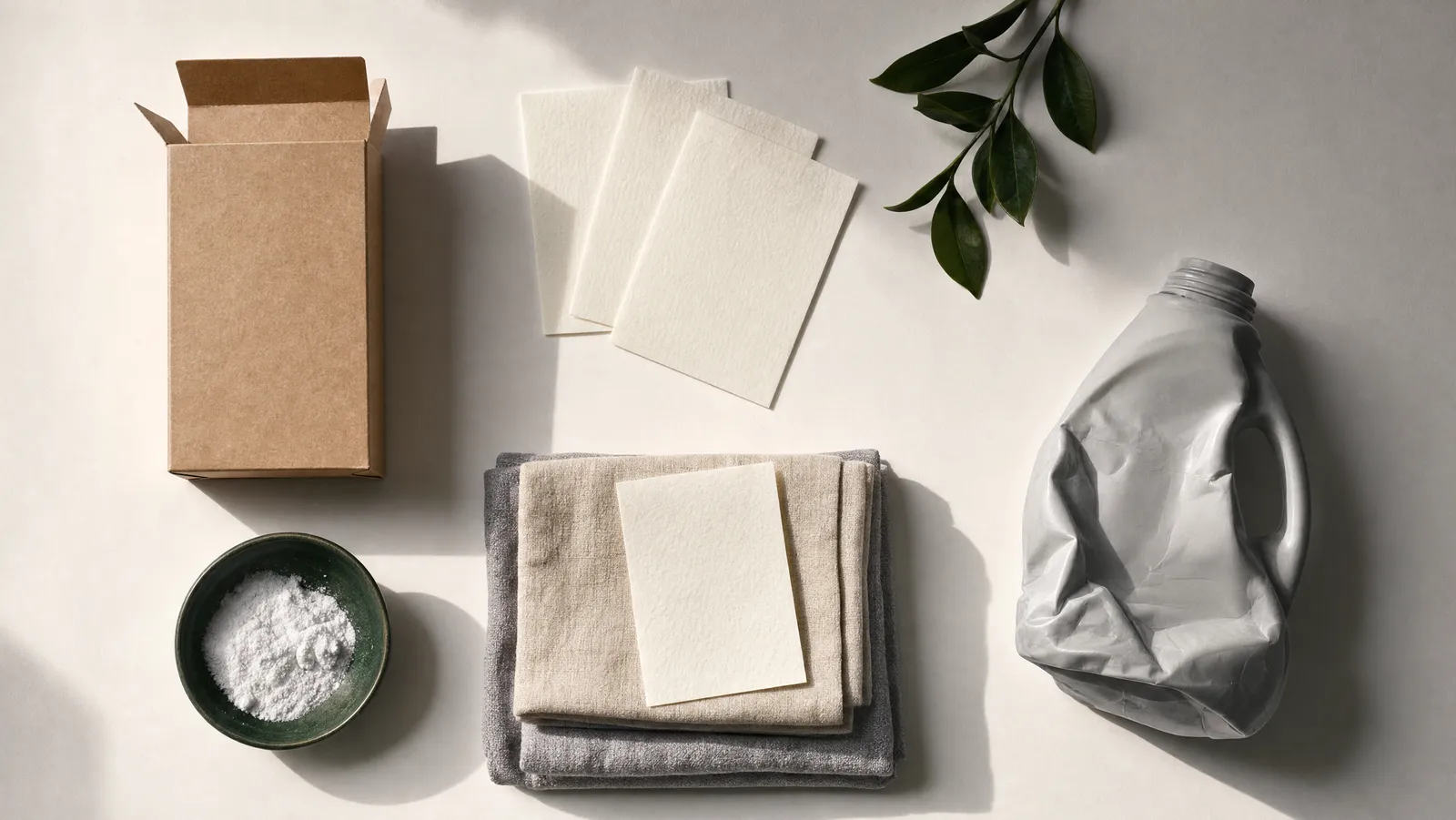
The best eco friendly laundry detergent sheets depend on which job you are buying them for. Earth Breeze if you want the safe default, Arm & Hammer if perfumes and dyes are the problem, ECOS if the packaging is the whole point, Cleancult if you want the strongest stain claim and the best box, AIDEA if you want the lowest cost per wash. Eco-Friendly Review is reader-supported, so if you buy through our links we may earn a small commission, at no extra cost to you.
Before any of that, the thing a roundup like this normally buries: we do not think the plastic-free claim on this category is settled, and publishing five picks does not mean we changed our minds. The sheet itself is usually held together by polyvinyl alcohol, a synthetic polymer, and whether it truly biodegrades after it leaves your drain is a live scientific argument. We took it apart at length in our piece on whether laundry detergent sheets are actually plastic-free, and nothing has resolved since.
So this is a roundup written from an unresolved position, which is the only honest way to write one. If you are buying sheets anyway, here is which box and why, with the arithmetic shown and the trade-off named every time, alongside the rest of our eco-friendly laundry coverage.
What the plastic-free claim on laundry sheets actually covers
Two claims get blurred into one on every box in this category, and separating them takes thirty seconds.
The packaging claim is real. A cardboard sleeve or paper box instead of an HDPE jug, no cap, no scoop, no shrink wrap. There is no asterisk on this part.
The sheet claim is the contested one. The binder is polyvinyl alcohol, written as PVA or PVOH, the same water-soluble film that wraps a laundry pod. It dissolves - but dissolving is not biodegrading. Dissolving means the polymer disperses into the water; biodegrading means microbes break the chain down. Whether the second happens depends on what lives in your wastewater plant and how long the water stays there.
Both sides of that argument have a stake. The study most often cited against PVA is Rolsky and Kelkar's 2021 paper in the International Journal of Environmental Research and Public Health, which modeled US emissions from detergent pods and estimated that roughly 61 percent of PVA reaches the environment via the sludge route and about 15.7 percent via the aqueous phase. Read its funding statement: "This research was funded in part by Blueland," a company that sells PVA-free cleaning products, whose "sponsorship and critical input greatly assisted with the study."
The most consequential neutral voice went the other way. When Blueland, the Plastic Pollution Coalition and 15 partner organizations petitioned the EPA to compel testing of PVA, the agency denied the petition in a response signed April 21, 2023, concluding of the PVA grades used in Safer Choice-certified products that "the weight of evidence for environmental toxicity and fate demonstrates that PVA meets the Safer Choice Criteria for Colorants, Polymers, Preservatives, and Related Chemicals." The EPA also stated that "the OECD biodegradation test conditions are more conservative than real world conditions in WWTPs."
That is a genuine regulatory result and we will not pretend otherwise. It is also not a measurement of PVA leaving a municipal plant. Buy sheets knowing the packaging win is certain and the sheet question is open.
The load count asterisk is the whole story of this category
Some brands count physical sheets. Some count torn halves. A box holding 80 sheets is sold as 160 loads if the instructions say tear each one in half for a small load. Nothing is hidden - every maker prints the basis somewhere - but it means the headline numbers on two boxes can describe wildly different quantities of detergent.
Run our five through it, using August 2026 prices and each maker's own count:
- AIDEA claims 160 loads from 80 sheets. 6.74 divided by 160 is about 4 cents.
- Earth Breeze claims 60 loads from 30 sheets. 13.99 divided by 60 is about 23 cents.
- Cleancult claims 60 loads from 60 sheets. 13.98 divided by 60 is about 23 cents.
- Arm & Hammer claims 50 medium loads from 50 sheets, or 100 small ones. 12.48 divided by 50 is about 25 cents.
- ECOS claims 64 loads from 64 sheets. 15.96 divided by 64 is about 25 cents.
Now redo it in the only unit that is the same across all five - the price of one whole sheet:
- AIDEA: 6.74 divided by 80 sheets is about 8 cents a sheet.
- Cleancult: 13.98 divided by 60 sheets is about 23 cents a sheet.
- ECOS: 15.96 divided by 64 sheets is about 25 cents a sheet.
- Arm & Hammer: 12.48 divided by 50 sheets is about 25 cents a sheet.
- Earth Breeze: 13.99 divided by 30 sheets is about 47 cents a sheet.
The ranking does not survive the switch. Earth Breeze goes from the joint-second-cheapest load to the most expensive sheet on the page, by almost double. AIDEA stays cheapest either way, but its headline figure is twice as flattering as the honest one. Cleancult and ECOS barely move, because they count one sheet as one load and have nothing to gain from the arithmetic.
None of this tells you how much detergent is in a sheet, which none of these five listings discloses in grams. But cost per whole sheet means the same thing on every box, and it is the number we used to check every pick below.
Best overall - Earth Breeze Fresh Scent
Earth Breeze is the pick for most people because it is the least wrong in the most situations, not because it wins anything outright. It is stocked everywhere, premeasured, and packs flat, and Earth Breeze says the sheets suit all washing machines and work in hot or cold cycles. The brand also calls them dermatologist-tested, hypoallergenic and cruelty-free, made at its own facility in Harrodsburg, Kentucky.
At 13.99 as of August 2026 for a pack the brand rates at 60 loads, that is about 23 cents a load, which sits mid-table.
The trade-off is the one we just did the arithmetic on. Those 60 loads come from 30 physical sheets. Buy this expecting 60 sheets and you will be annoyed. Tear each sheet in half as instructed and you are running half a sheet per small load, which is fine for lightly soiled laundry and thin for a full drum of towels. Per whole sheet, at about 47 cents, this is the most expensive box here.
One more precision. Earth Breeze's listing calls the sheets microplastic-free. That is a claim about particles, and PVA's whole point is that it dissolves rather than persisting as a particle - which is why that phrase does not settle the argument above. Brand wording, not a verdict on the polymer.
Best for sensitive skin - Arm & Hammer 5in1 Power Sheets
The sensitive-skin pick is made by a mainstream laundry company with no eco positioning whatsoever, and that is not an accident. Arm & Hammer's 5in1 Power Sheets in Free & Clear are, per the listing, free of perfumes and dyes and dermatologist tested, and they contain the same type of cleaning ingredients as Arm & Hammer's liquid detergent. If someone in your house reacts to fragrance, "no perfume, no dye" is the specification that matters, and a big conventional brand is perfectly capable of meeting it.
It is also the only pick whose listing makes a specific promise about the failure everyone complains about. Arm & Hammer describes Quick Dissolve Technology that "dissolves quickly and fully in all wash temperatures including cold water," and says the sheets suit high-efficiency machines. We cannot verify that against a lab, and ECOS also says its sheet dissolves in hot and cold - but Arm & Hammer is the only one of the five whose listing promises it dissolves fully.
At 12.48 as of August 2026, 12.48 divided by 50 medium loads is about 25 cents a load, and the same 25 cents per whole sheet, because 50 sheets equals 50 medium loads. The listing's 100-load figure is half sheets for small loads.
The trade-offs, plainly. The listing's sustainability claim is narrow and self-referential - 99 percent less water and zero plastic bottle waste per medium load "versus leading value detergent" is a comparison the brand chose, and it says nothing about the sheet's polymer. There is no third-party mark of any kind here. And "dermatologist tested" tells you a test happened, not what it found. You are buying a fragrance-free formula from a company that has made laundry detergent for a very long time, which for a lot of households is the right trade.
Best plastic-free packaging - ECOS Free and Clear
If the entire reason you are on this page is getting plastic out of the laundry room, ECOS Laundry Detergent Sheets put the strongest version of that claim in writing. The listing states 100 percent plastic-free packaging, which is a more specific commitment than the "no plastic jug" phrasing most competitors use, since a box can be jug-free and still have a window film or a poly liner.
The formula reads as a straightforward free and clear. ECOS says it is dermatologist tested and hypoallergenic, made without dyes, optical brighteners, parabens, phosphates or more than 500 other ingredients, and built on enzymes the company has used since 1967. It also notes it is a women-owned and Black-owned company. Optical brighteners on that exclusion list is the genuinely useful detail - brighteners do not clean anything, they deposit on fabric to make whites look whiter.
The count is honest: 64 sheets, one sheet per full load, half for a small one. 15.96 divided by 64 is about 25 cents, and it is the same 25 cents per whole sheet.
The trade-off is money. At 15.96 as of August 2026 this is the most expensive box on the page, and the premium buys packaging integrity and an exclusion list, not more detergent. Be exact about what the packaging claim covers, too - the box, not the sheet. No listing here resolves the PVA question.
Best for stains - Cleancult Wild Lavender
Cleancult makes the most aggressive cleaning claim of the five, saying these are the only laundry sheets containing three stain-fighting enzymes and that the formula fights stains, removes odors and softens clothes. That is Cleancult's claim, not our finding. We did not run a controlled stain test and we are not going to launder someone else's marketing copy into a test result. What we can say is that it is the only listing here that names a mechanism rather than an adjective, and enzymes are the mechanism that does most of the real work on protein and starch stains.
The formula is listed as free of 1,4-dioxane, phosphorus, parabens, phosphates, phthalates, dyes and SLS. That first one needs context. According to New York State's Department of Environmental Conservation, 1,4-dioxane "is not listed as an ingredient in products because it is a manufacturing byproduct, not an intentionally added ingredient," and New York caps it at 2 parts per million from December 31, 2022 and 1 part per million from December 31, 2023 in household cleansing and personal care products. So "free of 1,4-dioxane" is a claim about contamination control, and anything legally sold in New York is already at or under 1 ppm. Worth caring about; not the differentiator the box implies.
At 13.98 as of August 2026 for 60 sheets, 13.98 divided by 60 is about 23 cents, whole sheet, no tearing. The resealable paper box is the best storage design in this group, and that matters more than it sounds - an open sleeve of sheets in a humid laundry room is how they end up welded together.
Two trade-offs. It is scented with wild lavender, so it is the wrong pick if fragrance is the problem you are solving. And the listing says the product is certified plastic neutral, which is not a statement about the product at all. Per rePurpose Global, which runs the best-known program of this kind, businesses earn Plastic Neutral certification by purchasing plastic credits equivalent to the plastic waste they generate each year alongside a commitment to reduce plastic use, and the company is explicit that such certifications are "not a license to continue using plastic." Plastic neutral means waste was funded out of the environment somewhere else. It does not mean there is no plastic here.
Best cost per load - AIDEA Fresh Linen
AIDEA is here for one reason and it is a good one. At 6.74 as of August 2026 it is roughly half the price of the next cheapest box, and it stays cheapest even after you correct its arithmetic. 6.74 divided by the claimed 160 loads is about 4 cents. 6.74 divided by the 80 sheets actually in the box is about 8 cents. The honest figure is still roughly a third of the next cheapest sheet.
AIDEA describes a low-foam formula containing cleansers and stain removers, suitable for all fabric types, with no plastic jug, no measuring and a pack small enough to travel with. That is close to the entire specification.
The trade-off is information. There is no certification, no dermatologist testing claim, no exclusion list, no fragrance disclosure beyond "fresh linen," and no statement about water temperature. Compare that with the ECOS listing's 500-plus excluded ingredients or Arm & Hammer's cold-water dissolving claim and you can see what four cents a load buys you and what it does not. If you want a plastic-free-ish format at student prices, or a strip of sheets for a suitcase, this is the obvious call. If you want to know what you are washing your baby's clothes in, buy one of the others.
What we tested, and what we could not
We handled all five the way you would at home: dosing them, tearing the ones meant to be torn, watching them in a cold fill, checking whether the boxes reseal, and doing the division behind the cost figures above. Those are the honest limits of what we can tell you.
We did not run a controlled wash test, so we are not ranking cleaning power. And here is the uncomfortable thing we are obliged to pass on rather than route around. According to Consumer Reports, which does run a controlled lab test, "sheets test so poorly in our labs that we don't recommend them," and their cleaning power "falls short of that of other detergents, and they score lower than the lowest-scoring liquids and pods in our tests." CR also notes that it washes its test loads in cool water "because today's washers are designed to operate with cooler water."
That detail matters, because cold water is where sheets are most often reported to leave chalky residue. Four of our five listings address it - Earth Breeze says hot or cold, ECOS says both hot and cold, Cleancult says all water temperatures, Arm & Hammer claims full dissolving at all temperatures - and all four are manufacturer claims.
The habit that helps is putting the sheet in the empty drum first, underneath the clothes, so incoming water hits it directly rather than trapping it in a fold of a towel. Never put a sheet in a dispenser drawer designed for liquid.
So: sheets are a packaging decision that costs you something in measured cleaning performance. We would rather you knew that going in than discovered it on a collar.
Who should skip laundry sheets entirely
Sheets are not the plastic-free-est option available, and it would be dishonest to imply otherwise on a page selling five of them.
Powder in a paper and metal canister has no polymer binder, no film and no packaging asterisk. If your goal is the maximum defensible plastic reduction rather than the most convenient one, that is the format with the least ambiguity, and it is the pick we made in the best eco-friendly laundry detergents we tested. Powder is fussier - it wants to go in the drum, and it wants water warm enough to dissolve it - but the argument about what it leaves behind is much shorter.
Two other groups should think twice. If you fight heavy, greasy or set-in stains regularly, the Consumer Reports finding above should push you to a liquid. And if you route greywater onto a garden, none of these listings tells you enough to choose well.
The reason liquid detergent is worth escaping at all is straightforward: it is mostly water you are paying to ship. Seventh Generation's own safety data sheet for its Free and Clear liquid detergent lists "aqua (water)" as a diluent at 30 to 100 percent of the formula, with every other ingredient at 10 percent or less. That is the honest core of the sheets pitch, and it survives the PVA argument entirely.
The bottom line
Buy Earth Breeze for the default that is bad at nothing, and read the sheet count. Arm & Hammer if fragrance and dye are what you are eliminating and you do not need the brand to look green. ECOS if the packaging claim is the purchase. Cleancult for the best box on the page, if you can live with lavender. AIDEA if price is the whole decision and you accept knowing very little about what is in it.
And keep the two claims separate in your head. The jug is genuinely gone - that part is finished, verifiable and worth doing. The polymer question is not finished, the EPA has ruled one way, the most-cited study points the other, and the funding runs in both directions. We will update this page when that changes rather than when a brand asks us to.
If you want the rest of the routine mapped out, from dryer sheets to stain removers to what to do with the jug already under your sink, it is all in our guide to plastic-free laundry swaps.
What we tested

The one most people should buy middling on every axis and bad at nothing
- Material
- Paper-Boxed Detergent Sheets
- Credentials
- Jug-freePre-measured
Premeasured, packs flat for travel, and rated by the brand for hot and cold cycles in any machine, with no jug, cap or scoop to deal with.
No major drawbacks noted in testing.
The most widely stocked sheet in the category and the one we would hand someone switching from a jug for the first time. Earth Breeze says the sheets are made at its own facility in Harrodsburg, Kentucky, work in hot or cold cycles, suit all washing machines, and are dermatologist-tested, hypoallergenic and cruelty-free. Read the pack size carefully - the 60-load figure comes from 30 sheets, each torn in half for a small load.

Free of perfumes and dyes and the only pick claiming a dissolving fix
- Material
- Paper-Boxed Detergent Sheets
- Credentials
- Jug-freePre-measured
No perfumes, no dyes, dermatologist tested, and the only sheet here whose listing makes a specific promise about dissolving fully in cold water.
No major drawbacks noted in testing.
A mainstream laundry brand with no eco positioning at all, which is exactly why it is worth listing. Arm & Hammer says the Free & Clear formula has no perfumes or dyes, is dermatologist tested, and uses Quick Dissolve Technology that dissolves fully in all wash temperatures including cold. The listing also states it uses 99 percent less water and creates zero plastic bottle waste per medium load versus a leading value detergent.

The only box here that claims 100 percent plastic free packaging
- Material
- Paper-Boxed Detergent Sheets
- Credentials
- Jug-freePre-measured
An explicit 100 percent plastic-free packaging claim, an honest one-sheet one-load count, and a long exclusion list on a free and clear formula.
No major drawbacks noted in testing.
If the point of the switch is getting plastic out of the laundry room, this is the listing that commits to it in writing. ECOS states the packaging is 100 percent plastic-free, that one sheet handles a full load and half a sheet a small one, and that the Free & Clear formula is dermatologist tested and hypoallergenic, made without dyes, optical brighteners, parabens, phosphates or 500-plus other ingredients. It is also the most expensive box on this page.

A resealable paper box and the strongest stain claim on the page
- Material
- Paper-Boxed Detergent Sheets
- Credentials
- Jug-freePre-measured
The resealable paper box is the best storage design here, the load count is honest at one sheet per load, and the formula is listed as free of 1,4-dioxane, phosphorus, parabens, phosphates, phthalates, dyes and SLS.
No major drawbacks noted in testing.
Cleancult makes the boldest cleaning claim in this group, saying these are the only laundry sheets containing three stain-fighting enzymes and that the formula fights stains, removes odors and softens clothes. That is the brand's claim, not our test result. The packaging is a resealable, recyclable paper box, which is the detail that actually earns its keep once the box has been open for a month in a humid laundry room.

Genuinely the cheapest per sheet with the thinnest information behind it
- Material
- Paper-Boxed Detergent Sheets
- Credentials
- Jug-freePre-measured
Nothing else here is close on price, and the sheets are light and compact enough that a strip of them lives easily in a suitcase or a dorm caddy.
No major drawbacks noted in testing.
The cheapest way onto this page by a wide margin, and the clearest example of the load-count problem - the 160-load figure describes 80 physical sheets, each counted twice. Even after correcting for that it is still the cheapest sheet here per whole sheet. AIDEA describes it as a low-foam formula with cleansers and stain removers, suitable for all fabric types, with no plastic jug and no measuring.
The top three, compared
| Spec | Best OverallEarth Breeze Laundry Detergent Sheets (Fresh Scent) | Best for Sensitive SkinArm & Hammer 5in1 Power Sheets (Free & Clear) | Best Plastic-Free PackagingECOS Laundry Detergent Sheets (Free & Clear) |
|---|---|---|---|
| Verdict | Fair | Fair | Fair |
| Composite | 2.9/5 | 2.9/5 | 2.9/5 |
| Materials | 3.0 | 3.0 | 3.0 |
| Health | 3.2 | 3.2 | 3.2 |
| Durability | 2.2 | 2.2 | 2.2 |
| End-of-life | 2.8 | 2.8 | 2.8 |
| Price | — | — | — |
| Get it | Check price | Check price | Check price |
How we score
What it’s made of.
Chemistry you’ll touch.
How long it lasts.
Where it goes after.
Each pick scores 0–5 on the four axes above, weighted into the composite verdict at the top. Scores are derived from what a product is verifiably made of and certified as — not how green its label looks.
About the author
Ruth Lopez
I'm Ruth Lopez and I'm a lover of nature and the environment. I'm very passionate about finding eco friendly products that don't damage the environment and also support companies that have the same philosophy.