The Best Drying Racks for Skipping the Dryer

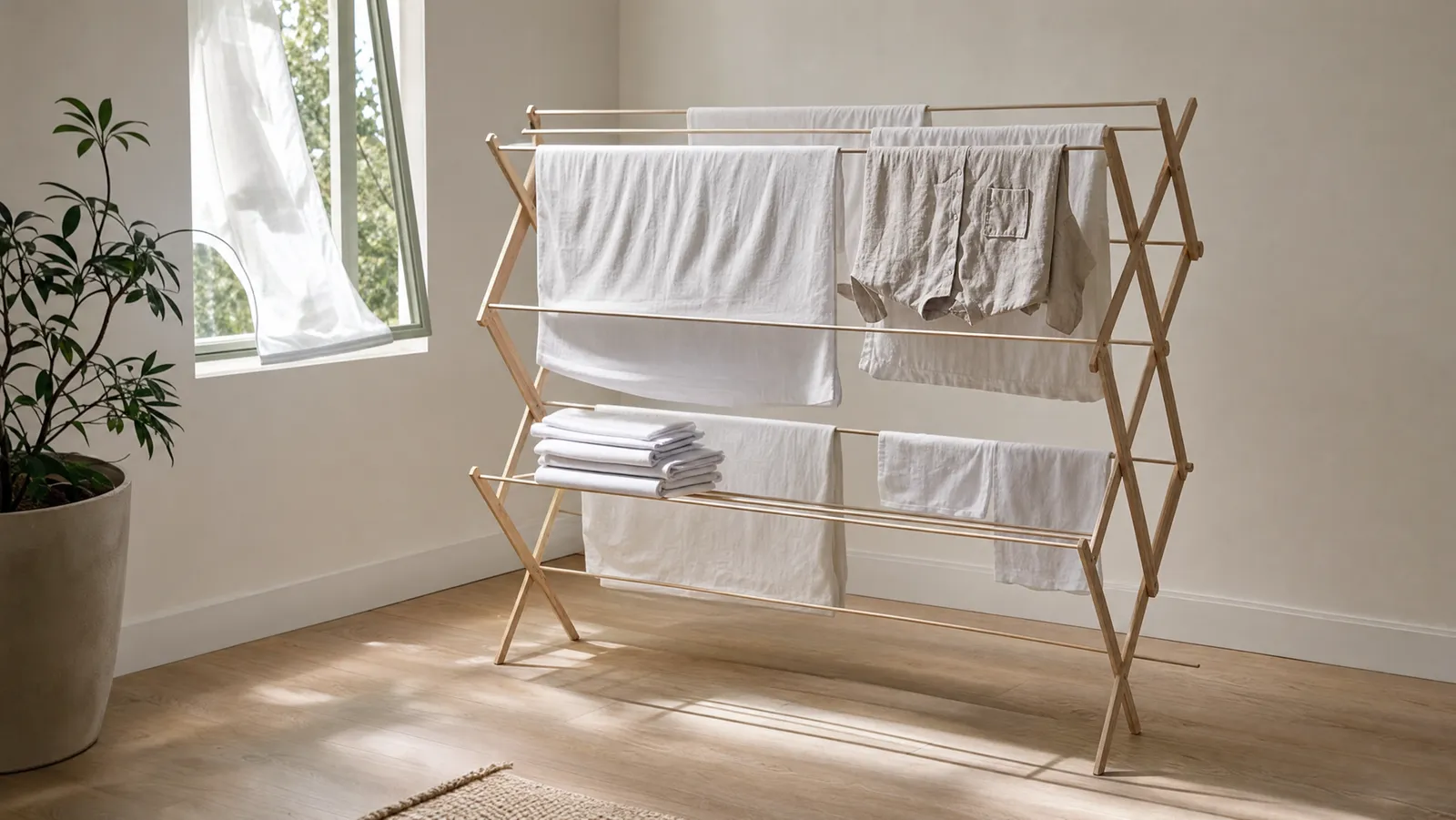
The best clothes drying rack is the one with enough bar length for a whole wash load and enough space around each item for air to move between them. Capacity and airflow decide whether you keep using it. The material decides almost nothing. Eco-Friendly Review is reader-supported, so if you buy through our links we may earn a small commission, at no extra cost to you.
Most rack roundups have this backwards. The rack is not the product. The tumble-dryer cycle you do not run is the product. A rack is a passive frame with no moving parts and no engineering worth 20 dollars of markup, and the handsome one folded behind a door is worth less than the ugly one standing in your hallway with a load on it. That makes it the cheapest appliance replacement in the house, and it slots into an eco-friendly laundry routine without asking you to change anything else.
It also has one genuine catch, which we have put in the first half of this article rather than the last paragraph, because every other roundup buries it.
What you are buying is the dryer cycle you skip
Start with the number everything else rests on. According to the US Energy Information Administration's 2020 Residential Energy Consumption Survey, the average American household using an electric clothes dryer burns 2.32 million Btu of site electricity a year on drying alone (Table CE5.3a). At 3,412 Btu to a kilowatt-hour that is roughly 680 kWh per household per year; nationally, EIA put dryers at 190.6 trillion Btu, about 56 billion kWh. The same survey's expenditure table puts the bill at 87 dollars a year per household using an electric dryer, in 2020 dollars.
Now the honest arithmetic, because this is where roundups start lying. Eighty-seven dollars is your entire dryer bill, not your saving. Nobody air-dries every load. If a rack displaces a third of your cycles you save somewhere around 30 dollars a year, and the 31.49-dollar Amazon Basics pick below pays for itself in roughly twelve months. That is a real return on a passive object with no failure modes. It is not "hundreds of dollars a year", and anyone quoting that figure has not done the division. The scale is national rather than personal: ENERGY STAR notes that about 80 percent of American homes have a clothes dryer, which is how a small per-household number becomes 56 billion kWh at the meter.
The dryer is a microfibre source in its own right
A tumble dryer does not just consume energy. It manufactures airborne fibre pollution, and a vented model pushes it out through a duct into the air outside your house.
According to a 2022 PLOS ONE study by Lant and colleagues, airborne microfibre release measured from a tumble dryer's exhaust averaged 81.2 percent of the level released down the drain during the wash cycle under North American test conditions, and 76.8 percent under European conditions. In other words, on those loads the dryer was very nearly as large a fibre source as the washing machine.
A follow-up PLOS ONE paper by Cummins and colleagues in 2023 measured the split directly on real consumer loads: vented dryers emitted 33.3 ppm of microfibre through the exhaust duct, with 86.1 percent of the fibre generated caught on the lint filter. Roughly one fibre in seven went outdoors.
Aftermarket filters for the vent side do exist, and they are partial: according to Fulfer and colleagues in Environmental Toxicology and Chemistry in 2025, three commercial add-on dryer filters captured 44 percent (a duct filter) and 70 and 81 percent (two indoor units) of the microfibres emitted to air. Skipping the cycle is the only measure that catches all of it, and it costs nothing. The wash side does have hardware, and we covered the best microplastic filters and wash bags separately.
Lint is not dust, it is your clothes getting shorter
The mechanism behind all that fibre is heat plus tumbling, and it is the same mechanism that wears out the garment. The clearest quantitative work we found is old but specific. According to research by Young-Sook Lee Buisson at the US Department of Agriculture's Southern Regional Research Center, presented in 1999 after an 18-month study of 100 percent cotton fabrics, cracks that form in cotton fibres after high-temperature drying can reduce fabric strength by 25 percent or more. Her practical recommendation was not to abandon dryers but to cut drying time by 10 to 20 percent, which avoided much of the damage.
We will not stretch that into a figure for how many extra months a t-shirt lasts on a rack, because nobody has measured that cleanly. The narrower claim holds: the lint trap is full of fabric that used to be on your clothes, and heat is what put it there.
Air drying clothes indoors puts litres of water into the room
This is the caveat, and it is not optional. All the water in a wet wash load has to go somewhere. Indoors, it goes into your air.
The reference work is the three-year study by the Mackintosh Environmental Architecture Research Unit at the Glasgow School of Art, funded by the EPSRC, which ran from 2008 to 2011 and audited laundry practice in 100 mainly social-housing Glasgow homes, published as Porteous and colleagues in Indoor and Built Environment in 2014. Its findings:
- 87 percent of the households surveyed during the heating season, September to May, dried laundry indoors.
- A typical wet wash load releases roughly two litres of water into the air as it dries.
- Laundry accounted for as much as 30 percent of the indoor moisture load in those homes.
- Over 75 percent of the homes had average moisture levels above the recognised upper threshold for dust mite growth.
- Spores of Aspergillus fumigatus, a mould that can cause lung infection in people with weakened immune systems, were detected in about 25 percent of the homes sampled.
Read that carefully rather than panicking: it describes a Glasgow winter in social housing, which is a cold, damp, tightly closed set of conditions. The underlying physics is not regional, though. Two litres a load, five loads a week, is ten litres of water a week evaporating inside your walls. Hence the rule that matters more than any rack on this page: ventilate the room you dry in, every time.
- Put the rack where you can open a window, not where the room feels warmest. Warm and closed is the worst combination.
- A bathroom with the extractor fan running is usually the best room for this, and usually the one people avoid.
- Never dry a load in a bedroom overnight with the door shut. You spend eight hours breathing the humidity.
- A dehumidifier in the same room is the best pairing for a rack. It turns the moisture problem back into a small, contained electricity problem, and per load it should draw less than a tumble cycle — but run it only while you need it. EIA's own 2020 survey puts average annual dehumidifier electricity above average annual dryer electricity, at 3.41 million Btu per household using one against the dryer's 2.32.
- Spin harder first. Water the drum pulls out mechanically is water your room never has to absorb.
And be honest about who should think twice. If your windows already stream with condensation in winter, if you have no extractor and no openable window in the drying room, or if anyone in the house has asthma or a mould allergy, indoor drying is not a free win for you. Dry outdoors where you can, run a dehumidifier where you cannot, and do not simply move a dryer's worth of water into a sealed room.
What we can tell you about a rack, and what we cannot
We can speak to footprint, to how a rack folds and where it stores, to whether it stays upright when one side is loaded heavier, to whether long items trail on the floor, and to roughly how long a load takes in a given room. We did not run comparative drying-time measurements in a lab, and any roundup handing you a ranked drying-speed table for five passive frames is inventing it.
We can also report how much each maker will commit to in writing, and it varies enormously:
- Honey-Can-Do publishes 25 linear feet and 40 pounds.
- Zetez publishes about 13.2 linear feet and 60 pounds, conditionally.
- BAZANADI claims 88 pounds with no stated test method.
- Amazon Basics publishes 32 pounds, the lowest figure of the five.
- Home IT publishes neither a capacity nor a linear-feet figure. You get dimensions and keywords.
That asymmetry is information: a maker who prints a number is a maker you can hold to it. And read capacities against the real world. A soaked bath towel runs something like 3 to 5 pounds, so a 32-pound rating is somewhere between six and ten towels, not a fortnight of laundry.
Home IT Wooden Clothes Drying Rack: the wooden drying rack for people with floor space
The Home IT wooden rack is our Best Overall for an unglamorous reason: it arrives assembled, moves one-handed, folds flat, and looks enough like furniture that people leave it out. A rack you leave out is a rack you use.
Now the trade-off. Home IT publishes no weight capacity and no linear-feet figure for this listing at all — the description is keyword soup wrapped around a set of dimensions (14.5 by 29.5 by 41.75 inches). Against the Honey-Can-Do below, which states 25 feet and 40 pounds, you are being asked to trust a frame nobody will quantify.
It is also bare wood, so it has to dry out fully between loads or it will spot and eventually mildew — particularly if you take our advice and park it in a bathroom. And at 39.99 dollars as of September 2026 it costs 8.50 dollars more than the Amazon Basics at effectively identical dimensions. What that 8.50 buys is wood instead of coated steel, and that is the entire difference. Fair price if it matters to you. If not, scroll down one pick.
Amazon Basics Foldable Drying Rack: the cheapest answer, and a defensible one
At 31.49 dollars as of September 2026, the Amazon Basics accordion rack is what we would hand anyone unsure they will stick with air drying. It is 14.5 by 29.5 by 41.8 inches, within a tenth of an inch of the wooden pick on every axis, collapses flat enough to carry one-handed, and Amazon Basics says the white finish protects against rust and mildew.
Three trade-offs, plainly. Its 32-pound rating is the lowest of the five, and against 3-to-5-pound wet towels it fills faster than the number suggests. The rust protection is a coating, not a property of the steel; chip it in a damp room and the bar underneath rusts. And it is the only pick made entirely of finished metal, which matters if you are shopping to get away from petrochemical-finished goods.
None of that stops it working. If your budget decides this, buy it without embarrassment — it is the same size as the rack costing 20 dollars more.
Honey-Can-Do Bamboo Rack: the best laundry drying rack for a full load
If your complaint about racks is that you always need two, the Honey-Can-Do bamboo rack is the answer. Honey-Can-Do publishes 25 linear feet of drying space across multiple tiers and says that takes a full wash load in one pass, on a braced bamboo frame rated to 40 pounds. It is 49.99 dollars as of September 2026. The tiers also let you lay knits flat rather than hanging them, which is the correct way to dry a heavy jumper without shoulder dents.
The trade-offs follow from the capacity. Twenty-five linear feet has to go somewhere, and open, this has the largest floor footprint of the five. Worse, a tiered rack stacks garments above one another, exactly the geometry that starves lower tiers of airflow at the full 40 pounds. Loaded heavy it will be slower per item than a smaller rack loaded properly.
One more thing, since bamboo is doing marketing work here. It is a fast-growing grass, genuinely better than slow-growing timber on land use, but this frame is still glued and finished. "Bamboo" is not automatically the greener answer.
Zetez Wall Mounted Drying Rack: when there is no floor to give up
In a galley utility room or a small flat, the Zetez wall-mounted rack solves what the others cannot: folded, it occupies no floor at all. It is 31.5 inches wide with five aluminum rods on a carbon steel back panel, roughly 13.2 linear feet of drying area, and Zetez says it holds 8 to 12 garments depending on weight. There are 10 integrated hooks and a bottom railing for light items, and at 51.49 dollars as of September 2026 it ships with a template, screws, anchors and a screwdriver.
Read the capacity claim precisely, because the wording is doing work. Zetez states 60 pounds when mounted into wooden studs. On drywall anchors alone that number does not apply, and the listing does not say what it becomes. Zetez calls drywall suitable with proper anchors, but not suitable for what load.
The other trade-offs are structural. This is the only pick that puts holes in your home, which rules it out for most renters. Carbon steel and aluminum make it the least plant-based item on the page. And at 13.2 linear feet it gives about half the Honey-Can-Do's drying space for a dollar and a half more. You are paying for the floor it does not use.
BAZANADI Wooden Tripod Rack: a clothes horse built like an umbrella
The BAZANADI beech tripod takes airflow seriously in a way tiered racks do not. Sixteen rods sit on independently rotating arms in an umbrella layout, which BAZANADI says keeps garments separated and improves airflow — the right instinct, given everything above about stacking and starved lower tiers. It is 44 inches wide by 48 inches high expanded, folds to 28 by 5.5 inches, weighs about 8.2 pounds, sets up with no tools, and costs 50.97 dollars as of September 2026 against a 59.99 list.
The trade-off is the flip side of the same geometry. Radial arms are short, so long items suffer — sheets, trousers and bath sheets will either trail on the floor or need folding double over a rod, and folding double is exactly the airflow penalty you bought this rack to avoid. If your laundry is mostly bedding, buy the Honey-Can-Do instead.
Two more caveats. BAZANADI states support for up to 88 pounds, the most generous claim on this page by a wide margin, with no stated method behind it — read it as marketing, not measurement. And it is the newest listing of the five, with the least accumulated track record.
Nobody air-dries everything, and that is fine
We are not going to pretend a rack replaces a dryer. Towels come out stiff, bedding takes a day, and some weeks the weather and your schedule both say no. The goal is displacing cycles, not abolishing them, and the arithmetic above works perfectly well at one load in three.
For the loads you do tumble, the next question is what goes into the drum with them, which we have covered in wool dryer balls versus dryer sheets.
And if you can hang outside, do — though the claims made for sunlight are larger than the evidence. The one controlled test we could find is narrow: according to Amichai and colleagues in the Israel Medical Association Journal in 2014, 52 socks contaminated with the fungus behind athlete's foot were split between three consecutive days in the sun and three indoors, and contamination fell significantly more in the sun-exposed group. That is 52 socks, one fungus, three days, from patients with an active infection. It is not evidence that an afternoon on the line disinfects your bedding, and we will not stretch it into one. Hang outside because it is free and it moves the moisture out of your house, not for a germicidal effect nobody has substantiated. Traditional advice says darks go out inside out, because direct sun does fade dyes.
The bottom line
Buy the cheapest rack that fits the load you actually wash, put it in a room you can ventilate, and use it. That is the whole method.
If you rent and want floor space back, the Zetez is out and the BAZANADI folds smallest. If you wash full loads and want one rack to take all of it, the Honey-Can-Do's 25 linear feet is the only figure here that does it. If you want wood in a room you sit in, the Home IT is pleasant and pre-assembled. And if none of that moves you, the 31.49-dollar Amazon Basics is a perfectly good answer, and we are not going to pretend otherwise to sell you the wooden one.
What you are buying, at any of these prices, is the same thing: roughly 680 kWh a year of dryer electricity that you get to spend a fraction of instead, fibre that does not leave through a vent, and clothes that stop being dismantled by heat. Set it up next to the rest of the plastic-free laundry swaps worth making, open a window, and let it work.
What we tested

The one to buy if you want wood and you have the floor space
- Material
- Beech Bamboo & Coated Steel
- Credentials
- No-energyVentilation-checked
Arrives fully assembled, drops into position in seconds and folds flat afterwards, and it looks enough like furniture to live in a room you actually sit in.
No major drawbacks noted in testing.
A pre-assembled folding wooden rack measuring 14.5 by 29.5 by 41.75 inches, at 39.99 dollars as of September 2026 against a 49.99 list price. It is light enough to move one-handed and folds flat for storage, which is most of the reason people keep using it rather than leaving it behind a door. Home IT publishes no weight capacity and no linear-feet figure for this listing, only those dimensions, so the frame and the footprint are the only things you can judge before it arrives.

The cheapest pick here and a completely defensible answer
- Material
- Beech Bamboo & Coated Steel
- Credentials
- No-energyVentilation-checked
The cheapest way to find out whether a rack will genuinely displace dryer cycles in your house, at almost exactly the same size as picks costing twenty dollars more.
No major drawbacks noted in testing.
An accordion-style steel rack, 14.5 by 29.5 by 41.8 inches, which the maker rates for up to 32 pounds and sells at 31.49 dollars as of September 2026 against a 34.42 list. Amazon Basics says the white finish protects against rust and mildew, and the frame collapses flat enough to carry one-handed. It is 8.50 dollars cheaper than the wooden pick above at effectively identical dimensions, and it is marked for indoor use only.

The only pick that takes a whole wash load in one pass
- Material
- Beech Bamboo & Coated Steel
- Credentials
- No-energyVentilation-checked
Twenty-five linear feet is the number that decides whether one rack handles a whole load instead of two thirds of it, and nothing else here comes close.
No major drawbacks noted in testing.
The most drying space on this page: 25 linear feet across multiple tiers, which Honey-Can-Do says fits a full wash load in one go, on a braced bamboo frame the company rates to 40 pounds. At 49.99 dollars as of September 2026 it is also the only pick here with tiers you can lay knits flat on instead of hanging them, which is how you avoid shoulder dents in a heavy jumper. It folds slim enough to store beside a washer, but open it wants real floor.

For homes with no floor to give up
- Material
- Beech Bamboo & Coated Steel
- Credentials
- No-energyVentilation-checked
Uses no floor at all when it is folded away, which is the entire argument for it in a small flat or a narrow utility room.
No major drawbacks noted in testing.
A wall-mounted rack, 31.5 inches wide, with five aluminum rods on a carbon steel back panel giving roughly 13.2 linear feet of drying area that Zetez says holds 8 to 12 garments depending on weight. It retracts flat against the wall and adds 10 integrated hooks plus a bottom railing for light accessories. At 51.49 dollars as of September 2026 it ships with a mounting template, screws, anchors and a screwdriver, and the 60 lb capacity Zetez states is specified for mounting into wooden studs.

The umbrella style frame that keeps garments off each other
- Material
- Beech Bamboo & Coated Steel
- Credentials
- No-energyVentilation-checked
Sixteen rods on rotating arms hold garments apart better than stacked tiers do, and the whole thing goes up and down without tools.
No major drawbacks noted in testing.
A solid beech tripod carrying 16 rods on independently rotating arms, 44 inches wide by 48 inches high when expanded and folding down to 28 inches high by 5.5 inches wide. The umbrella layout is the whole point: BAZANADI says it keeps garments separated and improves airflow, which is the variable that actually decides how quickly a room dries a load. It weighs about 8.2 pounds, sets up without tools or screws, and costs 50.97 dollars as of September 2026 against a 59.99 list.
The top three, compared
| Spec | Best OverallHome IT Wooden Clothes Drying Rack for Laundry - Foldable & Pre-Assembled | Best ValueAmazon Basics Foldable Portable Clothes Drying Rack for Indoor Air Drying | Best CapacityHoney-Can-Do Bamboo Collapsible Clothes Drying Rack, 25 Linear Feet |
|---|---|---|---|
| Verdict | Buy | Buy | Buy |
| Composite | 4.3/5 | 4.3/5 | 4.3/5 |
| Materials | 5.0 | 5.0 | 5.0 |
| Health | 3.7 | 3.7 | 3.7 |
| Durability | 5.0 | 5.0 | 5.0 |
| End-of-life | 3.2 | 3.2 | 3.2 |
| Price | — | — | — |
| Get it | Check price | Check price | Check price |
How we score
What it’s made of.
Chemistry you’ll touch.
How long it lasts.
Where it goes after.
Each pick scores 0–5 on the four axes above, weighted into the composite verdict at the top. Scores are derived from what a product is verifiably made of and certified as — not how green its label looks.
About the author
Ruth Lopez
I'm Ruth Lopez and I'm a lover of nature and the environment. I'm very passionate about finding eco friendly products that don't damage the environment and also support companies that have the same philosophy.