Bokashi Composting and How Fermentation Differs From a Compost Bin

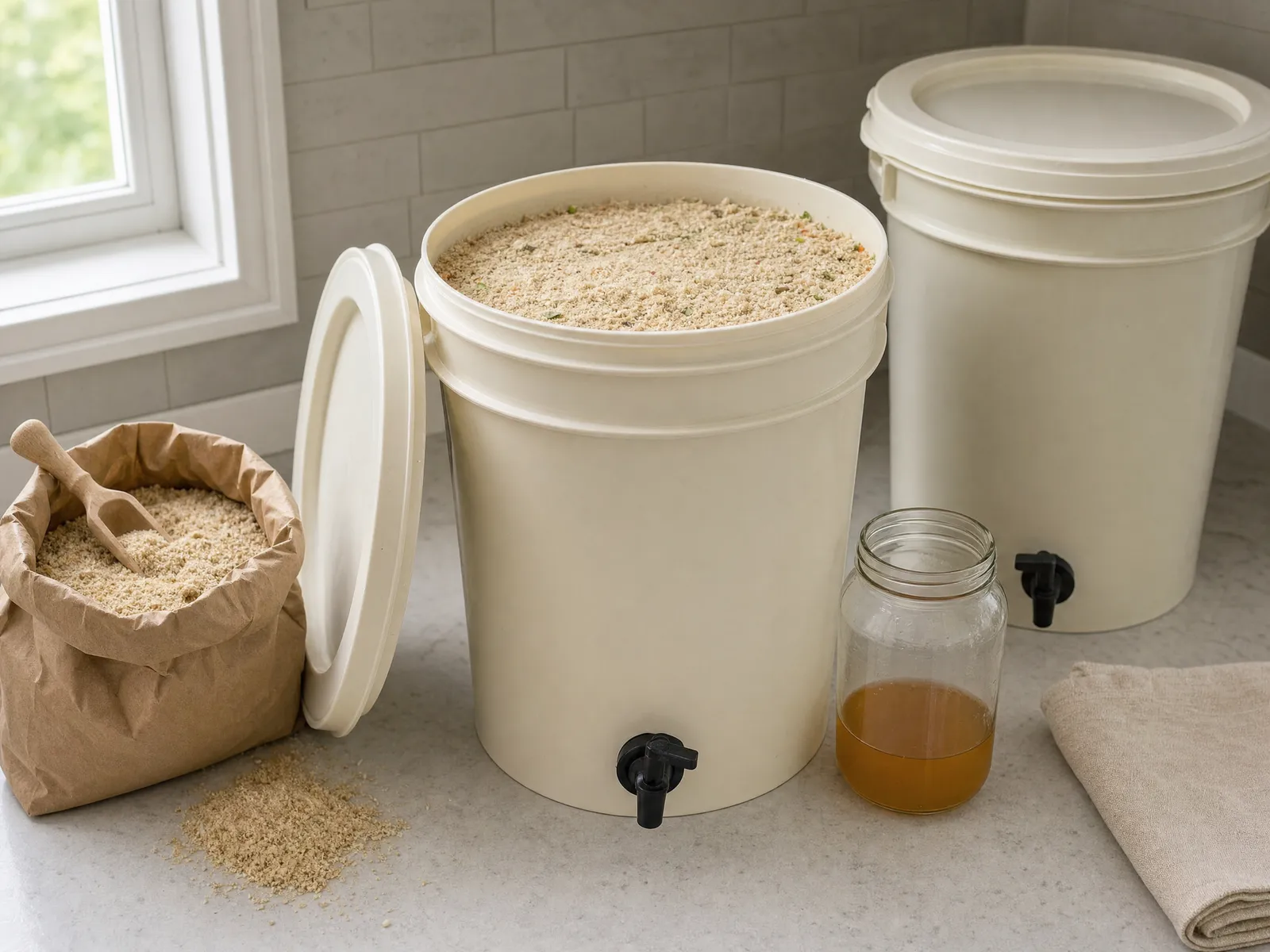
Bokashi is not composting. Sealing kitchen scraps in an airtight bucket with an inoculated bran ferments them, and fermentation is the opposite move to composting: composting speeds decomposition up, fermentation stops it. That single mechanical fact is the whole of bokashi composting - it is why a bucket under the sink can take meat, dairy and small bones without smelling of rot, and it is also why what comes out is not compost and has to go under soil before anything will grow in it. We earn a commission if you buy through our links, which costs you nothing.
The short answer. Bokashi is anaerobic lacto-fermentation, closer to sauerkraut or silage than to a compost heap. It accepts almost everything an aerobic bin refuses, stays sealed against fruit flies, and works in a flat in February. In exchange it hands you acidic pre-compost that still looks like food, a bag of bran to reorder, and a reason to own two buckets.
This is week four of our series on composting kitchen scraps. We have not run a bucket on a bench; we have read the extension guidance and the peer-reviewed work, which agree on the central question.
What bokashi composting actually is, and why pickling is the right word
Washington State University Extension's Kitsap County office, in guidance funded by Kitsap County Public Works Solid Waste Division, defines it in one sentence: "Bokashi is an anaerobic fermentation system for managing food waste using a sealed container and an inoculated bran made of beneficial bacteria and yeast." The bran is "a mix of wheat bran or rice hulls infused with beneficial microorganisms, including lactic acid bacteria, yeasts, and phototrophic bacteria."
Dr Charles N Merfield of the BHU Future Farming Centre in Lincoln, New Zealand, reviewed this exact comparison for Gisborne District Council in February 2012, and he is the clearest source we found on why the two are not variants of one another. Composting "aims to speed-up / enhance decomposition", he writes, "while fermentation aims to completely halt the decomposition process, which is why it is able to preserve food." It does that by excluding oxygen and through "The production of a range of organic acids that lower pH below that at which most microorganisms can survive / function." Katharina Kujala of the Natural Resources Institute Finland and Veera Kinnunen of the University of Oulu, in FEMS Microbes on 11 April 2026, sequenced samples from six urban bokashi practitioners and found communities "dominated by lactic acid bacteria".
A bokashi bucket is a pickling jar with a tap on it, and every advantage and every cost below follows from that.
Teruo Higa, EM-1, and how much of that story to believe
Kujala and Kinnunen describe the culture in the bran as "a microbial inoculum consisting of about 80 microbial species that was developed in Japan by Teruo Higa", citing Higa's own 1991 paper in the proceedings of the 1st International Conference on Kyusei Nature Farming published by the USDA, and note that EM is "a trademark licensed by EMRO" whose "detailed composition of EM is kept secret." Merfield's caveat stands next to it: "some of the claims made for EM are not supported within the peer reviewed scientific literature." We could not confirm the dates of EM-1's commercialisation from anything but the company selling it. Nor does the popular gloss of the word survive checking: Japanese-English dictionaries give bokashi as the shading or gradation of an image, especially in woodblock prints, and Wikipedia's own entry concedes that "its application to fermented organic matter is of uncertain origin."
The microbiology is documented, the branding is not, and you need not believe the origin story to buy a bag of bran.
Bokashi takes meat, dairy and small bones, and that is the real argument
Here is what fermentation buys a household that actually cooks. WSU: "bokashi allows you to compost almost all types of food waste, including fruit and vegetable scraps, cooked food, dairy, meat, and even small bones."
Put that against the list every aerobic bin runs on. Our breakdown of what you can and cannot compost from a kitchen is mostly a catalogue of exclusions, the same ones everywhere: meat, bones, dairy, oil, plate scrapings. A worm bin's list is narrower still. For a kitchen that roasts chickens and finishes cheese, an aerobic caddy takes the peelings and the bin bag takes the rest, which is a method solving half the problem. Merfield explains why: fermenting microbes use "sugars, starches and proteins" rather than "cellulose or lignin", so "material suited to fermentation is not suited to composting."
If your scrap stream is mostly cooked food, bokashi is the only home method here that takes all of it, and that is a strong argument.
Does bokashi smell? It smells pickled, which is not the same as odourless
The sealed bucket removes the two complaints that end many indoor composting attempts, because fermentation requires closed containers and so designs flies and odours out rather than managing them. WSU's fruit-fly entry confirms the corollary: insects inside the bucket mean "Oxygen and access point exists", from a lid "opened too frequently" or "not sealing". Compare the carbon-filter arms race in do kitchen compost bins smell and how to stop fruit flies, where the filter manages a symptom.
What it does not do is smell of nothing. WSU says bokashi "should have a sour, tangy, pickled, vinegar-like smell (not sulfur, rot, or ammonia)". SCD Probiotics claims its lid "makes it virtually odorless", which is the maker's word for its own product and a different claim from WSU's. WSU's signals, which are specific enough to act on:
- Sour and pickled. Working as intended.
- Rotten or putrid. "Anaerobic fermentation failed and putrefaction is occurring." Add bran, compress, drain daily, check the lid gasket.
- White mould on the surface. Labelled GOOD: "Healthy fermentation is occurring - this is ideal".
- Green, black or blue mould. Labelled BAD: "Competing fungi or aerobic contamination", from air exposure, too little bran or too much moisture. If it dominates, "discard and restart".
Bokashi trades the smell of rot for the smell of a pickle jar, which some households will like less than they expect.
The output is pre-compost, not compost, and that is the whole catch
This is the most important paragraph on the page. WSU puts it beyond doubt: "Bokashi material, as a fermented pre-compost, is not finished compost. It is acidic and biologically active and must be mixed with soil to complete decomposition. Do not leave it exposed or apply it like mulch."
It will also still look like dinner, and that is correct rather than broken. WSU lists "Food Still Looks 'Fresh' After Fermentation" as "Normal for Bokashi - fermentation preserves structure", clarifying that "Bokashi does not break food down visually. It chemically and microbially alters it." Merfield predicts the same from a sealed vessel: the ferment shows "only a limited reduction in volume."
So the bucket is a staging post and burial is the second half. WSU: a trench 8 to 12 inches deep, one to two inches of material, "Mix thoroughly with at least 2-3 times its volume in soil", cover completely, then wait, minimum 2 weeks and ideally 3 to 4, since "Cooler soils may require longer". Gene Fox, area agent for consumer horticulture at N.C. Cooperative Extension's Beaufort County Center, publishing an article on 22 April 2025 written by Extension Master Gardener volunteer Angela Mason Foster, gives "at least 8 inches deep to avoid attracting animals" and reports that "Once buried, the material fully decomposes within two to four weeks."
Bokashi is a two-stage method and the marketing only ever sells you stage one. That is the real difference from the appliances in electric kitchen composters and whether the output is real compost: a dried, heat-dehydrated powder may have little live biology left in it to finish the job. Both are pre-compost, and only the bokashi kind is what WSU calls "biologically active".
Which means bokashi gets recommended to exactly the households that cannot finish it: a fortnightly bucket needs two to three times its volume in soil, eight to twelve inches down, away from roots, and six houseplants are not that. Bokashi solves odour and acceptance; it does not solve destination, and no sealed bucket can. If that is you, the honest options are in how to compost in an apartment without a yard.
It is acidic, which is why it goes under soil rather than on it
The acidity is the active ingredient and the handling constraint at once. Merfield gives the figure: "The pH of compost is typically around 7, while ferment is typically around 4." Kujala and Kinnunen measured the liquid side: "All leachates were acidic with pH ranging from 3.7 to 4.9 and contained large quantities of organic acids."
That is why WSU's burial works by dilution and time - "Soil microbes neutralize acidity, complete mineralization, and stabilize nutrients" - and why its list of things not to do is mostly about contact: "Do not surface-apply or mulch with Bokashi", "Do not plant immediately", "Never place Bokashi directly against roots or trunks."
The drained liquid needs the same respect. Merfield notes leachate "normally needs to be drained from the fermentation vessel, as fermentation will not proceed beneath the leachate layer", and warns it is "both valuable and potentially hazardous, e.g., polluting waterways", his comparison being silage leachate, which the European Union regulates. No extension publication we could reach would give a dilution number; the ratio in circulation comes from retailers, with Wiggly Wigglers stating that "The recommended dilution ratio for bokashi liquid is 1 part bokashi liquid to 100 parts water".
Treat the leachate as a strong acid feed: heavily diluted, on soil rather than foliage, or down the drain, and never left standing in the bucket.
No heat means no sanitising step
A hot heap sanitises by temperature: Merfield writes that "It is the high temperatures produced during hot composting that kill harmful microbes, such as human, animal and plant pathogens" and deactivates "weed seeds and agricultural pesticides". Fermentation has no such step, because in a sealed vessel little energy is released and "the containers do not increase in temperature by any appreciable amount unlike hot compost which should reach 65°C" - about 149 degrees F. WSU sites the bucket at 65 to 85 degrees F, roughly 18 to 29 degrees C, which is a room.
What stands in for heat is acid, and the sources part company on how much credit to give it.
- WSU is confident. "The high acidity of the process suppresses pathogens and weed seeds." Note the verb: suppresses, not eliminates.
- Merfield is not. He finds "Good evidence of the inactivation of animal pathogens", citing Truesdale and Green 2010, but "limited to no information on plant pathogens, weed seeds and pesticides", concluding that the degree to which such materials "are degraded in the ferment is unclear."
- The newest evidence is reassuring about the kitchen. Kujala and Kinnunen found potential pathogens at trace levels - in metagenomes from actively fermenting bokashi, "on average only 0.04% and 0.3% of the reads were classified as potentially human-pathogenic species and genera, respectively" - and conclude that "urban Bokashi is likely not associated with increased health risks."
Both can be right, because they answer different questions: whether a bucket in a kitchen is hazardous to the household, which Kujala and Kinnunen think it is not, and whether ferment can replace compost on a field, which Merfield says nobody has established. A bokashi bucket is a reasonable thing to keep in a kitchen, and it is not a sanitising step, so bury the output deep and away from where salad roots are going next month.
How a bokashi cycle actually runs, in order
WSU's sequence, with the timings its own page gives:
- Layer the scraps. Everything goes in. Chop large pieces, which WSU says speeds fermentation.
- Sprinkle bran on every addition. "Every time you add food waste to the bin, sprinkle a handful of bokashi bran on top." Under-dosing is the first cause of a putrid bucket.
- Press out the air and seal. "Compact the food waste slightly to remove excess air, then tightly seal the bin."
- Drain the liquid. "This should be drained every few days to prevent unpleasant odors", and daily for a wet, slimy bucket.
- Fill it, then ferment sealed. A full bin stops taking scraps, which is the argument for a second bucket. "Once the bin is full, allow the contents to ferment for about two weeks." Expect a sour smell, a softened texture, possibly white mould, and food still recognisable as food.
- Bury it. Eight to twelve inches down, mixed with two to three times its volume of soil, then two to four weeks before planting.
The sources disagree on how long the sealed stage takes. WSU gives "about 10-14 days after filling". Merfield reports that "Fermentation is external temperature dependent, with a range of one to six weeks for processing". Kujala and Kinnunen sampled active buckets "after 2-5 weeks" and call two weeks a minimum.
All are right because the clock is the room: a warm kitchen runs at WSU's fortnight, a cold utility room at Merfield's slow end. Two weeks is a minimum, not a deadline.
The two recurring costs: bran, and a second bucket
Every other method in this series is buy-once. Bokashi has a consumable, and WSU names it: "While Bokashi requires an ongoing input of inoculant (commercial or DIY bran), it offers a high nutrient return".
Put numbers on it. As of November 2026 the Southern Oregon Bokashi bran is 24.95 dollars for 3 lb, about 8.32 dollars a pound by our arithmetic and the cheapest refill on our page. Bokashi Living's single-bin listing gives the only usage estimate anyone offers: its 2.2 lb bag "includes enough bran to ferment at least 6 full bokashi bins, which lasts a typical smaller kitchen about 9 months." That is their estimate for their bran in their bin, not our test. Taken at face value against that refill price, bran runs roughly 24 dollars a year, about 120 dollars over five years - a second purchase price, in instalments.
Then the configuration. Bokashi Living's two-bin listing opens by arguing you need both: "Successful bokashi composting needs 2 bins, to allow you to continuously collect and ferment ALL of your food waste." Its single-bin listing repeats the point against its own cheaper product. That is a maker talking a reader into a dearer setup, and it is also true: a sealed bucket cannot be opened daily while it ferments.
Which is where we argue against our own links. There is nothing in a purpose-made bin that a food-grade bucket with a tight lid and a way to drain the leachate cannot do, and the bran is makeable too - Kujala and Kinnunen describe the standard preparation as mixing EM "with wheat or rice bran, molasses and water", and WSU links to DIY recipes under the promise that you can "Greatly reduce the cost of this system". We would still buy the first bag.
Bokashi against its siblings in this series
- Against an aerobic countertop bin, bokashi wins on what it accepts and on odour, because meat and dairy go in and the lid stays shut, which no pail in the best countertop compost bins can claim.
- Against a drop-off programme, bokashi loses on effort and cost, because a freezer tub and a fixed collection day need no bran and no soil - the hunt is in where to take food scraps if you do not compost at home.
- Against a worm bin, bokashi trades livestock for a consumable, swapping a colony kept in a narrow temperature band for a bag you reorder, a bargain set out in indoor worm bins and what vermicomposting actually takes.
- Against an electric composter, bokashi wins on biology and ties on destination, because both hand you unfinished material and only ferment is alive when it reaches the ground.
Choose bokashi for the input list and the sealed lid; choose something else if your objection was ever effort or price.
The bottom line
Buy a bokashi kit only if you cook meat and dairy, have soil you control, and accept that the bucket is stage one of a two-stage method - and if you do, the SCD Probiotics All Seasons kit at 72.95 dollars as of November 2026 is the cheapest complete way in, while the Bokashi Living two-bin kit at 143 dollars as of November 2026 is the configuration that runs continuously. If the acidic, unfinished, barely shrunken output has nowhere to go, nothing on this page is for you.
The free version is real and we earn nothing from it: a food-grade bucket with a tight-sealing lid, one bag of bran, and a trench. Everything else is a nicer lid and a spigot.
Where the scraps go and every other decision in the chain is in our full kitchen composting guide.
What we tested

The cheapest complete way into fermentation and one bin is one bin
- Material
- Sealed Buckets & Bokashi Bran
- Credentials
- Takes meat & dairyNeeds soil
The pick for a reader who wants to find out whether fermenting is for them without spending three figures. Bucket, spigot and enough bran to start, at the lowest price on this page.
No major drawbacks noted in testing.
72.95 dollars as of November 2026 for what SCD Probiotics describes as a "5-gallon countertop compost bin with strainer & spigot. 2 lbs. (1 gallon) of compost starter included." Five gallons is about 19 litres by our arithmetic, and the spigot is not a luxury: Charles Merfield's review notes that leachate has to be drained because "fermentation will not proceed beneath the leachate layer". SCD's pitch is the one that matters in this category - "TURN ALL FOOD WASTE INTO COMPOST - Even meat, small bones and dairy" - and its workflow line is accurate to the method: "Simply scrape food scraps into compost pail, sprinkle a layer of bokashi compost starter to reduce odor & break down food, then close the lid. Repeat at each meal." It also claims "NO ELECTRICITY NEEDED", "FOUR SEASON USE", and that it is "made with a small carbon footprint right in beautiful Kansas City, MO". Three costs. The headline promise is wrong in the way the whole category is wrong: WSU Extension's Kitsap County office states that "Bokashi material, as a fermented pre-compost, is not finished compost", so what this bin makes is pre-compost you then bury. "MINIMAL ODOR ... virtually odorless" is SCD's claim, not a measurement, and WSU's own description of a correctly working bucket is a "sour, tangy, pickled, vinegar-like smell". And it is a single bin, which is the configuration Bokashi Living's own listing argues against.

The configuration the method actually needs argued for by the company selling it
- Material
- Sealed Buckets & Bokashi Bran
- Credentials
- Takes meat & dairyNeeds soil
The pick for a household that cooks daily and has soil to bury the output in, because two bins is the only version of this method that runs continuously. Buy it if you have already decided bokashi is your answer.
No major drawbacks noted in testing.
143 dollars as of November 2026 for "2 x bokashi bins, 2 x 2.2 lb bags of premium bokashi bran, and our Complete Guide to Bokashi Composting." The reason to read this listing is the first sentence of it: "Successful bokashi composting needs 2 bins, to allow you to continuously collect and ferment ALL of your food waste. This is why our 2-bin kit is ideal for households new to bokashi composting." That is a maker arguing a reader into a dearer configuration, and it is also mechanically true - a sealed bucket cannot be opened daily to add scraps while it ferments, and WSU Extension's instruction is to let a full bin sit "for about two weeks". One bin plus a two-week wait is a fortnight with nowhere to put peelings. Bokashi Living also promises "superior quality lids and spigots" and "the industry only 1 year warranty on all parts and components", and spends a bullet on competitors: "Do not be fooled by the slightly cheaper, Made in China copies of our bins!" Three costs. That last line is a claim about rival products from the company selling against them, and we have no test of either. The price is 60.50 dollars more than Bokashi Living's own single-bin kit for a second bucket and a second 2.2 lb bag. And the listing data we have does not state the bins' capacity, so we cannot tell you how many litres 143 dollars buys.

The thing you will buy again which no other method in this series has
- Material
- Sealed Buckets & Bokashi Bran
- Credentials
- Takes meat & dairyNeeds soil
The pick for anyone already running a bucket, because the bran is what you actually reorder and this is the cheapest honest refill here. Buy the bin once and this repeatedly.
No major drawbacks noted in testing.
24.95 dollars as of November 2026 for 3 lb, which is about 8.32 dollars a pound by our arithmetic and the cheapest refill on this page. This is the pick that explains why bokashi is not like the rest of our kitchen composting series: every other method is buy-once, and fermentation has a consumable. WSU Extension says so plainly, noting that "Bokashi requires an ongoing input of inoculant (commercial or DIY bran)". Southern Oregon Bokashi claims "SOUTHERN OREGON CRAFTED - Made in small batches in the USA with active EM-1 cultures. Fresh, moist, and potent; never a dry, dusty import", that it will "COMPOST MEAT & DAIRY", and that it works as an "OUTDOOR PILE ACCELERATOR" that "acts as a safe probiotic for worm bins." Three costs. Those last two uses are the maker's, not findings - Merfield's review warns that claims for effective microorganisms are "probably best therefore analysed on a case by case basis to establish its efficacy". Freshness is a real variable with no number on it: WSU's troubleshooting tells you to "Replace bran if it smells musty or neutral instead of yeasty/sour", and nothing on a listing tells you how old a bag is. And a consumable is a recurring cost whatever the bag price - on Bokashi Living's own estimate that 2.2 lb lasts a smaller kitchen about 9 months, our arithmetic on this bag puts bran at roughly 24 dollars a year, or about 120 dollars over five years.

The same kit halved with the most candid sentence on this page attached
- Material
- Sealed Buckets & Bokashi Bran
- Credentials
- Takes meat & dairyNeeds soil
The pick for one or two people who cook lightly, and the cheapest way to own a Bokashi Living bin. Read the maker's own note about two bins before you decide this is enough.
No major drawbacks noted in testing.
82.50 dollars as of November 2026 for "1 x bokashi bin, 1 x 2.2 lb bag of premium bokashi bran, and our Complete Guide to Bokashi Composting." Bokashi Living then talks you out of it, in writing: "Using a single bokashi bin is an excellent composting option for kitchens that generate only smaller amounts of food waste. Note that for most households, our 2 BIN STARTER KIT would be the preferred choice, as using two bins allows you to continuously collect and ferment ALL of your food waste." A seller telling you its cheaper product suits fewer people than its dearer one is still an upsell, but it is an upsell with a mechanism behind it. The listing also supplies the only consumable estimate anyone on this page gives: this kit "includes enough bran to ferment at least 6 full bokashi bins, which lasts a typical smaller kitchen about 9 months." Three costs. That 9 months is Bokashi Living's estimate for its own bran and its own bin, not a result. It is 9.55 dollars more than the SCD Probiotics kit, which comes with a stated 5-gallon capacity and 2 lb of bran, while this listing states no capacity at all. And one bin means the fortnight problem: while it ferments, your scraps need somewhere else to live.

A listing that will not tell you what you are buying
- Material
- Sealed Buckets & Bokashi Bran
- Credentials
- Takes meat & dairyNeeds soil
Hard to recommend over the two kits either side of it on price, because neither we nor you can see what it is. If the grey colour and the price are what you want, buy it knowing the listing told you nothing.
No major drawbacks noted in testing.
75 dollars as of November 2026 for what the title calls a "5-Gallon Indoor Kitchen Composter - Gray, with 2.2 lb Premium Bokashi Bran" that is "US Patented". Everything else we have is a single bullet, reproduced here in full: "Sunwood Life Bokashi Composting System - Fast, Odor-Free Food Waste Recycling. Efficient & Complete Composting System. Fast Fermentation Process. Odor-Free. Compost More Than Just Scraps. Nutrient-Rich Results for Your Garden. Sustainable Living Made Simple." Three costs, and they are all the same cost. That bullet contains no specification - no spigot, no lid seal, no materials, no dimensions, no patent number to look up behind "US Patented" - so at 75 dollars you are paying 2.05 dollars more than the SCD Probiotics kit for strictly less information. "Fast Fermentation Process" is a claim with no figure attached, while WSU Extension puts fermentation at "about 10-14 days after filling" and Merfield's review gives a range of one to six weeks depending on ambient temperature. And "Complete Composting System" is the wrong word twice over, because what any bokashi bucket produces is pre-compost that still has to be buried. A listing that will not say what is in the box is a finding about the product.
The top three, compared
| Spec | Best OverallAll Seasons Indoor Composter Kit - 5 Gal Bin, 2 lb Bokashi Compost Starter | Compost Meat Bones Dairy, Makes Compost Tea Fertilizer, Kitchen Compost Bin with Lid, Includes 2 lb Bokashi Bran, Recyclable | Best Setup That WorksPremium Bokashi Composting Starter Kit (Includes 2 Bokashi Bins, 4.4 lbs of Bokashi Bran and Full Instructions | The ConsumableSouthern Oregon Bokashi Compost Starter - 3 lb. Bag, Brown |
|---|---|---|---|
| Verdict | Solid | Solid | Fair |
| Composite | 3.5/5 | 3.4/5 | 3.3/5 |
| Materials | 3.0 | 3.0 | 3.0 |
| Health | 3.2 | 3.2 | 3.2 |
| Durability | 3.6 | 3.6 | 3.0 |
| End-of-life | 4.5 | 4.0 | 4.0 |
| Price | — | — | — |
| Get it | Check price | Check price | Check price |
How we score
What it’s made of.
Chemistry you’ll touch.
How long it lasts.
Where it goes after.
Each pick scores 0–5 on the four axes above, weighted into the composite verdict at the top. Scores are derived from what a product is verifiably made of and certified as — not how green its label looks.
About the author
Ruth Lopez
I'm Ruth Lopez and I'm a lover of nature and the environment. I'm very passionate about finding eco friendly products that don't damage the environment and also support companies that have the same philosophy.