How to Make Your Own Laundry Detergent Without the Mess

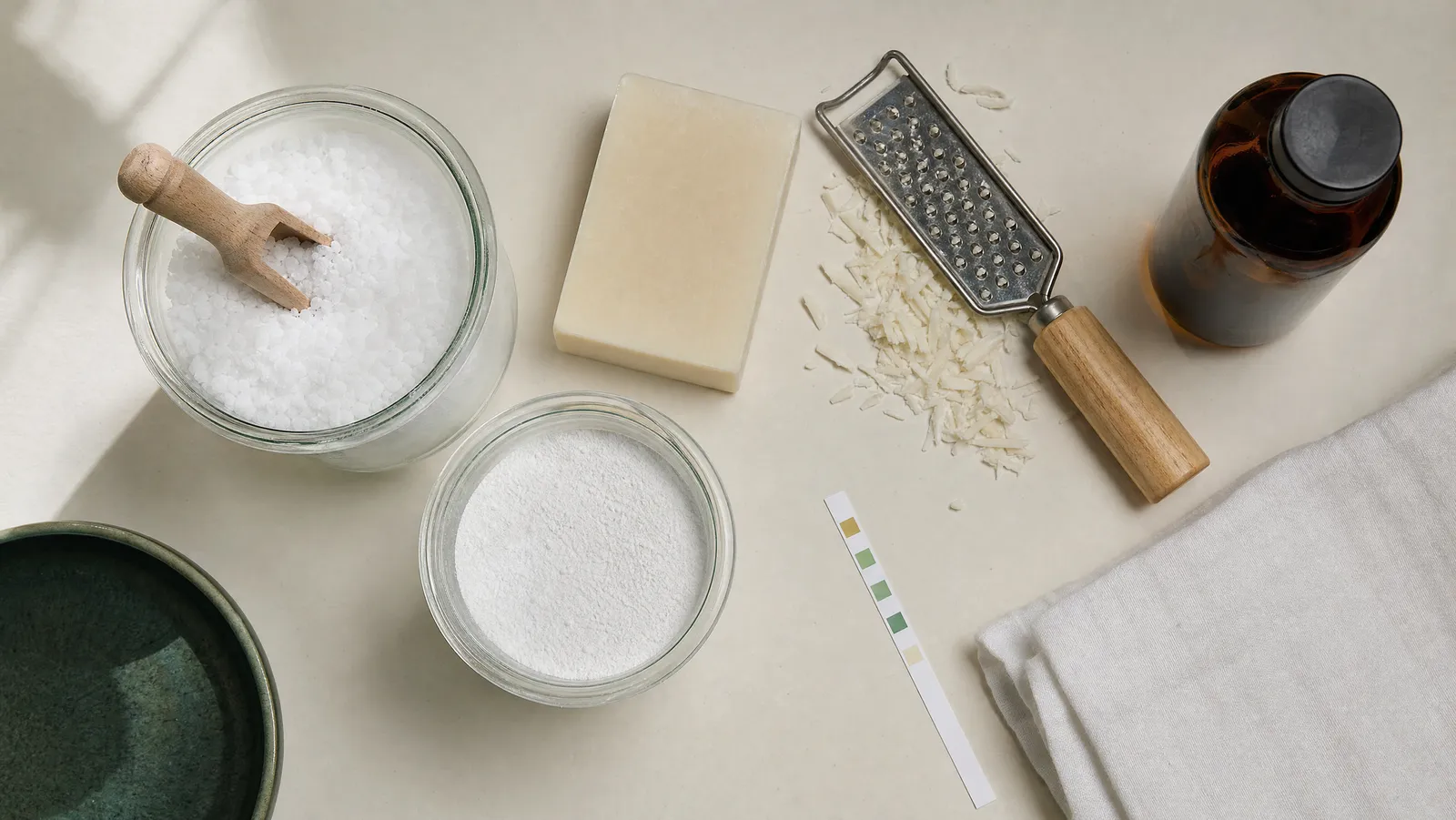
Yes, you can make homemade laundry detergent, and mixing a batch takes about ten minutes. But one number decides whether it works in your house, and it appears in no recipe: the hardness of your water. In soft water a soap-based powder is genuinely fine. In hard water the classic recipe will slowly turn your laundry grey.
The complaint is always the same. It worked beautifully for six months, then the whites went dull, the towels stiffened and the gym shirts came out smelling sour. That is not a bad batch or user error but a chemical reaction you could have predicted from your utility's water report.
So: the recipes, properly, with the conditions each needs — and the three messes the phrase "without the mess" is actually about, which are the grating, the greying and the film inside your machine. If you are working through a plastic-free laundry routine, this is the swap most worth understanding before you commit. And we are not selling anything on this page. No products, no affiliate links, nothing to buy. Every ingredient here is a commodity; buy whichever comes in cardboard at the lowest price per pound.
Homemade Laundry Detergent Is Not Detergent At All
The most-shared recipe on the internet — grated bar soap, washing soda, borax — does not make detergent. It makes soap. Those are two different classes of chemistry, and the difference is the whole article.
Soap is a salt of a fatty acid. Drop it into hard water and the sodium trades places with the calcium and magnesium already dissolved there, and the products of that swap are not soluble. According to Chemistry LibreTexts, those cations "react with soap to form insoluble compounds that are then deposited on the sides of the tub" — magnesium plus stearate yields magnesium stearate, "responsible for the infamous soap scum" — and this reaction "is the reason it is difficult for soap to foam or lather well in hard water."
Synthetic detergents do not do that. Chemistry LibreTexts again: synthetic detergents are usually alkylbenzene sulfonates, "which are more soluble in hard water because the polar sulfonate is less likely than the polar carboxylate (of soap) to bind to calcium and other ions found in hard water." One molecule falls out of solution and stops cleaning; the other stays dissolved and keeps working. That difference is why the detergent industry exists.
The U.S. Geological Survey supplies the word we want. Its now-retired Office of Water Quality page on hardness and alkalinity — still quoted verbatim by the Water Quality Association — put it this way: hardness "was originally applied to waters that were hard to wash in, referring to the soap wasting properties of hard water," and it "prevents soap from lathering by causing the development of an insoluble curdy precipitate in the water." The live USGS water science pages say the same thing more plainly: soaps "react first with hardness salts in the waters to form insoluble calcium and magnesium stearates and oleates," and "in hard water, soap reacts with the calcium (which is relatively high in hard water) to form 'soap scum'."
Now picture that curd inside a washing machine rather than on a bathtub. It does not rinse away cleanly: it redeposits on fabric and films the drum and hoses. It is cumulative, which is the most plausible explanation for the six-month pattern: early washes look fine because the deposit is too thin to see.
Test Your Water Before You Grate Anything
Finding your number is a five-minute job, and it decides which recipe to make. The USGS classifies water by dissolved calcium carbonate: 0 to 60 mg/L is soft, 61 to 120 moderately hard, 121 to 180 hard, above 180 very hard. US water professionals talk in grains per gallon instead: the Water Quality Association puts one grain at about 17.1 mg/L and notes that the NSF/ANSI 44 and 330 standards define soft water as under 1 grain per gallon. Convert the USGS bands and they land near 3.5 and 7 grains.
Two ways to find it:
- Your utility's annual water quality report. US community water systems publish one every year, with hardness in the mineral table. Search your supplier plus "water quality report."
- A hardness test strip. A few dollars a vial, ten seconds for a result, and the only option on a private well.
Under 60 mg/L, or 3.5 grains: green light, a soap recipe will behave. 60 to 120: borderline — it will work at first, so watch dark cottons and towels for two months. Above 120: do not make a soap-based mix your everyday wash. Make the booster below.
Before assuming you are fine: USGS reporting on domestic wells found hard water "prevalent in the east-central and western United States." Most of the country is not soft.
The DIY Laundry Powder We Actually Recommend
Here is where the evidence took us, and it is not a full replacement. The version that works in any water and creates none of the three messes is a booster run alongside a real detergent at a reduced dose.
Mix by volume:
- 2 parts washing soda
- 1 part oxygen bleach
That is the entire recipe: no grating, no melting pot, no bucket cooling overnight. Stir it in a dry jar.
Use one to two tablespoons per load with roughly half your usual dose of a normal detergent. The washing soda ties up the hardness minerals so the surfactants are not spending themselves on your water, and the oxygen bleach does the whitening and deodorising a soap recipe cannot.
Washing soda is not baking soda, and the substitution does not work. Washing soda is sodium carbonate; baking soda is sodium bicarbonate. PubChem, citing the Kirk-Othmer Encyclopedia of Chemical Technology, gives a 1 percent sodium carbonate solution at 25 degrees C a pH of 11.37; it gives sodium bicarbonate 8.0 to 8.6 at the same strength, with the Merck Index reporting 8.3. Sodium carbonate is alkaline enough to precipitate hardness minerals and cut light greasy soil. Bicarbonate mostly buffers and absorbs odour. Substituting one for the other is not a frugality hack, it is a different chemical.
Oxygen bleach is sodium percarbonate. PubChem records it as an adduct of sodium carbonate and hydrogen peroxide, which is how it behaves: in water you get peroxide plus more washing soda. Used warm or as a hot soak, it does the real work on tea, sweat and general dinginess.
Washing soda is strongly alkaline. A 1 percent solution sits near pH 11.4, and the classification most companies notify to the ECHA inventory, as aggregated by PubChem, is H319, causes serious eye irritation. Gloves on, out of your eyes, out of reach of children.
The Classic Laundry Soap Recipe and the Conditions It Needs
If your water is soft, or you are making a wool wash, or a fragrance sensitivity means you want full control over what touches your skin, here is the traditional recipe done properly.
Mix by volume:
- 1 part grated pure bar soap, such as an unscented castile or olive oil bar
- 2 parts washing soda
- optional, 1 part borax, discussed below
Solving the grating. The mess that makes people quit in week one has three fixes: buy soap flakes and skip the step; pulse chunks of bar soap in a food processor with a scoop of washing soda in the bowl, which stops the shreds pasting onto the blade; or use the fine side of a box grater and accept ten minutes of forearm work. Let the shreds dry a day before jarring them.
Using it without the greying. One to two tablespoons per load, dissolved in a mug of hot water and poured into the drum rather than tipped dry into the dispenser drawer — the same advice we give for commercial powders. Run warm rather than cold where the fabric allows. Test on dark cotton first: pale specks or a chalky bloom after drying means your water is harder than this recipe can cope with.
Good for: lightly soiled cottons, bed linen, wool and delicates. Not for: athletic synthetics, anything greasy, cold-wash households, hard water.
Borax: What the Regulators Actually Say
Borax is the contested ingredient: two regulators read the same toxicology and draw different lines. We will report both rather than pick one.
The EU position. The European Chemicals Agency lists disodium tetraborate on the REACH Candidate List of substances of very high concern, on the basis of a Category 1B reproductive toxicity classification. The hazard statement, H360FD, reads that it may damage fertility and may damage the unborn child. That classification sits in Table 3 of Annex VI to the CLP Regulation, and borates also appear on the REACH Annex XVII restriction list.
The US position. The National Pesticide Information Center — a cooperative agreement between Oregon State University and the US EPA — published a technical fact sheet in May 2012 stating that "boric acid and sodium tetraborate decahydrate (borax) are low in toxicity for acute oral exposures," with rat oral LD50 values of 4,550 to 4,980 mg/kg for borax. The same sheet states that both "have been found to act as reproductive toxins to males and females exposed to sufficient doses," citing testicular effects at 17.5 to 29.2 mg boron per kg per day in rats and dogs. EPA set a reference dose of 0.2 mg boron per kg per day and classifies boric acid as "not likely to be carcinogenic to humans."
Read together, the disagreement is narrower than the internet suggests. Both accept that borates are reproductive toxicants at sufficient dose; the EU classifies on intrinsic hazard, the US regulates on exposure. Neither says a jar of hand-mixed laundry powder is harmless, and neither says it will hurt you.
Practically: the recipes above work without it. Borax is in the classic formula as a water softener and pH buffer, and washing soda already covers the softening. If you keep it, wear gloves, store it labelled, and keep it off an open counter in a house with small children.
What a DIY Laundry Detergent Cannot Do
Even in perfect water, a homemade powder is missing most of what does the visible work. There are no enzymes in it, and no way to add them. Enzymes break down stains "that are otherwise hard to remove with conventional surfactants alone," as a University of Maryland engineering course page puts it, describing proteases and amylases as active ingredients in laundry detergents. The American Cleaning Institute sorts them by job: protease for protein stains such as grass, blood and egg, amylase for starches, lipase for oils. A soap-and-washing-soda mix has none of them, and will not touch dried blood, egg or grass the way a supermarket detergent does.
The workaround is to move stains upstream, out of the wash — treat them individually before the load goes in, matched to the class of stain, as natural stain removers that actually work sets out. A homemade wash plus deliberate pre-treating is a workable system. A homemade wash expecting the detergent to rescue a set-in stain is not.
Soap nuts get raised here as the alternative, and the evidence for them is thin. The most-cited favourable result, in Personal Care Magazine, is supplier-published — the piece is written around a soap nut extract sold by Kaden Biochemicals — and it reports that "very low ratios of 1.5% to 3.5% of soap nut shell extract are sufficient to wash a drum of laundry with a satisfying result," with the degree of cleaning varying by the kind of soil. Independent testing is less kind: the Australian consumer group CHOICE scored soap nuts 42 percent in a front-loader test and does not recommend them, and secondary write-ups of that testing say they did no better than the plain-water baseline CHOICE ran alongside — the water score itself sits behind CHOICE's paywall, so treat that last step as reported rather than confirmed. Saponin content also varies between Sapindus species, so any dose is approximate.
Will Homemade Detergent Hurt Your Washing Machine
No manufacturer we could find says that homemade detergent voids a washer warranty. That claim circulates widely and, as far as we can establish, traces to forum anecdotes rather than published policy — treat the warranty version as undocumented. Manufacturers are not silent on homemade detergent itself, though. Whirlpool's use and care guide for its top-load HE washers warns that "not all detergents labeled as High Efficiency are identical in formulation and their ability to reduce suds. For example, natural, organic, or homemade HE detergents may generate a high level of suds." The same manuals and Whirlpool's product help pages state that high-efficiency washers are designed to use only HE detergent, and warn that low-water washing with a regular non-HE detergent creates excessive sudsing, which "will likely result in longer cycle times and reduced rinsing performance" and "may also result in component failures and noticeable mold or mildew." No homemade mix carries an HE rating, because nobody certifies one.
The mitigation is cheap whatever you wash with: run an empty hot maintenance cycle once a month. Whirlpool recommends cleaning the washer monthly to remove detergent residue; washing soda on an empty hot drum does the same. On a soap-based recipe, treat it as non-optional.
The Cost Arithmetic, Done Honestly
You will find "two cents a load" on dozens of pages. We are not repeating it, because we cannot rebuild it from prices we would still stand behind in six months, and because most versions quietly assume one tablespoon of a soft-water recipe as the dose. Double the dose for hard water and the number doubles with it.
Do the arithmetic yourself. Weigh your dose on a kitchen scale in grams, divide the package net weight by that dose weight for a real load count, divide the package price by the load count, then repeat per ingredient at its share of the mix. Two minutes, and it stays true when prices move.
Compare against the right benchmark, which is not premium liquid in a jug: the cheapest boxed powder on the shelf, which also skips the shipped water and the plastic bottle. We ran the per-load logic for the commercial formats in how sheets pods and powder compare; put your homemade batch through the same steps for a like-for-like answer.
What We Would Actually Do
Find your water hardness first; everything else follows.
- Soft water, and you want the full DIY: the grated soap and washing soda recipe is fine. Dissolve it before it goes in the drum, pre-treat stains separately, run a monthly hot maintenance wash.
- Above about 120 mg/L, which is much of the country: skip the soap. Two parts washing soda to one part oxygen bleach, alongside a half dose of a real detergent. Most of the cost saving, all of the packaging saving, no grating and no curd.
- Either way: washing soda not baking soda, gloves on, borax optional, and no expectation that a homemade mix will lift a protein stain.
That is less romantic than a bucket of hand-stirred laundry soap, and it is the answer that survives a year of washing. The case for cutting plastic out of this room does not rest on making your own at all, and our eco-friendly laundry guide walks through the swaps that hold up, in the order we would make them.
There is nothing to buy on this page, and that is rather the point.
How we score
What it’s made of.
Chemistry you’ll touch.
How long it lasts.
Where it goes after.
Each pick scores 0–5 on the four axes above, weighted into the composite verdict at the top. Scores are derived from what a product is verifiably made of and certified as — not how green its label looks.
About the author
Ruth Lopez
I'm Ruth Lopez and I'm a lover of nature and the environment. I'm very passionate about finding eco friendly products that don't damage the environment and also support companies that have the same philosophy.