How to Stop Your Laundry From Shedding Microplastics

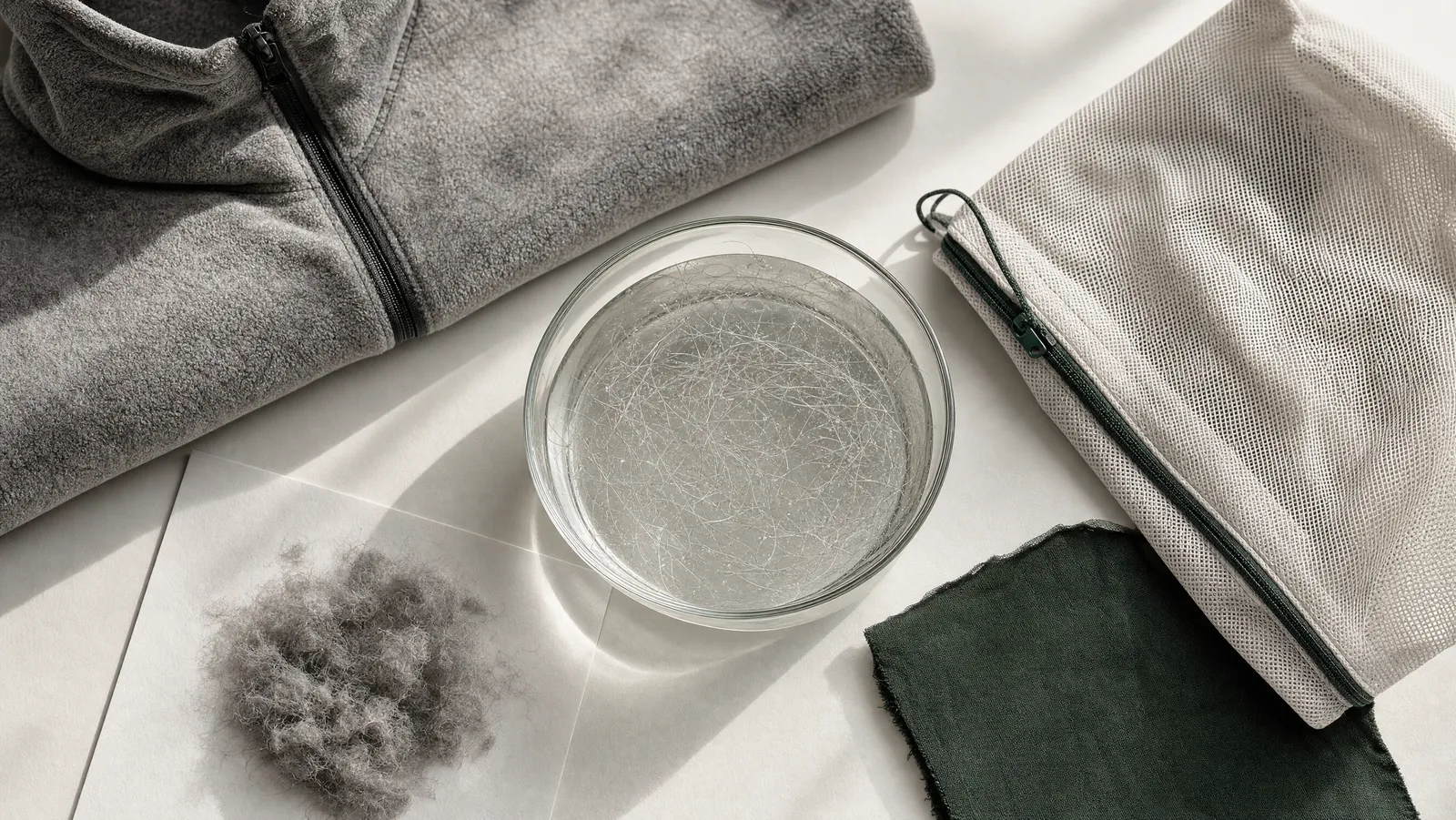
The highest-impact change here is the one nobody sells you: wash the synthetic clothes you already own less often, in fuller and cooler loads, and buy fewer new ones. Every device on the market cuts fibre release by some fraction. Not running the wash cuts it by all of it.
That is an unsatisfying opening if you came here to buy something, so let us be plain about why this page has no products on it. Most articles about laundry microplastics open with a frightening number and close with a link to a filter. We ordered the interventions by what the measurement literature supports, and the free behaviour changes came out above the hardware. Selling you something mid-ranking would have undermined it. This page belongs to our wider eco-friendly laundry coverage, and it is the one page in it with nothing to sell.
Do clothes shed microplastics, or is it mostly cotton?
Both, and the proportions depend entirely on whose wash you measure.
The most-cited laboratory work is Napper and Thompson's 2016 study at Plymouth University in Marine Pollution Bulletin. They laundered polyester, acrylic and polyester-cotton blend fabrics at 30 and 40 degrees Celsius, with and without bio detergent, non-bio detergent and conditioner, then counted the fibres in the effluent. Scaled to a typical 6 kg load, they estimated 137,951 fibres for the polyester-cotton blend, 496,030 for polyester and 728,789 for acrylic. The fibres averaged 11.9 to 17.7 micrometres in diameter and 5.0 to 7.8 mm long.
Now the counterweight. A 2020 study in PLOS ONE by Lant and Hayward of Procter and Gamble with colleagues at Northumbria University measured 79 real, soiled consumer wash loads from UK households rather than test swatches. Those loads released a mean of 114 mg of microfibre per kg of fabric, and roughly 96% of what came off was natural fibre, cotton, wool and viscose, with only about 4% synthetic. It was sponsored by Procter and Gamble too, which we mention so you can weigh it, not because it invalidates the measurement.
Read together: wash a fleece and you are shedding plastic, but in a typical mixed household load most of the lint by mass is cotton, and the plastic fraction tracks how much synthetic clothing is in your wardrobe. That is the first clue about where the leverage is.
Where the 700,000 fibres per wash figure actually comes from
You will see "700,000 fibres per wash" quoted everywhere with no conditions attached. It is a real number from a real paper: the acrylic result above, rounded down from 728,789. It describes a 6 kg load of pure acrylic fabric, which is not a load anybody runs.
Two more things about it. It is a fibre count, not a mass, and the two behave differently: a count can rise while total shed mass falls, because one long fibre can break into many short ones. And Napper and Thompson found the effects of temperature, detergent and conditioner "less consistent" than the effect of fabric type, depending on the specific combination. Anyone quoting a clean percentage for "washing cooler" off that paper is quoting something it did not say.
The other famous figure is that synthetic textiles account for 35% of ocean microplastics. The source is the IUCN's 2017 report by Boucher and Friot, and the actual claim is narrower: 35% is textiles' share of primary microplastics released to the ocean, and the same report estimates primary microplastics at 15 to 31% of all plastic in the ocean. It also states plainly that it is a model built on publicly available data, not field measurements. The honest version: laundry is one of the two largest modelled sources of a category that is itself a minority of ocean plastic. Less dramatic, and true.
Shed fibres and dissolved polymer are two different arguments
These get muddled constantly, and the fix for one does nothing for the other.
Shedding is mechanical. Fibres are abraded off the fabric surface by water and agitation, and they leave the machine as solid particles. Dissolved polymer is a different story: it is the water-soluble binder in some detergent formats, most visibly polyvinyl alcohol in detergent sheets and pods, which dissolves into the wash water rather than shedding from it. We took that apart separately in our piece on whether laundry detergent sheets are actually plastic-free.
What the difference means: switching detergent format cannot reduce fibre shedding, because the fibres come from the clothes. What it does not mean is that the dissolved-polymer question is settled. Two arguments, two sets of evidence. Anyone who answers one by pointing at the other is dodging.
Where microfiber pollution ends up after the drain
The pipe leads somewhere, and the somewhere is more interesting than "the ocean".
According to Murphy and colleagues' 2016 study in Environmental Science and Technology, a secondary wastewater treatment works in Glasgow serving a population equivalent of 650,000 reduced microplastics from 15.70 particles per litre in the influent to 0.25 per litre in the final effluent, a 98.41% reduction. That is a genuinely high capture rate and deserves saying out loud. The same paper calculates that the remaining fraction still amounts to roughly 65 million microplastic particles leaving that one plant daily.
Then there is the captured 98%, which does not vanish. It becomes sludge. In a 2016 viewpoint in the same journal, Nizzetto, Futter and Langaas note that over 90% of microplastics entering treatment are retained in sewage sludge, that about half of sewage sludge in Europe and North America is processed for agricultural use, and they extrapolate an annual input of 63,000 to 430,000 tonnes of microplastics to European farmland and 44,000 to 300,000 tonnes to North American farmland. Their comparison is the striking part: those inputs exceed the 93,000 to 236,000 tonnes they cite as the accumulated microplastic burden in global ocean surface water.
So the accurate framing is not "your fleece goes to the sea". Treatment works largely do their job, and the material they capture is mostly moved to soil.
How to reduce microplastics from laundry, in order of effect
Here is the ranking, ordered by evidence of actual effect rather than by how buyable each option is.
1. Own fewer synthetics and wash them less often
This is first because it is the only intervention with a 100% effect size, and the one that never appears in a product roundup.
No study will tell you "a wool sweater instead of a fleece prevents X fibres", and we are not going to invent one. The relationship is structural: shedding scales with how much synthetic fabric goes through the machine and how many times it does. Hartline and colleagues' 2016 study in Environmental Science and Technology, which washed synthetic jackets and fleeces, recovered between roughly zero and 2 grams of microfibre per garment, exceeding 0.3% of the unwashed garment's mass, and found that mechanically aged garments shed more than new ones. An old fleece washed weekly is the worst case in the whole literature.
The practical version: air out and spot-clean synthetic outerwear rather than running a cycle, keep fleece and activewear out of the routine wash, and count fibre content when you next replace a garment. Free, unsexy, dominant.
2. Fill the drum, and run cool and quick
The Northumbria and P and G study is the most useful here because it used real loads. Two findings stand out.
- Fuller loads shed less. Loads of 3.5 to 6.0 kg released about 50% less microfibre than loads of 1.0 to 3.5 kg. The mechanism is water-to-fabric ratio, not virtue.
- Colder and shorter cycles shed less. Moving from 40 degrees Celsius for 85 minutes to 15 degrees for 30 minutes reduced microfibre generation by about 30%.
Both also save energy, so the microfibre answer and the carbon answer point the same way. Neither costs a penny.
3. Skip the delicate cycle, and prefer a front loader
Two counterintuitive findings, both worth checking rather than assuming.
The delicate cycle is the wrong instinct. Kelly and colleagues at Newcastle University, publishing in Environmental Science and Technology in 2019, found it is the volume of water in the cycle rather than the machine's spinning action that drives fibre release, and that European-style delicate cycles, which use more water, released on average 800,000 more fibres than a standard cycle. Gentle-feeling is not low-shedding.
Machine type matters more than most people expect. Hartline's team found microfibre masses from top-loading machines were roughly seven times those from front-loaders. That is not a reason to replace a working washer, since a new appliance carries its own embodied carbon. It is a reason to weigh the choice when the current one dies.
4. Detergent and softener: the evidence genuinely conflicts
This is where we have to be honest rather than tidy.
De Falco and colleagues, writing in Environmental Pollution in 2018, reported that using a softener reduced the number of microfibres released by more than 35%, and that powder detergent both increased release and made fibres harder to count, by leaving a layer on the filter that partly buried them. The 2020 Northumbria and P and G study found no significant effect from either fabric conditioner or detergent pods, in multicycle testing on polyester fleece rather than in the real soiled loads. Napper and Thompson found detergent effects that flipped depending on fabric and temperature.
Three studies, three answers, different fabrics and methods in each. Our read: do not choose a detergent for microfibre reasons. Whichever direction the effect runs, it is smaller and less reliable than load size, temperature and cycle length. Choose a detergent on packaging, ingredients and whether it cleans.
5. Wash bags and in-drum collectors: real but partial
Now the gadgets, whose effect sizes are smaller than the marketing implies.
Napper and colleagues at Plymouth tested six devices in a 2020 paper in Science of the Total Environment. A Guppyfriend-style wash bag reduced microfibre release to wastewater by about 54%, plus or minus 14, and interestingly it appeared to work mainly by reducing shedding from the clothing in the first place rather than by trapping fibres. In-drum balls test lower: McIlwraith and colleagues, working with the Rochman lab at the University of Toronto and Ocean Conservancy in 2019, found a Cora Ball captured 26% of microfibres by count, and unlike the filter they tested alongside it, it did not significantly reduce the weight of fibres released.
Both are single studies, small samples, mostly fleece test fabrics. Treat the percentages as orders of magnitude, not specifications. A bag is a reasonable buy if you already own fleece you have to wash. It is not a licence to wash it more.
6. In-line filters: the largest effect, and the largest hassle
The best results in the literature come from filters plumbed into the drain hose, but they vary enormously by design.
McIlwraith's team measured a Lint LUV-R filter capturing an average of 87% of microfibres by count, and it did significantly reduce fibre mass. The Plymouth device study found XFiltra best at 78%, plus or minus 5, and points to its 60 micrometre mesh and powered centrifugal separator. But it scored the same Lint LUV-R at only 29%, plus or minus 15, and a PlanetCare filter at 25%, plus or minus 20, both with mesh above 175 micrometres. One filter measuring 87% in Toronto and 29% in Plymouth is the real warning here: method matters more than the spec.
The honest costs: purchase price, an installation on the drain hose, and a cartridge or mesh you have to clean and eventually dispose of. A filter you stop emptying captures nothing. We are comparing specific models in a dedicated piece on the best microplastic filters and wash bags.
What the dryer adds
The washer is not the only exit. Kapp and Miller's 2020 study in PLOS ONE measured emissions from home electric dryers by counting fibres from bright pink polyester fleece blankets that landed on snow outside the vents. They found fibres throughout a 30-foot radius of the vent, with most within 5 feet, establishing that microfibres escape the lint trap and are emitted directly to outdoor air. It is two homes and one fabric, so read it as a demonstration that the pathway exists rather than as a quantification of your dryer.
The takeaways are small but free: clean the lint trap every load, because it is a filter you already own, and line-dry synthetics where you can. Nothing you add to the washer drum changes this pathway. If you are reconsidering what goes in the dryer anyway, we compared wool dryer balls versus dryer sheets separately, on their own merits rather than this one.
Do not wait for the machine to solve it
Built-in filtration is the obvious systemic fix and it keeps not arriving. California's AB 1628 would have required a microfibre filtration system in all new washing machines sold in the state for residential or state use by 1 January 2029. Governor Newsom vetoed it on 8 October 2023, writing that he was "concerned that this bill will increase costs to consumers in advance of further research being completed" and encouraging approaches that incentivise rather than mandate filters.
That same message is a fair description of where the health question stands. It notes the State Water Board "is currently assessing the potential impacts of microplastic pollution to aquatic ecosystems in coastal and estuarine environments, as well as humans through exposure in drinking water." Assessing. Microplastics have been detected in a widening range of places and research suggests reasons to take exposure seriously, but this is an environmental article, and we are not going to tell you what any of it does to your body.
The honest ordering
If you do nothing else, do the top three. They are free, and they carry the largest measured or structural effects.
- Buy fewer synthetic garments, and wash the ones you own less often. Unbounded effect, zero cost.
- Wash full loads. About 50% less microfibre than half-full loads in real consumer laundry.
- Wash cool and quick, and skip the delicate cycle. About 30% less from 15 degrees and 30 minutes; the delicate cycle released 800,000 more fibres in the Newcastle work.
- Prefer a front loader when you next replace the machine. Roughly seven times less shed mass than a top loader in Hartline's testing.
- Add a wash bag if you wash fleece. Around 54% in one study, with wide error bars.
- Add an in-line filter if you will maintain it. 78 to 87% at best, but 25 to 29% for two of the three filters in the Plymouth test.
- Ignore detergent claims about microfibres. The three studies we found disagree with each other.
Every number above is one team's measurement under one set of conditions, so the ranking is more durable than the percentages. We did not sell you anything on this page because positions one through three cannot be bought, and they matter most. When you are ready for the rest of the routine, the detergent, the dryer and the packaging, it is mapped in our guide to plastic-free laundry swaps.
How we score
What it’s made of.
Chemistry you’ll touch.
How long it lasts.
Where it goes after.
Each pick scores 0–5 on the four axes above, weighted into the composite verdict at the top. Scores are derived from what a product is verifiably made of and certified as — not how green its label looks.
About the author
Ruth Lopez
I'm Ruth Lopez and I'm a lover of nature and the environment. I'm very passionate about finding eco friendly products that don't damage the environment and also support companies that have the same philosophy.