Natural Fabric Softener Alternatives That Actually Soften

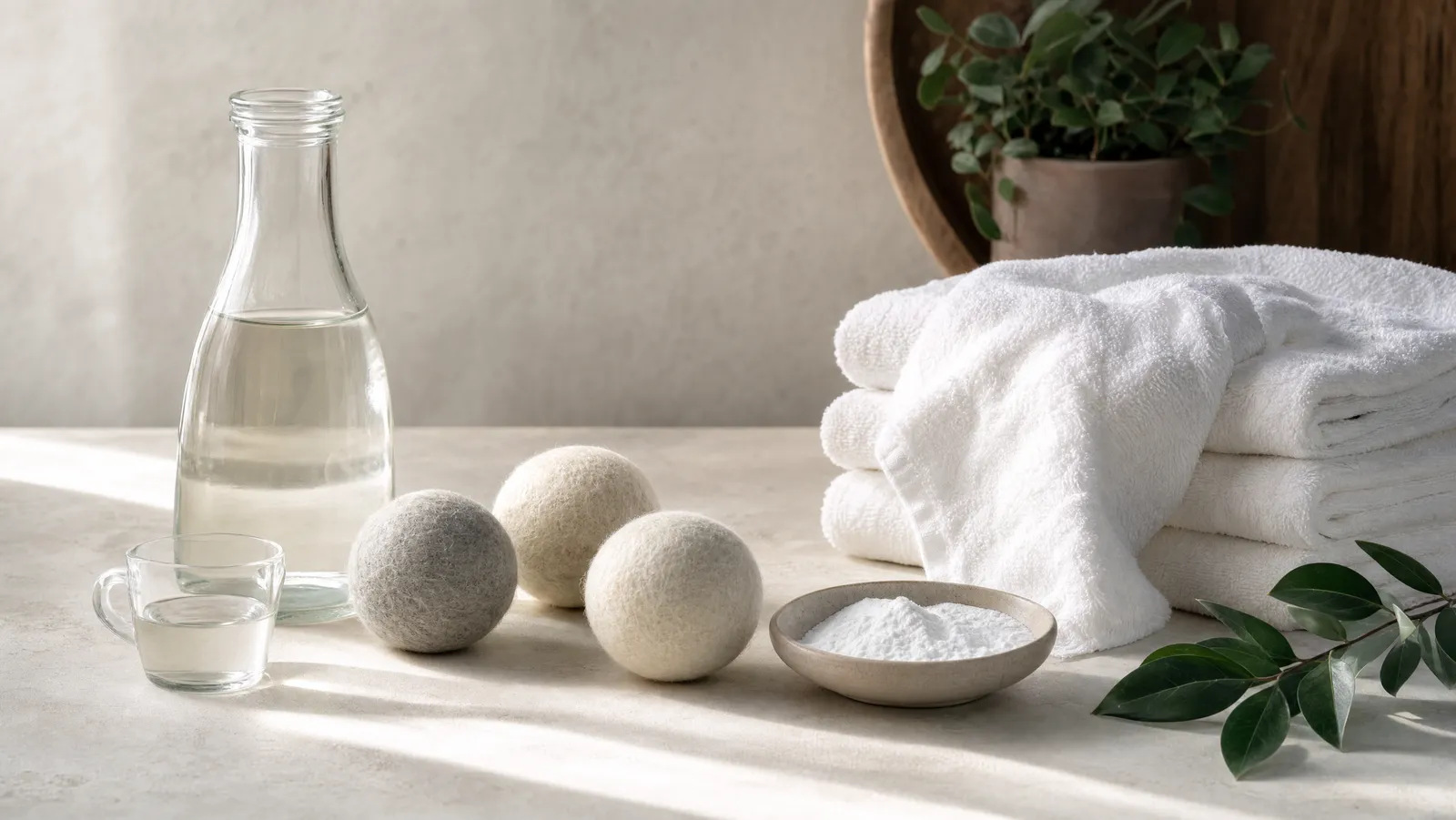
"Soften" is two complaints wearing one word. Stiffness is residue — minerals and detergent left sitting in the fibres, worst on line-dried cotton in hard water. Slipperiness and static is a coating, a thin positively charged film a commercial softener deposits on the outside of the fibre. Natural alternatives fix the first problem properly. None of them reproduce the second.
That distinction organises everything below. If you want the almost waxy hand-feel of a bottle of conditioner, no vinegar, wool ball or salt-and-essential-oil recipe will give it to you, and every article claiming otherwise is quietly changing the subject. If you want towels that do not come off the line like cardboard, that is a real problem with a free fix, and it is mostly about what you stop doing rather than what you buy. It belongs to the same set of decisions as the rest of an eco-friendly laundry routine.
What a fabric softener actually does to the fibre
According to Igarashi, Morita, Okamoto and Nakamura, writing in the Journal of Surfactants and Detergents in 2015, the active ingredient in a rinse-cycle softener is a cationic surfactant with two long alkyl chains — the quaternary ammonium family, with distearyldimethylammonium chloride as their working model. In water these form vesicles that, in the authors' words, "are adsorbed to the surfaces of the fibers, which are electrostatically negatively charged." As the load dries, those "vesicles collapse and the fiber surfaces are covered by layers of the hydrophobic alkyl chains that have low surface energies in air."
A positively charged wax sticks to a negatively charged fibre and stays there. That is the product. Every good thing and every bad thing about fabric softener follows from that one sentence.
The same paper is useful for what it questions. The textbook explanation is pure lubrication — the film lets fibres slide past each other. Igarashi and colleagues argue a second mechanism matters more than that: bound water "functions as a cross-linking agent between fibers, imparting hardness in dried cotton," and part of what the softener does is get in the way of it. They conclude that "some of the softening effect caused by fabric softeners on cotton can be attributed to the prevention of cross-linking by bound water between cotton fibers."
Which is why the natural options are not hopeless. Even the commercial product is partly managing a residue-and-water problem. That half you can attack for free. The coating you cannot.
The coating has a cost, and it lands on your towels
A hydrophobic film is exactly the wrong thing to put on an absorbent textile. Rich Handel, a test project leader at Consumer Reports who specializes in laundry, told CR that softener "can leave a layer of residue on your clothes and reduce the absorption of your towels." CR adds in its own words that it "can even diminish workout clothes' wicking ability." It lists two more consequences people rarely connect to the bottle: softener "can reduce flame resistance on children's sleepwear," and dryer sheets "can leave a residue on the dryer moisture sensor, reducing its effectiveness."
Garment makers say it more directly. According to Patagonia's own care instructions, "Generally we don't recommend using fabric conditioners or softeners on our products. They can cause seam slippage in clothing with open-weave construction, and can decrease overall durability," and for its GORE-TEX and H2No shells the instruction is a flat "Don't use a fabric softener." Nike is blunter about the mechanism: its care guidance says fabric softeners "clog the fibers" of a performance garment and "prevent the fabric from serving its intended purpose, which is to breathe and wick away moisture from the skin."
So before any alternative, a deletion list. Keep softener away from towels, microfibre cloths, moisture-wicking athletic wear, children's sleepwear and waterproof shells. Their whole job is moving water, and the coating is designed to stop water moving.
The best natural fabric softener costs nothing
The strongest recommendation in this category is not a purchase: use no softener and less detergent.
Most people dose by habit rather than by load size or water hardness, and the surplus does not vanish. It stays in the fabric, and dried detergent residue is stiff. Consumer Reports makes the same point from the machine's side, noting that the minimum amount of detergent necessary reduces smelly buildup. Cut your usual dose by a third for a fortnight and watch how the towels feel. If they feel better, cut again. If anything comes out visibly less clean, go back up a step. Most households find the floor well below the cap line on the bottle.
Two things make this work better:
- Fill the drum to about three-quarters. Fabric needs room to move for rinse water to reach it.
- Run an extra rinse. On most machines this is one button, and it is the most direct way to remove what is making the cloth stiff. No extra-rinse option? A short rinse-and-spin after the wash does the same job.
Neither is glamorous and neither has a brand behind it, which is why the internet is bad at recommending them.
White vinegar in the rinse: real, small, and not risk-free
Vinegar is the most-recommended natural softener and the most over-claimed.
What it actually does: household white vinegar is a dilute acid — Consumer Reports describes distilled white vinegar as diluted with water to about 5 percent acidity — and a mild acid rinse helps strip alkaline detergent residue and mineral deposits out of fibres. That is a genuine mechanism for the stiffness problem. What it does not do is deposit anything, so it cannot produce the lubricated hand-feel of a softener. If it seems to, you are feeling the absence of residue, not the presence of a coating.
Where it goes matters. Vinegar belongs in the rinse, in the softener dispenser, not the detergent drawer. Detergents work in an alkaline environment, so an acid in the wash just neutralises part of what you paid for. A quarter to a half cup is the usual dose, and more is not better.
Does it wreck your machine? Here the internet is confidently split and the evidence is genuinely thin. The strongest published caution we found is Consumer Reports, which warns that using vinegar regularly "can damage the rubber seals and hoses in some washing machines, potentially leading to leaks," and reports that front-load washers are especially susceptible, citing Steven Grayson, owner of Foothills Appliance Service in Wilkesboro, North Carolina. Against that, an appliance repair specialist writing elsewhere says he has "not seen any verifiable evidence that suggests that a dilute vinegar solution used during rinse cycles presents any risk to washing machine components" — one technician's experience, not a study. What is missing on both sides is a controlled test.
Our position: this is technician experience and manufacturer caution rather than measurement, so treat it as a real but unquantified risk. Check your machine's manual first — some rule vinegar out explicitly, which makes it a warranty question as well as a chemistry one. If the manual is silent, occasional use in the rinse is a reasonable bet; a cup in every load for years is the pattern technicians complain about.
Hard water is usually the actual culprit
If your laundry went stiff and nothing about your routine changed, suspect the water.
According to Nebraska Extension's hard water publication by Sharon Skipton and Bruce Dvorak, "soap curds lodge in fabric during washing to make fabric stiff and rough," and incomplete soil removal "causes graying of white fabric and the loss of brightness in colors." The USGS puts numbers on the input: water is classified as soft up to 60 mg/L of calcium carbonate, moderately hard from 61 to 120, hard from 121 to 180, and very hard above 180 — and notes that with hard water, "more soap or detergent is needed to get things clean."
Note the trap. Hard water pushes you to use more detergent, more detergent leaves more residue, residue makes fabric stiffer, and stiffness feels like you need softener. The loop is the problem.
Two ways out, neither of which is a softener:
- Add a water softener to the wash, not the rinse. Washing soda (sodium carbonate) ties up calcium and magnesium before they can combine with your detergent, which lets you use less detergent, not more.
- Fit a whole-house softener if your supply is at the very hard end and the problem shows up on the kettle and the shower screen too. That is a plumbing decision, but it solves the laundry as a side effect.
This is the same chemistry that decides whether a homemade detergent works or turns your towels grey, which is why how to make your own laundry detergent spends so long on water hardness. Soap curd from a bar-soap recipe and hard-water stiffness are the same deposit under different names.
Wool dryer balls: they unstiffen, they do not soften
Wool balls are worth having and consistently mis-sold. A wool ball has no chemistry. It is a felted lump that separates wet items so hot air reaches more surface and clothes do not weld themselves into a knot. That mechanical separation is real, and it does reduce the matted, board-like finish a tightly packed load produces. Consumer Reports — which states plainly that it has not tested their effectiveness — describes wool balls as "purported to be cost-effective alternatives that soften clothes by lightly beating up against them in the dryer, working out any stiffness or lumps." Even that description is about working stiffness out, not adding softness.
What a wool ball cannot do is coat a fibre, which means it cannot deliver the slipperiness or the static control a dryer sheet delivers. We ran that head-to-head in full in wool dryer balls versus dryer sheets, including what the independent lab tests found about drying time. For the purposes of this article the summary is short: buy them for tangle and bulk, not for hand-feel.
The combination worth trying is line-drying most of the load, then fifteen minutes in the dryer with wool balls at the end. Line-dried cotton goes stiff partly because it dries undisturbed; a short tumble breaks that set without a full cycle's energy cost.
Static is a dryer problem, so fix it in the dryer
Static is what people miss most when they drop softener, and its cause is not chemical. According to Whirlpool's dryer guidance, static in clothes comes from the transfer of electrons between materials as they tumble, "synthetic materials, such as polyester and nylon, are particularly prone to generating static because they do not absorb moisture well," and "over-drying clothes in a dryer can strip them of moisture, making static cling more likely." Damp fabric conducts charge away; bone-dry fabric holds it.
Three fixes that cost nothing:
- Stop the cycle while the load is still slightly damp and hang the rest. Biggest single lever.
- Dry synthetics separately from cotton. Static needs two dissimilar materials rubbing, so a polyester-only load is far quieter.
- Use auto-dry rather than a timer, so the machine stops when clothes are dry, not ten minutes later.
If you do none of those and genuinely hate static, use a dryer sheet on that load rather than pretend a wool ball does the same job.
The recipes that do not survive scrutiny
Three popular ones deserve a straight verdict.
Vinegar plus baking soda. These cancel each other out. According to Nathan Kilah, a senior lecturer in chemistry at the University of Tasmania writing in The Conversation, mixing the two causes an immediate reaction that forms "water, sodium acetate (a salt) and carbon dioxide — the fizzy part," and most recipes use such a large excess of one component that the fizz is essentially theatre. Use one or the other, never mixed in a jar. The same pantry-chemistry rules apply to spots and marks, which we worked through in natural stain removers that actually work.
Never mix vinegar with bleach. This one is non-negotiable. According to the Washington State Department of Health, "when chlorine bleach is mixed with an acid, chlorine gas is given off," and the department lists vinegar among the household acid products in question — exposure "even at low levels and short periods of time, almost always irritates the mucous membranes." If you use chlorine bleach on whites, keep vinegar out of that load entirely.
Epsom salts and essential oil "softener crystals." We found no evidence that magnesium sulphate softens fabric, and the proposed mechanism is unclear — adding a dissolved salt to wash water is closer to adding hardness than removing it. Treat it as unproven rather than disproven; what people respond to here is the scent, not the softness.
Essential oils dripped onto wool balls. Two honest problems. Very little fragrance survives a hot tumble, so the effect is weaker than the recipes imply. And oils on porous material plus heat is the classic setup for spontaneous heating: a 2023 National Park Service structural fire alert records seven incidents of oil-soaked kitchen rags and towels self-heating to ignition, including towels that had already been washed and tumble-dried before they began to smoulder. We found no controlled study of a few drops on a wool ball, so we will not tell you it has caused fires — only that the evidence is thin in both directions and the upside is small. If you want scent, spray it on cool fabric after the cycle ends.
One more, because it comes closest to working: DIY softeners built on hair conditioner. That is not a natural alternative. Alkyltrimethylammonium surfactants are routinely measured in hair conditioners and fabric softeners together in the analytical chemistry literature, precisely because they are the same class of compound. Thin out conditioner and pour it in the rinse and you are using a fabric softener from a different bottle, absorbency consequences included.
What we would actually do
Work in this order, and stop when the problem goes away.
- Cut your detergent dose by a third and run an extra rinse. Free, and it fixes most stiffness.
- Check your water hardness. If it is over 120 mg/L, add washing soda to the wash so you can keep the detergent dose low.
- Stop over-drying. Pull loads slightly damp, dry synthetics separately, use auto-dry. That is your static answer.
- Add wool balls for tangle-prone loads and for a short finishing tumble after line-drying.
- Vinegar in the rinse, occasionally, if residue is still the issue and your machine's manual does not rule it out.
And the part nobody wants to print: if you still miss the slippery hand-feel after all that, the feeling was never cleanliness. It was a coating, and the choice is between having it and having absorbent towels. We think the towels are the better deal, but it is a trade, not a free win, and you deserve to know which one you are making. The rest of the routine — detergent format, microfibre, packaging, the swaps that are worth it and the ones that are not — is in our full eco-friendly laundry guide.
How we score
What it’s made of.
Chemistry you’ll touch.
How long it lasts.
Where it goes after.
Each pick scores 0–5 on the four axes above, weighted into the composite verdict at the top. Scores are derived from what a product is verifiably made of and certified as — not how green its label looks.
About the author
Ruth Lopez
I'm Ruth Lopez and I'm a lover of nature and the environment. I'm very passionate about finding eco friendly products that don't damage the environment and also support companies that have the same philosophy.