The Best Microplastic Filters and Wash Bags for Your Machine

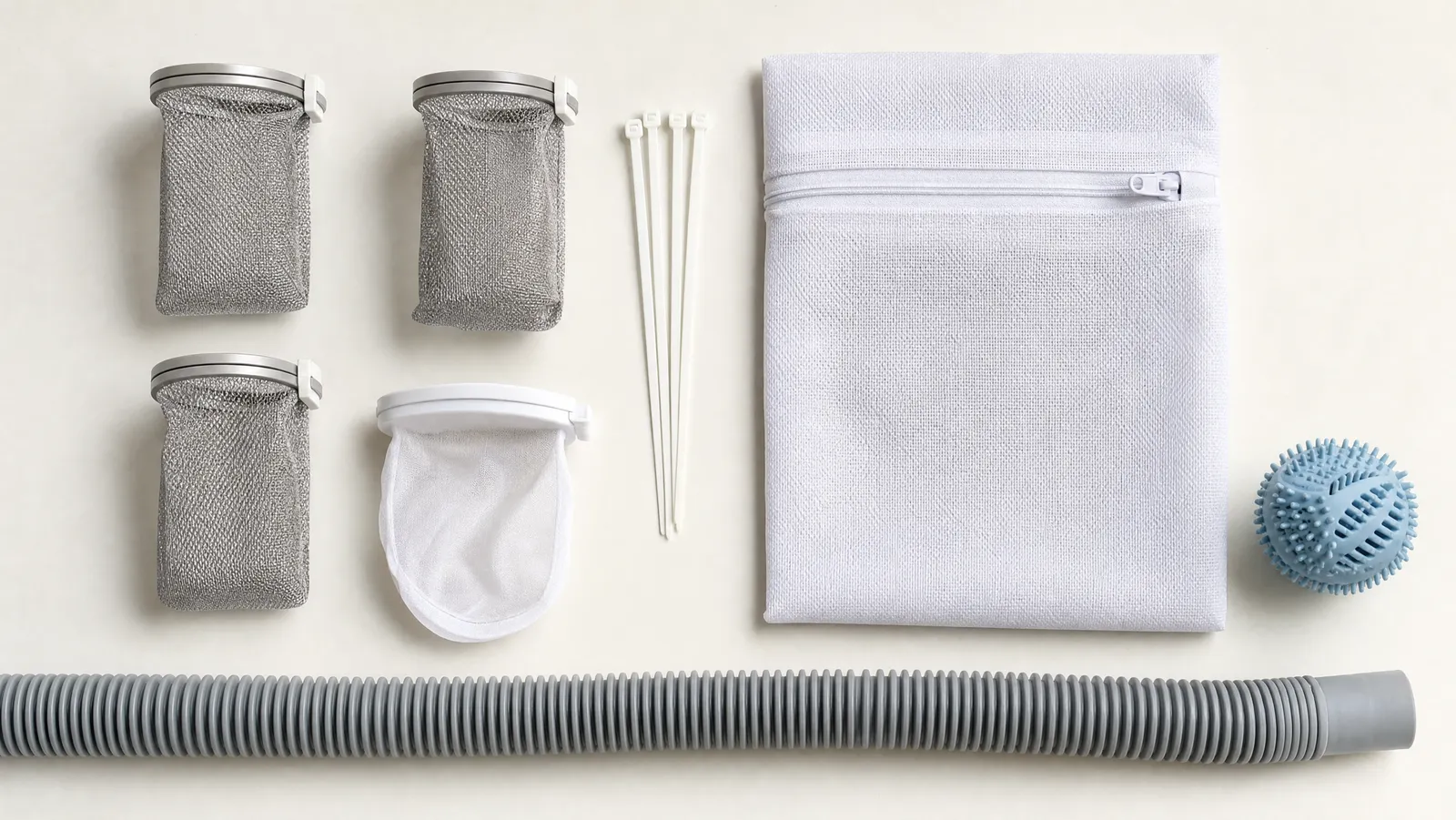
A washing machine microplastic filter with published capture data is not something we are going to sell you here. The devices the research tested, XFiltra, the Guppyfriend bag, the Cora Ball, the Lint LUV-R, Filtrol and PlanetCare, are mostly sold direct or through specialist retailers, and not one of them is a pick on this page. What we can link instead is drain-hose lint traps, mesh delicates bags and one silicone ball. Eco-Friendly Review is reader-supported, so if you buy through our links we may earn a small commission, at no extra cost to you.
That is a strange way to open a roundup, so here is the deal instead. We are not going to call a plumbing part a microfibre filter. None of the five products below publishes a pore size, none publishes a capture figure, and not one is even marketed as a microplastic filter. What we can do is lay out what the published testing found, show you where each product sits relative to it, and be exact about what we could and could not verify. This page sits inside our wider guide to a plastic-free laundry room, and it is the most heavily caveated page in it.
A microfiber filter for a washing machine solves one of two different problems
Everything in this category falls into two classes, and the research treats them separately because they work by different mechanisms.
In-line filters bolt onto the drain hose and strain the effluent after it leaves the machine, catching fibres that already came off your clothes. In-drum devices, meaning bags and balls, ride inside the wash. The interesting finding is that the good ones mostly do not work by trapping fibres at all.
According to Napper, Barrett and Thompson's 2020 study in Science of the Total Environment, out of the University of Plymouth's International Marine Litter Research Unit, six devices tested on identical 7 kg front-loaders running a 45-minute synthetic cycle at 30 degrees Celsius ranked like this, measured as mass of fibre reaching the wastewater against a no-device control that shed 0.44 grams per wash:
- XFiltra, an external filter prototype with a 60 micrometre mesh and a powered centrifugal separator: 78 plus or minus 5 percent
- Guppyfriend washing bag, in-drum, 50 micrometre pore size: 54 plus or minus 14 percent
- Cora Ball, in-drum, no mesh at all: 31 plus or minus 8 percent
- Lint LUV-R, external filter, pore sizes of 285 and 175 micrometres: 29 plus or minus 15 percent
- PlanetCare, external filter, 200 micrometre pore size: 25 plus or minus 20 percent
- Fourth Element bag, an in-drum prototype, 50 micrometre pore size: 21 plus or minus 9 percent
Two things there matter more than the ranking. The paper reports that the Guppyfriend "appeared to mainly work by reducing microfibre shedding from the clothing during the washing cycle" rather than by catching much. And the two bags had pore sizes both measured at 50 micrometres and scored 54 and 21 percent, which the authors attribute to shape and design. Pore size alone does not predict performance, even when a maker publishes one.
The same filter measured 87 percent in Toronto and 29 percent in Plymouth
Before treating any of those numbers as a specification, look at what a different lab found for the same device.
According to McIlwraith and colleagues' 2019 paper in Marine Pollution Bulletin, from the Rochman lab at the University of Toronto with Ocean Conservancy, the Lint LUV-R captured an average of 87 percent of microfibres by count and the Cora Ball captured 26 percent by count, washing fleece blankets in a top-loading machine. The Lint LUV-R also significantly reduced total fibre weight and average fibre length; the Cora Ball did not reduce weight.
So the same filter scores 87 percent by count in one study and 29 percent by mass in another. Different fabrics, machines and metrics, and a spread far wider than any of the error bars. Treat every percentage in this category as one team's measurement under one set of conditions, not as a product spec.
The best microplastic catcher is a load you did not run
Hardware is the last lever, not the first, and it is the only one anybody sells.
Wash fuller loads, wash cooler and shorter, skip the delicate cycle, own fewer synthetics. Those are free, and they have more published measurement behind them than anything you can buy on this page. We ranked them properly in our guide to how to stop your laundry shedding microplastics, which has no products on it for exactly that reason.
One free lever deserves repeating, because it has been measured and none of the products below has. According to Hartline and colleagues' 2016 study in Environmental Science and Technology at UC Santa Barbara, which washed new and mechanically aged polyester fleece jackets and sweaters, microfibre masses recovered from top-loading machines were approximately seven times those from front-loaders. Recovered mass ran from roughly zero to 2 grams per garment, exceeding 0.3 percent of the unwashed garment's mass, and aged garments shed more than new ones. Nobody should scrap a working washer over this. But when the current one dies, that single choice does more than a 78 percent filter would.
Where the fibres go after the drain, which is not the ocean
This is the fact that changes what a filter is actually for, and it is almost never mentioned in this category.
According to Murphy and colleagues' 2016 study in Environmental Science and Technology, a secondary wastewater treatment works serving a population equivalent of 650,000 cut microplastics from 15.70 particles per litre in the influent to 0.25 per litre in the final effluent, a 98.41 percent reduction, while still discharging around 65 million particles a day. Treatment works are already good at this.
The question is where the captured 98 percent goes. According to Nizzetto, Futter and Langaas, writing in the same journal in 2016 from the Norwegian Institute for Water Research and the Swedish University of Agricultural Sciences, most of those microplastics accumulate in sewage sludge, roughly 50 percent of that sludge in Europe and North America is reused as fertiliser, and they estimate 110,000 to 730,000 tonnes of microplastics reaching agricultural soils across those regions every year.
That reframes the whole purchase. A drain-line trap is not mainly keeping fibres out of the sea, because the treatment plant was already doing most of that. It is diverting them from farmland into your bin, which means landfill. That is a defensible thing to want. It is just not the thing the marketing implies.
Mesh size is the whole argument, and nothing on this page publishes one
Here is the closest thing to direct evidence about the sort of mesh these products use.
According to Vassilenko and colleagues' 2021 study in PLOS ONE, from the Ocean Wise Conservation Association in British Columbia, mesh taken from two marketed laundry lint traps was tested across a range of porosities. Internal mesh porosities of 50 to 200 micrometres captured between 88.2 and 89.9 percent of polyester fibres by weight, even though the fibres themselves had a median width of only 12.4 plus or minus 4.5 micrometres. Retention of polyester fell to 41.2 percent at the largest porosity tested, 1,588 micrometres. Nylon did far worse throughout: 46.0 percent retained at 50 and 100 micrometres, dropping to 19.4 percent at 150 micrometres.
That cuts both ways. A mesh sixteen times wider than a fibre still holds most of the polyester, because fibres tangle and mat and form their own filter cake. But retention collapses as the weave opens up, and it collapses faster for nylon.
Now the sentence that matters. We searched for published fibre-capture testing on the disposable stainless-mesh sleeves sold as washing machine lint traps in the plumbing aisle, and we did not find any. Not a pore size, not a capture percentage, not an independent test. The Vassilenko work is the nearest analogue, and it was mesh from branded in-line filters, not from a 37-cent sleeve. What it tells you is that porosity decides everything, and porosity is precisely the number none of the five products below discloses.
What we mean when we say we tested these
We did not measure fibre capture. We have no filtration lab, and inventing a number would be worse than admitting we lack one.
What we did check, on a standard front-loading machine and a laundry sink: whether each product fits, how long installation takes, which plumbing configurations it rules out, how fast it clogs in ordinary mixed loads, and how unpleasant it is to empty. Read the picks below as an assessment of usability and honest positioning, not of performance.
Best value: suoundey stainless steel lint traps
The suoundey 24-pack is the cheapest route into the drain-line approach at 8.99 dollars as of September 2026, or about 37 cents a trap, and it is also the pick with the biggest disqualifier.
Lead with that disqualifier, because suoundey does: the listing states plainly that it works only on a hose that drains into a sink, and is not applicable for stand-pipe drains or pipes that go into the wall. That single line rules the product out for a large share of American laundry rooms. If your washer's hose disappears into a vertical pipe behind the machine, close this tab and go rearrange your wash loads instead.
With a sink, this is easy. The sleeves slide over the hose end by hand and the cable tie holds them, and suoundey sizes them for hoses one to three inches across, each trap expanding to about 27 cm by 5 cm. They fill with visible lint fast on towel and fleece loads, and swapping one takes seconds.
The trade-off: twenty-four disposable sleeves is twenty-four pieces of waste, which is an odd thing to buy in the name of pollution. And we can tell you it catches lint. We cannot tell you what it does with a 12 micrometre polyester fibre, because nobody has published that.
Best reusable: PlumbCraft nylon lint trap
If the disposable arithmetic bothers you, the PlumbCraft nylon trap is the same idea as one object you rinse out. It is 8.80 dollars as of September 2026, so it costs about the same as twenty-four sleeves and replaces all of them.
The elastic cuff grips the hose without a cable tie, which sounds trivial and is not: it means you will actually take it off and clean it, and a trap you stop emptying catches nothing. PlumbCraft positions it as a cheaper alternative to aluminium lint catchers and markets it for pet hair, human hair and lint. Note the framing. Its stated benefit is preventing drain clogs, not environmental capture, and we are not going to upgrade that claim on their behalf.
The trade-off is genuinely awkward here. The trap is nylon. Nylon is a plastic, and it is the fibre type mesh held on to worst in the Vassilenko testing. A nylon sock sitting in hot effluent every wash is itself a shedding surface. We still think reusable beats disposable, but this is not a clean win.
Best in-drum bag: OTraki fine mesh laundry bags
The bag category is the one where the research is most encouraging and the available product is least like what was tested. The OTraki 2-pack is a delicates bag, not a Guppyfriend, and the distinction is the point of this section.
The Guppyfriend's whole design argument rests on a specific tight weave, and Plymouth measured its pore size at 50 micrometres. OTraki publishes no pore size at all. Its stated purpose, in its own words, is protecting delicates from wear, snagging and tangling, and a generic "fine mesh" is near-certainly coarser than 50 micrometres. Given that the two 50 micrometre bags at Plymouth scored 54 and 21 percent, a gap the authors could only put down to shape and design, an undisclosed coarser weave is not a small unknown. It is the entire unknown.
What is good about it: at 7.12 dollars for two as of September 2026, the 24 by 32 inch size is unusually large, so a whole fleece goes in without cramming, and the covered metal zipper stayed shut through repeated cycles. OTraki rates the polyester mesh for 140 to 176 F.
The trade-off: the bag is polyester, the same material as the fibres it is meant to hold. Buy it as a cheap way to try the in-drum approach on synthetics you already own, not believing you have bought a capture figure.
Best in-drum catcher: Feazac silicone laundry ball
The Feazac ball is shaped like the device that was studied, and it is not the device that was studied.
Everything in its listing is Feazac's own claim, so here it is attributed: Feazac says its 4,400-plus silicone bristles help loosen dirt and lint from fabric, that the internal filter chamber helps collect pet hair, lint, threads and small particles, and that the ball separates garments to reduce tangling and twisting. Not one of those claims mentions microfibres. The Cora Ball, which this resembles, scored 31 plus or minus 8 percent at Plymouth and 26 percent by count in Toronto, and none of that transfers to a different product with a different geometry.
In use it is the least demanding pick here. It needs no plumbing access, works on stand-pipe installs where the drain-hose traps cannot go, the soft silicone did not snag knitwear for us, and the chamber opens so you can see what you collected.
The trade-off is the price. At 18.99 dollars as of September 2026 it is more than twice anything else here and carries the least evidence of the five. Our honest answer: buy it only if a stand-pipe drain has ruled out the traps and you want something rather than nothing in the drum. If you have a laundry sink, spend a third as much on a trap.
Cheapest way to start: Dr Quality Parts lint trap 12-pack
The Dr Quality Parts 12-pack is here to make a point about the category, and at 6.98 dollars as of September 2026 it is the smallest outlay on the page.
Per trap it is worse value than the 24-pack, roughly 58 cents against 37. Buy it anyway if you are unsure, because the real question is whether your hose and drain will accept a trap at all, and twelve is plenty to find out. It is 304 stainless steel mesh with nylon cable ties, marketed for lint, hair, debris and tissue and for reducing laundry sink and basin clogs.
Now the point. The listing contradicts itself: the title sells a 12-pack while the bullet copy describes a 40-pack at 29 by 6.5 cm. Treat the title as what arrives and the rest as unchecked. That is characteristic of the whole shelf. These are plumbing parts, sold by parts suppliers, with copy nobody has audited, and none of them makes an environmental claim.
That is a reason to trust them more, not less. A supplier who never claimed to filter microplastics has not misled you. It does mean you are on your own for what they capture, which is why the free levers above matter more than anything you add to the drain.
The dryer is the other end of the same pipe
Fitting a trap to the drain hose fixes one exit and leaves the other open. Tumble drying sheds fibres too, and a vented machine sends them straight to outdoor air rather than to a treatment works, so nothing in this article touches that pathway.
The free fix is the one you already own: clean the lint screen every load. If you are rethinking what goes in the dryer anyway, we compared wool dryer balls versus dryer sheets on their own merits. Line-drying synthetics removes the pathway entirely, which is the same shape of answer as everything else here.
The bottom line
Ordered by how confident we are, which is not the order the picks appear in:
- If your washer drains into a sink, start with the Dr Quality Parts 12-pack to confirm it fits, then move to the suoundey 24-pack or the PlumbCraft reusable.
- If you have a stand-pipe drain, the drain-hose traps are not for you, and the OTraki bag is the sensible cheap experiment.
- The Feazac ball is the fallback for a stand-pipe household that wants a catcher rather than a bag, and it is the one we would argue with you about.
- Nobody here publishes a pore size or a capture figure, and the one category with strong published numbers is not purchasable through us.
If that reads like a roundup arguing you might not need a roundup, good. The measured hierarchy is clear: fuller loads, cooler and shorter cycles, fewer synthetics, and a front-loader when the old machine finally goes. Devices come after all of that. When you are ready for the rest of the routine, the detergent, the dryer and the packaging, it is mapped in our eco-friendly laundry guide.
What we tested

The cheapest way to filter the drain line if your washer drains into a sink
- Material
- Stainless Mesh & Fine-Weave Polyester
- Credentials
- Drain-lineEvidence-checked
At roughly 37 cents a trap it is the cheapest way to put anything at all in the drain line, it fits a wide range of hose diameters, and swapping a clogged sleeve for a fresh one takes about ten seconds.
No major drawbacks noted in testing.
Twenty-four stainless steel mesh sleeves and twenty-four cable ties, sized by suoundey to fit hoses from one to three inches across, with each trap expanding to about 27 cm long by 5 cm wide. It slips over the end of the discharge hose by hand, no tools involved, and suoundey says the steel mesh will not rust or readily tear. Read the maker's own limitation before you buy, because it is the whole story: this works only on a hose that drains into a sink or tub, and is not applicable for stand-pipe drains or pipes that run into the wall.

One trap you rinse and reuse instead of two dozen you throw away
- Material
- Stainless Mesh & Fine-Weave Polyester
- Credentials
- Drain-lineEvidence-checked
It is the only pick here that is not a consumable, the elastic cuff holds without a zip tie, and rinsing it out is a ten-second job at the laundry sink.
No major drawbacks noted in testing.
The same drain-hose idea without the consumable. An elastic form-fitting cuff grips the end of most washing machine discharge hoses, so it goes on by hand with no cable tie, and it comes off for rinsing just as easily. PlumbCraft positions it as a cheaper alternative to aluminium lint catchers and markets it for pet hair, human hair and lint, framing the benefit as preventing drain clogs rather than as environmental capture. The tension worth naming out loud is that the trap is nylon, which is a plastic, and nylon sheds too.

The in drum approach for about three and a half dollars a bag
- Material
- Stainless Mesh & Fine-Weave Polyester
- Credentials
- Drain-lineEvidence-checked
The 24 by 32 inch size is the useful part, because it is one of the few bags large enough to take a whole fleece or a jacket without cramming, and the covered metal zipper survived repeated cycles without popping open.
No major drawbacks noted in testing.
Two fine-mesh bags at 24 by 32 inches each, which is 60 by 80 cm, big enough for sweaters, coats, jackets and bedding rather than just socks. OTraki states the purpose plainly as protecting delicates from wear, snagging and tangling, and rates the polyester mesh for 140 to 176 F. A metal zipper with a cover flap keeps it from opening mid-cycle, which matters more than it sounds. Two honest caveats: this is a delicates bag with no published pore size and no capture data, and the mesh itself is polyester, the same material as most of the fibres you are trying to hold on to.

Shaped like the device that was studied but not the device that was studied
- Material
- Stainless Mesh & Fine-Weave Polyester
- Credentials
- Drain-lineEvidence-checked
It is the only in-drum pick with a chamber you can actually open and empty, the silicone is soft enough that we saw no snagging on knitwear, and it needs no plumbing access at all.
No major drawbacks noted in testing.
A soft silicone ball carrying more than 4,400 bristles and an internal filter chamber, sold to tumble loose in the drum. Feazac says the bristles help loosen dirt and lint from fabric, that the chamber helps collect pet hair, lint, threads and small particles, and that the ball separates garments to reduce tangling and twisting. Every one of those claims is the maker's, none of them is about microfibres, and at 18.99 dollars as of September 2026 this is the most expensive item on the page while being the one with the least behind it. Rinse and air dry between uses.

A small pack for finding out whether drain hose traps fit your plumbing at all
- Material
- Stainless Mesh & Fine-Weave Polyester
- Credentials
- Drain-lineEvidence-checked
The cheapest total outlay on this page at 6.98 dollars as of September 2026, which makes it the sensible way to discover whether your washer's hose and drain will take a trap at all before you commit to a case of them.
No major drawbacks noted in testing.
The lowest-commitment way into the drain-hose approach: twelve 304 stainless steel mesh traps with nylon cable ties, sliding onto the discharge hose end with no tools. Dr Quality Parts markets it for catching lint, hair, debris and tissue and for reducing laundry sink and basin clogs, which is a plumbing claim rather than an environmental one. Be warned that the listing contradicts itself, since the title sells a 12-pack while the bullet copy describes a 40-pack at 29 by 6.5 cm. Treat the title's 12-pack as what arrives, and treat the rest of the copy as unreliable.
The top three, compared
| Spec | Best Valuesuoundey Stainless Steel Washing Machine Lint Traps (24 Pack with Cable Ties) | Best ReusablePlumbCraft Nylon Lint Trap for Washing Machine Drain Hose | Best In-Drum BagOTraki Fine Mesh Laundry Bags 24 x 32 inch (2 Pack) |
|---|---|---|---|
| Verdict | Solid | Solid | Solid |
| Composite | 3.6/5 | 3.6/5 | 3.6/5 |
| Materials | 3.7 | 3.7 | 3.7 |
| Health | 3.4 | 3.4 | 3.4 |
| Durability | 4.3 | 4.3 | 4.3 |
| End-of-life | 3.2 | 3.2 | 3.2 |
| Price | — | — | — |
| Get it | Check price | Check price | Check price |
How we score
What it’s made of.
Chemistry you’ll touch.
How long it lasts.
Where it goes after.
Each pick scores 0–5 on the four axes above, weighted into the composite verdict at the top. Scores are derived from what a product is verifiably made of and certified as — not how green its label looks.
About the author
Ruth Lopez
I'm Ruth Lopez and I'm a lover of nature and the environment. I'm very passionate about finding eco friendly products that don't damage the environment and also support companies that have the same philosophy.