Electric Kitchen Composters and Whether the Output Is Real Compost

Dehydration is not decomposition. Driving the water out of a potato peel with heat and chopping what remains into crumbs changes the shape of the peel; composting is the aerobic microbial digestion that changes what it is. That distinction is the entire answer to which is the best electric kitchen composter, because almost every machine sold under that name is a dehydrator, and what it hands you is dried, ground food waste rather than finished compost. We may earn a commission when you buy through links on this page, at no cost to you.
The short answer. Four of the five machines below heat and grind. One holds a live microbe colony and is the only one with a mechanistic claim to actual decomposition. The published laboratory work on dehydrator output found it biologically dead, salty and acidic, and in the published germination trial rye grass would not grow in it at all. Nobody needs one of these to compost.
This is the appliance instalment of our series on kitchen composting, and like the liner instalment it spends its first half arguing against its own category. We have not run one of these on a bench. What we have done is read the published analysis of this output closely, and it is not ambiguous.
What an electric kitchen composter actually does to food
Four of the five machines here do the same three things. They heat the bucket, blades chop what is in it, and a fan pushes the water vapour out through a carbon filter. Lomi, the best-known name in the category, works the same way.
Theresa Greinig, education coordinator at the Solid Waste Agency of Northern Cook County, and Caroline French, sustainability program associate at Seven Generations Ahead, writing for the Illinois Food Scrap and Composting Coalition in September 2025, describe the machines as devices that "use heat, agitation, and airflow to rapidly dry and grind food scraps into a fine, soil-like material". Their description of the result is the sentence the marketing never uses: "The end product is typically a sterilized, dehydrated food powder". The heat is doing that deliberately - it is applied "to kill bacteria and microbes, essentially sterilizing the material" - and the powder "does not provide the same benefits to soil as finished compost does".
Zach Brookes, owner and founder of Arizona Worm Farm, put the mechanism to Mitch K of Gear Patrol in September 2022 in one line: "The heating and drying actually kills microbes like bacteria, fungi and nematodes." Of the output he said "It's not compost", and called it "dried ground up food".
Heat is the whole point of the appliance, and heat is also the reason the output is not compost. A sterile powder has nothing in it to finish the job.
Do electric composters make real compost? The laboratory analysis says no
Ron Alexander is a horticulturist and president of R. Alexander Associates in Apex, North Carolina, with more than 40 years in compost and recycled organics product development and marketing, and an industry liaison to the Association of American Plant Food Control Officials. He published "Electric Kitchen 'Composter' Confusion" in BioCycle on 25 September 2023, after having the output of two dehydrator units laboratory-analysed and compared against real compost.
What the analysis found:
- The process. "The dehydration units use temperatures ranging from approximately 165° to 275° F for a 4-to-20-hour timeframe", and "The systems can reduce the volume of food waste by up to 90%".
- No biology left. Genome Insights of Hillsborough, North Carolina sequenced a sample Alexander produced and found "no measurable (microbial) DNA".
- Salt. The material showed "a high electrical conductivity, sodium and chloride content", with sodium and chloride "two to three times higher than most yard trimmings/food waste-based composts" he has evaluated.
- Dry and acidic. A "very low moisture content and pH", with the output under 10 percent moisture.
- Poor stability and maturity. Alexander rates the samples poor on both.
Those last two words are not adjectives in this field: stability and maturity are the paired measurements that say whether a material has finished composting and is safe to put near a root. Alexander also cites a Universiti Brunei study, Azis and colleagues in 2023, which found the material "still found to be immature and would require additional curing" and reported "a substantial level of phytotoxins within the samples, even after four weeks of curing."
An appliance that sterilises its contents cannot produce a mature compost, because maturity is something microbes do over months and this machine's selling point is that it takes hours.
What dehydrated food waste does in soil: mould on day three, no germination at all
Alexander did not stop at the laboratory sheet. He ran the output through the uses the marketing suggests, and this is the part to read if you were planning to feed houseplants.
In a rye grass germination trial he blended 25 percent dehydrated food or 25 percent compost into 75 percent sandy soil with no added fertility. The compost blend grew well. In the other, "there was no germination at all in the dehydrated food-soil blend", and he abandoned the treatment after two weeks.
Left in containers, the samples did what wet, sterile food powder does. "On the third day significant mold generation occurred in some of the dehydrated food samples", and "After five days, mold had just about covered both of the dehydrated food samples". Outdoors the samples "attracted flies on an ongoing basis". In a 25-day mondo grass trial, two of four pots containing dehydrated food held living insect larvae, and by day 25 the plants in three of the four pots were badly damaged, with one pot nearly all dead.
Mould and flies are precisely the problems the machine is sold to solve, and they came back the moment the powder was rehydrated - the same lesson as the carbon filter in stopping smells and fruit flies, which manages a symptom rather than removing a cause.
If houseplant pots are your only destination, the published trial for that exact use case left the plants in three of its four pots greatly damaged and one pot nearly all dead. Mix it into outdoor soil at a low rate and bury it, or keep it off plants entirely.
The one mechanism here that is not dehydration
The Reencle Prime works differently, and the difference is real enough to report separately. Instead of a batch bucket you dry and empty, it is a 14 litre chamber holding a live microbe colony you feed continuously. Reencle states it "utilizes patented microbe technology to turn food scraps into real, nutrient-rich compost effortlessly" under the heading "AEROBIC COMPOSTING: Reencle creates an optimized environment that speeds up the microbial decomposition of food scraps".
Aerobic microbial decomposition is what composting is. So on mechanism this is the one product here whose claim is the right shape, and a machine that keeps microbes alive is not the machine Alexander analysed.
Now the honest part. We searched for an independent analysis of Reencle's output and did not find one. What exists is the company's own material and reviews without laboratory results. We found no published stability, maturity, conductivity or germination figures for a live-colony machine, which leaves the compost claim Reencle's rather than a result. Alexander's findings do not transfer to it, and neither does an exemption.
The listing also argues with itself. It promises "nutrient-rich fertilizer in just 2-24 hours" and to "reduce up to 90% of your food waste effectively" - a dehydrator timescale and a dehydrator metric inside a microbial claim.
Buy this one for the mechanism if the mechanism matters to you, and hold the word compost at arm's length until somebody publishes a test.
Two good sources disagree about 90 percent, and both are right
Every listing on this page claims roughly 90 percent reduction. The one independent measurement we found reports a much smaller number, and the gap is instructive rather than damning.
Hannah DeFelice and Kaitlin Stack Whitney of Rochester Institute of Technology published a trial of two household machines, a Lomi Classic and a Pursonic food waste composter, in the student research journal Food-Fueled in 2024. Across cycles they measured mass reductions averaging 64 and 66 percent for the two machines, with individual cycles ranging from 54 to 76 percent. Alexander's figure, "up to 90%", is a volume reduction.
Both are true of the same event, because they measure different things. Mass leaves the chamber as water vapour, so mass reduction is capped by how much water the scraps held. Volume falls further because blades grind what is left into a dense powder. Neither number is a measurement of decomposition. Both are measurements of drying and crushing, which is why the figure on the box is the volume one.
The RIT authors' conclusion was that the machines reduced food waste mass but had "limitations in their feasibility as a large-scale solution to the problem of food waste", and that for most households able to do it, an outdoor pile or turning bin "remains a less expensive and more environmentally friendly method of reducing food waste".
Is an electric kitchen composter worth it? Start with the cost of a cycle
The running cost is small, knowable, and almost always quoted vaguely. Food Cycler says the Eco 5 "consumes less power than your average clothes dryer", which is a comparison rather than a figure.
The RIT trial metered it. Across both machines a cycle drew 0.881 to 1.187 kilowatt hours, and at New York residential rates the authors put a single cycle at 20 and 27 cents. Nationally, the US Energy Information Administration's October 2026 Short-Term Energy Outlook projects the average US residential electricity price at 18.2 cents per kilowatthour for 2026. Our arithmetic on those two sources: about 16 to 22 cents a cycle, and about 59 to 79 dollars a year if you run one cycle every day.
Two costs belong next to it. Filters are consumables - Ouaken rates its own for "up to 5 months of use". And durability is a line item: the Pursonic unit in the RIT trial "stopped performing well after the 4th cycle run and failed completely after the 5th cycle run". That is one unit and not a brand verdict, but it is the only published durability observation we found.
Electricity is not the argument against these machines. At roughly 60 to 80 dollars a year it is minor next to a purchase price of 159.99 to 499.99 dollars as of November 2026. The argument against them is what comes out, and where it goes.
The output has to go somewhere, and that is the decision
Rank these machines by features and you buy the wrong one. Rank them by one question - do I have somewhere to put a bucket of dried food powder? - and the decision makes itself.
- You have a garden bed or a pile. The output is a usable feedstock that finishes decomposing in soil. The Illinois coalition calls it "more like a pre-compost material" and tells you to "Bury it in your garden or compost pile to allow further decomposition", with the caveat that dehydrated scraps "could temporarily tie up nitrogen during that process". That is sound, and it is also exactly what the pile would have done with the raw peelings, for free.
- You have houseplants only. Re-read the germination trial above. Do not apply this directly to pots.
- You have a drop-off. Check before you assume: programmes are built around what a facility can process. Finding and using one is covered in where to take food scraps if you do not compost at home.
- You have no destination at all. Then the machine's real product is odour-free, shelf-stable storage. That is a genuine convenience, and still several hundred dollars for a problem a freezer solves for nothing.
Some local authorities have decided the storage convenience is worth subsidising. The Municipality of Central Manitoulin in Ontario runs a FoodCycler pilot with Food Cycle Science Corporation "with support from Impact Canada", offering the 2.5 litre FC-30 at a subsidised 150 Canadian dollars plus tax and the 5 litre Maestro at 300, and says it "is now on of over 78 municipalities to offer the program". Note how its own page words the output: the machine "dries and grinds food waste into a dry, odourless, nutrient-dense by-product", it "Produces a valuable soil amendment", and the material is "transformed into a compost amendment" that "can be used in your backyard garden". The machine itself is "an on-site composting alternative". By-product, amendment, alternative. A municipal programme that paid for these machines still will not call the output compost.
If you have no outdoor space, the options that do produce compost indoors are in composting in an apartment without a yard, and none of them is an appliance.
The countertop food recycler listings argue with themselves
Read these five listings against each other and the category convicts itself. We are quoting makers on their own products, all a listing is evidence of.
Start with the Soliddis. Its title says "Turns Garbage to Compost in 4-6 Hours". Its own pro tip says: "To unlock maximum nutrients, mix the processed biomass with garden soil at a 1:10 ratio, bury it near plant roots, and water thoroughly to naturally enrich your garden!" That is a burial instruction at a one-to-ten dilution, which is what you do with unfinished material, not with compost - and the same listing calls the output "processed biomass", which is the correct term. The thesis of this article is stated, in two different places, by a manufacturer selling against it.
The others:
- Ouaken draws the line itself. It sells "Crush, Ferment, or Clean modes" and distinguishes them by output: "Crush Mode is more about reducing waste volume and odor with low energy usage, and Ferment Mode focuses on creating high-quality compost/fertilizer through an accelerated fermentation process". Splitting the two is an admission that drying and grinding is not making compost. We found no published test of the Ferment mode either way.
- Airthereal says the quiet part. "Food composters transform food scraps and kitchen waste into powder by drying it out and grinding it up. You can use this powder as fertilizer for your plants or throw it away to reduce the volume and odor of your trash." Throwing it away is offered as a legitimate use. That is the most accurate paragraph on the page, and it is on the cheapest machine.
- Food Cycler will not use the word. It calls the Eco 5 "a convenient electric kitchen composter alternative to eliminate food waste" and the output "plant food". An alternative to a composter is not a composter.
Who should buy one, and who should not
Nobody needs an electric kitchen composter in order to compost. That is the house position and the evidence above is why. The reader who should still buy one is specific, and small:
- No outdoor space and no secure place to keep a sealed pail.
- A drop-off that is monthly, distant, or otherwise not a weekly errand, so scraps have to be held in a shelf-stable form.
- A smell or pest problem that a lidded pail and a fixed emptying day have genuinely not fixed.
- Several hundred dollars to spend on convenience rather than on composting, with no expectation of a soil product at the end.
If that is you, you are buying a dryer for food waste, and a dryer is a reasonable thing to buy. Everybody else is better served by the free sequence in how to start composting kitchen scraps: find the destination, freeze the scraps today in a container you already own, and buy the pail last. Our ranking of the countertop bins we tested is where that purchase ends, at a fraction of the price of the cheapest machine on this page.
How we ranked these electric kitchen composters
Mechanism first, then price, then bucket size, because the mechanism is the only thing separating these products and the bucket is the only spec that changes your day.
Prices as of November 2026, cheapest first:
- 159.99 dollars, 2.5 litres: the Airthereal R500, dehydrate and grind, and the most candid listing here.
- 219.99 dollars, 4 litres: the Ouaken, dehydrate and grind, with a separate Ferment mode.
- 319.99 dollars, 4.2 litres: the Soliddis, dehydrate and grind, with a clean-and-dry cycle.
- 449 dollars, 14 litres: the Reencle Prime, a continuous live-microbe chamber.
- 499.99 dollars, 5 litres: the Food Cycler Eco 5, dehydrate and grind, and the only hard-scrap claim.
The gap from the Airthereal to the Eco 5 is 340 dollars for the same mechanism and 2.5 litres more bucket, which is the hardest number in this category to justify. The Reencle is the only price on the list that buys something different rather than something larger.
The bottom line
If you have a garden, a pile, or a drop-off, buy nothing: these machines dry and grind, the published analysis of that output found no measurable microbial DNA, poor stability and maturity, and no rye grass germination at all, and your destination was already going to do the biology for free. If you have none of those and you need scraps to sit on a shelf without smelling, the Airthereal R500 at 159.99 dollars as of November 2026 is the cheapest honest version of that appliance, and the Reencle Prime at 449 dollars is the only one on this page claiming a different mechanism.
The free option is the one we would take, and we earn nothing from it: a lidded tub in the freezer tonight. Cold stops the biology, which stops the smell and the flies, and it costs nothing on top of a freezer you are already running. Where the scraps go after that, and every other decision in the chain, is in our kitchen composting series.
What we tested

The cheapest machine here and the only listing that calls the output powder
- Material
- Heated Steel & Cast Aluminium
- Credentials
- Mains-poweredOutput-not-compost
For the reader who has decided they want one anyway, this is the cheapest way in and the only listing whose own description of the output matches what the published analysis found. Buy it for odour-free storage of dried scraps, not for compost.
No major drawbacks noted in testing.
159.99 dollars as of November 2026, down from a listed 249.99 dollars, for a 2.5 litre bucket and what Airthereal describes as a 4-hour cycle. It is the only listing on this page that describes its own mechanism accurately: "Food composters transform food scraps and kitchen waste into powder by drying it out and grinding it up. You can use this powder as fertilizer for your plants or throw it away to reduce the volume and odor of your trash." Airthereal also gives the workflow plainly - "Collect food waste in the bucket throughout the day then turn on the machine before going to bed. After 4 hours your food scraps will be ground up and dried into powder so you can empty it out in the morning" - and says the bucket "is made of cast aluminum, which is easy to clean and dishwasher safe". Three costs. At 2.5 litres it is the smallest bucket here, under the Ouaken's 4 litres and the Eco 5's 5 litres. The powder is dried food waste rather than compost, and everything Ron Alexander's laboratory analysis in BioCycle found travels with it. And the convenience it buys is dry, odour-free storage, which is a problem a lidded tub in the freezer already solves for nothing.
The most bucket per dollar and a listing that quietly concedes the argument
- Material
- Heated Steel & Cast Aluminium
- Credentials
- Mains-poweredOutput-not-compost
The pick for a household that fills a pail in a day and has a garden bed to bury the output in. Its own mode names concede that drying and grinding is not composting, which is more candour than most of this category manages.
No major drawbacks noted in testing.
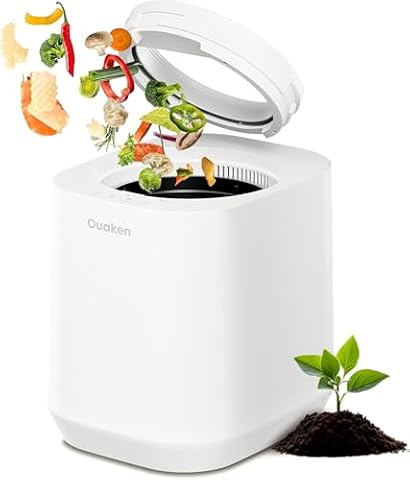
219.99 dollars as of November 2026, down from a listed 279.99 dollars, for 4 litres - the most capacity per dollar on this page. Ouaken says it uses "high-temperature drying, grinding, and cooling methods" and "reduces waste by up to 90% within hours", with "low-speed, high-torque blades" running "at a quiet noise level below 40dba", a carbon filter it rates for "up to 5 months of use", and a detachable bucket that "is also dishwasher safe". It offers "Crush, Ferment, or Clean modes", and its own distinction between the first two is the most candid sentence in the listing: "Crush Mode is more about reducing waste volume and odor with low energy usage, and Ferment Mode focuses on creating high-quality compost/fertilizer through an accelerated fermentation process". Three costs. We found no published test of the Ferment claim, so it stays Ouaken's claim. Ouaken instructs you to "empty the bucket each time before running the composter", so the 4 litres is a daily batch rather than storage. And what 219.99 dollars reliably buys is volume reduction, which is the one thing this category does well.

The only machine here that is not a dehydrator on a claim nobody has published a test of
- Material
- Heated Steel & Cast Aluminium
- Credentials
- Mains-poweredOutput-not-compost
The only pick with a mechanistic claim to actual decomposition rather than drying, and the one we would choose if the mechanism matters to you more than the price. Treat the compost claim as Reencle's until somebody publishes an analysis of the output.
No major drawbacks noted in testing.
449 dollars as of November 2026, down from a listed 499 dollars, for a 14 litre chamber you feed continuously rather than a batch bucket you empty. Reencle states it "utilizes patented microbe technology to turn food scraps into real, nutrient-rich compost effortlessly" and that "AEROBIC COMPOSTING: Reencle creates an optimized environment that speeds up the microbial decomposition of food scraps", with a "compost starter pack" in the box, an "advanced 3-layer filter system" and operation "at as low as 28 dB". That is a genuinely different mechanism from the other four machines here, and aerobic microbial decomposition is what composting is. Three costs. We could not find a published independent analysis of this output, so the compost claim is the maker's own and not a result. The same listing promises "nutrient-rich fertilizer in just 2-24 hours" and to "reduce up to 90% of your food waste effectively", which are dehydrator timescales and a dehydrator metric sitting inside a microbial claim. And at 449 dollars it is the second dearest machine on the page, with a live colony to keep fed.

The self cleaning bucket and the listing that argues against its own title
- Material
- Heated Steel & Cast Aluminium
- Credentials
- Mains-poweredOutput-not-compost
The pick for anyone whose real objection to this category is washing the bucket, because it is the only one here with a dedicated clean-and-dry cycle. Read its own pro tip before you believe its own title.
No major drawbacks noted in testing.
319.99 dollars as of November 2026 for 4.2 litres in what Soliddis calls a "heavy-duty cast aluminum kitchen composter bucket that offers superior thermal conductivity for faster drying and maximum scratch resistance", with "3 tailored modes (Low, Medium, Large)", an "extra-large 900mL active carbon filter system", a rinse you run by adding water and activating "Bucket Clean Mode ... followed by Bucket Dry Mode", a claimed noise figure "under 48dB", and volume reduction "by over 90% in just hours". It is also the only machine here with a stated "1-Year Warranty and 24/7 technical support". Three costs. Its title says "Turns Garbage to Compost in 4-6 Hours" while its own pro tip tells you to "mix the processed biomass with garden soil at a 1:10 ratio, bury it near plant roots, and water thoroughly" - which is a burial instruction, not a compost one. The same listing calls the output "processed biomass", and that is the accurate term. And at 319.99 dollars it costs 100 dollars more than the Ouaken for 0.2 litres more bucket.

The biggest bucket the hardest scraps and the one maker that refuses the word composter
- Material
- Heated Steel & Cast Aluminium
- Credentials
- Mains-poweredOutput-not-compost
The pick if your scrap stream is bones, stone fruit pits and plate scrapings rather than peelings, because it is the only listing here that claims to grind them. The maker's own refusal of the word composter is the most honest sentence on the page.
No major drawbacks noted in testing.
499.99 dollars as of November 2026 for 5 litres, the largest batch bucket here and the dearest machine on the page. Food Cycler calls it "a convenient electric kitchen composter alternative to eliminate food waste" - the only maker here that declines the word composter for its own product - and says it "quietly grinds your food waste into plant food, reducing odors, messes, and the amount of trash you take out", taking "a whopping 5L of food waste" and recycling "it to almost 90% less than what it was in just hours", with "A refillable carbon filter" and a "removable bucket". Its "INNOVATIVE VORTECH SYSTEM: The Eco 5's Vortech(TM) patented grinding system can grind what others can't. Toss in your pits, peels, bones, leftovers!" is the only hard-scrap claim on this page. Three costs. It is 340 dollars more than the Airthereal for the same heat-and-grind mechanism. Its energy line, that it "consumes less power than your average clothes dryer", is a comparison rather than a figure. And "plant food" is the maker's word for dried, ground food waste.
The top three, compared
| Spec | Best OverallAirthereal R500 Electric Kitchen Composter, SHARKSDEN Tri-Blade, 2.5L, Grey | 4-hr Cycle, SHARKSDEN Tri-blade, 90% Reduction in Waste Volume | Best Capacity Per DollarOuaken 4L Electric Composter for Kitchen, Smart Countertop Compost Bin | Odorless | Low Noise | Auto Clean | Turn Food Waste into Fertilizer, Indoor Food Waste Compost Machine, White | Best Mechanism On PaperReencle Prime Electric Composter - 14L Kitchen Composter, Decomposes Up to 2.2 lbs Food Waste Daily, Odorless Indoor Composting with Whisper-Quiet Technology & Rapid Decomposition (Silver) |
|---|---|---|---|
| Verdict | Solid | Solid | Solid |
| Composite | 3.7/5 | 4.1/5 | 4.0/5 |
| Materials | 3.7 | 3.7 | 3.7 |
| Health | 3.2 | 3.7 | 3.7 |
| Durability | 4.3 | 4.9 | 4.3 |
| End-of-life | 4.0 | 4.4 | 4.4 |
| Price | — | — | — |
| Get it | Check price | Check price | Check price |
How we score
What it’s made of.
Chemistry you’ll touch.
How long it lasts.
Where it goes after.
Each pick scores 0–5 on the four axes above, weighted into the composite verdict at the top. Scores are derived from what a product is verifiably made of and certified as — not how green its label looks.
About the author
Ruth Lopez
I'm Ruth Lopez and I'm a lover of nature and the environment. I'm very passionate about finding eco friendly products that don't damage the environment and also support companies that have the same philosophy.