Laundry Sheets vs Pods vs Powder and What to Actually Buy

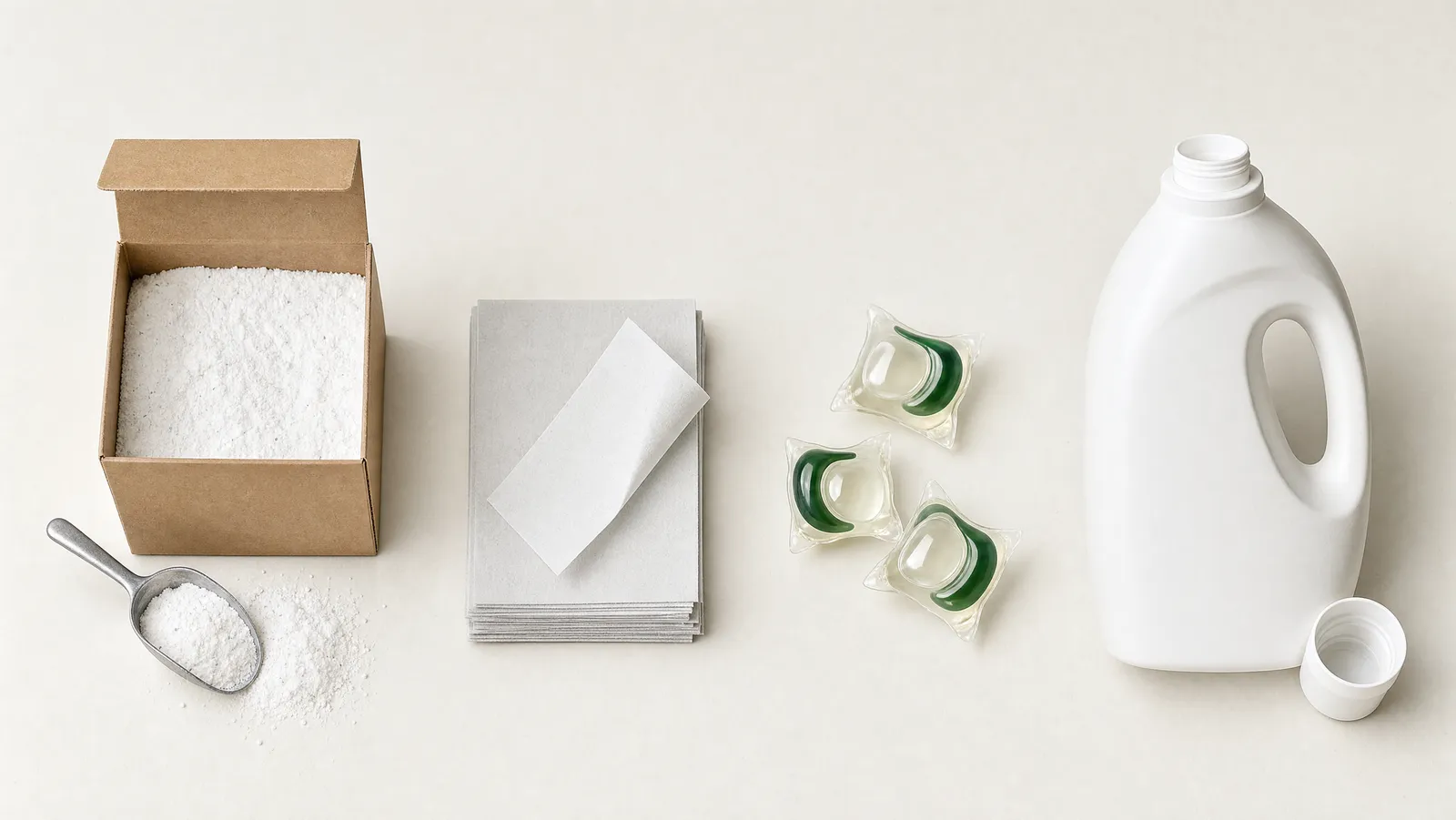
Powder in a cardboard box wins for most people. It is the least-packaged, least-polymer, cheapest-per-load format in the aisle, and the one almost nobody recommends. The exception is real and specific: if you wash cold in hard water, powder can leave residue on your clothes, and a detergent sheet is the better trade.
Eco-Friendly Review is reader-supported, so if you buy through our links we may earn a small commission, at no extra cost to you. There are no affiliate links in this article, because this is not that kind of article.
Laundry detergent sheets vs pods vs powder vs liquid is four answers to one problem — get surfactants into a drum — and each solves a different part of it while quietly creating a new one. Naming the winning format and naming a product are different jobs. This page does the first. If you are auditing the whole room, our guide to eco-friendly laundry maps every swap in the routine.
How We Judge Every Laundry Detergent Format
Six axes, same order, all four contestants. A comparison that changes criteria between entrants has already picked a winner.
- The packaging, and whether it is recyclable in practice — not in principle, not in the marketing copy.
- How much water you are shipping — water is heavy, and free at the tap.
- The dosing problem — can a normal person, in a hurry, get the dose right.
- The polymer situation — what synthetic material, if any, goes down the drain with the wash.
- Cost per load — the number that decides whether you keep buying it.
- Who it is wrong for — every format is wrong for somebody.
One note on axis five. We are not printing a cost-per-load table, because we do not have a dated price set for every format that we would still stand behind in six months. The arithmetic is more durable than any number anyway: divide the shelf price by the load count on the package, then check that the count is calculated at the dose you actually use. Most packages quote loads at their smallest recommended dose, so if you use the big scoop, halve the number before you divide.
Laundry Powder in a Cardboard Box: The Format Nobody Recommends
Packaging. A carton, sometimes a paper-and-steel canister. This is the least-packaged format by a wide margin, and there is peer-reviewed evidence for it rather than intuition. In a cradle-to-grave life-cycle assessment of five UK laundry detergents published in Tenside Surfactants Detergents in 2003 by Procter and Gamble researchers Gert Van Hoof, Diederik Schowanek and Tom Feijtel, compact powder used the least packaging per wash of every format studied — an index of 21 against regular powder at 100, with the liquid unit-dose system highest of all at 117.
The recycling caveat is the one the format's fans skip. A carton with a plastic pour spout, a poly liner or an LDPE coating is not clean cardboard. According to How2Recycle, multi-component labels exist because each part of a package has its own answer, and its guidance is that "local recycling guidance should always take precedence over the How2Recycle label." So: the paperboard body, curbside, clean and dry. The spout, the liner and the scoop are separate items with separate answers, and a carton that got damp may not be accepted at all.
Water shipped. None. This is the whole point. You add the water at home, for free, from a pipe.
Dosing. A scoop, which means it is on you, and overdosing is easy.
Polymer. No dissolvable film, no binder, no wrapper — powder is the only format of the four that does not need one to hold itself together. It is not polymer-free, though, and we will not pretend otherwise: the ingredient list in that same Van Hoof assessment shows polyacrylate, carboxymethyl cellulose and a soil-release polymer in the powders, and an unspecified polymer in all five products studied. What powder avoids is the contested one.
Cost per load. Generally the cheapest of the four. The mechanism is not mysterious: no shipped water, no wrapper.
Who it is wrong for. Cold-water washers with hard water, and this is a genuine defect rather than a quibble. It is documented in the industry's own patent literature. Church and Dwight's 2001 patent on improved cold-water powder puts it plainly: "With the increasing trend to cold water washing of fabrics at wash water temperatures below about 60 degrees Fahrenheit for energy conservation, commercial laundry detergent compositions tend to leave a cold water residue of undissolved detergent solids after completion of the wash machine cycles." The mechanism, per the same document: in hard water, precipitated calcium carbonate coats the granules and suppresses dissolution of the sodium carbonate inside them.
But note what that is. It is partly a timing and placement problem rather than an inherent one. The same patent observes that wash water is normally added over about five minutes with the agitator off, "thereby providing a relatively static medium around the detergent particles" — which it calls "a critical phase of the laundering operation." Dissolve powder in a cup of warm water first, or dose it into the empty drum before the clothes, and most of the problem goes away. If you have hard water and you will not do that, buy sheets.
Laundry Detergent Sheets: The Convenient Compromise With an Open Question
Packaging. A cardboard sleeve or envelope — powder's packaging profile without the scoop. One limit, stated plainly: we found no peer-reviewed life-cycle assessment covering sheets, so there is no measured packaging index for this format the way there is for the other three, and the comparisons that favour sheets are mostly published by firms that sell sheets.
Water shipped. Effectively none. Sheets are dehydrated detergent, and the freight saving is the least disputed claim the format makes.
Dosing. The best of the four for most people. One sheet, one load, tear in half for a small one. No scoop to over-fill, no cap to eyeball.
Polymer. The unresolved part, stated briefly rather than re-argued. The binder holding most sheets together is polyvinyl alcohol, PVA or PVOH, a synthetic water-soluble polymer. It dissolves; dissolving is not biodegrading. According to the 2021 paper by Charles Rolsky and Varun Kelkar in the International Journal of Environmental Research and Public Health, roughly 77 percent of the PVA from detergent pods and sheets is not fully degraded in US wastewater treatment — but that paper is a literature review plus a mass-balance model rather than direct sampling, and its funding statement reads "This research was funded in part by Blueland," a company selling PVA-free products. Against it, Procter and Gamble's technical review cites OECD 301B, 302 and 309 testing plus studies from Byrne, Menzies and McDonough, and says all "report a positive biodegradability assessment."
Both of the loudest voices in this argument have money in the answer. If this is the axis you care about, read whether laundry detergent sheets are actually plastic-free rather than take a one-paragraph verdict from anybody, us included.
Cost per load. Generally the most expensive of the four, though we are not printing a figure we cannot date. You are paying for convenience.
Who it is wrong for. Tight budgets, heavily soiled work clothes that want a bigger dose, and anyone for whom the polymer question is a dealbreaker.
Laundry Pods: The Worst Packaging and the Only Format With a Poison-Control Literature
Packaging. A tub or a bag, plus a film around every single dose — and the penalty is structural, not just the tub. The Van Hoof life-cycle assessment found unit-dose systems need "more stringent packaging requirements" to stop doses breaking or leaking, producing "significant higher amounts (more than twofold) of packaging per wash" than the ordinary compact version of the same detergent. The pod does not merely fail to improve on the jug. It roughly doubles the packaging of the format it was built from.
Corroborated from an unexpected direction: in a 2020 comparative life-cycle assessment in Sustainability of three liquid detergent packaging systems, the conventional HDPE pourable bottle beat both the rigid PET tub of pods and the flexible pouch of pods in every impact category except ecotoxicity, driven by the extra packaging material pods require. The plastic jug beat the pods.
Water shipped. Less than a jug; pods are concentrated. The one axis where they beat liquid outright.
Dosing. The best in the category on accuracy, and a real benefit the format's critics tend to skip. The Van Hoof paper is explicit that unit-dose systems were designed to "overcome a consumer concern of over/underdosing." One pod, one dose, every time.
But dosing accuracy and dosing safety are different things, and this is where pods lose. According to a 2023 study in Clinical Toxicology by Alice Zhang, Gary Smith, Christopher Gaw and colleagues at Nationwide Children's Hospital, drawing on National Poison Data System records from 2014 to 2022, US poison centers logged 36,279 liquid laundry detergent packet exposure calls in the three most recent years of the study — an average of one call every 44 minutes, out of 114,826 exposures across the full nine years. Children under six were 87 percent of exposures, about 6 percent of single-substance exposures produced a serious medical outcome, and nine deaths occurred over the study period, all in adults, seven of them over 70. The trend improves in one direction only. The same research found the number, rate and severity of exposures falling among children under six, which the authors link to the voluntary safety standard, public awareness campaigns and packaging changes — but it also found that burden among young children still high, and exposures rising among older children, teenagers and adults, with the adult exposure rate up 147 percent between 2014 and 2022. That is more than 12,000 calls a year, and no other format has a comparable surveillance record.
Polymer. The same PVA question as sheets — a dissolvable film here, a binder there — and no reliable published figure for how much of it each format sends down the drain per wash, so we are not ranking the two on it.
Cost per load. Expensive — pods and sheets are the two dearest formats per load, and the gap between the two depends on the brand.
Who it is wrong for. Households with young children, or with an adult who has cognitive impairment. That is not a small carve-out, and it is the clearest single recommendation in this article.
Liquid Laundry Detergent in a Jug: Mostly Water, Still Winning
Packaging. An HDPE jug — legitimately among the more recyclable plastics in the curbside stream, and still a new jug every time the last one empties, forever.
Water shipped. Most of the bottle — and rather than assert one figure, here is what the sourced ranges say. A Shell Oil patent on liquid laundry detergent formulations puts water at about 30 to 80 percent by weight of a standard composition, preferably 40 to 70. Ultra-concentrates are defined by how much surfactant they carry and how small the dose is rather than by a water ceiling, and they run lower. Procter and Gamble's 2003 material safety data sheet for Liquid Tide reports the product as 60.99 to 61.66 percent volatile by volume, with ethanol at 1 to 5 percent — that volatile fraction is water plus the ethanol, and the sheet is old enough that today's concentrates will sit lower still. Call it more than half the jug, with concentrates meaningfully lower. That is a range, and we are calling it one on purpose.
Concentration is also the one place the shipping-emissions argument has real backing rather than hand-waving about weight. The Van Hoof assessment concluded that compact detergents, powder and liquid alike, are "environmentally preferable detergent formulations," and put compact powder and compact liquid more than 20 percent below regular powder on climate change impact once the use stage was excluded.
Dosing. The worst of the four. A translucent cap with faint moulded lines, over an opaque bottle, in bad light. Overdosing is easy.
Polymer. No film and no binder, though the same ingredient list puts a polymer in the liquid formulations too. The jug is the plastic you can see.
Cost per load. Cheap on the shelf, less cheap per wash than it looks, because you are buying water and the cap encourages overdosing.
Who it is wrong for. Anyone whose actual goal is less plastic. The jug is the thing you are trying to stop buying.
The Caveat That Outranks All Six Axes
Here is the finding we are obliged to report even though it undercuts the article. In that same Procter and Gamble assessment, the use stage — chiefly the electricity to heat wash water — drove more than 70 percent of the overall contribution for many indicators, so differences between formats were small once the whole life cycle was counted. Their conclusion: "there is no single detergent formulation that is clearly outperforming all others on all indicators."
Read that honestly. Washing cold and washing full loads matters more than which of these four boxes you carry home. The format question is real and it is second-order. Anyone selling a detergent as a climate decision is overselling it.
The nuances cut both ways, too. The same study found biological oxygen demand highest for liquids, extra aquatic toxicity from producing the sodium carbonate and sodium sulfate that only powders use, and the worst ozone-depletion figure of the five for regular powder, traced to zeolite, carbonate and sodium sulfate. Powder wins on packaging and polymer. It does not win on everything.
No Detergent Format Fixes a Stain
This is a common reason people abandon a format they just switched to. A sheet did not fail on the olive oil because it was a sheet. Washing and pre-treating are separate jobs, and detergent — any format, any price — does the first one. If you switch and start noticing marks your old jug seemed to handle, the likely explanation is a pre-treat step your old routine included and you had stopped noticing. Add it back. Our guide to natural stain removers that actually work covers what to keep on the shelf for it, and none of it needs to be branded.
The Verdict on Laundry Sheets vs Pods vs Powder
Ranked on the six axes, in order:
- Powder in a cardboard box wins. Least packaging per wash in the peer-reviewed data, no PVA film or binder, no shipped water, cheapest per load. Its defect is real and it is fixable: dissolve it first, or dose it into the empty drum.
- Sheets are the right compromise if powder's defect is your defect. Excellent packaging, excellent dosing, highest price per load, and a polymer question that is genuinely unresolved rather than settled either way.
- Liquid in a jug is the honest incumbent. It works, it is cheap on the shelf, and it is mostly water in a bottle you will buy again. Buy the concentrate if you buy it at all.
- Pods are last. They roughly double the packaging of the format they came from, carry the same contested polymer as sheets, and are the only format with more than 12,000 poison-control calls a year attached. The dosing accuracy is real. It is not enough.
Which format you buy and which bottle you buy are separate decisions, and you have now made the first. For the second, the best eco-friendly laundry detergents we tested names the powders, sheets and concentrates that survived our testing, including the ones shipping in nothing but paper and steel.
What To Do Next
Do not throw out what you have. Finish the jug, finish the tub, finish the box — discarding a working product for a marginally better one is a certain waste traded for a small saving, and a common mistake in this category. When it empties, change what your hand lands on: powder in a carton, dissolved in a cup of warm water first if your tap runs hard. Wash cold, wash full, and skip the stain step at your peril.
That is the whole method, and it is the same one behind everything we publish on cutting laundry plastic: the swap that lasts is the one made at the moment of repurchase, in a format that cleans as well as the thing it replaced.
How we score
What it’s made of.
Chemistry you’ll touch.
How long it lasts.
Where it goes after.
Each pick scores 0–5 on the four axes above, weighted into the composite verdict at the top. Scores are derived from what a product is verifiably made of and certified as — not how green its label looks.
About the author
Ruth Lopez
I'm Ruth Lopez and I'm a lover of nature and the environment. I'm very passionate about finding eco friendly products that don't damage the environment and also support companies that have the same philosophy.