Are Laundry Detergent Sheets Actually Plastic-Free

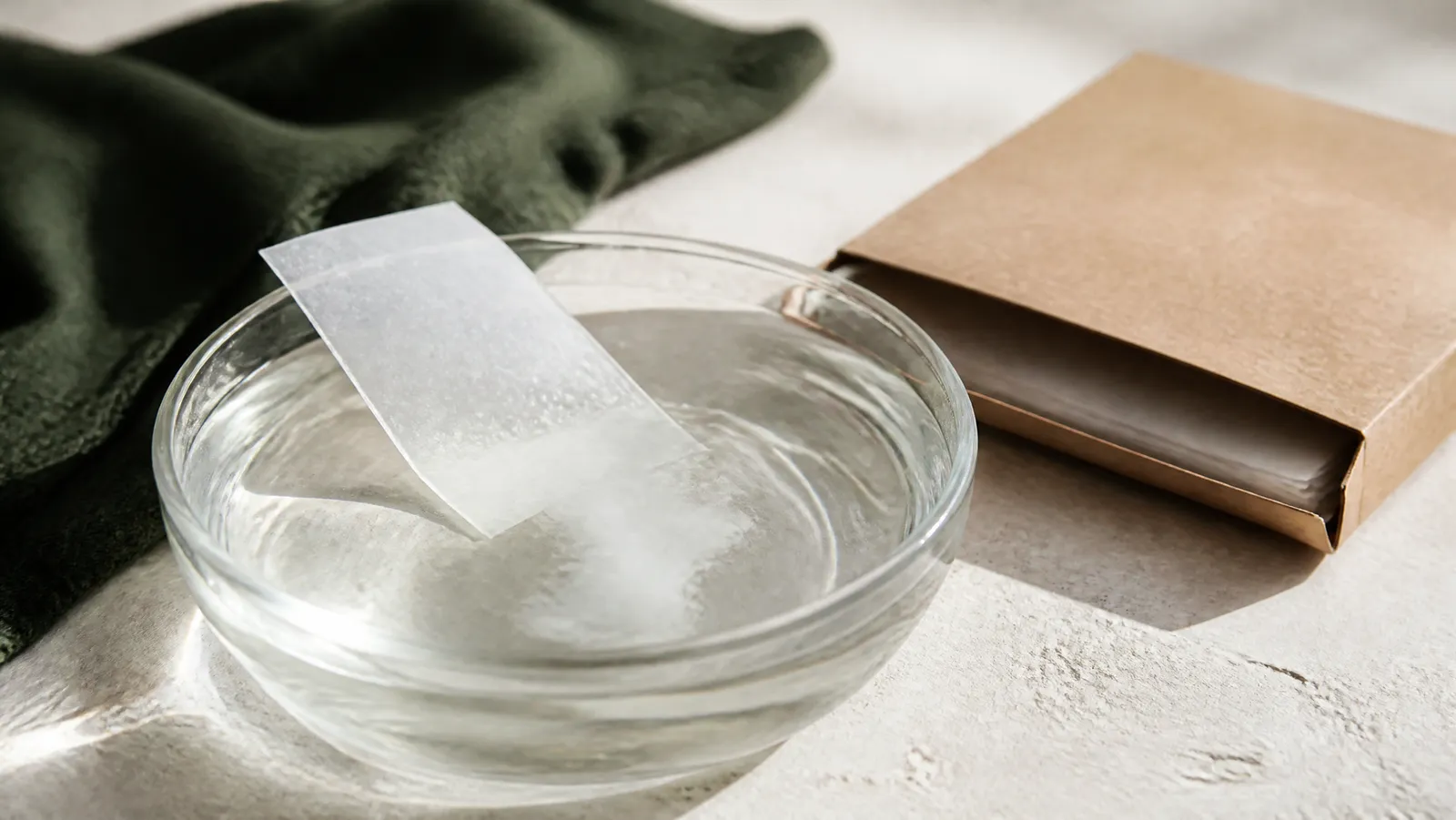
Mostly — but not in the way the box implies. The packaging is genuinely plastic-free: cardboard sleeve, no jug, no scoop, no cap. The sheet itself is usually held together by polyvinyl alcohol, a synthetic polymer, and whether that polymer truly biodegrades after it washes down your drain is an open scientific argument that nobody has won yet.
That is the whole article, and we are not going to tidy it up for you. Detergent sheets are the most-recommended single swap in a plastic-free laundry routine, and they have earned some of that reputation. But the question at the center of the category — does the sheet leave invisible plastic behind after it removes the visible plastic — is genuinely contested, the two sides have different funders, and most coverage picks a team and stops reading. We went through the studies, the EPA docket and the actual bill text, and here is what is established, what is disputed, and what a reasonable person can do in the meantime.
What Is Actually In a Laundry Detergent Sheet
A detergent sheet is dehydrated laundry detergent pressed into a thin, papery rectangle. Take a normal bottle of liquid detergent, remove the water — which is most of the bottle by weight — and you are left with surfactants, enzymes, builders and fragrance. Those ingredients are powders and pastes. Something has to hold them in a sheet shape until they hit the drum.
That something is almost always polyvinyl alcohol, written on labels as PVA or PVOH. It is the same water-soluble film that wraps a laundry pod. In a pod it is the wrapper; in a sheet it is the matrix the whole thing is built on.
So when you ask "are laundry detergent sheets plastic-free," you have to separate two claims that get blurred constantly:
- The container. Real win, no asterisk. Sheets ship in a cardboard sleeve or envelope. No HDPE jug, no plastic scoop, no shrink wrap. This part is not marketing.
- The shipping weight. Also real. Water is heavy; removing it means far less freight per load of laundry, which is the strongest environmental argument the format has.
- The sheet. This is where the argument lives. The binder is a synthetic polymer made from fossil feedstocks, and it goes into the wastewater system every single wash.
Nobody serious disputes the first two. Everything below is about the third.
Laundry Detergent Sheets and PVA: Dissolving Is Not Biodegrading
Here is the distinction that the entire debate rests on, and it takes ten seconds to understand.
Dissolving means the polymer disperses into water. The solid stops being a solid. It is still there — it is just now spread through the water at a scale you cannot see, the way sugar is still there after you stir it into tea.
Biodegrading means microbes actually eat the polymer and break its chain into carbon dioxide, water and biomass. The material stops existing as a polymer.
A detergent sheet unquestionably dissolves. Everyone agrees on that; you can watch it happen. Whether it then biodegrades depends on whether the right microbes, with the right enzymes, get enough time with it. According to Consumer Reports, CR chemist Eric Boring puts it plainly: "Specific enzymes and microorganisms... need to be present. These enzymes/microorganisms may or may not be present in the environment."
There is one more nuance worth holding onto, because it explains why smart people disagree. PVA is not a single substance. Consumer Reports quotes the EPA's own framing: "The range of chemicals described as PVA include a variety of polymeric structures with varying toxicity, biodegradability, and other parameters." Different grades, different molecular weights, different degrees of hydrolysis — different behavior. Two labs can test "PVA" and be testing meaningfully different materials.
The Case Against: What the Blueland-Funded Research Found
The paper everyone cites is a 2021 study in the International Journal of Environmental Research and Public Health, titled "Degradation of Polyvinyl Alcohol in US Wastewater Treatment Plants and Subsequent Nationwide Emission Estimate," authored by Charles Rolsky and Varun Kelkar of Arizona State University. Its headline finding: roughly 77 percent of the PVA from detergent pods and sheets is not degraded in US wastewater treatment, amounting to an estimated 8,100 metric tons, plus or minus 2,400, entering the environment each year.
Two things about it deserve equal billing.
The first is the method. This was not a lab that measured PVA at treatment plant outflows. It combined an online survey of 527 US respondents, US Geological Survey water-use data, and a review of the existing PVA degradation literature into a nationwide emissions estimate. It is a modeling and literature exercise. That is a legitimate way to do this work, and it is also a weaker form of evidence than direct measurement — a distinction that the headlines built on it almost never make.
The second is the funding. According to Grist, the review was commissioned by Blueland, a cleaning-products company that sells PVA-free alternatives and therefore has a direct commercial interest in the finding. The paper itself is upfront about it: its funding statement reads "This research was funded in part by Blueland," and the authors declare that "the funders had no role in the design of the study; collection, analyses, or interpretation of data, writing of the manuscript, or decision to publish the results." Take that declaration for what it is worth — it is standard, and it is not nothing. It also does not make the work independent in the sense readers assume, and any article calling it "a study found" without naming the funder is doing you a disservice.
The argument itself is still worth engaging with, because it is about time. Rolsky's point, as quoted by Grist, is a mismatch in timescales: at most wastewater plants water is retained for at most a week, and "more realistically it's days to hours." If meaningful PVA breakdown takes weeks, the water is long gone before it happens.
The Case For: What the Industry and the EPA Say
The pushback is organized and, on its own terms, substantive.
The American Cleaning Institute — the US trade association for cleaning-product makers, which is to say the companies selling pods and sheets — says the Arizona State work "presents a flawed model and uses flawed data in that model," and points to peer-reviewed laboratory work — chiefly OECD 301 ready-biodegradation tests — indicating that detergent packet film fully biodegrades in 90 days or less.
Here the funding cuts both ways, and it should. According to Grist, the research finding that PVA reaches 60 percent degradation in 28 days and 90 percent in 60 days was sponsored by cleaning-product industry groups. So the two poles of this debate are a study paid for by a company that sells PVA-free products and a body of work paid for by companies that sell PVA. Neither is disqualifying. Both are relevant. Notice also that even the industry-friendly numbers describe degradation over weeks, not the hours a treatment plant actually has. The industry's answer to that objection is that the standardised tests understate real-world speed: the EPA's position, quoted below, is that OECD ready-biodegradation conditions are more conservative than what PVA actually meets inside a wastewater plant. Whether you find that convincing is the crux of the whole dispute.
The most consequential third-party voice is the EPA, and it has ruled. In January 2023, Blueland, the Plastic Pollution Coalition and 15 partner organizations filed a petition under Section 21 of the Toxic Substances Control Act asking the agency to compel health and environmental testing of PVA, and separately, under the Administrative Procedure Act, to downgrade PVA's status on the Safer Chemical Ingredients List from a green circle to a gray square until that testing was complete. The EPA denied both requests, in a response signed April 21, 2023 and published in the Federal Register on April 27, 2023. Its stated conclusion: "The weight of evidence for environmental toxicity and fate demonstrates that PVA meets the Safer Choice Criteria for Colorants, Polymers, Preservatives, and Related Chemicals." The agency also argued that standard ready-biodegradation tests are "more conservative than real world conditions in WWTPs" — the opposite of the critics' assumption.
That is a real result, and pretending otherwise would be dishonest. It is also not the same as a study proving PVA disappears in a municipal plant. It is a regulator concluding the petitioners had not made their case for mandatory testing.
Where the Law Actually Stands Right Now
This is the part that gets reported wrong constantly, so we pulled the record.
In February 2024, New York City Council Member James Gennaro introduced Int 0035-2024, the so-called "Pods Are Plastic" bill, which would have made it unlawful to sell laundry or dishwasher pods and sheets containing polyvinyl alcohol in the city, with penalties running from 400 to 1,200 dollars. It was referred to the Committee on Environmental Protection, Resiliency and Waterfronts on the day it was introduced.
It never got a vote. According to the New York City Council's own legislative record, Int 0035-2024 was filed at the end of session on December 31, 2025 — the procedural end of the line for a bill that did not advance. We found no reintroduced 2026 version on the sponsor's current legislation list.
So, to be exact about it, as of August 2026:
- No US federal restriction on PVA in detergents exists. The EPA petition was denied and PVA remains on the Safer Chemical Ingredients List.
- No New York City ban is in force. The proposed ban died in committee.
- We could not verify any New York State bill on PVA in detergents. Searching the state legislature's records surfaced bills on detergent-pod child safety and on 1,4-dioxane in cleaning products, but nothing we could confirm targeting PVA. If you have seen this reported as pending state law, treat it with suspicion.
Anyone telling you PVA sheets are "being banned" is describing a bill that already failed.
Which Brands Use PVA, and What PVA Free Laundry Detergent Looks Like
We will only say what a company says about itself, because formulations change and guessing here is how misinformation starts.
Tru Earth discloses polyvinyl alcohol in its Eco-Strips ingredient listing, identified by CAS number 25213-24-5 and described as a structuring agent, consistently across its fragrance-free and scented variants. Earth Breeze likewise lists polyvinyl alcohol on its ingredients page, describing its job as holding the cleaning ingredients together until the sheet dissolves in water. Neither company is hiding it; both publish it.
On the other side, Blueland builds its whole brand on PVA-free cleaning products — Grist describes it plainly as a company that manufactures PVA-free alternatives, which is also why its funding of the Arizona State work matters.
Beyond those three, check the label yourself. If a sheet brand does not publish a full ingredient list, that absence is your answer for now. And be alert to the specific weasel phrasing this category has developed: "plastic-free packaging" is a claim about the box, not the sheet, and it is true even when the sheet contains PVA.
Do Laundry Detergent Sheets Work? What the Testing Shows
Set the chemistry aside for a moment, because there is a second problem that a typical laundry sheets review skips: cleaning.
According to Consumer Reports, detergent sheets as a group did not perform as well as liquids and pods in its lab tests, and CR does not recommend the category. Its testers wash fabric swatches soiled with blood, body oil, chocolate, coffee, dirt, grass and salad dressing, then measure how much stain is left — and sheets, along with powders, landed at the bottom among the "gentle" detergents CR evaluated. CR's own summary is blunter than ours: "Detergent sheets generally don't clean well, so we don't recommend them."
It is not a blanket write-off. Consumer Reports' 2026 ratings still identify the strongest performers within the sheet-and-tile group — Tide Evo Free and Gentle fiber tiles and Arm and Hammer Power Sheets — but is clear about the ceiling: sheets, it says, "score lower than the lowest-scoring liquids and pods in our tests," and even the category-topping Tide Evo "cleans more like an adequate powder than a higher-performing liquid or pod," according to CR's Rich Handel, who oversees its detergent testing.
Our read: sheets are likely fine for lightly soiled everyday loads and a poor choice for the load with the grass stains and the gym kit in it. If you are compensating by running hotter cycles or rewashing, the environmental math you switched for starts eroding.
What We Would Do While This Is Unresolved
There is no honest way to resolve this for you, so here is how we are actually handling it in our own homes.
- If you want out of the argument entirely, use powder in a cardboard canister. No film, no binder, no jug, no polymer question — just detergent in a box. It is the cleanest way to sidestep PVA, and several of the best eco-friendly laundry detergents we tested come in exactly this format.
- If you already own sheets, use them up. Throwing away a working product to avoid a contested harm is a guaranteed waste in exchange for a hypothetical saving.
- If you love the format, keep it — knowingly. The jug you did not buy is certain. The PVA harm is unproven in both directions. That is a defensible trade to make on purpose; it is not a trade to make because a box told you it was plastic-free.
- Buy a concentrate, not water. Whatever format you land on, the shipping-weight argument holds. It is the least disputed environmental benefit in this whole category.
- Wash cold, wash full, wash less. Energy use and garment lifespan swamp the packaging question by a wide margin. This is the boring answer and it is still the biggest lever you have.
Our own roundup of the best laundry detergent sheets carries this same caveat on its front page rather than buried at the bottom. A category-wide open question belongs in the introduction, not the footnotes.
Our Verdict: An Honest, Unfinished Answer
Are laundry detergent sheets plastic-free? Their packaging is. Their formula, in most cases, is not — and the case that this matters is unproven, as is the case that it does not.
What is established: the sheet contains a synthetic polymer, it dissolves rather than vanishing, and dissolving is not biodegrading. What is disputed: how much of it actually breaks down within the days a wastewater plant has, and whether the remainder does any harm. Who is disputing it: a company selling PVA-free products on one side, an industry trade association and its member companies on the other, with the EPA having declined to force the testing that would settle it.
We think the reader who finishes this article knowing precisely that is better served than one handed a verdict. Sheets are not a scam. They are a real packaging win wrapped around an unresolved chemistry question, sold with a confidence that the evidence does not currently support. Buy them for the jug you skip, not for a plastic-free claim that only covers the cardboard.
And if you are auditing the whole room rather than one product, our full guide to eco-friendly laundry works through every swap in the routine — including the several that are settled science, which after all this may be a relief.
How we score
What it’s made of.
Chemistry you’ll touch.
How long it lasts.
Where it goes after.
Each pick scores 0–5 on the four axes above, weighted into the composite verdict at the top. Scores are derived from what a product is verifiably made of and certified as — not how green its label looks.
About the author
Ruth Lopez
I'm Ruth Lopez and I'm a lover of nature and the environment. I'm very passionate about finding eco friendly products that don't damage the environment and also support companies that have the same philosophy.