The Zero Waste Bathroom and Every Plastic-Free Swap Worth Making

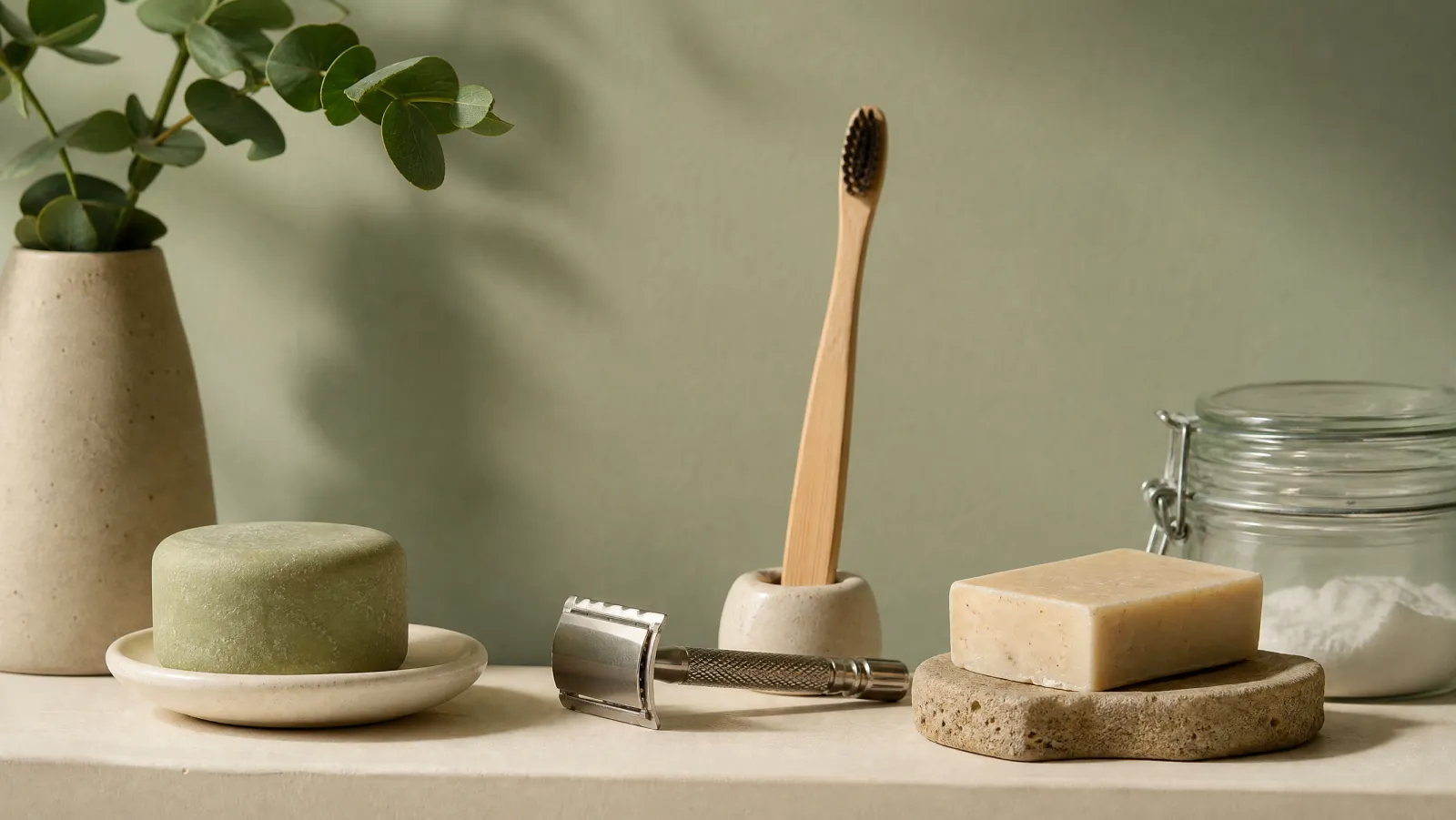
A zero waste bathroom is one where the disposable products you buy on repeat, from plastic shampoo bottles to cartridge razors and tube toothpaste, have been replaced with durable or refillable versions that last for years. You do not build one overnight. You swap items as they run out, one at a time.
That last point matters more than any product recommendation. The fastest way to fail at this is to bin a cabinet full of half-used bottles and buy replacements in a weekend. That is not lower waste — it is just faster waste. The bathroom is the easiest room in the house to green precisely because it runs on habit: you already reach for the same shampoo, the same razor, the same roll of paper. Change what your hand lands on, and the rest follows.
How to Think About the Bathroom
Look at your bathroom as a room of small disposables. Almost everything in it is designed to be used up and thrown out: the bottle, the cartridge, the tube, the wrapper, the roll. Each of those disposables has a durable or refillable counterpart — a bar instead of a bottle, a metal handle instead of a plastic one, a tablet instead of a tube.
The trick is to treat this like a queue, not a purge. When the shampoo runs low, the next purchase is a bar. When the razor gets dull, the replacement is a safety razor. This is the same reasoning behind switching to a reusable bottle over single-use plastic: the win is not one heroic purchase, it is removing a repeat purchase from your life for good.
A few honest caveats before you start. Not every swap is cheaper on day one — some cost more up front and pay back over months. A couple take genuine adjusting, and one or two are not worth it for everyone. We will flag those as we go. The goal here is a working bathroom you actually like using, not a photogenic shelf of jars.
Below is the full map: ten categories, what each swap replaces, what it costs you, and whether we think it earns its place. Where we have tested products head to head, we point you to the deeper review.
Shampoo and Conditioner Bars
Solid shampoo is the swap most people meet first, and for good reason: a bar removes a plastic bottle from your shower entirely. According to The Earthling Co., which points to Ethique's lifecycle analysis, a single shampoo bar replaces roughly three 12-ounce bottles of liquid shampoo. Multiply that across a household and a year, and the bottle count adds up fast.
Bars have come a long way. Early formulas were essentially soap and left a lot of hair feeling stripped or waxy; the better modern bars use gentler surfactants and behave much more like the liquid you are used to. In our testing, the difference between a mediocre bar and a good one is enormous, which is why format alone is not the whole story.
The honest trade-offs:
- There is a transition. Hair can feel different for the first week or two as it adjusts, especially if you are coming off silicone-heavy products.
- Hard water fights you. In hard-water areas, some bars leave a film; a diluted apple-cider-vinegar rinse usually fixes it.
- Conditioner bars are hit or miss. They work well for fine hair and can underdeliver on thick or curly hair, where a rinse-out liquid still has an edge.
Store the bar somewhere it can dry between uses — a draining dish, not a puddle — and it will outlast its bottled equivalent. When you are ready to choose one, our roundup of the best shampoo bars we tested breaks down lather, longevity, and which hair types each suits.
Safety Razors for a Plastic-Free Shave
The disposable razor is one of the purest examples of the throwaway bathroom. According to the U.S. Environmental Protection Agency, roughly 2 billion disposable razors are thrown out in the United States each year — a figure that dates to a 1990 study and, as EcoWatch notes, has not been updated since, so the real number today is likely higher. Cartridge heads are worse than fully disposable ones in one respect: they fuse metal and multiple plastics, which makes them effectively unrecyclable.
A safety razor replaces all of that with one metal handle you keep for years and a thin steel blade you can recycle. The economics are the reason it converts skeptics. According to Fendrihan, a shaving retailer, double-edge blades cost around 10 cents each — roughly 10 dollars for a pack of 100 — versus 2 to 5 dollars for a single cartridge. According to Tiny Earth Impact's cost breakdown, a safety-razor setup runs about 24 cents per shave against 67 cents for a cartridge system, which works out to roughly 500 dollars less over five years.
It is not a zero-effort swap. A safety razor takes a lighter, slower hand than a pivoting cartridge, and there is a short learning curve while you find the right angle and pressure. Once it clicks, most people find the shave closer, not worse. Buy a modest blade sampler first — blade preference is intensely personal, and a 10-dollar variety pack saves you from committing to 100 of the wrong ones. We compare weights, balance, and beginner-friendliness in our guide to the best safety razors for a plastic-free shave.
Bamboo Toothbrushes
Plastic toothbrushes are small, so it is easy to forget how many of them there are. According to One Green Planet, Americans throw out around 1 billion plastic toothbrushes a year — about 50 million pounds of waste — and each one can take hundreds of years to break down. Because the handle blends resins, rubber, and sometimes metal, almost none of them are recyclable.
A bamboo toothbrush swaps the fossil-fuel handle for a fast-growing grass that composts. It is the lowest-stakes swap on this list: it costs about the same as a decent plastic brush, cleans exactly as well, and you already replace your brush every few months anyway, so there is no waste in switching now.
Two things to be honest about:
- The bristles are usually still nylon. Truly compostable bristles exist but are rare and stiff; most bamboo brushes ask you to snap or pull the bristles out before composting the handle. Treat "compostable handle" as the claim, not "the whole brush disappears."
- Bamboo needs to dry. Left sitting in water, the handle can darken or grow soft at the base. A brush stand and a shake after use solve it.
Otherwise, this is as close to a free swap as the bathroom offers. If you want specifics on bristle firmness, handle finish, and which brands actually let you compost the handle, see our picks for the best bamboo toothbrushes.
Toothpaste Tablets and Tabs
Toothpaste tubes are a recycling dead end. They combine thin layers of different plastics — often with a sliver of aluminum — which most curbside programs will not accept, so the tube generally goes to landfill even in diligent households. Tablets and tabs sidestep the tube entirely: you get a small chewable that you bite and brush, sold in a glass jar, tin, or refillable pouch.
In our testing, the experience is genuinely different rather than simply worse. You crunch the tablet first, then wet the brush; the paste forms as you go. Foam is lighter than a conventional gel, which throws some people at first and delights others who never liked the mouthful of foam to begin with. Fluoride versions exist alongside fluoride-free ones, so you are not forced to give up cavity protection to lose the tube.
Where we stay measured is on cost and convenience. Per brush, tablets often run a little more than tube paste, and they are less travel-flexible in humid climates unless the jar seals well. They are also a harder sell for kids used to sweet gel. None of that is disqualifying — it just means this is a swap you choose on preference as much as on waste.
One practical upside worth naming: tablets travel well. A tin of tabs sails through airport security with no liquid limits and no risk of a tube bursting in a bag, which quietly makes this the swap frequent flyers keep even when they are lukewarm on the rest. Refill pouches also stack far smaller in the cabinet than a row of boxed tubes.
If you are on the fence, that is reasonable. We dug into whether toothpaste tablets are worth it — comparing taste, foam, fluoride options, and real per-use cost — so you can decide before buying a jar you might not finish.
Bidet Attachments
A bidet is the swap with the biggest footprint payoff relative to how little you interact with it. The waste it targets is toilet paper, and the numbers there are large. According to Scientific American, Americans use roughly 36.5 billion rolls of toilet paper a year — the equivalent of about 15 million trees — plus the water and bleach it takes to manufacture them.
A simple bidet attachment clamps onto your existing toilet under the seat, taps into the water line, and needs no electricity. It does not eliminate paper — you still use a little to dry — but it slashes how much you reach for. According to a bidet buyer's guide from Horow, households that add one typically cut toilet-paper use by around 75 percent.
The trade-offs are real but small:
- Installation. Fifteen minutes with an adjustable wrench for most attachments; a shut-off valve and a little patience are all it takes.
- Cold water. Basic models run off the cold line, which is bracing at first. Warm-water and heated-seat models exist but cost more and need power.
- Up-front cost. A good non-electric attachment is inexpensive and pays for itself in paper over months, not years.
If you rent, an attachment is landlord-friendly because it reverses cleanly. We rank spray control, build quality, and easiest installs in our guide to the best bidet attachments.
Tree-Free Toilet Paper
Even with a bidet, most people keep some paper on hand, so the paper itself is worth getting right. The problem with conventional rolls is the source. According to the Natural Resources Defense Council, more than a million acres of Canada's boreal forest are clear-cut every year, in part to make toilet paper, and virgin tree fiber carries a heavier climate cost than the alternatives.
There are two tree-free routes, and they are not equal. Bamboo toilet paper uses a fast-growing grass instead of slow-growing trees; recycled toilet paper uses paper that already exists. According to the NRDC, recycled tissue has roughly one-third the carbon footprint of tissue made from virgin trees and uses about half the water — and the group consistently grades recycled content highest. Bamboo scores better than virgin wood pulp on land use, but it usually ships a long way and, if a plantation replaced natural forest, some of the benefit is lost.
Our plain read: if you want the lowest footprint, post-consumer recycled paper is the safer default. If you find recycled rolls too rough or want a softer feel, quality bamboo is a reasonable compromise and still far better than virgin tree tissue. Look for the recycled percentage on the label — "recycled" with no number can mean very little.
We lay out the full comparison of bamboo versus recycled toilet paper, including softness, ply, and how to read the packaging claims, in the dedicated review.
Making the Switch to Solid Hair Care
Switching to solid hair care fails for the same avoidable reason most often: people expect a bar to behave exactly like their old bottle on day one. It usually does not, and that first week decides whether the swap sticks. So it is worth treating the transition as its own small project.
Here is the approach that worked in our testing:
- Finish the old bottle first. No need to waste it — start the bar when the liquid runs out.
- Wet the bar and your hair thoroughly. Rub the bar between your hands or straight onto your scalp until you feel slip, then work the lather in with your fingers, not the bar.
- Rinse longer than you think. Under-rinsing is the number-one cause of the "waxy" complaint.
- Do a clarifying rinse if hair feels coated. A diluted apple-cider-vinegar rinse once a week during the transition resets buildup, especially in hard water.
- Give it two weeks. Hair and scalp adjust; judging on day two is judging the adjustment, not the bar.
Store the bar dry between uses and it will last for weeks of showers. The payoff is a shower with no plastic bottles, no pump, and nothing to recycle. If you want the step-by-step with photos and troubleshooting, we cover exactly how to switch to a shampoo bar in its own walkthrough.
Plastic-Free Period Care
Period products are a large, hidden source of bathroom plastic. According to a review published in the WHO's bulletin, a person who menstruates may use on the order of 10,000 disposable products in a lifetime, and modern pads are roughly 90 percent plastic — one reason the review notes disposable pads can take 500 years or more to break down, with the large majority ending up in landfill.
The durable alternatives fall into three groups, and which suits you is personal:
- Menstrual cups. A medical-grade silicone cup can last for years, replacing a mountain of tampons. The trade-off is a genuine learning curve for the first couple of cycles.
- Reusable cloth pads. Washable pads that snap around underwear; the adjustment is mostly about laundry routine.
- Period underwear. Absorbent built-in layers; the easiest to adopt, the highest up-front cost.
The honest picture is that all three cost more on day one and less over any reasonable time horizon, and each asks for a short adjustment. We are not going to prescribe a choice — comfort and fit are individual. What we can do is compare capacity, materials, and ease of care so you can pick with eyes open. Our overview of plastic-free period care walks through each option and who it fits.
Building Your Bathroom on a Budget
The worry that a zero waste bathroom is expensive is understandable and mostly wrong — but only if you sequence it well. Some swaps save money almost immediately; others cost more per use. Do the money-savers first and the rest becomes easy to fund.
Order your swaps by payback, not by enthusiasm:
- Start with the razor. It has the fastest and largest return. As noted above, Tiny Earth Impact estimates a safety-razor setup can run roughly 500 dollars less than cartridges over five years, so this one pays for the others.
- Add a bidet next. An inexpensive attachment pays for itself in reduced toilet paper within months.
- Swap consumables as they run out. Bamboo brushes and recycled paper cost about the same as what they replace, so there is no premium — just switch at reorder time.
- Save the pricier durables for last. Period cups, period underwear, and premium bars cost more up front; fund them with what the razor and bidet save you.
A budget bathroom does not mean buying the cheapest version of everything. It means letting the swaps with strong economics carry the ones that are about waste more than money. We put real numbers to each stage in our guide to how to build a zero waste bathroom on a budget.
Cleaning the Bathroom Without Plastic Bottles
The last cluster of bathroom plastic hides under the sink: spray bottles, toilet cleaner, and the roll of paper towels on the counter. Each is a repeat plastic purchase, and each has a durable answer.
Refillable cleaning is the core move. Instead of buying a new plastic bottle of cleaner every few weeks, you keep one sturdy bottle and refill it — from a concentrate you dilute, or from a tablet you drop into water. The bottle stays; only a tiny tablet or a small refill enters the house. It is the same refill-not-rebuy logic behind swapping paper towels for washable dishcloths, which handles most bathroom wipe-downs without a single sheet of paper.
For the actual wiping, reusable cloths do nearly everything paper towels do. Keep a small stack, use them, wash them, repeat. A couple of microfiber or cotton cloths outlast dozens of rolls. For scrubbing, a wooden brush with a replaceable head or a bristle brush avoids the all-plastic scrubber that gets tossed in weeks.
A word on the products themselves: "natural" cleaner branding is not the point here, and some of it is greenwashing. The waste win comes from the format — a bottle you refill instead of rebuy — not from the label. A plain concentrate in a bottle you keep beats a beautifully branded single-use bottle every time, and it usually costs less per spray once you stop paying to ship water.
You do not need a shelf of specialty products. A refillable all-purpose spray, a bathroom cloth or two, and a decent brush cover most bathroom cleaning, and none of them become landfill after one use. When you are ready for specifics, our guide to zero waste bathroom cleaning covers refill systems, cloth types, and which brushes actually last.
The Bottom Line
A zero waste bathroom is not a single purchase or a personality — it is a queue of small, sensible swaps you make as things run out. Start with the two that pay you back fastest, the safety razor and the bidet, and let the savings fund the rest. Swap consumables like brushes and paper at reorder time, when there is no premium to pay. Save the pricier durables for last. Do that, and within a year the room quietly runs on things that last, with almost nothing left to throw away. The principle is the same one that runs through every swap on this list: remove the repeat purchase, and you remove the waste with it.
Explore the full series
- The Best Shampoo Bars We Tested for Every Hair Type — Five bars we tested, matched to fine, oily, normal and volume-seeking hair.
- The Best Safety Razors for a Plastic-Free Shave — Five double-edge razors from budget to heirloom, for a plastic-free shave.
- The Best Bamboo Toothbrushes for a Plastic-Free Brush — Four bamboo packs and one bioplastic alternative, kids included.
- Do Toothpaste Tablets Actually Work and Are They Worth It — Foam, fluoride and real per-brush cost, measured against the tube.
- The Best Bidet Attachments to Cut Your Toilet Paper Use — Five non-electric routes to less paper, from a $19 sprayer to a full seat.
- Bamboo vs Recycled Toilet Paper and Which Is Greener — Which tree-free route actually wins on footprint, and how to read the label.
- How to Switch to a Shampoo Bar Without the Mess — The wash technique, the hard-water fix and what week one really feels like.
- Zero Waste Period Care and How Cups Discs and Underwear Compare — Four reusable formats compared on capacity, care and learning curve.
- How to Build a Zero Waste Bathroom on a Budget — The payback-ranked order to green the room without overspending.
- Zero Waste Bathroom Cleaning Without the Plastic Bottles — One bottle you keep, tablets that refill it, and two brushes that outlast plastic.
How we score
What it’s made of.
Chemistry you’ll touch.
How long it lasts.
Where it goes after.
Each pick scores 0–5 on the four axes above, weighted into the composite verdict at the top. Scores are derived from what a product is verifiably made of and certified as — not how green its label looks.
About the author
Ruth Lopez
I'm Ruth Lopez and I'm a lover of nature and the environment. I'm very passionate about finding eco friendly products that don't damage the environment and also support companies that have the same philosophy.