Indoor Worm Bins and What Vermicomposting Actually Takes

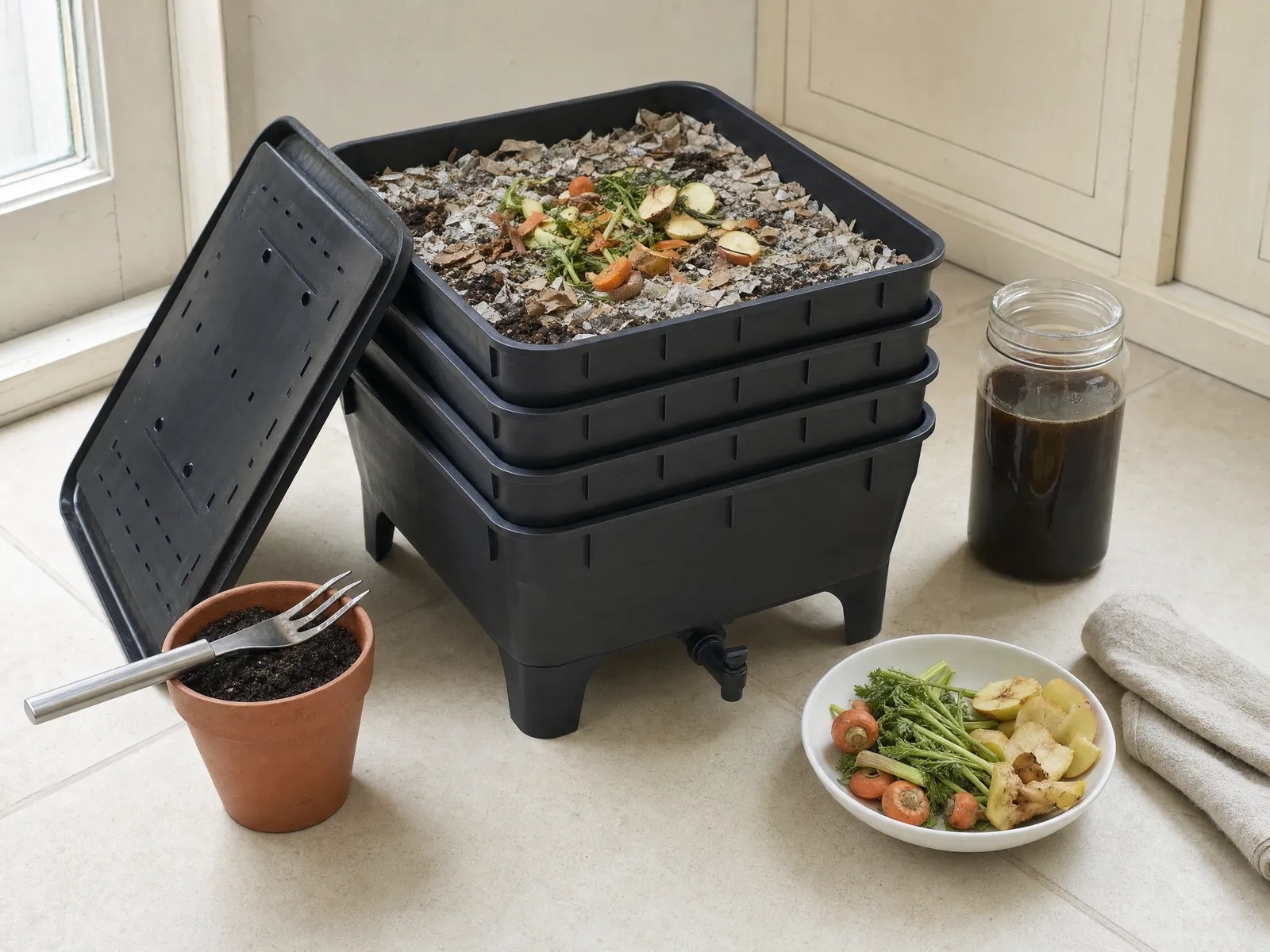
A worm bin is livestock. Every other method in this series is equipment; this one is a few thousand animals in your kitchen that die if you get the temperature, the moisture or the feeding rate wrong. What an indoor worm bin actually takes is about a thousand red wigglers, a stable indoor temperature of 59 to 77 degrees Fahrenheit, and the worms bought separately - because none of the four bins on this page include them. We earn a commission if you buy through our links, which costs you nothing.
The bin is the cheap part. The animal is the commitment, and the commonest way to kill a bin is kindness: feeding it more than its population can eat. This is the last instalment of our series on kitchen composting. We have not run these bins on a bench; we have read the extension literature and held the listings up against it.
The species is not the worm in your garden
Vermicomposting is species-specific in a way composting is not. Rhonda Sherman, extension solid waste specialist in horticultural science at NC State Extension, writes in Worms Can Recycle Your Garbage (AG-473-18, 29 March 2017) that of 9,000-plus earthworm species "only 7 species have been identified as suitable for vermicomposting", and that "only one species of earthworm is used for vermicomposting by most people worldwide: Eisenia fetida (common name: red wiggler)."
The worm in your flowerbed will not do the job, because of where it lives. The UF/IFAS Extension factsheet Vermicomposting 101, published through its Leon County office in Florida, explains that the recommended species "are epigeic, meaning they live on the soil surface and feed on leaf litter and other decomposing organic matter." A tray bin is a stack of shallow litter layers; a deep burrower has nothing to do in one. Sherman rules out digging your own with a question: "how could you tell what species is Eisenia fetida?"
Here is the fact that governs this page: the animals are a separate purchase, and not one of the four bins includes them. Sherman's minimum is "at least one pound (about 1,000) of red wigglers to one square foot of surface area of the worm bin". One listing says both things at once: Blutezeit's title promises a "Worm Farm with Compost Worms Starter Kit", while its final bullet ends "Worms NOT included." Both strings sit on the same page; we quote them and leave it there.
Temperature is the constraint that kills indoor worm bins
Sherman gives the range in both units: "the temperature inside the bin should be maintained between 59° and 77°F (15° to 25°C)", with published survival limits of 32 to 95 degrees Fahrenheit, 0 to 35 Celsius. The US Environmental Protection Agency gives the same pair: "You want to maintain a bin temperature of 59° to 77° F; however, the worms can survive at 32° to 95° F if they have at least four inches of bedding." Sherman's current NC State household page, updated 5 June 2025, gives the band as "between 55 and 85 degrees Fahrenheit, with around 70 degrees being ideal", and names the mechanism: outside those limits "the worms will decrease the amount they eat and breed."
Eighteen Fahrenheit degrees of comfort is a heated interior, not a balcony, a garage or an unheated porch. A January night in most of the country is below the survival floor; an August garage is above the ceiling. We said the same about every indoor method in composting without a yard, and where the EPA puts the bin: "under a sink, in a closet or basement".
Feeding rate is where beginners fail, and the arithmetic is short
The rule is a fraction of the animals' own body weight. The EPA: "Worms eat about 25 percent of their weight each day." Sherman's current page converts it: "one pound of earthworms may theoretically consume 1/4 pound of food per day."
Run the 1,200-worm listing through it. At the figure both sources use, "approximately 1,000 Eisenia fetida earthworms per pound", 1,200 worms weigh about 1.2 pounds, so about 0.3 pounds of food a day. Sherman's weekly version agrees: "One pound of red wigglers will eat up to two pounds of food scraps a week." So the starter population most readers buy handles roughly two to two and a half pounds of scraps a week - a small mixing bowl of peelings every two or three days - and that is the ceiling, not the target.
Overfeeding is not a subtle failure. Sherman: "If you add more food than the earthworms can consume, it will start to rot and become smelly." Her troubleshooting table names "Overfeeding" as the first cause of a bin that smells bad and "Too much food" as a cause of one that attracts flies - the same pair of symptoms we diagnose in smells and fruit flies. Neither source gives a schedule. The EPA gives a test: "Always ensure the food scraps have been eaten before adding more."
Three extension sources give three feeding rates, and the spread is twofold
- EPA and NC State, the conservative figure. About 25 percent of body weight a day, roughly two pounds a week per pound of worms.
- UF/IFAS, in the middle. "1 lb. of worms can eat roughly 1/3 lb. of food/day once established", about 2.3 pounds a week.
- WSU Whatcom, the high figure. Washington State University Extension's Whatcom County Master Composter programme, in Worm Composting Basics (last updated January 2018), says 250 worms, a quarter of a pound, "can compost roughly 1 lb. of food scraps per week" - four pounds a week per pound of worms.
All three can be true of the same bin. NC State's business-facing page, updated 11 February 2025, gives the range as "about 25 - 35% of their body weight per day", depending on temperature, moisture, humidity, pH, salinity and ammonia in the feedstock. Plan on the low figure. The high one describes a mature, warm, well-run bin, and a bin in its first month is none of those.
Moisture and bedding, which are most of the bin and nearly free
Bedding is the bulk of a worm bin, it is also food, and it is free. Sherman's list is "shredded paper ... decaying leaves, or coconut pith fiber (coir)", filling the bin "about halfway" and topped up every couple of months because the worms eat it.
The moisture standard is the wrung-out sponge, literally: soak bedding "for 5 to 10 minutes in a bucket of water and then wring it out so it is a little wetter than a moist sponge", aiming for "very damp, but not soaking wet". Washington State's Whatcom sheet is blunter: "Bedding should be damp but not dripping. Too much moisture will drown your worms and smell." Two instructions people break - Sherman's "Never pour water into your worm bin!", and her warning not to stir it, because a bin "does not need to be aerated like a compost pile".
So the running cost of a worm bin is shredded junk mail and cardboard: nothing. Blutezeit's "Coco-coir Brick for bedding" is a convenience, not a requirement.
The refusal list is nearly the aerobic list, which is why bokashi exists
Sherman: "Never add meat scraps or bones, fish, greasy or oily food, onions, garlic, fat, tobacco, citrus, salty foods, or pet or human manure." UF/IFAS gives the chemistry rather than the rule: citrus fruits "contain citric acid and limonene, which can be toxic to worms", and alliums "contain sulfur compounds that can be harmful to worms". The full list is in what you can and cannot compost from a kitchen.
That is almost exactly what an aerobic bin refuses, so if your household cooks, worms will not solve the part of your waste stream that bothers you most. Which is the argument for bokashi, the one home method that takes cooked food, meat and dairy, at the cost of a pre-compost you have to bury. Sherman's own answer to the overflow is a second system: "It's a good idea to have a backyard composting bin in addition to your worm bin, because you can put excess food scraps in it, along with citrus, onions, and garlic." That second system is an ordinary aerobic one, and the smallest version of it that works is in how to start composting kitchen scraps.
The real maintenance rhythm, holidays included
- Feeding. Every few days to weekly, on evidence rather than on a calendar, in layers Sherman says "should not exceed 1-inch high", each covered with "1 to 2 inches of bedding to prevent fruit flies from finding the food". Between feeds the scraps have to wait somewhere, which means the freezer or a countertop caddy.
- Moisture and bedding. Check by squeezing; mist, never pour. Top up bedding every couple of months, because the worms eat it.
- Harvesting. Sherman: "In about four months, it will be time to harvest the vermicompost." The EPA says three to six months. UF/IFAS, working a three-bin stack, says castings reach the top "typically 2-3 months", then the worms need a few weeks to migrate up into fresh bedding.
- A fortnight away. More forgiving than expected, and we checked rather than assumed. Sherman: "the earthworms can be fed as seldom as every two to three weeks", and before a two-week trip you "apply 1/2-inch layer of food scraps and cover it with two inches of moistened, shredded paper."
A two-week holiday is a non-event. Two weeks of August in a garage is not.
What you harvest, and what the evidence for worm castings shows
Sherman defines the solid output precisely: vermicompost is "soil-like material containing a mixture of earthworm castings (feces) and partially decomposed bedding and food scraps", so castings is loose shorthand. The EPA notes it "doesn't need to cure and can be used immediately".
Now the sober part. The best quantitative summary we found is a meta-analysis by Manuel Blouin and five co-authors, "Vermicompost significantly affects plant growth. A meta-analysis", in Agronomy for Sustainable Development in 2019: "We found that vermicompost brought about average increases of 26% in commercial yield, 13% in total biomass, 78% in shoot biomass, and 57% in root biomass." Two caveats in the abstract matter more. The effect "reached a maximum when vermicompost represented 30 to 50% of the soil volume" - a potting-mix rate, and far more material than a kitchen bin makes in a year. And the authors flag the literature's own distortion: their results "are discussed through an analysis of potential publication biases showing an over-representation of studies with a high effect size."
The extension services hedge it too. NC State's household page says vermicompost "may also help plants grow bigger, increase crop yields, and decrease plant diseases and pest attacks", and the archived version of that page carried the same "may" in 2019. An unattributed vermiculture question-and-answer handout hosted by University of California Agriculture and Natural Resources drops the hedge, claiming vermicompost "also helps plants grow bigger, increases crop yields, and decreases plant diseases and pest attacks". We would keep the hedge. Vermicompost is a real soil amendment with a measured effect, and most of that effect comes from pot trials at rates a kitchen bin cannot supply. Treat a few litres of castings a year as good compost, not as a growth drug.
The drained liquid is the other output, and a maker and an extension service use the same words differently. FCMP Outdoor: "The liquid collected in the reservoir base is known as Worm Tea. Mix 1 part tea with 1 part water to create an excellent fertilizer for plants." Sherman reserves "vermicompost tea" for a brew made on purpose from the finished solid, and in her troubleshooting table "Liquid collecting in bottom" is a problem, cause "Poor ventilation; over-watering". It is a drainage symptom in the extension literature, a feature in the marketing.
One responsibility note about releasing composting worms
Composting worms are imports, and two good sources read the risk differently. UF/IFAS states: "Although Eisenia fetida originate from Europe, they do not pose a threat to forest ecosystems in the U.S. because they cannot survive exposure to freezing temperatures." The Minnesota Department of Natural Resources goes the other way: "Never release any worm into the environment - all earthworms are non-native to Minnesota." Minnesota also names the bin as a pathway: earthworms bought for composting "may be contaminated with jumping worms", and buyers should "Check your order to ensure it doesn't have jumping worms in it." Those worms, Amynthas and Metaphire species, "were listed as prohibited invasive species" in Minnesota beginning 1 July 2024.
Both can hold at once: a worm that cannot overwinter outdoors is a low risk where it cannot, and a box of live annelids shipped across state lines is still a vector for something that can. The Elisabeth C. Miller Library at the University of Washington Botanic Gardens "did not find any documentation to suggest that red wiggler worms are a problem in the Pacific Northwest" and still landed on the rule we would follow: "never dispose of the contents of a worm bin in a wooded area", and "it's prudent not to release your vermicomposting worms into the wild anywhere."
That is our position, and it costs nothing: keep the animals in the bin, put the castings in soil you cultivate, and do not tip a tray out in the woods.
What a working setup costs, and the tote that costs almost nothing
FCMP Outdoor is the only listing that explains how its own product works - "52 angled MIGRATION TUNNELS" between trays, "AERATION SUPPORT POINTS molded into the side of the trays" - and the only one volunteering the bad news, in capitals: "Worms are NOT included with the unit". The Worm Factory 360, the bin most guides reference, did not come back in our product data, so we name it unpriced. Prices as of November 2026, animals included.
- Cheapest working setup: the Outsunny four-tray at 50.99 dollars plus 1,200 red wigglers at 38.50 dollars: 89.49 dollars.
- Best documented: the FCMP Outdoor four-tray at 97.99 dollars plus worms, 136.49 dollars.
- In between: Blutezeit's three-tray at 52.99 dollars, the VermiHut Plus five-tray at 82 dollars.
Now the no-purchase version, which NC State describes before any product. Sherman: "you can make your own plastic worm bin by buying a storage bin with a tight-fitting lid", dark coloured "because earthworms are highly sensitive to light", with aeration holes near the lid and "six 1/4-inch holes, equally dispersed, in the bottom" for drainage. Her harvesting instructions then put the trays in their place: "either buy a manufactured stacking bin or make your own by purchasing two identical storage bins and drilling extra holes in the bottoms."
An opaque tote with drilled holes and shredded newsprint for bedding is a working worm bin. The trays buy easier harvesting, not better composting, and we would rather say that than earn the click. The worms are the one thing nobody can improvise.
Who should actually keep an indoor worm bin
Our honest read: a worm bin suits a reader who has plants or a garden to feed, a stable indoor temperature and some appetite for keeping an animal - and it is the wrong first choice for someone who just wants food scraps out of the landfill. We say that on a page carrying affiliate links because it is true. Buy one if all four apply:
- You have somewhere for the output to go. Houseplants, window boxes, a bed, an allotment. With no destination you have only moved the problem four months down the calendar.
- You have a stable indoor spot in the 59 to 77 degrees Fahrenheit band, year round, out of the light.
- Your scraps are mostly peelings, cores, coffee grounds and eggshells. Not plate scrapings, meat or dairy.
- You are willing to keep an animal. Checking moisture, feeding on evidence, noticing trouble before something dies.
If your goal is diversion rather than soil, do not start here. A lidded tub in the freezer and a trip to a drop-off diverts the same scraps, plus the meat, dairy and citrus a worm bin refuses, with nothing to buy.
The bottom line
If you have plants to feed, a stable indoor temperature and the patience for an animal, buy the worms first and the bin second: 1,200 red wigglers at 38.50 dollars as of November 2026 are the only item here you cannot improvise, and the cheapest honest tray to put them in is the Outsunny four-tray at 50.99 dollars. If you want the listing that explains itself, it is the FCMP Outdoor at 97.99 dollars, which says in capitals that the animals are a separate order.
If diversion is all you want, buy nothing. Drill holes in a dark storage tote, shred your junk mail for bedding and spend the money on worms - or skip the livestock and freeze the scraps for a drop-off, which we earn nothing from recommending. Every other decision in the chain, from caddy to destination, is in our guide to composting kitchen waste.
What we tested

The one item on this page that cannot be improvised
- Material
- Stacking Trays & Live Worms
- Credentials
- LivestockIndoor-only
Buy this first and the bin second, whichever bin you end up choosing. It is the only item on this page that no storage tote and no drill can substitute for, and at 38.50 dollars it costs less than every tray bin here.
No major drawbacks noted in testing.
38.50 dollars as of November 2026 for what NaturesGoodGuys lists as "1,200 Live Red Worms / Red Wiggles!", and the single purchase that decides whether any bin on this page works, because none of the four bins here ship with animals. At the stocking figure both the US EPA and NC State Extension use - approximately 1,000 Eisenia fetida per pound - 1,200 worms is roughly 1.2 pounds, a shade over the one pound per square foot of bin surface that Rhonda Sherman calls the minimum "to have a chance of developing a sustainable system". Run that through the EPA's rate, "Worms eat about 25 percent of their weight each day", and this population theoretically handles about 0.3 pounds of scraps a day, or two to two and a half pounds a week. Three costs. It is a live animal arriving by post, with a delivery window and a mortality risk no plastic tray has. The listing's "Treats up 1,200 Sq. Ft." is a garden application claim, not a kitchen throughput figure, and should not be used to size a bin. And once they arrive you are keeping livestock inside Sherman's published survival limits of 32 to 95 degrees Fahrenheit, with the Minnesota Department of Natural Resources asking buyers to "Check your order to ensure it doesn't have jumping worms in it."

The only listing that explains its own mechanism and admits what is missing
- Material
- Stacking Trays & Live Worms
- Credentials
- LivestockIndoor-only
The pick for a reader who wants to understand what they are buying. It is the one listing here whose described mechanism maps onto published extension guidance rather than onto marketing adjectives, and the one that tells you plainly that the animals are a separate order.
No major drawbacks noted in testing.
97.99 dollars as of November 2026 for four trays, and the best-documented product on this page by a wide margin. FCMP Outdoor is the only maker here that names the three variables the extension sheets tell you to manage: "1) The MOISTURE CONTROL WATER RETENTION CHANNEL running around the outside of each tray collects water to prevent the bedding from drying out along the edges. 2) A collection of 52 angled MIGRATION TUNNELS extend down from the base of each tray providing ample opportunity for worms to migrate between trays. 3) AERATION SUPPORT POINTS molded into the side of the trays allow excellent 360-degree airflow." Moisture at the edges, migration for harvesting, airflow for aerobic conditions - that is the whole job. It also puts "Worms are NOT included with the unit" in capitals in its first bullet, which is the most useful sentence any of these listings contains. FCMP states the build is "BPA free, UV-inhibited recycled polypropylene" and "Made in Canada", and claims "Year-Round Indoor Use" on the grounds that vermicomposting "keeps typical composing odor to a minimum". Three costs. It is the dearest bin here, 47 dollars above the Outsunny for the same four trays. Its "Worm Tea - The liquid collected in the reservoir base is known as Worm Tea. Mix 1 part tea with 1 part water to create an excellent fertilizer for plants" names the drained liquid as a product, where NC State's troubleshooting table lists liquid collecting in the bottom as a fault to fix. And the indoor-odour claim is conditional on maintenance, which is the maker restating the EPA's "If your worm bin is properly maintained" without the condition.

The cheapest way in and the only bin that publishes its footprint
- Material
- Stacking Trays & Live Worms
- Credentials
- LivestockIndoor-only
The pick for a reader who has already decided on trays and wants to spend the money on worms instead of plastic. Buy it for the published dimensions, which are the only spec on this page you can check against the cupboard you intend to put it in.
No major drawbacks noted in testing.
50.99 dollars as of November 2026, down from a listed 54.99 dollars, for four trays and a stated 7.4 gallon capacity - the cheapest route to a tray bin on this page. It is also the only listing here that gives external dimensions: "Overall Dimensions: 15.4 inch L x 15.4 inch W x 20.3 inch H. Each Tray Dimensions: 15.4 inch L x 15.4 inch W x 5.1 inch H." That matters twice over. A bin this size has to fit the cupboard or the under-sink space it will live in, and a 15.4-inch square tray works out at about 1.6 square feet of surface, so the one pound of worms per square foot that NC State Extension sets as the minimum stocking rate asks for about 1.6 pounds in a fully stocked working tray - more than the 1,200 worms the listing here supplies. Outsunny says each tray "features a grid design that allows airflow and allows worms to move freely between layers", includes "shovel and scraper", and adds a "bottom spigot and collection tray" for liquid. Three costs. The bullets describe features and never the mechanism, so you are buying on price rather than on documentation. The included tools are accessories, not the thing that makes a bin work. And its own note - "Keep the compost bin well ventilated and in a cool, but protected place" - is vaguer than every temperature figure the extension services publish, so use theirs.

Five trays and the most headroom with the least mechanism in its bullets
- Material
- Stacking Trays & Live Worms
- Credentials
- LivestockIndoor-only
The pick for a larger household, or for anyone who expects the worm population to double and wants the headroom ready. The water-filled base feet are a real answer to a real problem if your kitchen has ants.
No major drawbacks noted in testing.
82 dollars as of November 2026 for five trays, more trays than anything else here, from the tray-bin family most vermicomposting guides assume you already own. VermiHut describes a "Compact, High-Efficiency Footprint Designed to maximize composting capacity while minimizing floor space", a lid "with a built-in V-Board and coconut mat" that "supports airflow and moisture balance", a "Worm Saver Tray" that "Prevents worms and compost material from falling into the liquid collection area while improving airflow throughout the system", and an "Integrated Liquid Collection Base" moulded as one piece. The ant moat is the most practical idea in the bullets, described in the listing's own words as "Protective Base Feet (Shoes) This is special design to adding some water to pevent ants going into the worm bin", typo and all. Three costs. Worms are not included, and the listing does not say so as plainly as FCMP Outdoor does. Its odour claim - "Composting worms consume food scraps quickly, helping reduce odors" - is a restatement of how vermicomposting works, not a feature of this bin. And a fifth tray is only useful if your household actually generates more than the two to two and a half pounds of scraps a week that a starter population can process, which most one and two person households do not.

A title that promises worms and a bullet that takes them away
- Material
- Stacking Trays & Live Worms
- Credentials
- LivestockIndoor-only
The pick for a reader who wants every accessory in one box and a soil meter they will probably use twice. Buy it with your eyes open about the worms, and budget the 38.50 dollars the title implies you do not need to spend.
No major drawbacks noted in testing.
52.99 dollars as of November 2026, down from a listed 55.99 dollars, for three trays and the longest accessory list here. Blutezeit calls it a "Complete Compost Success Kit - Everything you need is included: Turning Fork, Shovel, Soil Meter, Coco-coir Brick for bedding, Non-woven Fabrics, Anti-slip Feet, Collection Cup, and Spigot for harvesting worm tea... Worms NOT included." Read that last clause against the product title, which reads "Blutezeit 3-Tray Worm Composter, 32QT Worm Farm with Compost Worms Starter Kit for Indoor & Outdoor". The title says starter kit with compost worms; the bullet says worms not included. Both strings are on the same listing, and we quote both so the reader can draw their own conclusion. The rest is ordinary: a stated "8Gal (30L) capacity", "optimal ventilation with air holes in each tray", and PP construction. Three costs. The contradiction above, which means the real entry price is 91.49 dollars once the animals are added. Three trays is the least headroom on this page. And the coco-coir brick is a convenience rather than a requirement, since NC State's own bedding list leads with shredded newspaper, which is free.
The top three, compared
| Spec | Buy This FirstNaturesGoodGuys Live Redworms Composting Red Worms - 1,200 Red Wigglers | Best OverallFCMP Outdoor - The Essential Living Composter, 4-Tray Worm Vermicomposter Bin, Black | Best ValueOutsunny 4-Tray Worm Composter Bin 7.4 Gal for Indoor & Outdoor, Black | Farm Starter Kits, Vermicomposting Starter, Garden Composting Bin, Recycling Food Waste |
|---|---|---|---|
| Verdict | Fair | Solid | Solid |
| Composite | 3.3/5 | 3.4/5 | 3.4/5 |
| Materials | 3.0 | 3.0 | 3.0 |
| Health | 3.2 | 3.2 | 3.2 |
| Durability | 3.0 | 3.6 | 3.6 |
| End-of-life | 4.0 | 4.0 | 4.0 |
| Price | — | — | — |
| Get it | Check price | Check price | Check price |
How we score
What it’s made of.
Chemistry you’ll touch.
How long it lasts.
Where it goes after.
Each pick scores 0–5 on the four axes above, weighted into the composite verdict at the top. Scores are derived from what a product is verifiably made of and certified as — not how green its label looks.
About the author
Ruth Lopez
I'm Ruth Lopez and I'm a lover of nature and the environment. I'm very passionate about finding eco friendly products that don't damage the environment and also support companies that have the same philosophy.