Wool Dryer Balls vs Dryer Sheets and Which One Wins

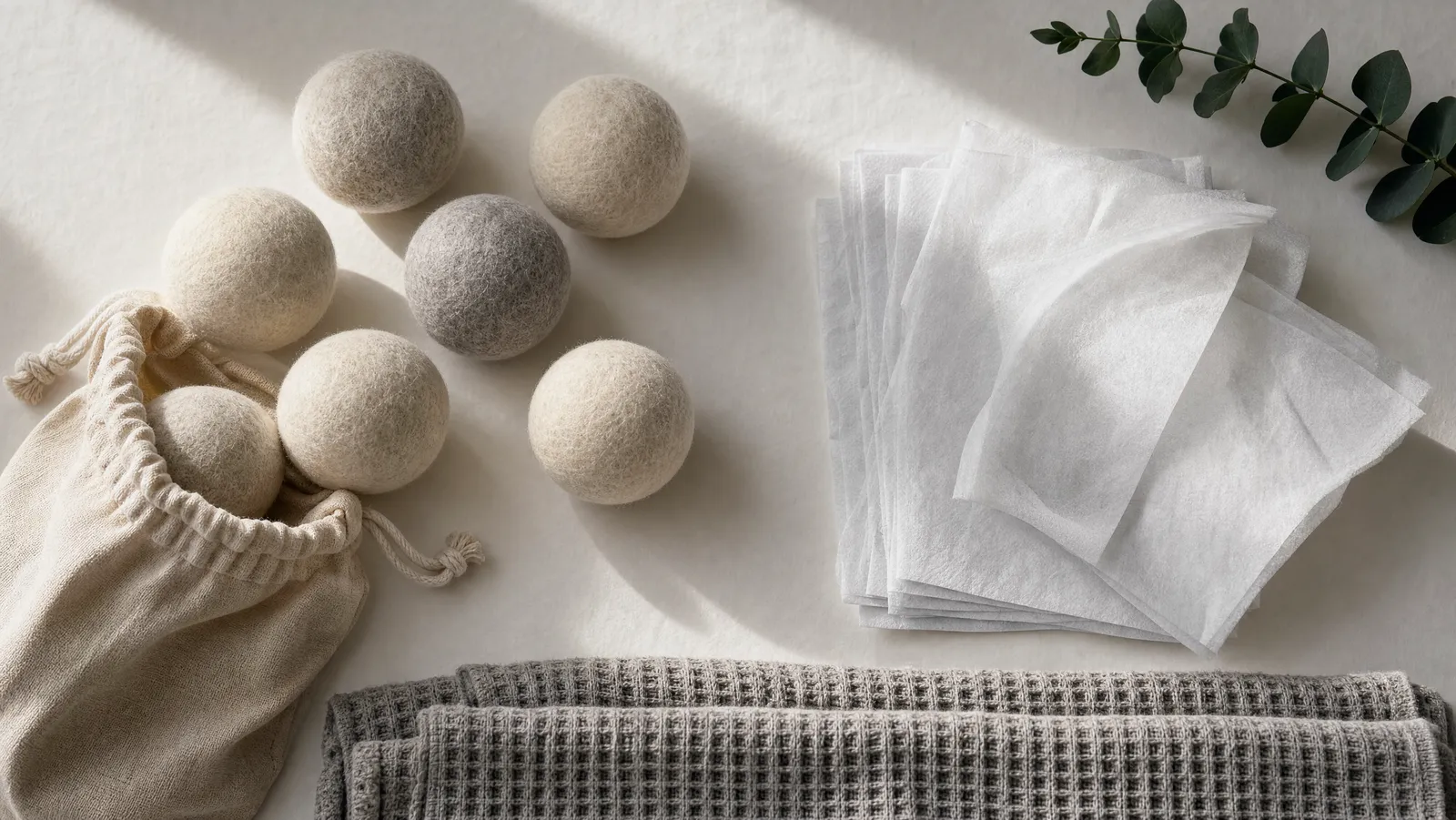
Wool dryer balls win on waste, on residue and on cost after the first year. Dryer sheets win on static and on scent, and if you want your laundry to smell like laundry, no ball of wool will ever do that for you. For most households wool is the better default, with one honest exception. Eco-Friendly Review is reader-supported, so if you buy through our links we may earn a small commission, at no extra cost to you.
The reason wool dryer balls vs dryer sheets gets argued badly is that both sides treat it as one question. It is eight or nine, and the two products split them. So we are running this as rounds on named axes, giving dryer sheets the rounds they win, and only then talking about which balls to buy. This swap sits inside a lower-waste laundry routine rather than replacing one.
How each one works, because the mechanism decides every round
A dryer sheet is a carrier cloth loaded with a waxy softening agent that melts in the heat and transfers onto your clothes. The active ingredients are cationic surfactants, mostly quaternary ammonium compounds. According to the 2023 review of quaternary ammonium compounds in Environmental Science and Technology, led by researchers at the University of Minnesota and the Green Science Policy Institute, this class has been used for decades as antimicrobials, preservatives and antistatic agents in cleaning products, personal care products and durable goods, and the compounds carry a permanent positive charge.
That charge is the whole trick. Tumbling fabric picks up negative charge, a positively charged film cancels it, and the same film lubricates the fibres so they feel softer. A dryer sheet works by coating your clothes. Everything good and everything questionable about it follows from that sentence.
A wool ball does nothing chemical. It is a felted lump that gets in the way, stopping items welding themselves into a wet knot so hot air reaches more surface. A wool ball works by mechanical separation. It cannot coat anything, which is why it cannot do the coating's job.
Round one: static goes to dryer sheets, clearly
This is not close, and pretending otherwise is how swap articles lose people. A film of positively charged surfactant neutralises static directly. A lump of wool can only reduce the friction that generates it.
Wool balls do help a little, and the reason is water: damp fabric conducts charge away, bone-dry fabric holds it, so a load that finishes sooner and tumbles freely over-dries less. The effect is indirect and unreliable. In Prudent Reviews' 2025 dryer ball test, loads run with balls averaged three instances of static cling each against four for the control loads, which the reviewer called inconclusive at that sample size.
What beats static is not a product:
- Pull the load out slightly damp and hang the last of it. Static is a dry-fabric phenomenon.
- Stop over-drying. ENERGY STAR's clothes dryer guidance notes that automatic termination detects when clothes are dry and prevents the wear and tear of over-drying. Less over-drying is also, for the reason above, less static.
- Separate synthetics from cotton. Static needs two dissimilar materials rubbing. Polyester with polyester is a much quieter load than polyester with towels.
If you do none of those and you hate static, a dryer sheet is the better tool. Say it plainly.
Round two: softening is closer than either side admits
Dryer sheets should win softening outright, because a lubricating film is a real thing that changes how cloth feels. In practice, measured tests find less than the marketing implies for both products.
Reviewed, the appliance testing lab, ran wool balls through a controlled lab wash and found no evidence the balls made towels softer than the control. Prudent Reviews scored softness across ten loads and got an identical average of 7.4 with and without balls. The honest reading is that wool balls do not soften; they stop clothes coming out stiff and tangled, which people describe as softer.
Sheets do soften, and that softness is a coating, which is round five. The choice is real softness with residue, or no residue and no softness. There is a third route, which we cover separately in our guide to natural fabric softener alternatives.
Round three: do wool dryer balls work on drying time
Every wool ball listing claims a large drying-time reduction. Molly's Suds says up to 30 percent, framed as up to 18 minutes off an hour. Big Wool Balls says up to 40 percent. Those are brand claims, and we have not run a stopwatch across machines, so we will not hand you a number as though we measured it. What independent testers found is much less exciting.
Reviewed's lab test of a popular wool ball brand used 13 towels, four pillowcases and two bedsheets pre-soaked to 1.7 times their dry weight, over ten cycles. Cycle times varied by five minutes in both directions with the balls in, which is another way of saying no reliable reduction; Reviewed concluded the brand's 25 percent claim was unsupported.
Prudent Reviews tested plastic balls rather than wool, in results updated May 2025, over ten loads of mixed clothing. Loads without balls averaged 47 minutes 37 seconds; loads with two balls averaged 41 minutes 20 seconds, a reduction of 6 minutes 17 seconds, which it reports as a 14 percent improvement.
The mechanism explains the gap. Balls help when a load would otherwise clump, and shirts, hoodies and shorts clump. A towel load already tumbles and dries slowly for reasons wool cannot fix. So the honest claim is a modest reduction on some loads, nothing measurable on others, and nowhere near 40 percent in any independent test we could find. If you get minutes back on your jeans load, treat it as a bonus.
Round four: scent, and dryer sheets win it outright
Wool balls do not scent clothes. Adding essential oil is the usual workaround, and it reportedly fades fast.
A very large number of people want their laundry to smell like something. That preference is not a failure of environmental character, and treating it as one is why swap advice bounces off most households. If the smell is part of why you like doing laundry, wool will feel like a downgrade on day one, and you should know that before you buy.
Two things to weigh against it. Fragrance is where nearly all the emissions evidence sits, so this is the round with the real trade-off attached. And the smell fades within days, while the ball keeps working for years.
Round five: residue, lint and what stays on the cloth
The coating does not only sit on your shirts; it accumulates in the machine. ENERGY STAR advises cleaning the lint filter after every load, and specifically recommends scrubbing the filter monthly if you use dryer sheets, to remove the buildup they leave. That is a government-run efficiency programme telling you the sheets leave a film on the screen. What lands on a mesh screen lands on your towels too.
The measured version comes from Reviewed again: towels dried with dryer balls absorbed water better than towels dried with a dryer sheet. That is the towel problem in one line. A towel's job is to move water, a softening film resists water, and the softest towel in the cupboard is often the worst at drying you.
One thing we will not blame on sheets: the lint itself. Dryer lint from synthetic clothing is shed fibre, and the dryer is a release route in its own right: Kapp and Miller's 2020 PLOS ONE study found emissions from tumble drying may equal or exceed the microfibre release from washing machines. Most of the fixes are upstream, and we covered them in how to stop your laundry shedding microplastics. Wool balls do not reduce shedding, and we will not sell them as a microfibre solution.
Round six: are dryer sheets bad, or is that mostly internet
The claim that dryer sheets are toxic is repeated constantly and sourced rarely. Here is what exists.
The one direct measurement is Steinemann and colleagues' 2011 study in Air Quality, Atmosphere and Health, which sampled residential dryer vents during use of fragranced detergent and fragranced dryer sheets. It found more than 25 volatile organic compounds leaving the vents, at highest concentration acetaldehyde, acetone and ethanol; seven are classified by the EPA as hazardous air pollutants and two, acetaldehyde and benzene, as carcinogenic ones.
Now the limitations, which are large and rarely quoted next to the findings. The study covered two homes in Seattle over two days, one grab sample per usage condition per site, each analysed once. It quantifies what leaves the vent. It does not measure anyone's exposure and does not establish a health outcome, and the authors frame it as a first characterisation pointing to further research.
The most useful line in it for a shopper is a different one: virtually none of the compounds found in the products' headspace appeared on the label or the safety data sheet, which used general terms such as softeners and perfume. You cannot read your way to an answer on the box.
On the softening chemistry, the 2023 Environmental Science and Technology review lists suspected or known adverse outcomes for quaternary ammonium compounds including dermal and respiratory effects, and says assessment is hampered by their structural diversity and a lack of exposure and toxicity data for most of them. That is a call for research, not a verdict on your dryer.
Self-reported data sits on top. Goodman, Nematollahi and Steinemann reported in the same journal in 2021 that 12.5 percent of the US general population and 6.1 percent in Australia report health problems when exposed to scented laundry emissions from a dryer vent, rising to 28.9 and 12.1 percent among people with asthma. Survey data has obvious limits. The same paper points at the practical lever: terpenes were prevalent in fragranced laundry products and absent from fragrance-free ones, and switching could cut limonene emissions by up to 99.7 percent.
So the fair summary is that the evidence concerns fragrance and coatings, it is thinner than the internet suggests, and the biggest single change available is unscented rather than wool. We are a testing bureau, not a health site.
Round seven: cost over three years
This is wool's most decisive win, and it needs stated assumptions rather than a confident number, because we cannot source a live dryer sheet price the way we source the balls.
Assume five loads a week: 260 loads a year, 780 over three years. Assume one sheet per load and a box of 120 sheets at 6 dollars. That is 6.5 boxes, or roughly 39 dollars and 780 sheets in the bin.
Against that, the SnugPad set is 8.95 dollars as of August 2026 and the Molly's Suds set is 15.95 dollars, bought once. Even if you replace the balls at three years rather than believing the makers' 1,000-load claims, wool costs a quarter to a half of the sheets. Change the assumptions and the ranking holds, because one number recurs 780 times and the other does not recur at all.
Round eight: waste, noise and the things nobody warns you about
Waste is the round wool wins without argument: one purchase against 780 used sheets and six and a half boxes.
The annoyances are real, and they are why people quit in week one.
- They are loud. Six felted balls in a metal drum sound like it. A dryer near a bedroom wall can be noticeably noisier.
- Cheap ones pill. Wool can shed a fuzz that shows on dark clothes, most often in the first few loads and with loosely felted balls.
- They hide. Standard balls can disappear into duvet covers and sleeves. The 4-inch ones exist largely to fix this.
- Day one is worse than day thirty. The first load has no scent, possibly some static, and some fuzz. That is the convenience gap.
- Hypoallergenic is a marketing word here, not a certification. These are pure wool. If wool is a problem in your house, do not assume a listing bullet has ruled it out.
The verdict on who should use which
Use wool if you want the waste gone, you dry mixed clothing loads, you care what ends up on your towels, or you are tired of buying a consumable. That is most households.
Use dryer sheets if scented laundry is the point for you, static is your main complaint, and you are not going to change how long you run the dryer. That is a legitimate position.
Use neither if you can hang things. The dryer is the expensive appliance in this room and a rack sidesteps every round above; we have a guide to the best drying racks for exactly that.
If you land in the middle, the compromise is fragrance-free sheets, or wool balls plus a shorter cycle.
The best wool dryer balls to start with
Three sets, three jobs, priced as of August 2026.
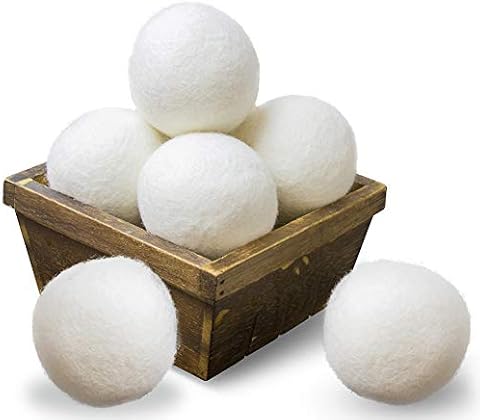
The SnugPad XL 6-pack at 8.95 dollars is the experiment: 1.49 dollars a ball for six XL balls of New Zealand wool. The maker claims 1000-plus loads, which we cannot verify, and Amazon returned no feature bullets for this listing, so we will not tell you anything else about it. If wool turns out not to suit your machine, you are out nine dollars.
Molly's Suds' set of six at 15.95 dollars, or 2.66 dollars a ball, is the one to buy if you want to know where the wool came from. The brand says it sources from small farms in New Zealand, that the balls are hand-felted by a fair-wage factory in Nepal providing work for women in rural areas, and that it is certified cruelty-free by Leaping Bunny. They arrive undyed and unbleached in a muslin bag, so the balls will not match. The up-to-30-percent drying claim is a claim; see round three.
Big Wool Balls' 4-inch 2-pack at 27.99 dollars is for duvets, heavy bedding and towel loads, where a bigger ball is harder to lose in a sleeve. Be clear what you are paying: 14 dollars a ball, nine times SnugPad's rate, for two separators instead of six. Its up-to-40-percent claim is the boldest here and the one independent testing supports least.
The bottom line
Wool beats dryer sheets on waste, on residue and on three-year cost, by margins that do not depend on which brand you buy. Dryer sheets beat wool on static and on scent, and those are not trivial rounds to lose. The drying-time claim that sells the category is the weakest part of the case, and you should buy as if it were zero.
If you want the one change with the best evidence behind it, it is not wool: it is going fragrance-free and running the dryer less. Wool balls are how you stop buying a consumable, a different and still worthwhile goal. The rest of the machine is mapped in our eco-friendly laundry guide.
What we tested
The cheapest way to find out whether wool balls suit your machine
- Material
- Felted New Zealand Wool
- Credentials
- ReusableFragrance-free
Six balls for roughly what a box of dryer sheets costs, which is enough separators to actually work a full load and cheap enough that a failed experiment costs you almost nothing.
No major drawbacks noted in testing.
Six XL balls of New Zealand wool at 8.95 dollars for the set as of August 2026, which works out at about 1.49 dollars a ball and makes this the lowest-stakes way to find out whether wool suits your machine and your loads. The maker claims 1000-plus loads and describes the balls as baby safe; both are the maker's words, not a measurement of ours. Amazon returned no feature bullets at all for this listing, so the wool, the XL size and the six-pack are honestly everything we can tell you about it.

The set that answers where the wool came from and who felted it
- Material
- Felted New Zealand Wool
- Credentials
- ReusableFragrance-free
No added fragrance and no softening chemicals, just wool, backed by the clearest sourcing and certification information of the three sets on this page.
No major drawbacks noted in testing.
The only set here with a supply chain you can actually read. Molly's Suds says the wool comes from small farms in New Zealand, that the balls are naturally cleaned and hand-felted by a fair-wage factory in Nepal providing work for women in rural areas, and that the product is certified cruelty-free by Leaping Bunny. Six XL balls arrive in a printed muslin bag, unbleached and undyed, so colour varies between balls. At 15.95 dollars as of August 2026 that is 2.66 dollars a ball, and the brand's up-to-30-percent drying figure and 1,000-load lifespan are claims rather than findings.

Two oversized balls for duvets towels and loads that clump
- Material
- Felted New Zealand Wool
- Credentials
- ReusableFragrance-free
The size is the whole point: on duvets and towel loads a 4-inch ball is harder to lose inside a sleeve and better at breaking up a clump than a standard one.
No major drawbacks noted in testing.
Four-inch balls, marketed as twice the size of a standard XL, which the brand says keeps them from disappearing inside sleeves and makes them suited to large loads, towels and heavy bedding. The listing describes them as 100 percent organic New Zealand wool, hand-felted, with no added fragrance. The catch is the arithmetic: 27.99 dollars for two as of August 2026 is 14 dollars a ball, roughly nine times the per-ball cost of the SnugPad set, and two balls do less separating than six. Treat the brand's up-to-40-percent drying claim and its 1,000-load figure as marketing.
Compared, side by side
| Spec | Best ValueSnugPad Wool Dryer Balls XL (6 Pack) | Best SourcingMolly's Suds Wool Dryer Balls XL (Set of 6) | Best for Bulky LoadsBig Wool Balls XXL 4-Inch Wool Dryer Balls (2 Pack) |
|---|---|---|---|
| Verdict | Solid | Solid | Solid |
| Composite | 3.4/5 | 3.4/5 | 3.4/5 |
| Materials | 3.0 | 3.0 | 3.0 |
| Health | 3.2 | 3.2 | 3.2 |
| Durability | 3.9 | 3.9 | 3.9 |
| End-of-life | 3.6 | 3.6 | 3.6 |
| Price | — | — | — |
| Get it | Check price | Check price | Check price |
How we score
What it’s made of.
Chemistry you’ll touch.
How long it lasts.
Where it goes after.
Each pick scores 0–5 on the four axes above, weighted into the composite verdict at the top. Scores are derived from what a product is verifiably made of and certified as — not how green its label looks.
About the author
Ruth Lopez
I'm Ruth Lopez and I'm a lover of nature and the environment. I'm very passionate about finding eco friendly products that don't damage the environment and also support companies that have the same philosophy.