How to Compost in an Apartment Without a Yard

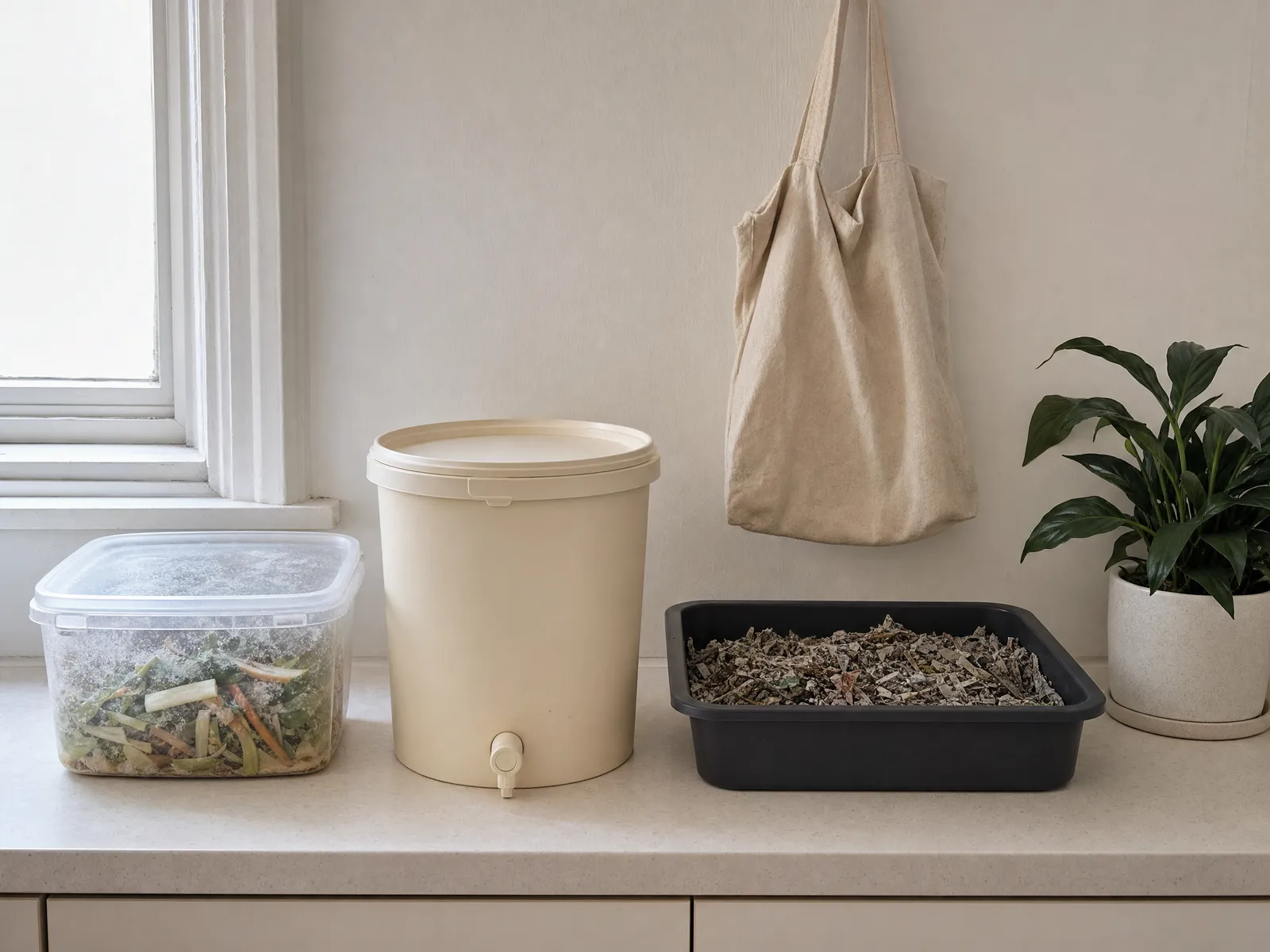
Composting is a conversion rather than a disposal. Peelings go in and a smaller volume of denser material comes out, and that material has to land somewhere: a bed, a pot, a pile, or somebody else's facility. Which is why the binding constraint on composting in an apartment is never the input - a flat generates scraps like any other kitchen - but the output, and three of the four methods that work indoors leave you holding material you then have to find soil for.
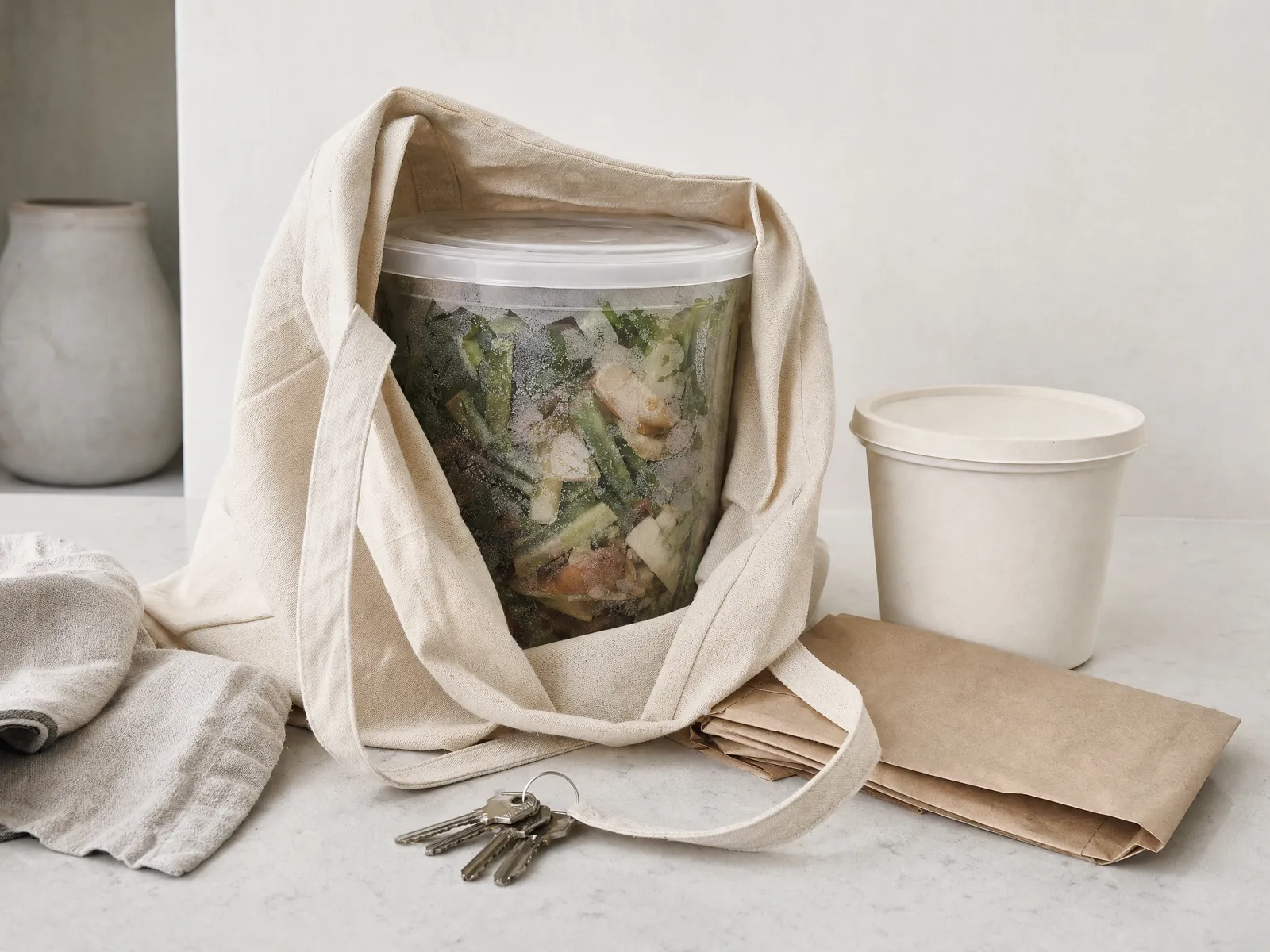
One does not, and it is the one we would start with: a lidded container in the freezer, carried to a drop-off on a fixed day. Free, fits any flat, scales from one person to five, and needs no landlord conversation, no insects and no explanation to a neighbour.
This is the small-space instalment of our week on composting kitchen scraps. Nothing on this page is for sale, and every method below can be started with containers already in your kitchen.
Answer the output question before you choose a method
Before you compare methods, answer one question: where does the finished material physically go? There are five honest answers in a flat.
- Houseplants. A few pots absorb a surprisingly small amount of compost a year.
- A balcony's worth of containers or window boxes. The best realistic answer short of a garden.
- A community garden plot or allotment. Often willing, usually unlisted. Ask.
- A neighbour or relative with a bed. Ask before you buy equipment.
- Nothing. No soil at all, anywhere you control.
Nothing is a legitimate answer, it is the common one in flats, and it points at a drop-off rather than at a purchase. Every method below except the freezer produces material, and material with nowhere to go is a second waste stream rather than a solved one.
The US Environmental Protection Agency gets there by a shorter route: "If you don't have a space for composting, consider participating in a local municipal or community composting program", which it notes "may collect your food scraps or offer a designated location where you can drop them off."
Whether one exists near you is a lookup, not a guess. Nora Goldstein, Paula Luu and Stephanie Motta, in part II of BioCycle's nationwide survey of residential food waste collection access, published on 11 September 2023 with support from the Composting Consortium at Closed Loop Partners, identify "a total of 400 programs, encompassing 710 communities", of which the drop-off-only category accounts for "139 programs, 357 communities, 5.1 million households with access". Nationally, "The number of households in the U.S. with access is 14.9 million", which the authors report as "a 49% increase in number of households with access between 2021 and 2023", up from 10.0 million. Fast growth on a base that does not cover the country, which is why nobody can tell you your own answer.
Why freezer plus drop-off is the honest default for composting without outdoor space
The freezer is the only method here that produces no output you have to house, because the output is somebody else's compost pile. The mechanism is cold. The US Department of Agriculture's Food Safety and Inspection Service, in its freezing and food safety guidance, states that "Freezing to 0 °F inactivates any microbes - bacteria, yeasts and molds - present in food." FSIS is writing about food you intend to eat, so we are borrowing the microbiology rather than a compost measurement, and it is equally clear that the effect reverses: "Once thawed, however, these microbes can again become active, multiplying under the right conditions." Frozen scraps are paused, not sterilised.
The freezer also takes the insect clock off the wall, which matters more in a shared building than in a house. Michael F. Potter, extension entomologist at the University of Kentucky College of Agriculture, writes in the university's Entfact-621 that for fruit flies "The entire lifecycle from egg to adult can be completed in about a week", and that "given the opportunity, they will lay about 500 eggs." A warm, moist, undisturbed tub of fermenting peel is where that happens. A frozen one is not.
In a flat, that is the whole method: a tub you already own, in the freezer, out of the building on a fixed day. The setup is in how to start composting kitchen scraps, and the hunt for somewhere to take the tub is in where to take food scraps if you do not compost at home.
A worm bin is the method the EPA names for indoor composting in a small space
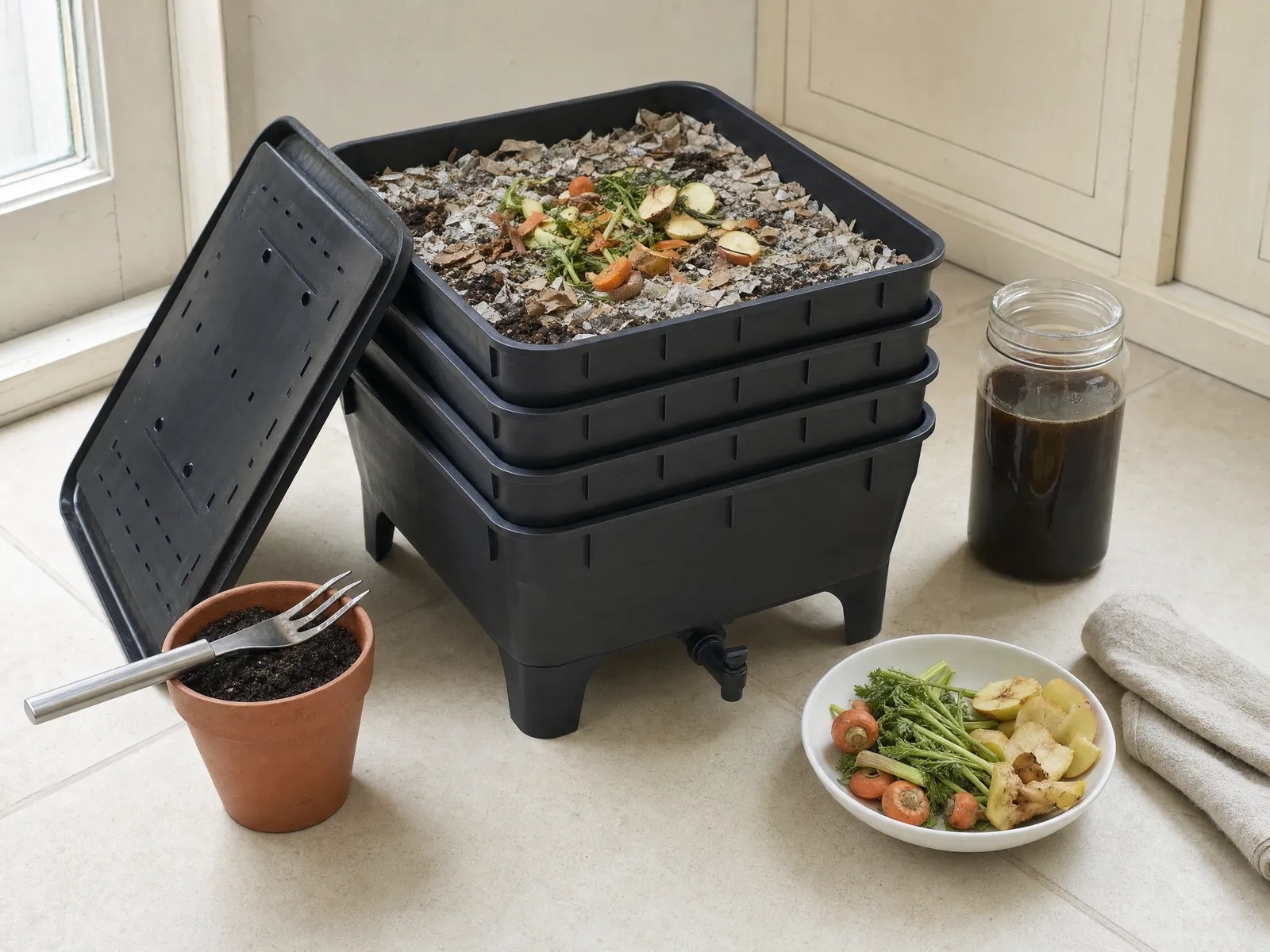
The EPA's own suggestion for composting in a small space is worms rather than hardware. Vermicomposting, it says, "takes up little space, the materials are simple and inexpensive, and it can be done indoors or outdoors", and "You can keep your worm bin indoors (e.g., under a sink, in a closet or basement) or outdoors in the shade." On the fear that stops most people it is reassuring but conditional: "If your worm bin is properly maintained, it should not emit odors or attract pests."
The temperature band is narrower than most people assume, and it is a living room rather than a balcony. Rhonda Sherman, extension solid waste specialist in horticultural science at NC State Extension, writes in Worms Can Recycle Your Garbage (AG-473-18, 29 March 2017) that "the temperature inside the bin should be maintained between 59° and 77°F (15° to 25°C)", and warns that direct sun "can cause the system to overheat and kill your earthworms". Austin Little, horticulture educator at University of Illinois Extension, writes on 8 November 2021 that red wigglers "are most active at temperatures between 55°F to 77°F" and that they "will die when it gets close to freezing". The EPA's own worm bin instructions put it without numbers: keep the bin "in an indoor space", because you "do not want the worms to freeze in the winter or get too warm in the summer".
A balcony is therefore ruled out in both directions in most of the country - a January night and an August afternoon are each outside the band. This is an indoor appliance made of worms.
The extension services disagree about how much a worm bin eats, and the gap is three and a half fold
- NC State, the conservative figure. Sherman: "One pound of red wigglers will eat up to two pounds of food scraps a week."
- Iowa State, in the middle. Megan Will, writing for Iowa State University Extension and Outreach's Yard and Garden pages: "If you start with a pound of worms, they can eat up to a ½ pound of food a day", or about three and a half pounds a week.
- Illinois, the high figure. Little cites "1lb of scraps per 1lb of worms a day", about seven pounds a week.
Both ends can be right, and the sources say why themselves. The high figures are a peak rate: an established bin at ideal temperature with chopped material. Little adds that feeding falls considerably in colder weather, and Sherman's "up to two pounds" is a planning number. Plan on the low figure, which means one pound of worms and about one square foot of bin surface per two pounds of weekly scraps - Sherman's stocking rate is "at least one pound (about 1,000) of red wigglers to one square foot of surface area of the worm bin".
The labour is light but not optional. The EPA says to "Only add more food to the worm bin once the food you previously added has been consumed", and that "Worms do best left alone, so it is best to feed them only once a week." Sherman wants bedding "very damp, but not soaking wet". The accepted-food list is narrow: the EPA says "Do not include any animal by-products (fat, bone, dairy, meat, waste)", Sherman says "Never add meat scraps or bones, fish, greasy or oily food" along with onions, garlic, citrus and salty foods, and Will adds vinegar and butter. Our breakdown of what belongs in a kitchen caddy overlaps that list without matching it.
And then the output. Sherman: "In about four months, it will be time to harvest the vermicompost." The EPA's two-bin design also collects liquid, with the instruction to "Once every few months, scoop the liquid out of the lower container." So a worm bin hands you two outputs on two schedules, and with no soil you have moved the problem four months down the calendar rather than solved it. We will treat indoor worm bins properly later in this series.
Bokashi takes meat and dairy, and then hands the output problem back
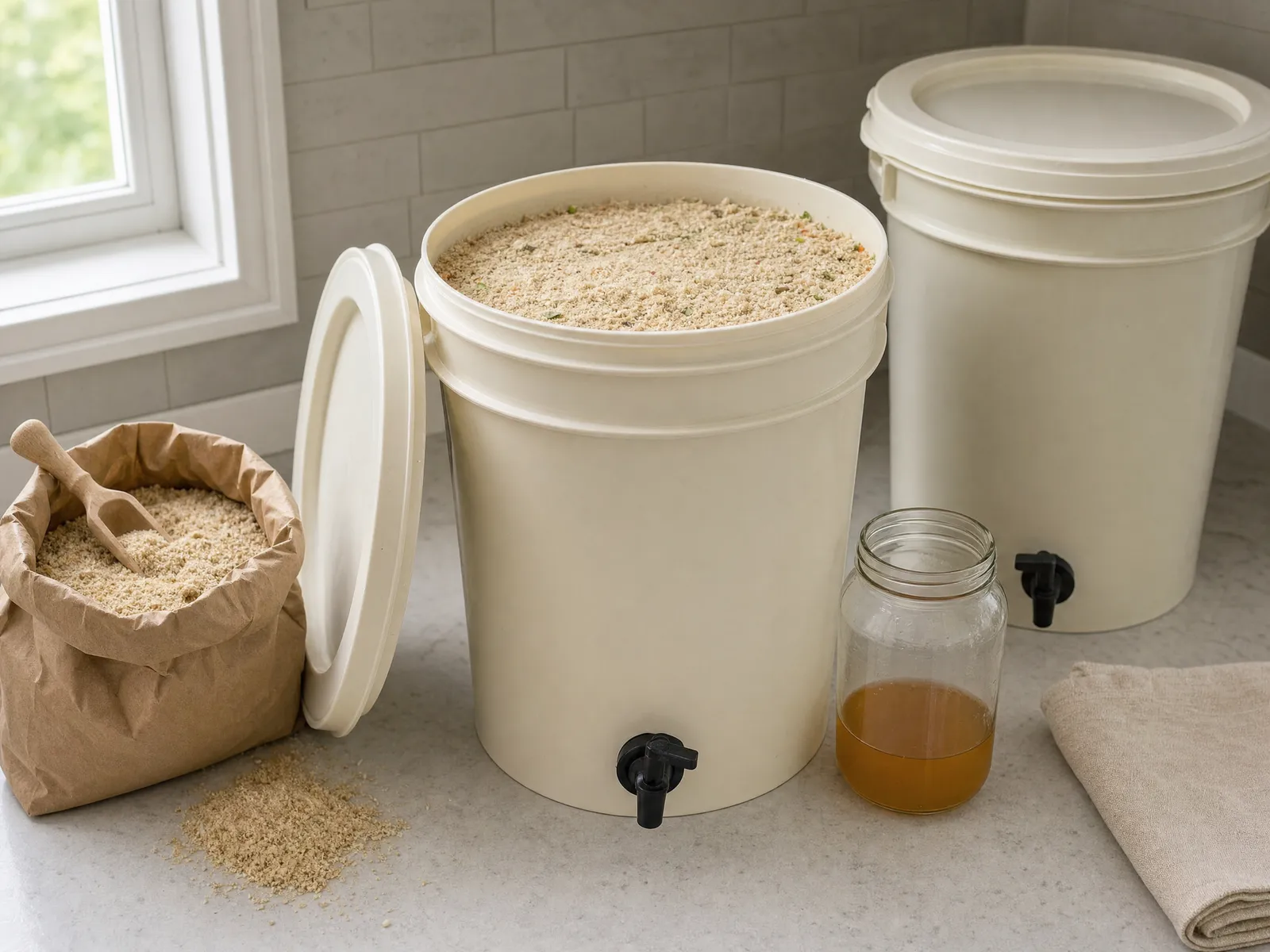
Bokashi breaks the usual rule about what a home system can accept. Washington State University Extension's Kitsap County office, in guidance funded by Kitsap County Public Works Solid Waste Division, describes it as "an anaerobic fermentation system for managing food waste using a sealed container" using an "inoculated bran made of beneficial bacteria and yeast", and says it "allows you to compost almost all types of food waste, including fruit and vegetable scraps, cooked food, dairy, meat, and even small bones." You "allow the contents to ferment for about two weeks."
That is the attraction. The catch arrives immediately after it. WSU is blunt: "Bokashi material, as a fermented pre-compost, is not finished compost." The process "produces a nutrient-dense pre-compost that must be buried in soil or finished in another compost system to complete breakdown", and the material "is acidic and biologically active and must be mixed with soil to complete decomposition". WSU's burial instruction is to mix it with at least two to three times its volume in soil, and it rules out the shortcut a flat-dweller reaches for: "Do not surface-apply or mulch with Bokashi" and "Never place Bokashi directly against roots or trunks." Gene Fox, area agent for consumer horticulture at N.C. Cooperative Extension's Beaufort County Center, publishing an article on 22 April 2025 written by Extension Master Gardener volunteer Angela Mason Foster, adds a depth, "at least 8 inches deep to avoid attracting animals", after which "Once buried, the material fully decomposes within two to four weeks."
A method needing two to three times its own bucket volume in soil, eight inches down and away from roots, is the worst possible fit for a home with no soil - which is precisely the home it gets recommended to most often. With a balcony of large containers, a plot or a neighbour's bed, bokashi is genuinely excellent and the only home composting route for cooked food, meat and dairy. With six houseplants it is a dead end on a fortnightly deadline. The full treatment of bokashi composting comes later in this series.
An electric unit is a dryer and a grinder, and the output still needs somewhere to go
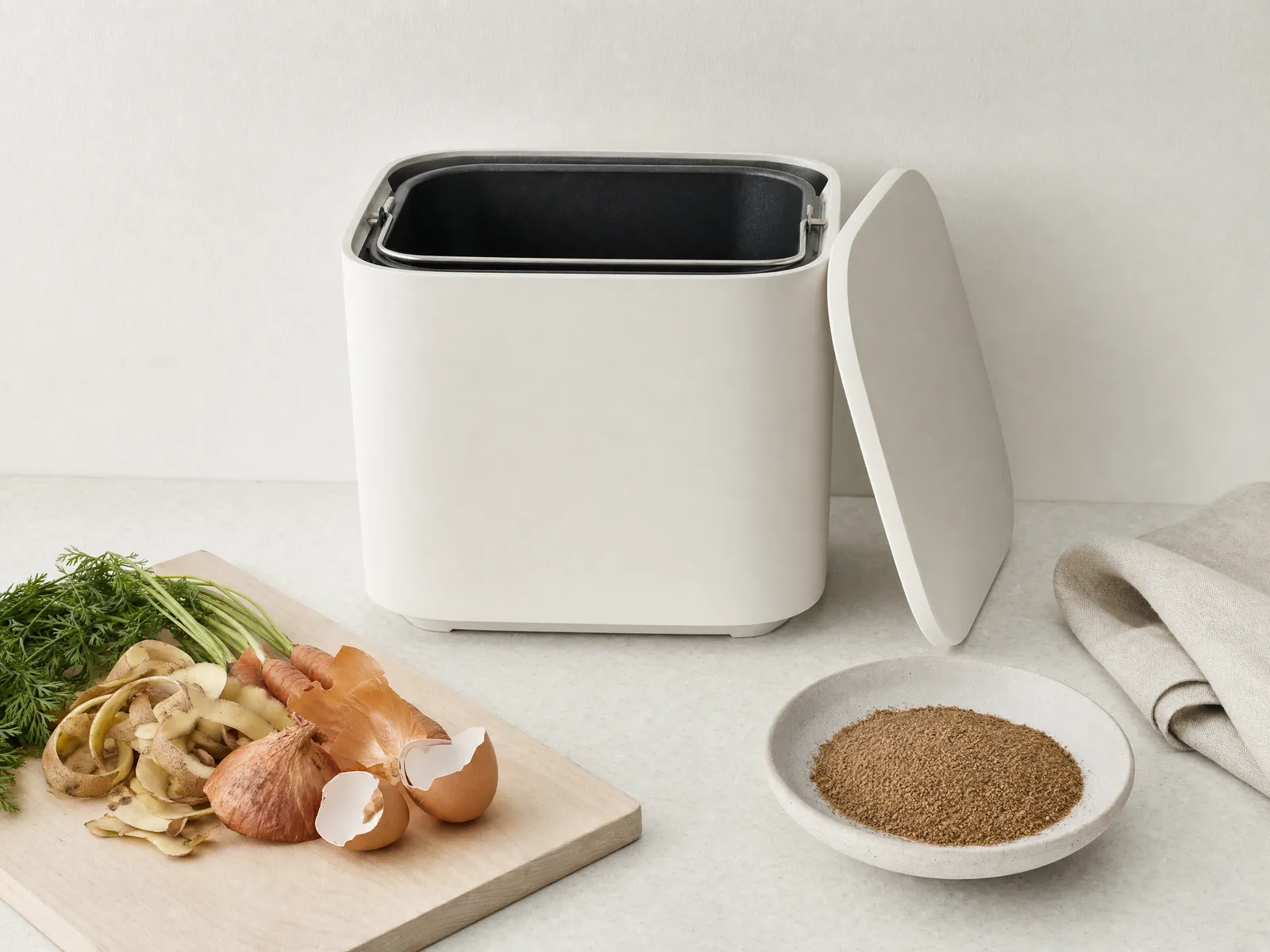
This category markets itself as the apartment answer, and the clearest description we have found of what it does comes from a waste authority rather than a maker. The Regional District of Central Kootenay in British Columbia, in its home organics factsheet on food waste pre-treatment appliances, says these machines "use a combination of heat and mechanical grinding action", then says what the output is not: "this material is simply dried and ground food waste; it has not decomposed at all and still needs to be broken down by microbes before nutrients are available to plants and soil organisms for healthy growth." The factsheet states plainly that "they do not create compost by themselves".
Two of its notes matter in a flat specifically. The output "should be considered an animal attractant" and needs storing sealed until it goes into a composter, into soil at fifteen parts soil to one part output, or to a facility that takes it. And the machine is indoor-only: the district says never to use or store one outdoors or in extreme temperatures, which it bounds as below 0 degrees C or above 35 degrees C. A balcony does not solve the counter-space problem.
So an electric unit converts a volume problem into a smaller volume problem and leaves the destination question exactly where it was. Our fuller assessment of the category is in electric kitchen composters and whether the output is real compost.
The four things that actually kill apartment setups
Not enthusiasm. These.
- Temperature. The published band runs from Sherman's 59 to 77 degrees F to Little's 55 to 77 degrees F, with death near freezing. That is a flat's interior, not its balcony, its fire escape or its unheated cupboard in February.
- The lease. We have not found a published survey of how often residential leases are read as covering a thousand worms, and we will not invent one. We would still read the pet and livestock clause before buying livestock by the pound.
- Odour and pests are a neighbour problem in a shared building. The EPA's reassurance is conditional on a bin being "properly maintained", and WSU says a correctly fermented bucket smells "a sour, tangy, pickled, vinegar-like smell (not sulfur, rot, or ammonia)" - both methods have a recognisable failure smell. Potter's one-week fruit fly cycle runs in your kitchen, not the building's bin store. The diagnostics are in stopping smells and fruit flies.
- Storage volume. A square foot of bin surface for worms, a sealed bucket plus a bag of bran for bokashi, and for an electric unit's output the Central Kootenay factsheet suggests a 5-gallon, 23-litre bucket with a tight lid. In a small kitchen that is real floor area.
The fifth failure is the one nobody counts: the trip. Every method here ends in a walk, to a drop-off or to soil you do not own, and a fortnightly walk with a frozen tub is the version that survives longest. Which is the argument for the freezer, and for checking your drop-off before you spend anything.
The bottom line
In a flat, choose the method by its output, not its input: if you have no soil you control, freeze the scraps in a lidded tub you already own and carry them to a drop-off, and buy nothing at all. That is free, it works in any apartment, and we earn nothing from recommending it.
If you do have somewhere for the output to land, the order changes:
- Houseplants only. Freezer plus drop-off. A worm bin or a bokashi bucket outproduces what a few pots can absorb.
- A balcony of containers or window boxes. A worm bin, kept indoors inside the 59 to 77 degrees F band, with castings out in about four months.
- A plot, an allotment or a willing neighbour's bed. Bokashi, the one home composting route for cooked food, meat and dairy, because somebody has eight inches of soil to bury it in.
- No soil and no drop-off within reach. Keep freezing, keep looking, and do not let an appliance stand in for a destination.
Start the tub tonight. Everything else in the system - what goes in, which caddy, liners, odour and where it all ends up - is in our full kitchen composting guide.
How we score
What it’s made of.
Chemistry you’ll touch.
How long it lasts.
Where it goes after.
Each pick scores 0–5 on the four axes above, weighted into the composite verdict at the top. Scores are derived from what a product is verifiably made of and certified as — not how green its label looks.
About the author
Ruth Lopez
I'm Ruth Lopez and I'm a lover of nature and the environment. I'm very passionate about finding eco friendly products that don't damage the environment and also support companies that have the same philosophy.