Plastic-Free Food Storage and Every Kitchen Swap Worth Making

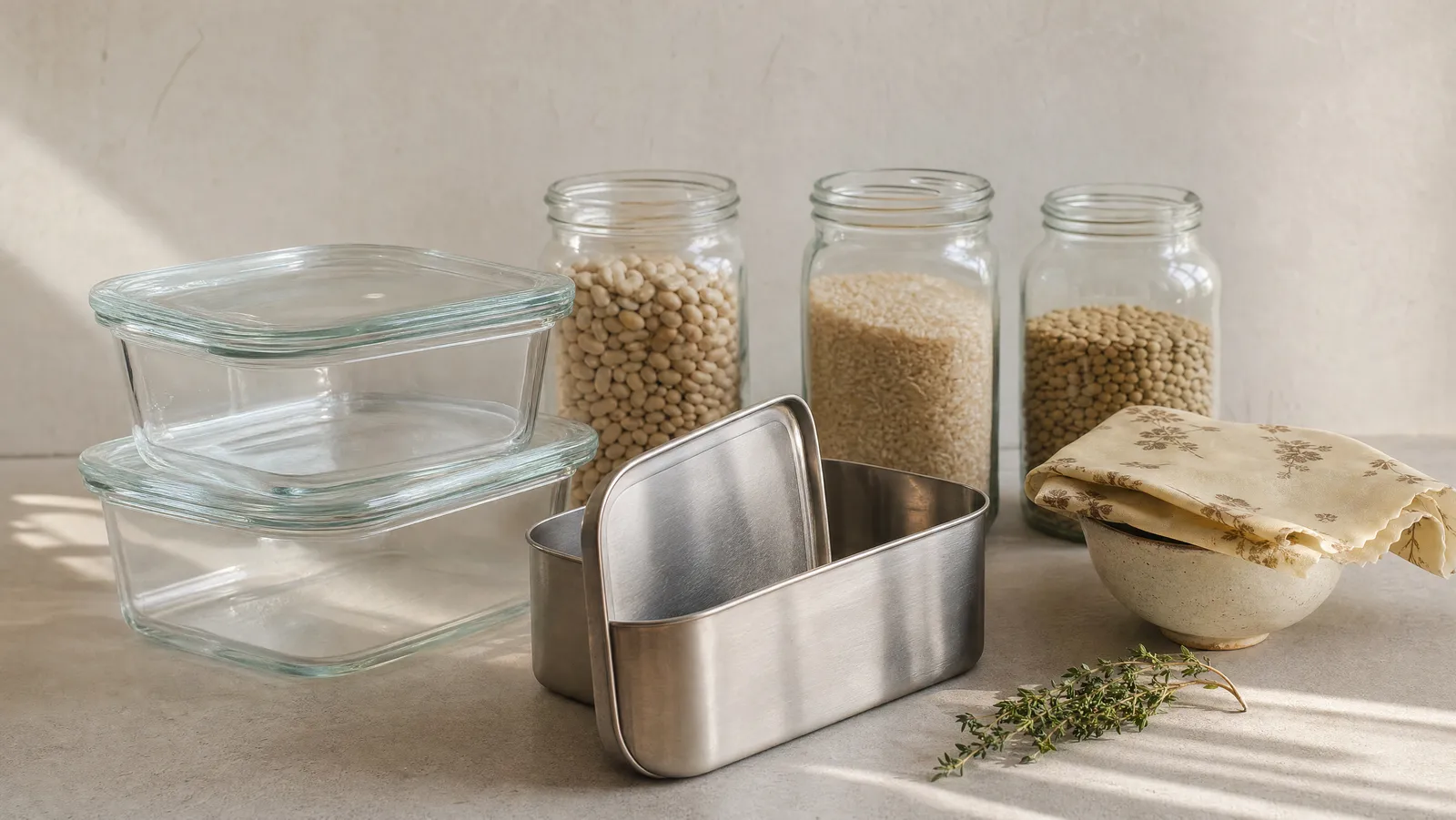
Plastic-free food storage is three separate problems sold to you as one. There is a leaching problem (what comes out of the container and into the food), a waste problem (where the container goes when it cracks), and a food-keeping problem (whether the spinach is still edible on Thursday). A glass box answers the first two and does almost nothing for the third.
Almost every guide in this category blurs them, which is how people end up with a cupboard of handsome glass boxes and the same bin full of slimy leaves. Sorting the three apart is the whole method, because each has a different correct answer and two of those answers are free.
Start with the free one. The jar your pasta sauce came in is food-grade glass with a lid, already in your kitchen, already paid for. We earn nothing when you run it through the dishwasher and fill it with rice, and it is still the first thing we would tell anyone to do. Buy after that only for jobs a jar genuinely cannot do: freezing flat, surviving a rucksack, holding a sandwich, keeping lettuce humid.
The Three Problems Hiding Under One Phrase
Problem one is chemical. Things migrate out of food contact materials and into food, and the two agencies best resourced to judge whether that matters currently disagree in public. The next section takes that apart. Note the practical shape of it now: the variable that keeps appearing is heat, not time.
Problem two is waste, and the numbers here are not ambiguous. According to the US Environmental Protection Agency's Facts and Figures data, plastics generation in the United States was 35.7 million tons in 2018, 12.2 percent of municipal solid waste, with an overall recycling rate of 8.7 percent. Landfills received 27 million tons of plastic that year, 18.5 percent of all landfilled municipal solid waste. Putting a cracked storage box in the recycling bin is not a disposal plan. Keeping a container in service is the only intervention with a reliable outcome, which is also the argument against throwing out a working cupboard.
Problem three is the one nobody counts, and it is the largest. EPA estimates that 66 million tons of wasted food was generated in the food retail, food service and residential sectors in 2019, that about 60 percent of it went to landfill, and that landfilled food waste accounts for an estimated 58 percent of the fugitive methane emissions from municipal solid waste landfills. A container that keeps food better than the plastic it replaced does more environmental good than one that is merely not plastic, and a container that keeps food worse can quietly undo its own case. The downstream half of that argument is in our kitchen compost bin guide.
Hold the three apart as you read. Most of the products below solve exactly one.
Containers: Glass, Steel and What to Actually Buy
The first move costs nothing, so make it first. Wash the jars you already own and use them. Passata jars, jam jars, pickle jars, the 700 ml one the olives came in. They are food-grade glass, they are dishwasher-safe, they stack badly and seal well, and we make no commission on any of them.
What jars cannot do is the entire case for buying anything:
- Freeze flat. A round jar wastes freezer volume and can break.
- Travel. A jar in a bag is a pressure test you will eventually fail.
- Hold a sandwich, or stack. Rectangles win.
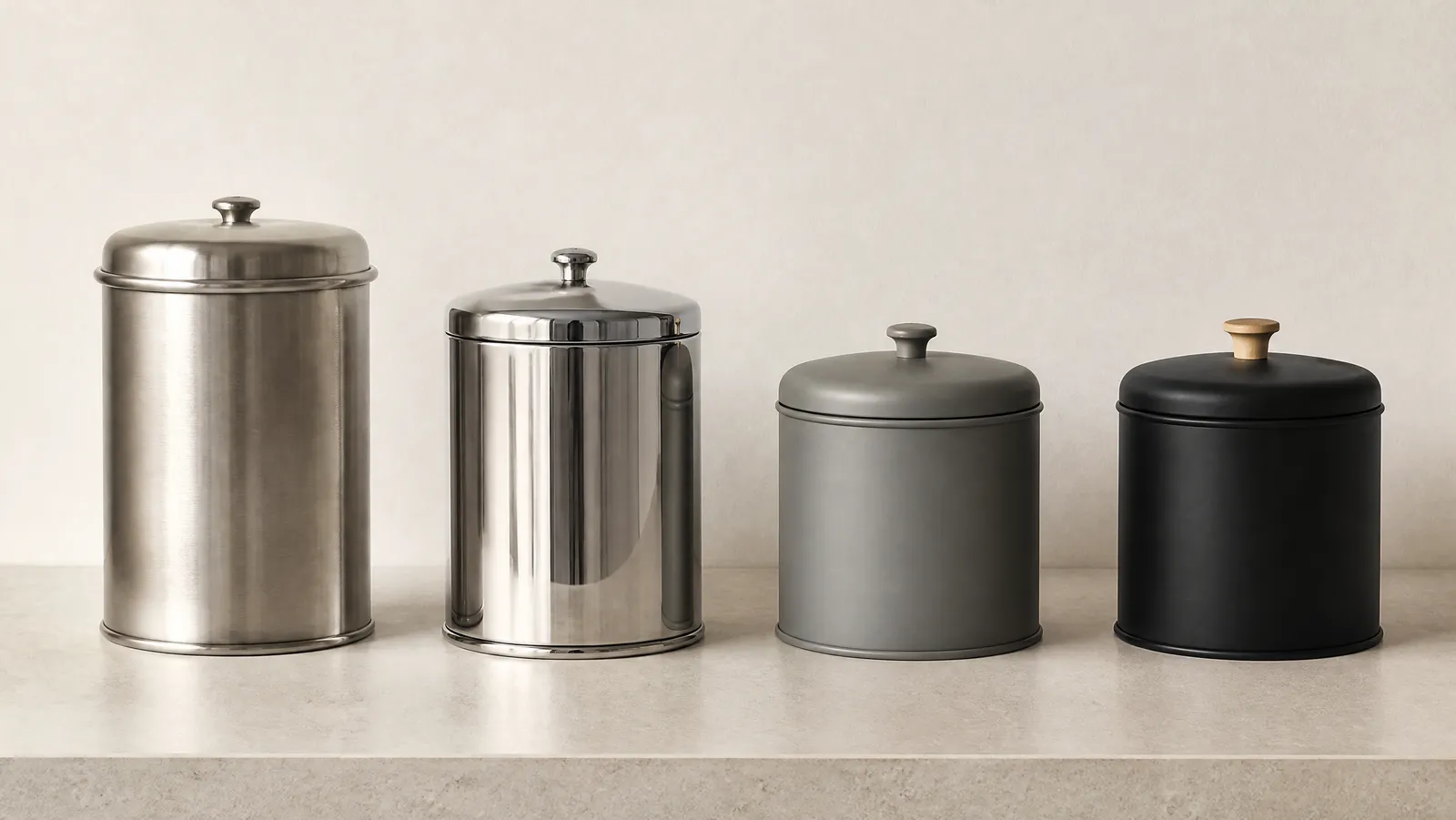
So the shopping list is short and job-shaped. A set of rectangular tempered-glass boxes with genuinely leakproof lids covers leftovers, meal prep and oven-to-fridge. A couple of stainless steel tins cover lunches, picnics and anything that will be dropped. That is most households done. We work through the best plastic-free food storage containers size by size in a separate piece, and the headline there is unglamorous: you are buying a lid, not a box. The glass is commodity. The gasket and the clips are where products differ and where they fail.
Now the trade-off nobody prints on the box. Almost nothing sold as plastic-free food storage is actually plastic-free. The lid is usually polypropylene, the seal usually silicone, and both are polymers. That is a design constraint rather than a scandal: an airtight seal needs something compressible. But the honest claim is "the food touches glass", not "there is no plastic here". Buy from makers that sell replacement gaskets, because the gasket dies first.
Is Storing Food in Plastic Actually Unsafe
The honest answer has three registers, and they should not be collapsed into one.
Established: chemicals from plastics are in the food supply, and swapping your containers does not remove most of them. Consumer Reports published testing in January 2024 in which it tested 85 foods, analysing two or three samples of each. It found phthalates "in all but one food (Polar raspberry lime seltzer)" and detected bisphenols "in 79 percent of the tested samples". The finding that undercuts the easy fix is this one: "The levels did not depend on packaging type, and no one particular type of food, say, dairy products or prepared meals, was more likely than another to have them." Organic made no difference either, and CR reported that the highest phthalate levels it found were in a can of Annie's Organic cheesy ravioli. Its explanation is a supply-chain one: phthalates "can also get in from the plastic in the tubing, conveyor belts, and gloves used during food processing, and can even enter directly into meat and produce via contaminated water and soil."
Read that before you spend money. Your storage cupboard is the last few hours of a food's life, not the whole of it. Replacing it is worth doing, and it is not a decontamination.
Contested: whether the exposures that remain are harmful. On bisphenol A, the US Food and Drug Administration's position, last updated in April 2023, is that "BPA is safe at the current levels occurring in foods." FDA did drop its authorisation in 2012 for "the use of BPA-based polycarbonate resins in baby bottles and sippy cups", and in 2013 for epoxy resin coatings in infant formula packaging, but it is explicit that this was "not based on safety, but is based on the fact that the regulatory authorization is no longer necessary" because those uses had been "permanently and completely abandoned."
Europe read the same field and went the other way. In April 2023 the European Food Safety Authority set a tolerable daily intake for BPA of 0.2 nanograms per kilogram of body weight per day, 20,000 times lower than its previous temporary TDI of 4 micrograms, concluding that "there is a health concern from dietary BPA exposure" because dietary exposure in all age groups exceeded the new limit "by two to three orders of magnitude". Commission Regulation (EU) 2024/3190 then banned BPA in food contact materials from 20 January 2025, with narrow exemptions where there must be no detectable migration into food.
Two of the world's best-funded food safety agencies read overlapping literature and reached opposite conclusions. Anyone who tells you the question is settled is telling you about their politics. We take apart whether it is safe to store food in plastic, agency by agency, in its own article.
Young and unresolved: microplastics. The most-quoted single result comes from Hussain and colleagues, writing in Environmental Science and Technology in 2023, who tested plastic containers and reusable food pouches using water and 3 percent acetic acid as food simulants. They found microwave heating caused the highest release, and that "some containers could release as many as 4.22 million microplastic and 2.11 billion nanoplastic particles from only one square centimeter of plastic area within 3 min of microwave heating."
Treat that number as contested rather than settled. The paper attracted a published Correspondence in the same journal in 2024 and a rebuttal from the original authors, which is what a disputed measurement looks like in print. And the FDA's own position, last updated in July 2024, is that "current scientific evidence does not demonstrate that the levels of microplastics or nanoplastics detected in foods pose a risk to human health", while noting that "there are no standardized methods for how to detect, quantify, or characterize microplastics and nanoplastics" and that "many of the scientific studies have used methods of variable, questionable, and/or limited accuracy and specificity." EFSA has said it expects to publish scientific advice on microplastics in food by the end of 2027. The field does not yet have agreed measurement methods, which is the stage before it can have agreed answers.
Two things survive all of that. Heat is the variable that shows up in every migration study, and it is entirely under your control. And ingestion is not the only exposure route: we went through the fibres your washing machine sends down the drain in how to stop your laundry from shedding microplastics, where the conclusion was the same as here, which is that the largest sources are rarely the ones being sold a solution. Consumer Reports' own advice to readers is narrower than the headlines that followed it: do not heat plastic containers in the microwave, "avoid using them to store hot food, because heat can increase leaching", and move to its own picks for glass and steel food storage containers. That is where we land too.
Bags: Silicone, Cloth and the Ziploc Habit
The zip-top bag is a flow problem, not a stock problem. One box of 50 becomes 50 pieces of landfill in a couple of months, and no single bag ever feels like a decision worth making. That is why it is one of the most expensive plastic habits in most kitchens.
The free fix first, again: a zip-top bag that held bread, cheese, vegetables or dry goods can be washed in warm soapy water, dried over a bottle and used again. We sell nothing here either, and it is not only our position: Ziploc's own published guidance is to hand-wash its bags in warm soapy water and reuse them, but not to reuse a bag that held raw meat, fish or a food someone is allergic to. Retire them on that rule, or when they are scratched, cloudy or torn. When you do buy, buy for the job:
- Silicone bags are the only reusable format that genuinely replaces a freezer bag: leakproof, freezable, usually dishwasher-safe, and they take liquid.
- Cotton or linen bags are for dry goods, bread and produce. They breathe, which is a feature for bread and a disqualification for soup.
- Steel tins beat both in a lunchbox, because they do not crush.
Trade-offs, plainly. Silicone bags are slow to dry, the stand-up styles tip over when half full, the seal is the failure point, and they cost many times what a box of disposables costs, so the payback is real but slow. A silicone bag is also still a polymer, which matters if your reason for reading this was the chemistry rather than the bin. Cloth does nothing for moisture retention, so a cloth bag of spinach in a fridge is a bag of wilted spinach by Wednesday. We compare the best reusable food storage bags against each other in their own piece. The same "bring your own container" logic that makes a tote worth carrying applies here, and we made that case in our guide to reusable grocery bags.
Beeswax Wraps and Their Real Job
Beeswax wraps are the most over-sold item in this category, because they are marketed as a cling film replacement and they are not one. They are a breathable cover, and breathable is either exactly right or exactly wrong depending on the food.
That narrow job is genuine. A cut lemon, a wedge of hard cheese, a bunch of herbs and a covered bowl all do better under something that lets a little moisture move than under something hermetic. Cheese sweats and goes slimy in plastic film. That is the use case, and the only one we would buy for.
The maker's own documentation is unusually clear about the limits, so read it as the specification rather than the marketing. Bee's Wrap says its wraps are ideal for "fruits, vegetables, fresh herbs, cheese, bread and leftovers", says they should not be used for raw meat, and instructs users to rinse in cool water with mild dish soap and air dry, because heat from hot water, ovens, microwaves or hot food will melt the wax. The company says you can expect its wraps "to last a year or longer" with regular use and proper care.
So the trade-off list is long, and should be stated before anyone spends 20 dollars: no microwave, no oven, no hot water, no raw meat, not airtight, not leakproof, and a service life of about a year. The freezer is the one limit the maker does not impose: Bee's Wrap says its wraps "can be used in the refrigerator, freezer or at room temperature". We would still call that short-term storage only, because a breathable cover is by definition not the air barrier that prevents freezer burn. They are also not vegan, and they only seal because the warmth of your hands softens the wax, so they seal poorly on a cold worktop. We look at what beeswax wraps actually work on, food by food, in a separate article. Wash them with something that will not shred the cotton, which is the same argument we made for biodegradable scrubbers.
Freezing Without Plastic
Freezing is where plastic-free advice most often fails on physics, so start from what a freezer container is for. According to the USDA's Food Safety and Inspection Service, freezer burn "does not make food unsafe, merely dry in spots", and it is "caused by air coming in contact with the surface of the food." FSIS also notes that it is safe to freeze meat or poultry in its original supermarket wrap, but "this type of wrap is permeable to air and quality may diminish over time", so prolonged storage needs an overwrap. The job of the container is to be an air barrier. Everything else is secondary.
The National Center for Home Food Preservation lists what a freezer container has to be: "moisture vapor resistant", "durable and leakproof", "not become brittle and crack at low temperatures", "resistant to oil, grease or water", "easy to seal" and "easy to mark". Glass, steel and silicone all meet that list. What none of them match is the flat zip-top bag, still the most freezer-space-efficient format ever designed, and we are not going to pretend otherwise.
Glass in a freezer needs two rules followed precisely or it breaks. NCHFP is blunt: "Regular glass jars break easily at freezer temperatures. If using glass jars, choose wide mouth dual purpose jars made for freezing and canning", which "have been tempered to withstand extremes in temperatures". And leave headspace, because "expansion of the liquid could cause the jars to break at the neck." NCHFP's published headspace figures for freezing are worth writing on a cupboard door:
- Liquid pack, wide-mouth containers: half an inch for a pint, 1 inch for a quart.
- Liquid pack, narrow-mouth containers: three-quarters of an inch for a pint, 1.5 inches for a quart.
- Dry pack (no added sugar or liquid): half an inch, wide-mouth or narrow-mouth, pint or quart.
Steel sidesteps the breakage problem and is the easiest freezer swap to recommend, at the cost of being opaque. We set out how to freeze food without plastic, format by format, in its own piece. The short version: wide-mouth tempered jars, headspace respected, cooled before they go in, and nothing round if freezer space is tight.
Glass vs Steel vs Silicone
Here is the comparison as we would make it, with the weakness of each named rather than implied.
Glass. Inert, transparent, oven and dishwasher friendly, does not stain or hold smells, and the only one of the three where "nothing is migrating" is a fair layperson's summary. Its weaknesses are physical, not chemical: heavy, breakable, hostile to thermal shock, and the worst of the three in a lunch bag or a freezer.
Stainless steel. Unbreakable in normal use, lighter than glass, and the right answer for anything that travels. Two honest caveats. It is opaque, which costs you more forgotten leftovers than you think, and it is not a microwave material. It is also not perfectly inert: according to Kamerud, Hobbie and Anderson, writing in the Journal of Agricultural and Food Chemistry in 2013, stainless steel leaches nickel and chromium into food during cooking, with nickel and chromium concentrations in tomato sauce increasing up to 26-fold and 7-fold respectively after six hours of cooking, depending on the grade of steel. Read the conditions before you panic: that is hours of simmering acidic sauce, not cold leftovers in a fridge. It matters for a steel pan and for people with a diagnosed nickel allergy, far less for storage.
Silicone. Flexible, freezer-to-oven, seals well, will not shatter, and the only one of the three that folds flat. It is also the one most often called inert without evidence. The FDA regulates silicone rubber for repeated food contact under its rules for rubber articles intended for repeated use, 21 CFR 177.2600, which is an authorisation, not a finding that nothing migrates. Chen, Li, Huang and Shentu, writing in Foods in 2026, profiled the migration of 35 siloxanes from 30 silicone food contact materials under what they describe as "worst-case intended-use scenarios", detecting migration up to around 23.72 mg per kg. They reported that total cyclic siloxane migration exceeded a proposed action limit of 12 mg per kg for adults in several samples and 2 mg per kg for children in most samples, and that D3 migration "posed a potential concern". That is a worst-case laboratory protocol rather than a description of your fridge, and it is still a reason to stop calling silicone inert.
So glass versus stainless steel versus silicone is not a ranking, it is a routing table. Glass for the fridge and the oven, steel for anything that moves, silicone for the freezer and for seals. We give each a full section in a dedicated comparison. Whichever you buy, cleaning matters more than material, because a scratched, film-coated container is worse in every respect, which argues for the gentler end of the biodegradable scrubbers we tested rather than anything abrasive.
Pantry Jars and Bulk Storage
Be honest about what decanting does. Pouring pasta out of its bag into a matching jar is mostly an aesthetic act, and pantry photography has sold a lot of jars for a job the original packaging was already doing. Three real functions justify a modest number of them.
- Pest exclusion. A screw-band or clamp lid keeps out the pantry moths and weevils that get into a folded paper bag. The strongest argument for a jar, and the least photographed.
- Visibility. You buy fewer duplicate bags of lentils when you can see the lentils. A food waste lever, not a decorating one.
- Bulk refills. If a refill shop is within reach, jars are the container the system assumes. Weigh the empty jar at the counter first, take the same jars every time, and the packaging disappears from the transaction. That is the principle behind taking your own reusable grocery bags, one step further down the aisle.
The trade-offs are shelf load and light. A wall of full glass jars is heavy, and clear glass gives no protection from light, so oils, nuts, spices and wholemeal flours belong in a dark cupboard rather than a sunny open shelf. A jar is also not airtight unless it has an intact gasket or a proper two-piece lid. We work through the best pantry storage jars, including which lids actually seal, in its own article.
Keeping Produce Fresh Without the Bag
This is where plastic-free advice most often costs people food, so state it plainly: the supermarket bag was doing a humidity job, and if you remove it without replacing the function you will lose the vegetables. According to Iowa State University Extension and Outreach, "low-humidity drawers introduce some airflow into the drawer while high-humidity drawers are enclosed", and the rule of thumb is to "put fruits that tend to rot in the low-humidity drawer and produce that tends to wilt in the high-humidity drawer". Extension adds that "greens, and anything else that can lose moisture quickly, are best stored in the high-humidity crisper drawer. The tighter seal in that drawer helps keep the moisture in", and that keeping high ethylene-producing fruit in the low-humidity drawer means "some of the ethylene gas will be let out keeping the fruits and vegetables in that drawer fresher longer."
Which gives a plastic-free approach built mostly on equipment you already paid for:
- Use the crisper drawers as designed. Vegetables in the high-humidity drawer, ethylene-producing fruit in the low-humidity one. Most households have never moved the slider.
- Wrap greens in a damp tea towel rather than sealing them in anything. That is high humidity with airflow.
- Stand asparagus, herbs and spring onions in a jar with an inch of water.
- Keep the ethylene producers apart from what they ripen. Apples, pears, tomatoes, avocados and bananas are the usual offenders.
And the trade-off, said out loud: for a few items, especially cut salad and soft herbs, a sealed bag genuinely outperforms everything above. If the choice is a plastic bag or food in the bin, take the bag. Wasted food is the bigger environmental problem by EPA's own accounting of landfill methane, and the scraps you do generate have a better destination than the bin, which is the argument in our kitchen compost bin guide. We go through how to keep produce fresh without plastic bags, item by item, separately.
If You Are Keeping Some Plastic
Most people should keep some. Throwing out working containers to buy replacements is the waste problem, performed in the name of solving it. With an 8.7 percent national recycling rate for plastics, a purge means a cupboard's worth of landfill today in exchange for a cupboard's worth avoided over years. So run the plastic you own to the end of its life, under rules that respect what the evidence shows.
Keep plastic for cold and dry. Leftovers going straight into the fridge, dry goods, lunch eaten cold, anything that gets shaken about in a bag. That is the regime with the least evidence of migration behind it and the most practical advantage.
Move everything hot to glass or ceramic. Do not microwave in plastic, do not decant hot soup or sauce into it, and do not leave it in a car in summer. This has the broadest support across the sources above: it is the condition that produced the largest particle counts in Hussain and colleagues' work, and it is the one specific behaviour Consumer Reports tells readers to stop.
Read the marks, and understand what they do not promise. A microwave symbol means more than "it will not melt". FDA's guidance for industry on premarket submissions for food contact substances asks for migration testing of microwave-only containers in an aqueous-food simulant at 100 degrees Celsius and in a fatty-food simulant at 130 degrees Celsius, for 15 minutes each, and reviews the consumer exposure that implies. So the symbol certifies that migration under the intended use falls inside FDA's limits. It is not a declaration that nothing migrates while the container is in there. Same for a dishwasher symbol and the top rack. We set out which plastics are actually microwave and dishwasher safe, code by code, in a separate piece.
Retire on condition, not on schedule. Bin a container when it is scratched, cloudy, warped, cracked, permanently stained or smelling of last month's curry. Those are surface changes, and a damaged surface both adds area for migration and gives bacteria more to hold on to. Takeaway tubs are the worst offenders, engineered for a single trip and then promoted to permanent reheating duty.
Drinks are the one place we would move faster, because a bottle is in contact with liquid all day and it is the easiest permanent swap in the house. Our case for that is in using a reusable water bottle.
Bread and the Staling Problem
Bread is pure food-keeping. Nobody is worried about what leaches into a sourdough loaf in 48 hours, so the storage question is entirely about texture, which makes it the clearest case of "plastic-free" and "keeps food best" being different objectives.
The first thing to fix is not the bag, it is the fridge. Bread stales fastest at fridge temperature, not on the counter. According to Aguirre and colleagues, writing in Starch/Stärke in 2011 on the effect of storage temperature on starch retrogradation in bread staling, 4 degrees Celsius produced the highest rate of retrogradation of the conditions they studied, and at minus 18 degrees only crystal growth occurred, whereas at 25 and 4 degrees new crystals formed as well. Staling is starch recrystallising and pushing water out of the crumb, and the fridge sits close to where that happens fastest.
That gives a simple hierarchy: counter for two or three days, freezer for everything beyond that, fridge never. Then the trade-off, which no plastic-free option escapes:
- Plastic keeps the crumb soft and ruins the crust. Moisture stays in, the crust goes leathery, and mould arrives sooner.
- Cloth, paper or a bread bin keeps the crust and dries the crumb. Moisture leaves, the crust stays crisp, and the loaf goes hard faster.
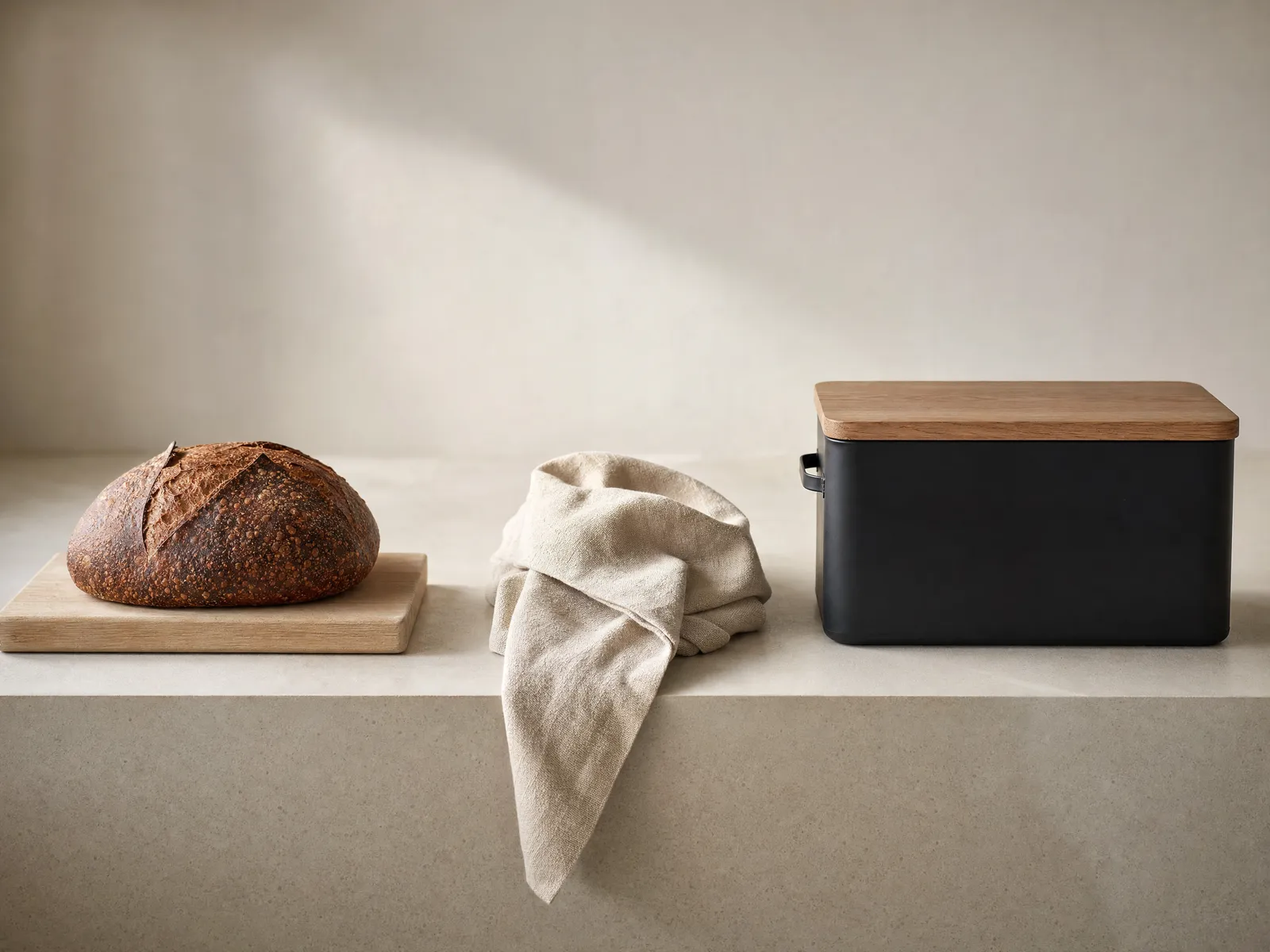
You are choosing which half of the loaf to sacrifice. A linen bag inside a closed bread bin is the best compromise we know of, and it is still a compromise. For a supermarket sandwich loaf the bag it came in genuinely suits it, because that bread is engineered around a soft crust in the first place. Slice and freeze whatever you will not eat in three days, and toast from frozen. We cover how to store bread without plastic, by loaf type, in its own article.
The Order We Would Do It In
Work down this list and stop when the problem goes away. The first three cost nothing.
- Wash and use the jars you already own. Free, and we earn nothing from it.
- Stop heating food in plastic. Microwave in glass or ceramic. Free, and the best-supported single change in this article.
- Use the crisper drawers properly and give greens humidity. Free, and it saves more food than any container purchase.
- Buy rectangular tempered-glass boxes with replaceable gaskets for leftovers, transport and oven-to-fridge. The one purchase most households need.
- Add one or two stainless steel tins for lunches and anything that gets dropped.
- Add silicone bags only if freezing flat is genuinely your constraint.
- Buy beeswax wraps last, for cheese, cut fruit and bowls, and only if you accept the one-year life.
- Retire the plastic you own as it fails, on condition, not in a weekend purge.
Two closing honesties. The first is that the health case is not as settled as either side says: FDA calls BPA safe at current dietary levels, EFSA cut its tolerable intake by a factor of 20,000, the EU banned it, and nobody has agreed a method for measuring microplastics in food, which is why EFSA's own advice is not due until the end of 2027. What is defensible today is heat, surface condition and keeping food from spoiling, three things you can act on without waiting for the science to resolve.
The second is that the cheapest swaps here are the best ones, the same pattern we found across the zero waste bathroom and across eco-friendly laundry. The durable thing wins because it deletes a repeat purchase. A cupboard of jars you did not pay for, a microwave you stop putting plastic in, and a crisper drawer set correctly get you most of the way. The rest is a short shopping list with the trade-offs written down.
Explore the full series
- The Best Plastic-Free Food Storage Containers We Tested — Five containers for five different jobs, with the lid problem nobody photographs.
- Is It Safe to Store Food in Plastic and What the Research Says — What the microplastics and leaching research actually shows, and where it stops.
- The Best Reusable Food Storage Bags for Ditching Ziploc — Silicone and cloth bags ranked, plus the seal that decides whether you keep using them.
- Beeswax Wraps and What They Actually Work On — The three foods they are genuinely good at, and the ones they quietly ruin.
- How to Freeze Food Without Plastic — Headspace, thermal shock and which containers crack at minus eighteen.
- Glass vs Stainless Steel vs Silicone for Food Storage — Three materials on the same seven axes, including the one nobody tests for.
- The Best Pantry Storage Jars for Bulk and Dry Goods — Gasket lids, decanting and whether the aesthetic pantry is worth the money.
- How to Keep Produce Fresh Without Plastic Bags — Which vegetables need humidity, which need air, and which need separating.
- Which Plastics Are Actually Microwave and Dishwasher Safe — The resin codes that matter, and why heat is the variable that changes everything.
- How to Store Bread Without Plastic — Why the fridge is the worst place for it, and what a bread box actually does.
How we score
What it’s made of.
Chemistry you’ll touch.
How long it lasts.
Where it goes after.
Each pick scores 0–5 on the four axes above, weighted into the composite verdict at the top. Scores are derived from what a product is verifiably made of and certified as — not how green its label looks.
About the author
Ruth Lopez
I'm Ruth Lopez and I'm a lover of nature and the environment. I'm very passionate about finding eco friendly products that don't damage the environment and also support companies that have the same philosophy.