Is It Safe to Store Food in Plastic and What the Research Says

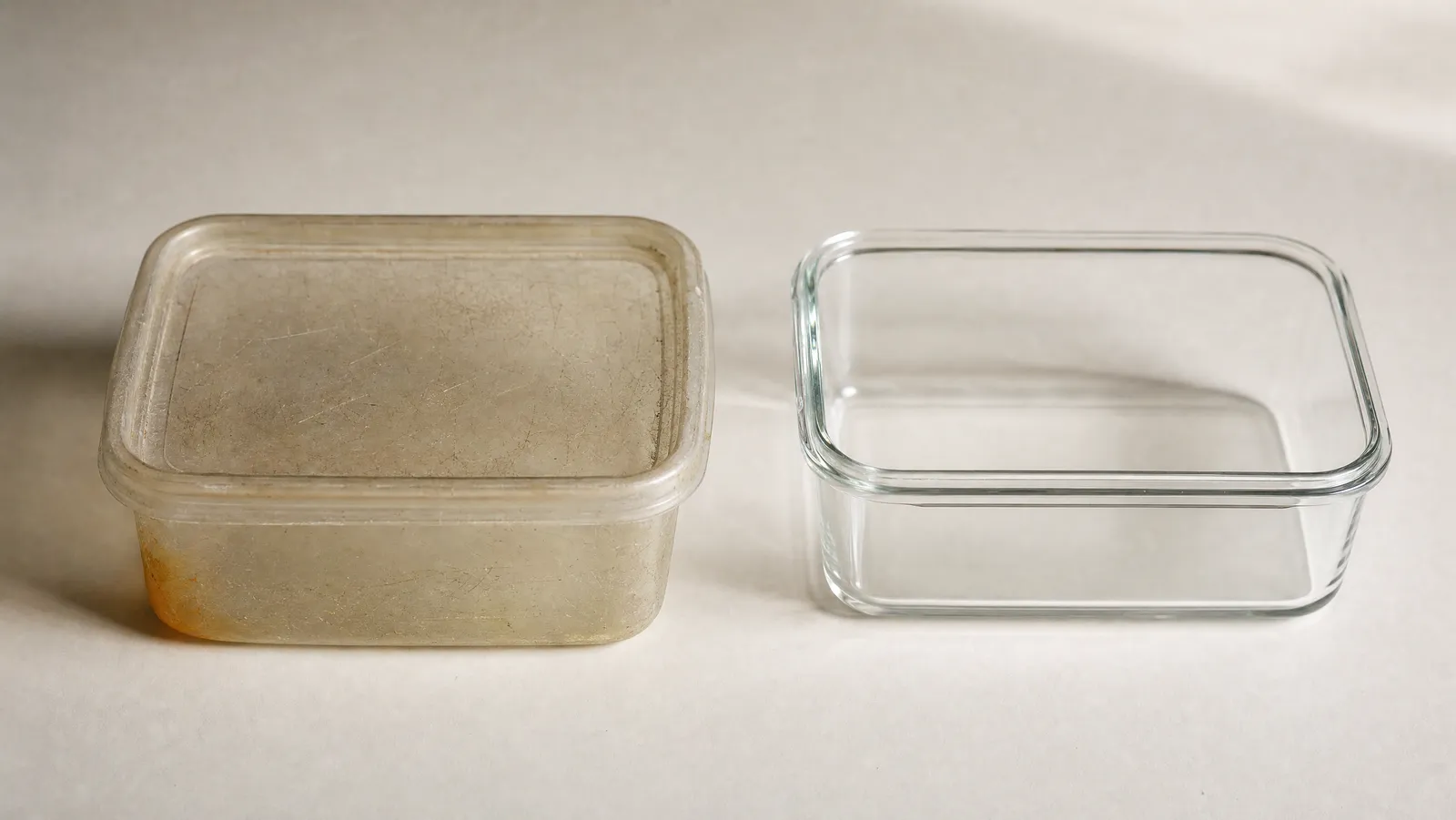
"Is plastic food storage safe" is three questions wearing one label. There is chemical migration — molecules that leave the plastic and end up in the food. There is particle shedding — the microplastic and nanoplastic fragments the material sloughs off as it wears. And there is heat, not a third risk so much as the multiplier on the first two.
Split that way, the literature gives a usable answer. For cold, short, undamaged storage the measured quantities are small and the evidence of human harm is thin. For heat — the microwave, hot food poured into a cold tub, the dishwasher — the evidence is far stronger, and none of it cares whether the lid says BPA-free. Most of the honest advice below is about behaviour, not about storing food without plastic entirely.
One thing up front: there are no products on this page and no affiliate links in it. We make nothing from this article either way. The subject is full of people with a tub to sell and people with a scare to sell, and we would rather be the third thing.
What is actually coming out of the container
In January 2024 Consumer Reports published results from testing 85 products — 67 supermarket items and 18 fast foods, 239 samples in all — bought between February and April 2023. It found phthalates, the plasticisers that make plastics flexible, "in nearly every food that was tested, often at high levels." Exactly one product showed no detection: a raspberry lime seltzer. Bisphenols turned up in 79 percent of samples, at levels Consumer Reports called much lower than when it last tested for BPA fifteen years earlier.
That gets misread in both directions. All the phthalate levels were within the limits set by US and European regulators — this is not a story about illegal food. But compliance is a statement about thresholds, not a demonstration of safety, and Consumer Reports said so.
Notice too that most of those foods were never in your Tupperware; they were processed, tubed and packaged industrially. Your own containers are one contributor to a far larger, mostly invisible exposure.
Heat is the variable, not the label
The clearest through-line in the migration literature is temperature.
According to Seref and Cufaoglu, writing in the Journal of Food Science in 2025 in a review of chemical migration from food packaging, "Although less migration occurs at freezing temperatures, the probability of migration increases as the temperature rises." The same review names the other levers: contact time, fat content — "the fat content in food can increase the movement of lipophilic substances from the package" — and acidity.
It also contains the most useful number we found for household purposes, and it is about wear, not heat. Summarising a 2013 study by Bhunia and colleagues on newborn baby bottles, the authors report BPA concentrations of "0.03 ppb at 40°C and 0.13 ppb at 95°C. However, after 10 uses, the concentration increased to 3.8 ppb, and this level persisted even after 100 uses."
Read that sequence. Going from 40 to 95 degrees roughly quadrupled migration. Against the 40°C figure, ten uses raised it by more than a hundredfold — though the review does not give the temperature for the ten-use measurement, so treat that multiple as indicative. Two things survive the caveat: repeated use matters at least as much as one hot exposure, and it plateaus rather than compounding indefinitely.
The microwave study, and what it does and does not show
The most-cited experiment on particle release is Hussain and colleagues at the University of Nebraska-Lincoln, published in Environmental Science and Technology in July 2023. The design, narrowly: two polypropylene baby food containers and one polyethylene pouch, all FDA-approved plastics, filled with deionised water or 3 percent acetic acid to stand in for acidic food, then microwaved at full power for three minutes in a 1,000-watt oven.
Some containers released as many as 4.22 million microplastic and 2.11 billion nanoplastic particles from a single square centimetre of plastic within three minutes of microwave heating. Crucially, the authors compared scenarios: microwave heating produced the highest release, above refrigeration and above room-temperature storage.
The caveats are not small. This was water and dilute vinegar, not food, and three containers is three containers. The accompanying cell work — only 23 percent of cultured human embryonic kidney cells survived the highest concentrations over two days — is cells in a dish at a modelled dose, not people eating lunch. And the paper drew enough published objection that the authors wrote a formal rebuttal to correspondence in the same journal in 2024.
It is not proof that a microwaved lunch harms you. It is proof that microwaving sheds particles, which is a different and much better-supported claim.
"Microwave safe" is a melting claim, not a shedding one
According to Keller and Heckman's PackagingLaw resource, "The U.S. Food and Drug Administration (FDA) has not issued any specific regulations on food packaging for microwave use."
Whatever clearance a manufacturer holds concerns migration under a declared condition of use: whether the material warps, melts or leaches past a limit at a given temperature. Nothing in it was built around particle counts. A microwave-safe symbol says the tub should survive the heat. It does not say the tub does not shed into your food, and it was never asked that question. We will cover which plastics are actually microwave and dishwasher safe separately.
Is BPA free plastic safe for food storage
Not automatically. When BPA became a liability, manufacturers reached for its nearest chemical cousins.
According to Johanna Rochester and Ashley Bolden, writing in Environmental Health Perspectives in 2015 in a systematic review of the two commonest substitutes, bisphenol S and bisphenol F show hormonal activity in the same range as BPA itself. Their pooled figures: average estrogenic potency relative to BPA was 1.07 for BPF and 0.32 for BPS, with wide ranges on both. One of the two common replacements tested about as estrogenic as the chemical it replaced. A 2022 study in PNAS points the same way, reporting that BPF and BPS "induce protumorigenic changes in human mammary gland organoid morphology and proteome" — in lab-grown tissue, not in people.
State the limits honestly, because they are real. Much of this evidence is in vitro or in rodents, and potency in a cell assay is not harm at dietary doses in humans. What it establishes is narrower, and Rochester and Bolden put it as a general problem with substitution: "many chemical replacements are untested before being placed on the market, and in some cases are similar enough to the original chemical to cause concern." Being not-BPA is not the same as having been shown to be safer. Exposure is widespread: in urine samples reviewed by Rochester and Bolden, BPS was detected in 78 percent and BPF in 55 percent of US samples.
"BPA-free" is a statement about one molecule. Treat it as a fact about the label, not a finding about the product.
The regulators genuinely disagree, and that is not a conspiracy
In April 2023 the European Food Safety Authority's panel on food contact materials re-evaluated BPA and set a new tolerable daily intake of 0.2 nanograms per kilogram of body weight per day — about 20,000 times lower than the temporary TDI of 4 micrograms per kilogram it set in 2015. EFSA concluded there is a health concern from dietary exposure, since previously estimated intakes sit two to three orders of magnitude above the new level. The Commission followed: Regulation (EU) 2024/3190, adopted 19 December 2024 and in force from 20 January 2025, prohibits BPA in food contact plastics, coatings, inks and adhesives, with staged transition periods and narrow exemptions.
The FDA reads an overlapping literature and reaches the opposite conclusion. Its consumer page on BPA in food contact applications states that "BPA is safe at the current levels occurring in foods," and that "the available information continues to support the safety of BPA for the currently approved uses in food containers and packaging."
It has withdrawn authorisations twice — polycarbonate baby bottles and sippy cups in July 2012, epoxy coatings in infant formula packaging in July 2013 — and the wording matters. An amendment of that kind, in the agency's words, "is not based on safety, but is based on the fact that the regulatory authorization is no longer necessary for the specific use of the food additive because that use has been permanently and completely abandoned." Industry stopped using it; the FDA tidied the rulebook.
Europe is not unanimous either. Germany's risk assessment body, the BfR, published its dissent (Opinion 018/2023) the same month, saying it "does not support the new TDI derived by EFSA due to several scientific and methodological divergencies" and deriving its own tolerable daily intake of 0.2 micrograms per kilogram of body weight per day — a thousand times higher than EFSA's.
Our position: this is a disagreement about how much weight to give low-dose endocrine endpoints, not a case of one side hiding data. Anyone telling you the answer is obvious has not read both opinions.
Microplastics: real particles, contested numbers, unestablished effects
Here the internet runs fastest and the evidence moves slowest.
The particles are real and they are in food. What they do to people is not established. The FDA published a page on micro- and nanoplastics in food in July 2024 stating that "Current scientific evidence does not demonstrate that levels of microplastics or nanoplastics detected in foods pose a risk to human health." It also names why the field is so noisy: there are no standardised methods for detecting, quantifying or characterising these particles, so many published studies have used methods of variable, questionable or limited accuracy and specificity.
The World Health Organization is in a similar holding pattern on drinking water. Jennifer de France, a WHO technical expert, put it plainly: "Based on the conclusions of our report, while we think that the risks to human health are low, this is based on a limited evidence base and we recognise that there is need for more research."
The cautionary tale is the study you have probably seen. In February 2025 Matthew Campen and colleagues reported in Nature Medicine a median of 4.9 milligrams of micro- and nanoplastics per gram of brain tissue across 24 post-mortem samples — the "spoonful of plastic in your brain" headline. It then drew serious objection. Martin Wagner and Phoebe Stapleton argued the investigators may have "massively overestimated the mass of microplastics," because brain lipids produce mass spectra similar to polyethylene. Duplicated images were later found in the supplementary material; Campen called the error "purely clerical," and Nature Medicine said it was "looking into the matter." Wagner's summary is the sentence we would put on the wall: "I think we should be more cautious about the limitations of our work before we tell people, 'You have a spoonful of plastics in your brain.'"
Read this as a field mid-argument, not as a settled danger and not as a debunking. Particles are being found. The quantities are disputed. The human health effects are, at present, not established.
Where your household microplastics actually come from
The dishwasher is the newly documented source. Elvis Okoffo and colleagues at the University of Queensland, publishing in ACS ES&T Water in 2025, estimated that a single dishwasher cycle with a full load of household plastic items releases about 920,000 micro and nano particles, scaled to roughly 33 million per household per year. Dishwashers combine the three things that destroy a polymer surface: detergent, abrasion and water up to 70 degrees Celsius.
Then the researchers' own framing, which press releases drop: "Despite the high number of particles released, the total mass released from plastic containers is low and is minor compared to other known sources of plastic pollution." Their figure is roughly 6 milligrams per person per year. Huge counts, tiny mass. Quoting only the first is how this subject goes wrong.
Textiles are the other domestic source worth acting on, with different enough mechanics that we handled them separately in how to stop your laundry from shedding microplastics.
Scratched and cloudy is the condition that matters
Everything above converges on one practical test that has nothing to do with the brand. A container put through hundreds of hot cycles has a physically different surface from a new one: micro-scratched, hazed, chalky, sometimes sticky. That is the surface that sheds. Keep our own distinction straight, though: the baby-bottle figures above are chemical migration, not shedding. What the two share is the condition under which each was measured highest — a worn, repeatedly heated surface.
If a tub is scratched, cloudy, warped, stained or crazed, retire it. That is the change here with the most evidence behind it per unit of effort, it applies to every plastic regardless of resin, and it costs one container rather than a kitchen refit.
Are plastic food storage bags safe
Bags are a lower-risk profile than tubs. A freezer or storage bag is thin polyethylene film used cold and briefly. Cold is the bottom of the migration curve, and bags are rarely microwaved, rarely dishwashed and rarely reused to the point of surface damage — which removes all three conditions driving the numbers above.
The honest cautions are narrower than the internet suggests. Do not microwave in a bag not sold for it, do not use one for sous vide unless the manufacturer says so, and do not decant hot food into one. Cold food, short storage, single use is the least concerning plastic contact in a normal kitchen. We will cover the freezer case separately in how to freeze food without plastic.
There is no such thing as certified microplastic free food storage
"Microplastic free" is an unregulated marketing claim. As the FDA has stated, no standardised method exists for detecting or quantifying microplastics — so there is no agreed test a manufacturer can pass, and we could find no standards body certifying the phrase. A glass jar does not shed polymer, which is a property of glass, not an achievement of the brand on it.
So what should you actually use instead
The best answer is the cheapest, and we make nothing from saying it: use the glass jars already in your house. Empty passata, jam and pickle jars cost nothing, are already made, and solve every problem here at once. The correct first step is not a purchase.
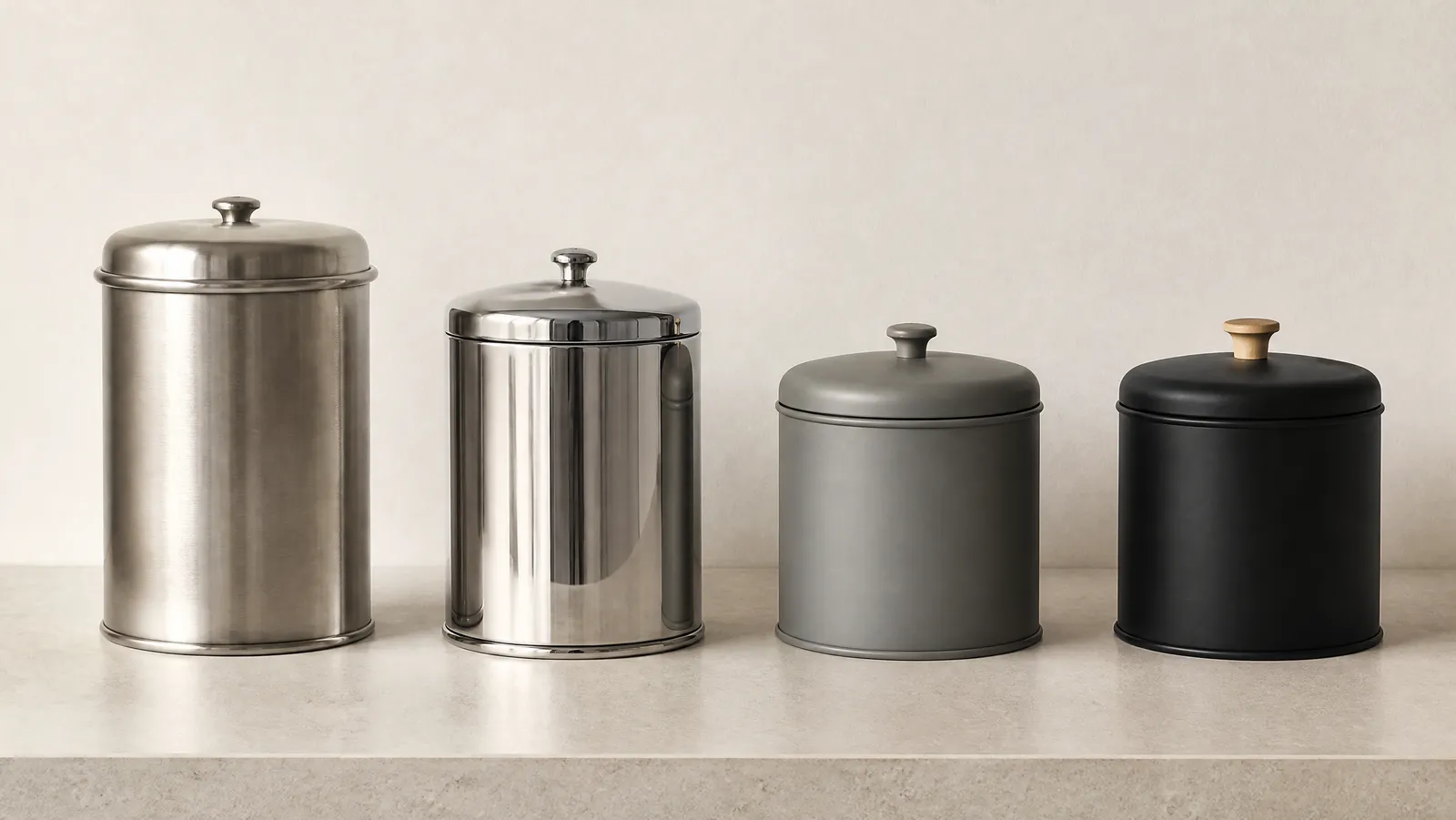
Beyond that the sensible materials are glass, stainless steel and, for covering a bowl, silicone — each with a trade-off worth naming. Glass is heavy, breaks, and is the worst option for a child's packed lunch. Steel cannot go in the microwave at all and hides what is inside it, which is how leftovers get forgotten. Silicone is a polymer, not glass — far more heat-stable than polypropylene, but not a synonym for inert.
If you would rather buy a set than improvise, we went through the market in the best plastic-free food storage containers, including where the compromises land.
What the evidence supports, and what is preference
Keep these two lists separate. Conflating them is how this subject makes people anxious for no return.
Evidence-backed, worth doing:
- Do not microwave food in plastic. Decant into ceramic or glass. The American Academy of Pediatrics advises: "Avoid microwaving food or beverages (including infant formula and pumped human milk) in plastic, if possible."
- Keep plastic containers out of the dishwasher. The AAP is explicit — "Do not put plastic food containers or utensils in the dishwasher" — and the Queensland work shows why.
- Let hot food cool before it goes into plastic, especially thin takeaway tubs, designed for one warm journey, not repeated thermal loading.
- Replace scratched, cloudy and warped containers rather than the whole cupboard.
- Prefer glass or steel for fatty and acidic foods — oil and acid both increase migration, per the Journal of Food Science review.
- Check the resin code if you want a simple filter. The AAP suggests avoiding codes 3, 6 and 7, associated respectively with phthalates, styrene and bisphenols.
Precautionary preference, not demonstrated risk:
- Binning every working plastic container. A new glass set has its own footprint, and cold storage in an undamaged tub is the least implicated scenario in the literature.
- Paying a premium for "microplastic free" labelling, which nobody certifies.
- Assuming BPA-free means safer. It means different.
- Treating any of this as a diagnosis. Nothing here says you have been harmed, and we cannot tell you what it means for your health.
The bottom line
Plastic food storage is not one risk with one answer. It is a set of conditions, and you control most of them. Cold, short, undamaged, non-fatty storage is the mild end. Hot food, microwaves, dishwashers, oily leftovers and a decade-old scratched tub are the other, and the gap between those ends is far larger than the gap between any two brands on a shelf.
Established: migration rises with heat, time, fat, acidity and wear. Suspected but unproven: that BPA replacements carry comparable hormonal activity at dietary doses. Honestly unknown: what the microplastics found in human tissue do, if anything, and in several cases how much is really there.
Change the behaviours at the top of that list, retire the containers that have earned it, and use the jars you already own for the rest. If you would rather move the kitchen off plastic properly, we have set out every plastic-free storage swap worth making, including the ones we think are not worth the money.
How we score
What it’s made of.
Chemistry you’ll touch.
How long it lasts.
Where it goes after.
Each pick scores 0–5 on the four axes above, weighted into the composite verdict at the top. Scores are derived from what a product is verifiably made of and certified as — not how green its label looks.
About the author
Ruth Lopez
I'm Ruth Lopez and I'm a lover of nature and the environment. I'm very passionate about finding eco friendly products that don't damage the environment and also support companies that have the same philosophy.