How to Freeze Food Without Plastic

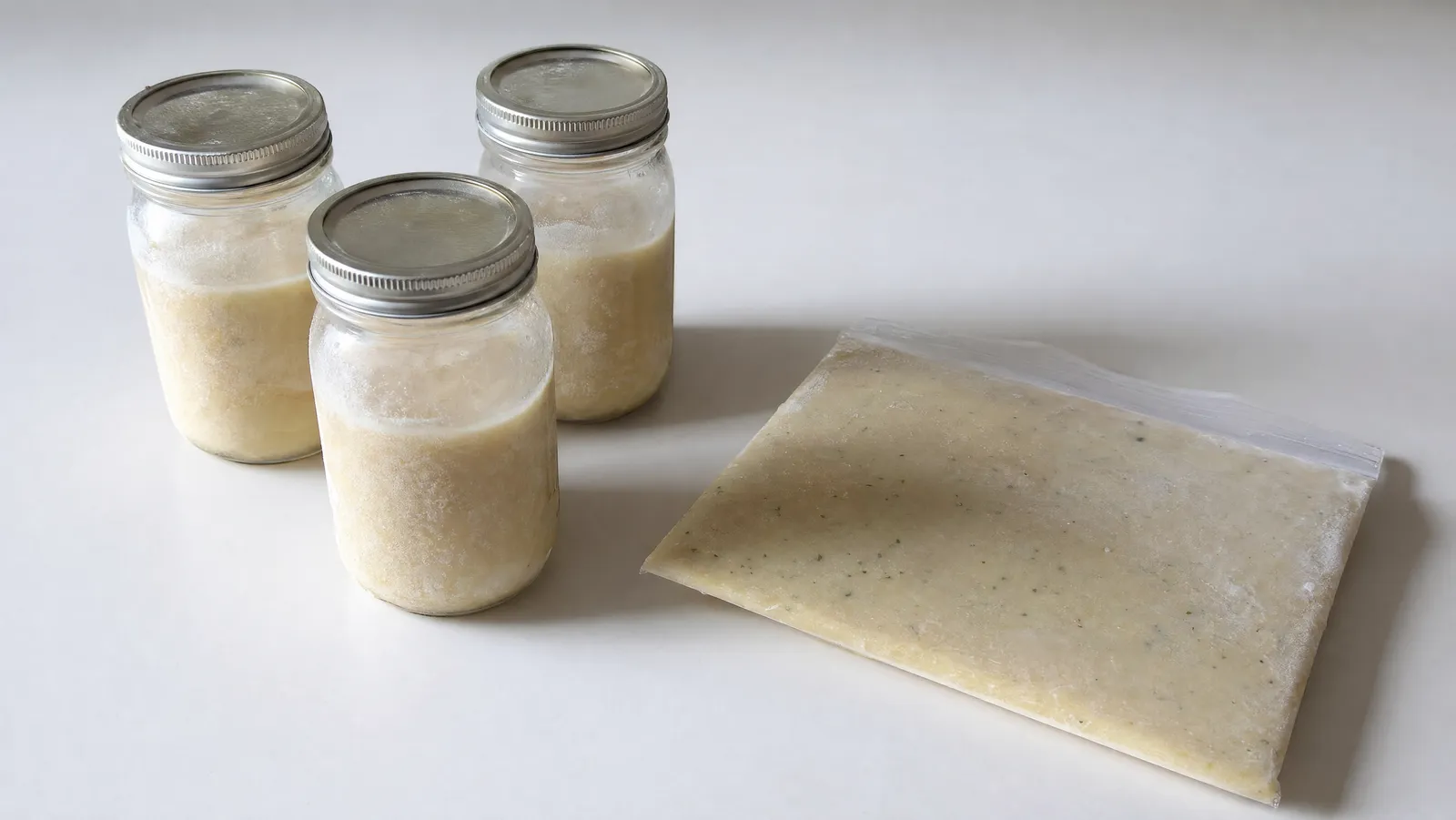
Freezing food without plastic is where plastic-free kitchen advice stops being an argument about chemistry and becomes an argument with physics. Three things wreck a plastic-free freezer, and most guides name one: expansion, which breaks glass; thermal shock, which breaks glass in the other direction; and air, which degrades the food whatever the container is made of. We may earn a commission when you buy through links on this page, at no cost to you.
Get those three right and the container question mostly answers itself. The job of a freezer container is to be an air barrier, and everything else is convenience. That is the test we applied to getting plastic out of food storage across the kitchen, and the freezer is where it bites hardest: this is the one place where the wrong container does not merely disappoint you. It cracks.
Freezer burn is an air problem, and not a safety problem
According to the USDA's Food Safety and Inspection Service, "Freezer burn does not make food unsafe, merely dry in spots. It appears as grayish-brown leathery spots and is caused by air coming in contact with the surface of the food." FSIS says to cut the burned portions away before or after cooking, and that heavily freezer-burned food "may have to be discarded for quality reasons." The failure mode people dread has one cause.
The same fact sheet is blunt about packaging: FSIS says it is safe to freeze meat or poultry directly in its original packaging, "however this type of wrap is permeable to air and quality may diminish over time," and that "for prolonged storage, overwrap these packages as you would any food for long-term storage."
Read that as the whole brief for a freezer container: it is a wall between food and air, not a material with the right label on it.
What a plastic-free freezer container has to be
The National Center for Home Food Preservation at the University of Georgia publishes the only requirements list worth memorising. Packaging materials must be:
- "Moisture vapor resistant"
- "Durable and leakproof"
- "Not become brittle and crack at low temperatures"
- "Resistant to oil, grease or water"
- "Protect foods from absorption of off flavors or odors"
- "Easy to seal"
- "Easy to mark"
Glass passes every line but one, and fails that one spectacularly: it does not turn brittle, but it breaks. NCHFP is explicit that "Regular glass jars break easily at freezer temperatures," and that if you use glass you should "choose wide mouth dual purpose jars made for freezing and canning," which have been tempered to withstand extremes in temperature.
Stainless steel passes all seven, and loses on price and on being opaque. Silicone is the only material here still flexible at minus 18 degrees Celsius, which is why it is the only one you can squeeze the air out of. It is also a polymer.
We are comparing glass versus stainless steel versus silicone in a separate piece. For rigid containers that survive a freezer, our picks and their compromises are in the best plastic-free food storage containers.
You probably do not need to buy anything
Wide-mouth jars already in your cupboard, plus half an inch of headspace discipline, cover most of what a household freezes, and that costs nothing. We make no money from that sentence and we have put it above the products deliberately.
Check the shape, because the maker publishes the answer. Ball's own step-by-step freezing guidance is that jars with straight or tapered sides can be used for freezing while shoulder jars — the ones that narrow towards the lid — should not be, since the shoulder closes in on the space the food is expanding into. North Dakota State University Extension puts it in one sentence: "Do not use regular, narrow-mouth canning jars for freezing foods packed in liquid."
The other free option irritates people. Wash and reuse the freezer bag you already own. Cold, brief, unheated contact with thin polyethylene is the least-implicated scenario in the migration literature, which is what we concluded in is it safe to store food in plastic. If your objection is the landfill rather than the chemistry, ten more uses from a bag you own beats a new silicone one, and we earn nothing from that either.
How much headspace to leave when freezing
This is the number that decides whether your glass survives. Water expands as it freezes — the US Geological Survey puts the density of ice at "about 9 percent" below that of liquid water — and that expansion is what splits a jar at its narrowest point. NCHFP publishes the figures:
- Liquid pack, wide top: half an inch for a pint, 1 inch for a quart
- Liquid pack, narrow top: three-quarters of an inch for a pint, 1.5 inches for a quart
- Dry pack: half an inch, whatever the mouth and whatever the size
- Juices, wide top: half an inch for a pint, 1 inch for a quart
- Juices, narrow top: 1.5 inches, pint or quart
A dry pack, in NCHFP's footnote, is "Fruit or vegetable packed without added sugar or liquid." Foods needing no headspace at all: loose-packing vegetables such as asparagus and broccoli, bony pieces of meat, tray-packed foods and breads.
A narrow mouth costs half again as much headspace, and NCHFP's stated reason is that expansion of the food during freezing can break the jar at the neck. So the wide mouth earns its place twice: it survives expansion where the glass is weakest, and it is the only shape a frozen block comes out of without thawing first.
Thermal shock runs in both directions
On the way in, it is warm food meeting cold glass. Cool first, and not only to save the glass — NDSU: "Cool all foods and syrup before packing. This speeds up freezing and helps retain natural color, flavor and texture." The University of Nebraska-Lincoln's food programme gives the method: "Cool foods to refrigerator temperature before bagging them for your freezer," reached by standing "a shallow container of food on a cooling rack" for about 20 to 30 minutes, with the depth limited to 2 inches.
On the way out, it is the manufacturer instruction almost everybody breaks. Pyrex's published safety and usage instructions say "AVOID sudden temperature changes, to avoid the risk of breakage," rule out adding liquid to hot glassware, and state flatly: "DO NOT transfer directly from freezer to hot oven." Thaw in the refrigerator instead: FSIS names three safe methods — "in the refrigerator, in cold water, or in the microwave" — and for cold water specifies a leakproof bag and water changed every 30 minutes.
"Borosilicate" and "tempered" are real properties, and neither is a freezer certification. Tempering leaves compressive stress at the glass surface, so more stress has to be applied before a crack starts: Vitro Architectural Glass puts heat-strengthened glass at "approximately twice as strong as annealed, or untreated, glass" and fully tempered at "four to five times stronger." Those are glazing figures, not kitchenware, and no jar maker we could find publishes a thermal-shock rating for freezer use. What is established for a household comes from the food-preservation people, not the glass industry: use jars sold for freezing, leave the headspace, change temperature slowly.
Getting the air out without a vacuum sealer
NCHFP's instruction runs to two sentences: "Pack foods tightly leaving as little air as possible in the package," and "Seal rigid containers carefully. Use a tight lid and keep the sealing edge free from moisture or food to ensure a good closure." A smear of soup on the rim is a failed seal.
- Bags, silicone or plastic. NDSU: "Beginning at the bottom of the bag, press firmly moving toward the top of the bag to prevent air from re-entering," or "force the air out by placing the filled bag in a bowl of cold water taking care that no water enters the bag." That is the closest a kitchen gets to a vacuum seal.
- Jars. You cannot remove the headspace air and must not try: that space is the expansion allowance. Match the jar to the portion so the headspace is the minimum the table allows, and move jarred food through in weeks rather than a year.
- Steel. Fill it. An opaque box half full of stew is a half box of air.
Here is the tension nobody in plastic-free content admits: the headspace that stops your jar breaking is also the air that causes freezer burn. A jar is a compromise, not a superior container, and you manage it by eating through the freezer rather than by buying a better jar.
Label it, and check the freezer is actually cold
"Easy to mark" is on NCHFP's list for a reason, and its labelling instruction is specific: "Label each package, including the name of the product, any added ingredients, packaging date, the number of servings of amount, and the form of the food, such as whole, sliced, etc." Freezer tape and a marking pen are what NCHFP names for the job, noting that freezer tape "is especially designed to stick at freezing temperatures" — which an ordinary printed sticky label is not. Steel needs it most, because it tells you nothing through the wall.
Most of the quality loss attributed to a container is a freezer running warm. The FDA's number: "The freezer temperature should be 0° F (-18° C)." FSIS explains why it matters — "Food stored constantly at 0 °F will always be safe. Only the quality suffers with lengthy freezer storage" — and advises keeping a thermometer in the freezer. Two loading rules from NDSU cost nothing: "Do not overload the freezer with unfrozen food. Add only the amount that will freeze within 24 hours," and "Leave space between packages so air can circulate freely."
The space problem, stated honestly
The flat zip-top bag is the most space-efficient freezer format ever designed, and the round jar is the least. A frozen slab files like a book. A quart jar is a cylinder, and a circle fills only about 79 percent of the square it sits in, before you count the lid band and the fact that a jar does not stack on a jar. Plastic-free storage can only lose less.
- Freeze flat in a bag. The University of Nebraska-Lincoln puts both benefits together: "Speed freezing and hasten thawing by freezing foods in a thin, flattened shape in freezer bags," because "a rounded shape takes longer to thaw through to the middle. Flatter packages also will stack better in your freezer."
- Standardise on one or two jar sizes, straight-sided or tapered, so a shelf becomes a grid rather than a jumble of diameters.
- Freeze the portion you will cook. A jar half emptied goes back with a jar's worth of air on what is left.
If space rather than plastic is your binding constraint, a reusable bag is the honest answer, and we said as much in the best reusable food storage bags.
Ball Wide Mouth Quart Mason Jars are the pick for soups and stocks
The Ball wide-mouth quart two-pack is the format the guidance names rather than one a brand invented: two 32 oz wide-mouth jars with lids and bands, 16.50 dollars as of September 2026. Ball states they are BPA-free, made in the USA, and sold for canning, preserving and storing. The closure is a two-piece metal lid and screw band rather than a plastic lid — the only closure on this page that is not a polymer. Set against the table above: a quart, liquid pack, wide top, so leave 1 inch of headspace and no more. The wide neck is what lets a frozen block come out.
Three trade-offs, none small. At 16.50 dollars for two, this is 8.25 dollars a jar, which is dear for a canning jar. Glass is the one material here that can break in a freezer if you overfill it, and it fails at the neck, where you cannot see the stress building. And a round quart is the least space-efficient shape a freezer shelf can hold.
Ball Wide Mouth 16 oz Six Pack is the cheapest route to single portions
Six wide-mouth pints for 22.56 dollars as of September 2026 against a 24.92 list, a 9 percent reduction and about 3.76 dollars a jar. That makes the Ball 16 oz six-pack the cheapest honest route to a freezer full of single portions, and the pint is the size household batch cooking actually produces. Ball states the glass is heat resistant and USDA certified food grade, and made in the USA.
Two things a plastic-free site has to say out loud, both from the maker's own listing. The lids are grommeted plastic — Ball describes them as grommeted with an airtight seal for leakproof fermentation and "made out of BPA free plastics, so no rusting happens over time." The glass is what touches the food; the seal is not plastic-free. For a closure with no polymer in it, buy the quart set above. And the listing makes no freezer claim at all. These are marketed for kombucha, kefir, pickling and canning. Freezing is our inference from the shape, not a use Ball certifies here.
Stasher Half Gallon is the only pick here that freezes flat
The Stasher half-gallon bag is 21.99 dollars as of September 2026 for one 64 oz platinum food-grade silicone bag with a Pinch-Loc seal. Stasher states it is free from lead, latex, phthalates, BPA and BPS, that it is freezer safe, and that it also handles the dishwasher, the microwave, the oven to 425F and sous vide, under a lifetime warranty against damage through normal use. Its own care note: avoid turning the bag inside out, as that can cause it to rip.
Its job is the one thing glass and steel cannot do. It freezes flat, the single biggest space saving available in a home freezer and the format the Nebraska guidance above recommends for stacking and faster thawing.
Three costs, all real. 21.99 dollars buys one bag. It is slow to dry after washing. And it is a polymer: silicone is more heat-stable than polyethylene, but it is not glass, so if your reason for leaving plastic behind was the chemistry rather than the bin, this pick does not answer it.
What not to freeze in
- Thin takeaway and deli tubs. NCHFP's requirement that packaging "not become brittle and crack at low temperatures" is the line they fail.
- Drinking glasses and tumblers. NCHFP's warning about regular glass jars breaking easily at freezer temperatures applies to them with more force, not less.
- Shoulder jars. Ball's own freezing guidance excludes them, and no amount of headspace fixes a shape that narrows above the food.
- Cardboard cartons from ice cream, milk or cottage cheese. NCHFP says they are not sufficiently moisture vapour resistant for long-term freezer storage unless lined with a freezer bag or wrap, and that wax paper is not moisture-vapour resistant either.
- Any mismatched or warped lid. NCHFP's instruction to keep the sealing edge clean assumes a lid that fits.
- Anything you cannot fill with headspace. A jar filled to the rim and screwed shut is a cracked jar with a date on it.
The bottom line
Freezing food without plastic is a method problem first and a shopping problem a distant second. Cool the food, leave the headspace the table says, use a wide mouth, get the air out, label it, hold the freezer at 0°F and turn things over in weeks rather than years. Do that with the jars already in your cupboard and most of it is solved for nothing.
If you are buying, buy for the job: the wide-mouth quart at 16.50 dollars for two as of September 2026 for stock, at the price of the worst shape on the shelf; the 16 oz six-pack at 22.56 dollars for single portions, with a plastic lid and no freezer claim; the Stasher at 21.99 dollars if you need flat, and still a polymer.
Keep the two failure modes straight, because they pull against each other: too little headspace breaks the jar, and too much air ruins the food. Everything above is a way of living between those numbers. The rest of the kitchen is in the plastic-free food storage guide.
What we tested

The exact jar format the freezing guidance actually names
- Material
- Tempered Glass & Silicone
- Credentials
- Plastic-freeHeadspace-checked
The only pick here that closes with metal rather than plastic, in exactly the wide-mouth quart format the freezing guidance names, and wide enough at the neck that a frozen block of stock comes out in one piece.
No major drawbacks noted in testing.
Two 32 oz wide-mouth jars with lids and bands for 16.50 dollars as of September 2026. Ball states they are BPA-free and made in the USA and describes them as jars for canning, preserving and storing, and the closure is a two-piece metal lid and screw band rather than a plastic lid. The wide-mouth quart is the format the National Center for Home Food Preservation names for freezing, and the wide neck is what lets a frozen block come out. Against that: 8.25 dollars a jar is dear, glass can break if you overfill it, and a round quart is the least space-efficient shape a freezer shelf holds.

Six wide mouth pints with a plastic lid we are not going to gloss over
- Material
- Tempered Glass & Silicone
- Credentials
- Plastic-freeHeadspace-checked
At about 3.76 dollars a jar this is the least expensive way to get six wide-mouth pints into a cupboard, and the pint is the portion size most batch cooking actually produces rather than the one a catalogue imagines.
No major drawbacks noted in testing.
Six wide-mouth 16 oz jars at 22.56 dollars as of September 2026 against a 24.92 list, a 9 percent reduction and about 3.76 dollars a jar. That is the cheapest honest route to a freezer full of single portions, and the pint is the size most household batch cooking wants. Ball states the glass is heat resistant and USDA certified food grade and made in the USA. The lids are the compromise and the maker says so: grommeted plastic, described by Ball as made out of BPA free plastics. The listing markets these for kombucha, kefir, pickling and canning, and makes no freezer claim at all.

The only pick on this page that freezes flat
- Material
- Tempered Glass & Silicone
- Credentials
- Plastic-freeHeadspace-checked
Nothing rigid on this page can freeze flat, and flat is the largest space saving available in a home freezer. Frozen on its side, one bag files like a book instead of occupying a shelf.
No major drawbacks noted in testing.
One 64 oz platinum food-grade silicone bag with a Pinch-Loc seal at 21.99 dollars as of September 2026. Stasher states it is free from lead, latex, phthalates, BPA and BPS, that it is freezer safe, and that it also takes the dishwasher, the microwave, the oven to 425F and sous vide, under a lifetime warranty against damage through normal use. It is the only format here that freezes flat, the biggest single space saving a home freezer offers. Three costs: 21.99 dollars buys one bag, it is slow to dry after washing, and it is a polymer rather than glass.
Compared, side by side
| Spec | Best for Soups and StocksBall Wide Mouth Quart Mason Jars with Lids and Bands, Set of 2 | Best for Single PortionsBall Wide Mouth 16 oz Glass Mason Jars with Airtight Lids, 6 Pack | Best for Flat-FreezingStasher Premium Silicone Reusable Food Storage Half Gallon Bag, 64 oz |
|---|---|---|---|
| Verdict | Solid | Solid | Solid |
| Composite | 3.8/5 | 3.8/5 | 3.8/5 |
| Materials | 4.1 | 4.1 | 4.1 |
| Health | 3.9 | 3.9 | 3.9 |
| Durability | 4.3 | 4.3 | 4.3 |
| End-of-life | 2.8 | 2.8 | 2.8 |
| Price | — | — | — |
| Get it | Check price | Check price | Check price |
How we score
What it’s made of.
Chemistry you’ll touch.
How long it lasts.
Where it goes after.
Each pick scores 0–5 on the four axes above, weighted into the composite verdict at the top. Scores are derived from what a product is verifiably made of and certified as — not how green its label looks.
About the author
Ruth Lopez
I'm Ruth Lopez and I'm a lover of nature and the environment. I'm very passionate about finding eco friendly products that don't damage the environment and also support companies that have the same philosophy.