Which Plastics Are Actually Microwave and Dishwasher Safe

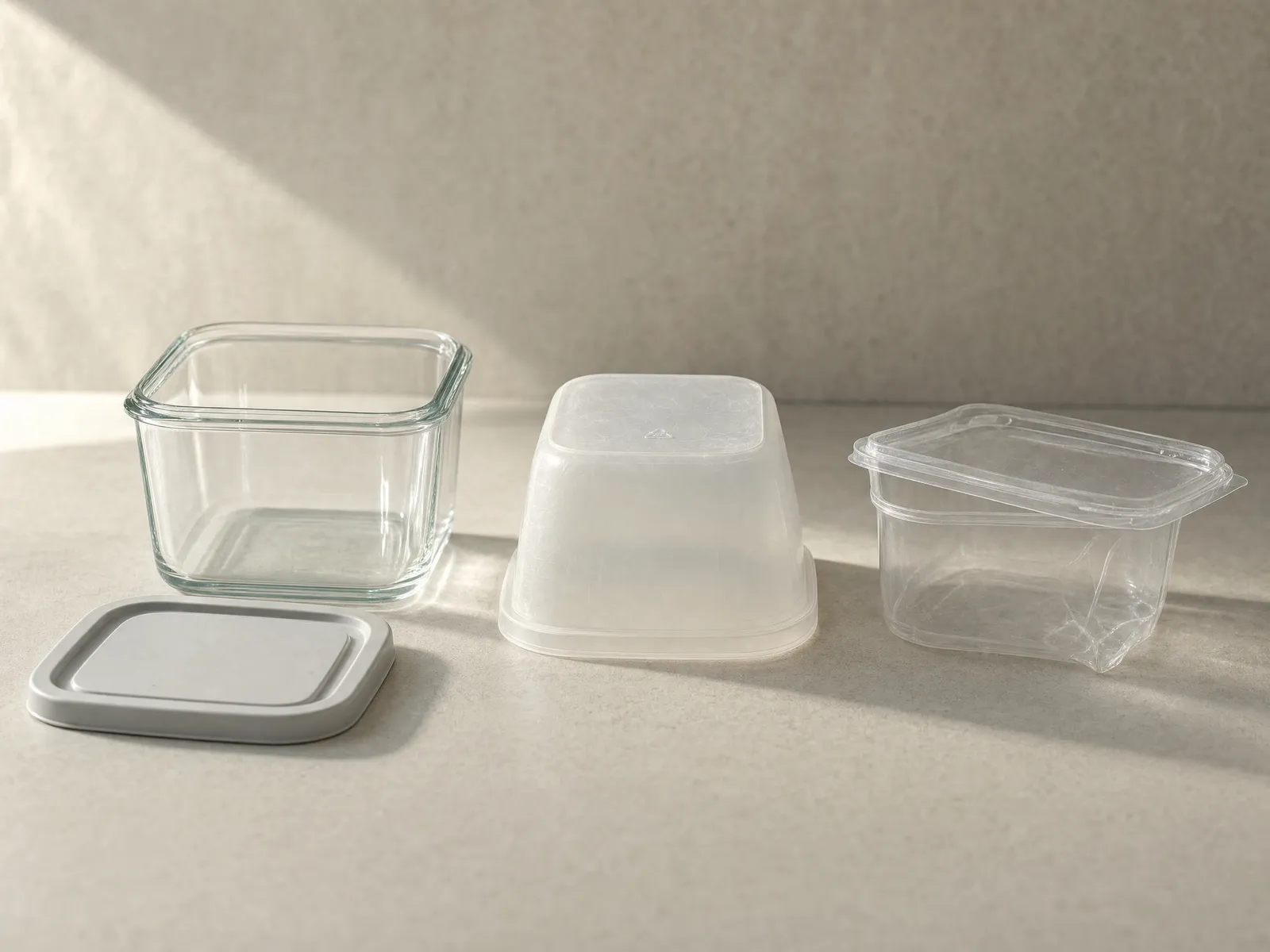
The number in the triangle on the bottom of your tub is a recycling sorting code, not a safety grade. Code 5, polypropylene, is what most reusable tubs and most genuinely microwave-rated containers are made of, because it tolerates heat better than the other resins a kitchen meets - but no plastic is "safe" in a microwave in the way most people mean. We may earn a commission when you buy through links on this page, at no cost to you.
So the sorting rule you need is about heat, and heat alone. That is better news for your cupboard than it sounds, because most of what is in there can stay exactly where it is. This is the last instalment of our series on plastic-free food storage, and it is the one written for the reader who is not going to replace forty containers this weekend.
One thing we are not doing: recommending a better plastic. There is no best-microwave-safe-plastic-container pick below, on purpose. We are explaining the codes so you can judge what you own.
Recycling codes and food safety are two different questions
The 1-to-7 system is an industry sorting scheme. It is now administered as ASTM D7611, and the standard is unusually blunt about its purpose: "Resin Identification Codes are used solely to identify the plastic resin used in a manufactured article." The same document states that the codes "are not 'recycle codes,'" bars the word "recyclable" from being printed near them, and notes that the practice "is based upon the system developed in 1988 by the Society of the Plastics Industry, Inc (SPI)."
Notice what is absent from that purpose: no food-contact grade, no temperature rating, no heat clearance. A resin code tells a sorting line what a thing is made of. It was never a message to the person eating out of it.
It is not much of a recycling promise either. The Center for Science in the Public Interest puts it plainly: "Plastic resin codes identify the type of plastic the product is made of," and "there are really only recycling markets for 1 and 2," with "very few" communities taking code 5.
Which plastics are safe for food storage, code by code
These are the typical materials behind each number, per the Center for Science in the Public Interest's listing, which also advises checking your own containers rather than assuming.
- 1, PET or PETE. Water and soda bottles, peanut butter jars, thin berry and deli tubs. Built thin, built once, built cold. Not a repeat-heat container.
- 2, HDPE. Milk jugs, detergent and shampoo bottles, some tubs. One of only two resins with a real recycling market, and rarely the material of a microwave-rated dish.
- 3, PVC or V. Pipe, tubing, vinyl, auto-product bottles. The one you least want anywhere near heat or fat.
- 4, LDPE. Film, bags, bread wrap, squeezable bottles. Flexible because of its branched, low-density structure rather than added softeners - the plasticiser story belongs to PVC.
- 5, PP, polypropylene. Yoghurt pots, straws, coffee-cup lids, amber pill bottles - and almost every reusable food tub and microwave-rated lid in your kitchen. This is the number worth knowing.
- 6, PS, polystyrene. Foam cups, egg cartons, takeaway clamshells, rigid disposable cups. The other one to keep out of the heat, and the one with the clearest published failure.
- 7, Other. A catch-all: toys, sippy cups, disposable utensils, CDs. Historically where polycarbonate sat, which is the entire BPA story, and also where bio-based plastics such as PLA sit. Its only reliable property is that it tells you nothing.
Is number 5 plastic safe, and what polypropylene food storage actually buys you
Code 5 earns its reputation on one axis: it holds its shape at temperatures that deform the others. Hong Kong's Centre for Food Safety, reporting a joint study with the Consumer Council on disposable containers, concluded that the expanded polystyrene, polystyrene and PET samples "are considered not suitable for holding food at temperatures of over 100oC" - 212F - and that for hotter food, containers "with relatively better heat resistance properties, such as PP plastic containers, should be considered," or the food should be cooled first.
The test result underneath is the part worth keeping. One polystyrene container exceeded the overall migration limit at 120 degrees Celsius (248F) with a fatty-food simulant, and met the same standard at 100 degrees Celsius. Same container, same simulant, different temperature, different answer. That is the whole article in one data point.
So polypropylene food storage is genuinely the better plastic for heat - a real but narrow physical advantage, and not a clearance for the microwave.
What does microwave safe mean on a label
Less than you would guess, and it is not the FDA's claim. According to Keller and Heckman's PackagingLaw resource, "The U.S. Food and Drug Administration (FDA) has not issued any specific regulations on food packaging for microwave use." Clearances run instead through lettered conditions of use, which are temperature categories. The firm's note says that "a clearance for Condition of Use A or B would permit use under standard microwave cooking temperatures," while Condition J, "Cooking at temperatures exceeding 250°F," is the one microwave susceptor materials need.
The wavy-lines symbol itself is a manufacturer's mark. The Chicago Council on Science and Technology's write-up notes that manufacturers add the logo themselves, that it will not tell you how long or how often a container can be heated, and that such logos "are not regulated by the FDA." Dr. Timothy Duncan, a chemist in the FDA's Human Foods Program, is quoted there saying the mark "helps people understand when microwave heating is less likely to deform or melt a plastic container," and also the uncomfortable part: "The microwaved product's temperature may rise high enough that its chemicals leach into the food at unsafe levels."
So "microwave safe" is a claim about the container surviving the heat, not a claim about what the container does to the food. We made the narrow version of that point in whether it is safe to store food in plastic. The practical consequence is the rest of this page.
The one hard prohibition in official advice is about disposables. The USDA's Food Safety and Inspection Service states that "plastic storage containers such as margarine tubs, take-out containers, whipped topping bowls, and other one-time use containers should not be used in microwave ovens," because "these containers can warp or melt, possibly causing harmful chemicals to migrate into the food."
Why heat is the variable that changes everything
Temperature is the lever everything else hangs off. In their 2025 review in the Journal of Food Science, Seref and Cufaoglu list the factors driving chemical migration into food as temperature, contact time, the chemical composition of the packaging, "the structure of the food (e.g., fat content, water activity, acidity)" and the size of the contact surface. Hot, fatty and acidic are the three properties that push migration up, and a reheated curry is all three at once.
The measured version is in a 2021 paper in the journal Foods by Ajaj and colleagues, who tested styrene coming out of polystyrene food-contact materials. Migration rose as the simulants went from low to high fat content, and rose with temperature across the 5 degrees Celsius (41F) to 70 degrees Celsius (158F) range they tested, though not every step in it reached significance. Format mattered as much as material: cups released at most 0.110 micrograms per millilitre, while food containers reached up to 6 micrograms per millilitre.
Particles are the newer and noisier half. In July 2023, Kazi Albab Hussain and colleagues at the University of Nebraska-Lincoln published work in Environmental Science and Technology in which two polypropylene baby-food containers and a polyethylene pouch were filled with water or 3 percent acetic acid and microwaved at full power for three minutes in a 1,000-watt oven. They estimated that one square centimetre of plastic could release as many as 4.22 million microplastic and 2.11 billion nanoplastic particles, and found microwave heating released more than refrigeration or room-temperature storage - though six months of either released millions to billions too.
Hold both halves of that: three containers, filled with water and dilute vinegar rather than food. Set against it, the FDA's page on micro- and nanoplastics in food says that "current scientific evidence does not demonstrate that levels of microplastics or nanoplastics detected in foods pose a risk to human health," partly because "there are no standardized methods for how to detect, quantify, or characterize microplastics and nanoplastics." What the Nebraska work establishes is that microwaving sheds particles. What nobody can yet tell you is what that does to a person. We do not know. That is the accurate sentence.
What a dishwasher cycle does that the fridge does not
The dishwasher is the other heat event in a tub's life, and it happens hundreds of times.
The evidence here is thinner, and should be labelled as thinner. The closest direct work we found is Selina Tisler and Jan H. Christensen's 2022 study in the Journal of Hazardous Materials, on reusable plastic drinks bottles rather than food tubs. They detected "more than 400 plastic- and more than 3500 dishwashing-related compounds," found that dishwashing "was found to enhance chemical migration," and reported more than 400 compounds still migrating after a cold-water rinse. Bottles are not tubs, so read it as direction rather than dose.
Mechanically the case is firmer. Researchers with Australia's National Environmental Science Program report that "solid-state thermal aging acts as a critical preconditioning step that enhances mechanically driven fragmentation" of polypropylene, and that "thermal preconditioning exerts a stronger influence on microplastic release than agitation intensity." They name "repeated dishwasher cycles, microwave heating, or other high-temperature consumer exposures" as scenarios risk assessments should include. Heat weakens the polymer; mechanical stress then takes pieces off it.
The dishwasher is a measurable particle source in its own right. Dr Elvis Okoffo and colleagues at the University of Queensland estimated that one cycle with a full load of household plastic items releases about 920,000 micro and nano particles, roughly 33 million per household per year - but by mass about 6 milligrams per person per year, which the team likens to a quarter of a grain of rice. Enormous counts, trivial mass. Quote only the first and you have misled someone.
"Top rack only" is a thermal instruction rather than a shelf preference. The usual explanation, which is an explanation rather than a published manufacturer rationale, is that the heating element sits at the bottom of the tub; that does not hold for every modern machine, since some have no exposed element, but the label is the manufacturer telling you the part is heat-sensitive. The thing to act on is the surface: a crazed, clouded, scratched tub is a worse container than the same tub was new - and it is the one judgement here you can make with your eyes.
The ten-minute cupboard sort, which costs nothing
This is the free part, it is the most valuable part, and we earn nothing from a word of it. Open the cupboard, pick up each container, and route it.
- Cold and dry storage: keep it. Rice, pasta, nuts, leftovers going straight into the fridge. Cold is the bottom of the migration curve, and keeping what you own is the lower-waste choice.
- Hot, fatty or acidic food: move it to glass. Tomato sauce, curry, chilli, anything oily, anything poured in hot. Those are the food properties Seref and Cufaoglu name as drivers.
- Reheating: the glass goes in and the lid comes off. It is the highest-heat moment in a container's life and the fix costs nothing.
- Dishwashing: glass on either rack, plastic lids on the top rack or in the sink.
- Retire it if it is crazed, cloudy, warped, stained, deeply scratched or still smelling of its last meal. That is one container, not a kitchen refit.
- Never: a single-use tub in the microwave. Takeaway boxes, yoghurt pots, deli and margarine tubs, exactly as the Food Safety and Inspection Service says above.
If something fails the sort, that is the moment to replace it, and we put the three materials worth replacing it with head to head in glass versus stainless steel versus silicone.
What BPA-free tells you and what it does not
It tells you about one molecule. When bisphenol A became a liability, manufacturers reached for its nearest relatives, bisphenol S and bisphenol F. According to Johanna Rochester and Ashley Bolden, writing in Environmental Health Perspectives in 2015 in a systematic review of 32 studies, most studies found BPS and BPF acting like BPA in estrogenic, antiestrogenic, androgenic and antiandrogenic assays, at potencies within the same order of magnitude, BPS generally the weaker. Their conclusion: "BPS and BPF are as hormonally active as BPA." UCLA Health has also reported 2016 work in PLOS Genetics, done in roundworms, in which BPS damaged egg cells at lower doses than BPA.
Be careful with that in both directions. Most of this work is in vitro or in animals, and potency in a cell assay is not harm at dietary doses. The honest reading is that "BPA-free" answers a narrower question than the shopper thinks it does - not that the label is meaningless, and not that the substitutes are proven worse.
Note what the label does not cover. "BPA-free" is silent on heat tolerance, on particle shedding and on the condition of the surface. Every plastic lid in the picks below is BPA-free, and not one of their makers claims the lid takes heat.
Three glass dishes whose own labels prove the rule
These are a coda, not the point, and they are here for one pattern: every maker below sells a glass vessel rated for heat beside a plastic lid that is not rated for heat, and says so in its own copy. You can apply that rule tonight, with containers you already own.
The Pyrex 7202 four-pack is 26.99 dollars as of October 2026 for four 1-cup bowls and four lids, made in the USA. Pyrex describes "durable tempered glass and a BPA-free plastic lid," states that "the bowl is microwave-, preheated oven-, refrigerator-, and freezer-safe," and then claims for the lid only that it is "refrigerator- and freezer-safe," with "top-rack dishwasher-safe" for the lid against dishwasher-safe for the glass. One maker, drawing our line. The cost is capacity: one cup is a sauce or a snack rather than dinner, and 26.99 dollars for four cups of total volume is dear per ounce.
The Zulay Kitchen five-pack is 39.99 dollars as of October 2026, down from a 49.99 list, a 20 percent reduction, for five 36 oz borosilicate containers with removable silicone sealing rings. Zulay states the glass "can withstand heat up to 600 degrees Fahrenheit," which is a maker claim about the glass rather than a figure anyone tested for us, and it says nothing of the sort about the lid. Then it prints the sentence this article exists to teach: "Lids and silicone rings need to be removed when heating food in the microwave or oven." The cost is at the sink: Zulay says the containers take either dishwasher rack but recommends the lids be hand washed - five lids, by hand, forever.
The OXO Good Grips two-dish set is 42.37 dollars as of October 2026, down from a 49.98 list, a 15 percent reduction, for a 3 Qt 9x13 and a 2 Qt 8x8. OXO states the dishes are "made from borosilicate glass to withstand extreme temperature changes without the risk of cracking or shattering" - thermal shock, the property that separates a dish you can move from freezer to oven from one that cracks, and the property we work through, format by format, in how to freeze food without plastic. The pattern holds: OXO calls the lid "BPA-free" and "sloshproof" and makes no heat claim for it at all. It is the most expensive line here, these are baking dishes before they are storage boxes, and 9x13 is a large footprint for a fridge shelf. For a set chosen as storage first, see the best plastic-free food storage containers.
The bottom line
The code on the bottom of the tub is a sorting number rather than a safety grade, and the rule that replaces it is about heat: cold storage in whatever you already own, hot and fatty and acidic in glass, and the lid off whenever something goes in the microwave. Keep this page if:
- Your cupboard is full of code 5 tubs in good condition. Keep them and use them cold. That is the lower-waste answer and it costs nothing.
- You reheat in plastic most days. This is the habit to change, not the cupboard. Decant into glass and leave the lid on the counter.
- Something is crazed, cloudy, warped or stained. Retire that one container, not the cupboard.
- You want a dish for the freezer-to-oven run. Borosilicate, per OXO's own thermal-shock claim, 42.37 dollars as of October 2026 for the pair.
The rest of the kitchen, swap by swap, is in our complete plastic-free kitchen storage guide.
What we tested

Two sentences from one maker drawing this article s line for us
- Material
- Polypropylene, PET & Borosilicate
- Credentials
- No-buyHeat-led
The only pick here cheap enough to buy as a demonstration: a maker who sells you a plastic lid and declines, in its own feature text, to claim that the lid takes heat.
No major drawbacks noted in testing.
Four 1-cup bowls and four lids for 26.99 dollars as of October 2026, made in the USA. Pyrex describes "durable tempered glass and a BPA-free plastic lid," states that "the bowl is microwave-, preheated oven-, refrigerator-, and freezer-safe," and then claims for the lid only that it is "refrigerator- and freezer-safe" - with "top-rack dishwasher-safe" for the lid against dishwasher-safe for the glass. The job is the single-portion reheat, where the glass goes in and the lid comes off. The cost is capacity: one cup is a sauce or a snack rather than dinner, and 26.99 dollars for four cups of total volume is dear per ounce.

The pick whose own listing prints the rule out loud
- Material
- Polypropylene, PET & Borosilicate
- Credentials
- No-buyHeat-led
This is the only pick on the page that states the article's rule in the maker's own words, in the meal-sized format where reheating actually happens.
No major drawbacks noted in testing.
Five 36 oz borosilicate containers with removable silicone sealing rings, 39.99 dollars as of October 2026 down from a 49.99 list, a 20 percent reduction. Zulay states the glass "can withstand heat up to 600 degrees Fahrenheit" - a maker claim about the glass only, not a tested figure and not about the lid - and then prints the sentence this article exists to teach: "Lids and silicone rings need to be removed when heating food in the microwave or oven." The cost is at the sink. Zulay says the containers take either dishwasher rack but recommends the lids be hand washed, which is five lids by hand, forever.

Borosilicate for the thermal shock end of the argument
- Material
- Polypropylene, PET & Borosilicate
- Credentials
- No-buyHeat-led
The only pick here whose maker makes an explicit temperature-change claim, which is the difference between a dish that survives the freezer-to-oven run and one that does not.
No major drawbacks noted in testing.
A 3 Qt 9x13 and a 2 Qt 8x8 for 42.37 dollars as of October 2026, down from a 49.98 list, a 15 percent reduction. OXO states the dishes are "made from borosilicate glass to withstand extreme temperature changes without the risk of cracking or shattering," which is the one property that separates a dish you can move from freezer to oven from one that cracks, and it describes the lid as "BPA-free" and "sloshproof." Three costs: OXO makes no heat claim for that lid at all, these are baking dishes before they are storage boxes, and 9x13 is a large footprint for a fridge shelf. It is also the most expensive line on the page.
Compared, side by side
| Spec | The Cheapest Honest Reheat DishPyrex 7202 1-Cup Glass Bowls & Dark Blue Lids (4-Pack) - Made in USA | Best for Reheating Real MealsZulay Kitchen Glass Storage Containers with Lids, Premium BPA Free 36oz, 5 Pack | Best for the Freezer-to-Oven RunOXO Good Grips Freezer-to-Oven Safe Glass Baking Dishes with Lids, 3 Qt (9 x 13) and 2 Qt (8 x 8) |
|---|---|---|---|
| Verdict | Solid | Solid | Solid |
| Composite | 3.7/5 | 3.7/5 | 3.7/5 |
| Materials | 3.7 | 3.7 | 3.7 |
| Health | 3.7 | 3.7 | 3.7 |
| Durability | 4.3 | 4.3 | 4.3 |
| End-of-life | 3.2 | 3.2 | 3.2 |
| Price | — | — | — |
| Get it | Check price | Check price | Check price |
How we score
What it’s made of.
Chemistry you’ll touch.
How long it lasts.
Where it goes after.
Each pick scores 0–5 on the four axes above, weighted into the composite verdict at the top. Scores are derived from what a product is verifiably made of and certified as — not how green its label looks.
About the author
Ruth Lopez
I'm Ruth Lopez and I'm a lover of nature and the environment. I'm very passionate about finding eco friendly products that don't damage the environment and also support companies that have the same philosophy.