The Best Plastic-Free Food Storage Containers We Tested

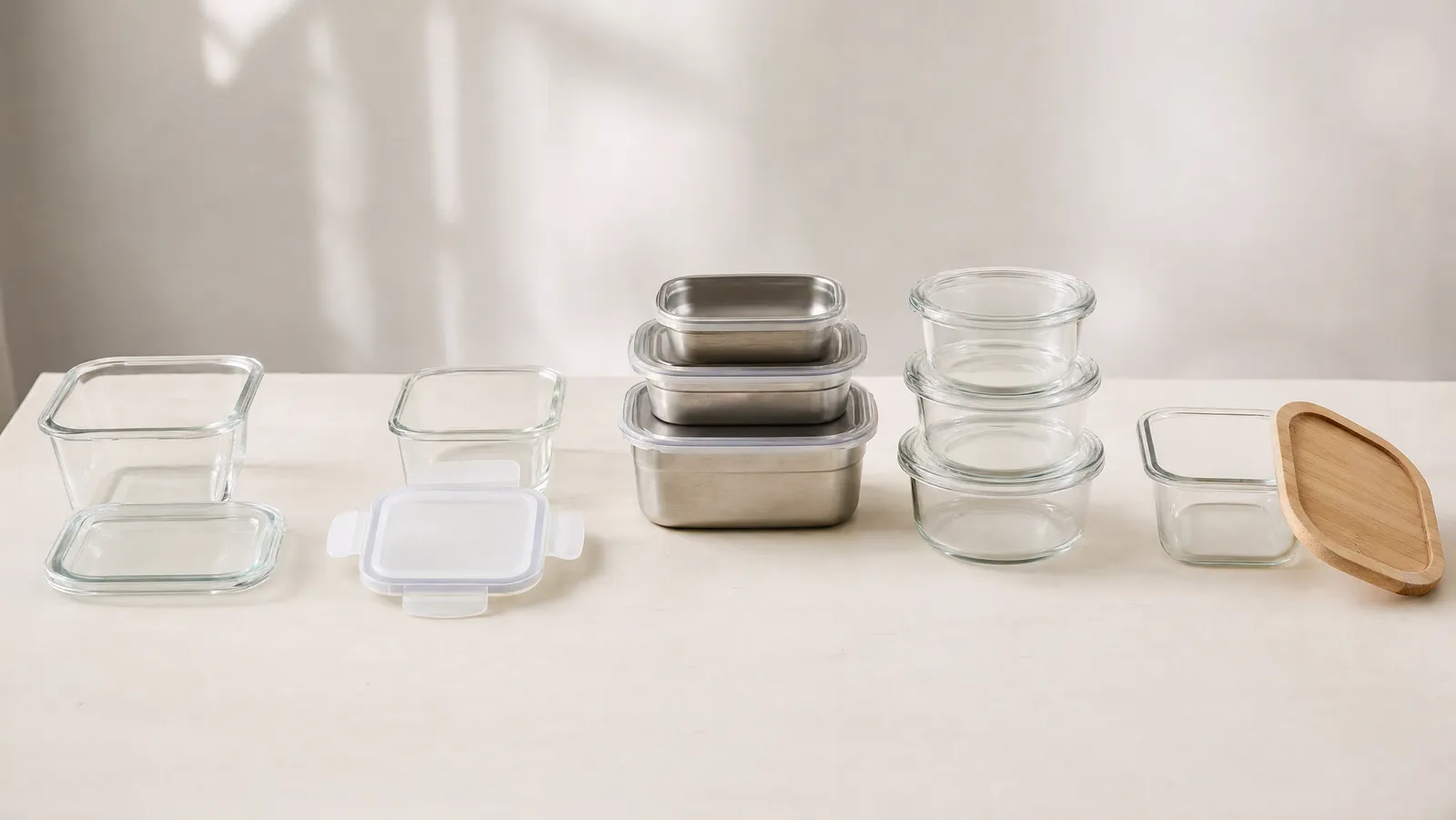
The best plastic-free food storage containers are the ones where the lid is glass too, because the lid is the part this category almost always gets wrong. Two of the five sets below do that. The other three put a plastic snap lid on a borosilicate body and are sold in the plastic-free aisle anyway. We may earn a commission when you buy through links on this page, at no cost to you.
That distinction organises everything here. A glass box with a polypropylene lid and a silicone gasket is glass where you can see it and plastic where the heat, the moisture and the friction are. That is still less plastic against your food than a stack of plastic tubs. It is not what the word on the box says. We have held every pick on this page to the lid, not the body, which is the same test we apply to the rest of plastic-free food storage.
The lid is where plastic-free food storage containers stop being plastic-free
The best evidence for treating the closure as the main event comes from drinks rather than leftovers.
In a study published in the Journal of Food Composition and Analysis in May 2025, France's food and environmental health agency ANSES measured microplastics in packaged drinks and found the opposite of what it expected. Glass bottles of cola, lemonade, iced tea and beer carried "around 100 microplastic particles per litre" — a level ANSES puts at five to 50 times higher than plastic bottles or cans. The particles were not shedding from the glass. The agency reports that they were "mostly the same colour and had the same composition as the paint on the caps," and that the caps carried "tiny scratches that were invisible to the naked eye" from rubbing together in storage. Blowing the caps with air and rinsing them cut contamination from an average of 287 particles per litre to 87; air alone got it to 106.
Two caveats, because this is a field where the press releases run ahead of the data. ANSES itself says that "in the absence of toxicological reference data, it is not possible to say whether the levels of microplastics found pose a health risk." And in September 2025 researchers led by Jane Muncke of the Food Packaging Forum published a comment in the same journal, arguing that counting particles per litre overstates contamination in the smaller glass bottles. Treat it as a pointer, not a verdict — nobody has run the equivalent test on a snap-lid lunch box.
The pointer is still worth having: the part of a glass container that abrades, flexes, gets clamped shut, heated and scrubbed is the lid. It is the same mechanism we traced in the washing machine, where the microplastics your laundry sheds come off the fabric under mechanical stress rather than out of the detergent bottle.
The best non-plastic food storage container is one you already own
Before any of this: a clean glass jar does most of this job for nothing, and we make no money telling you so.
Pasta sauce jars, jam jars and anything sold with a twist-off metal cap are food-grade glass, and most have already been through a hot-fill line. They are round, so they waste fridge space, but for soup, stock, grains, pulses, sauces and cut fruit they substitute directly for a plastic tub.
Two limits, from the people who make the jars.
- Do not bake in them. Ball, the canning brand whose jars Newell Brands makes under licence, states that it does not recommend baking in any size or shape of Ball or Kerr canning jar, because the glass is not tempered for oven use and is not intended as bakeware. Its guidance also rules out the microwave, and a pasta sauce jar has even less claim to oven safety than a canning jar does.
- Mind the shape in the freezer. Ball's freezing guidance is that tapered and straight-sided jars are freezer safe while shoulder jars are not, and that rigid containers need half an inch of headspace for liquid to expand into.
One caveat: the white ring inside that metal lid is usually plastisol, which packaging suppliers such as Container and Packaging describe as a flow-in compound, usually a dispersion of PVC resins in plasticisers, that forms the sealing gasket. Even the free option is glass with a plastic seal. That is the baseline every set below has to justify its price against.
Is the plastic in the lid actually harming you
This is the question everyone actually wants answered, and the regulators do not agree on it.
In April 2023 the European Food Safety Authority re-evaluated bisphenol A and set a tolerable daily intake of 0.2 nanograms per kilogram of body weight per day — roughly 20,000 times lower than its previous temporary TDI of 4 micrograms per kilogram — and concluded that dietary exposure to BPA is a health concern for consumers in all age groups. The US Food and Drug Administration has not moved. Its published position, resting on a four-year review completed in 2014 covering more than 300 studies, is that "BPA is safe at the current levels occurring in foods," and when it removed BPA from baby bottles, sippy cups and infant formula packaging in 2012 and 2013 it was explicit that an amendment based on abandonment "is not based on safety." EFSA's figure is contested from the other direction too: a 2024 paper in Toxicological Sciences, funded by the American Chemistry Council, argued the evidence EFSA assessed "does not support lowering the temporary tolerable daily intake for bisphenol A."
On microplastics the finding people cite is real and narrow. In Environmental Science and Technology in 2023, Kazi Albab Hussain and colleagues at the University of Nebraska-Lincoln reported that microwave heating released far more micro- and nanoplastic than refrigeration or room-temperature storage, with some containers shedding as many as 4.22 million microplastic and 2.11 billion nanoplastic particles from a single square centimetre in three minutes. That was measured into food simulants, deionised water and 3 percent acetic acid, not into dinner, and the authors are clear that the health consequences of ingesting these particles are not established.
Our position: the evidence is good enough to stop microwaving food in plastic, which costs you nothing, and not good enough to support panic. We go through the studies properly in is it safe to store food in plastic.
What actually separates these plastic free food containers
Five things, in the order they will matter.
Lid material and seal. Glass lid with a silicone gasket, plastic snap lid with a silicone gasket, or a silicone lid stretched over steel. Only the first removes rigid plastic from the equation, and all three still use silicone somewhere.
Silicone is not nothing. It is a polymer built from siloxane units, and it is not inert. In a 2022 report titled Half Baked, the European consumer organisation BEUC and nine of its national members tested 44 silicone baking moulds and found 23 percent released volatile constituents at high or increasing levels, while substances of concern turned up in 82 percent of samples "albeit at low levels." BEUC's own summary is measured: "while none of the tested products in isolation may endanger human health," the results show room to improve. Germany's BfR recommends that food-contact silicone lose no more than 0.5 percent of its weight in volatiles after four hours at 200C, and Asensio and colleagues, writing in Food and Chemical Toxicology in 2022, found two of four commercially bought cupcake moulds failed that threshold. Read that as a reason to be wary of silicone bakeware, not of a fridge seal — a cold gasket against cold food is far gentler duty than a mould of hot cake batter.
Thermal limits, and which part they apply to. Borosilicate resists thermal shock because it barely expands: SCHOTT's data sheet for DURAN borosilicate 3.3 gives a mean linear thermal expansion of 3.3 x 10 to the minus 6 per kelvin, and the DURAN Group quotes a resistance to temperature change of 100 kelvin. Kitchen glass is not laboratory glass, though, and the figures on a container listing are the maker's own. Pyrex's published safety instructions are the practical version: avoid sudden temperature changes, never add liquid to hot glassware or stand it on a wet or cool surface, let hot glassware cool before refrigerating or freezing, and never move it straight from the freezer to a hot oven.
Whether it survives a bag, and whether you can see inside. Glass loses the first outright and wins the second. Steel is the reverse, and being unable to see inside sounds petty until you own three opaque boxes of leftovers.
Urban Green Glass Food Storage Containers is the best plastic free glass food storage set here
The Urban Green four-pack is our Best Overall for one reason: it is the only set on this page whose glass lid also seals. Four rectangular 35 oz borosilicate containers with semi-tempered glass lids sealed by silicone, at 42.99 dollars as of September 2026. Urban Green states the containers are oven safe, the glass lid is not, and the set is microwave safe with the lid on provided the air vent stays open. Containers and lids are both dishwasher safe, which none of the plastic-lidded sets below can say.
Two trade-offs. At 42.99 dollars for four this is the most expensive per container here, roughly four times the HOMBERKING's per-piece price, and it comes in one size only. And the maker's own slogan — Urban Green markets the set as "No Plastic, Not Plastic, Plastic Free!" — rests on counting the silicone seal as not-plastic. Silicone is a different polymer family from polypropylene, but the BEUC work above shows it is not inert, and the honest description is a set with no rigid plastic rather than no synthetic polymer at all. We still think it is the right pick. We just think the box overstates it.
HOMBERKING 8 Pack is the value answer if you accept a plastic lid
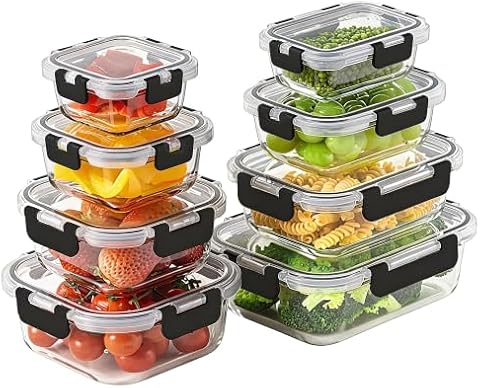
The HOMBERKING eight-pack is 20.98 dollars as of September 2026 against a 23.99 list, which works out at roughly 2.60 dollars a container, and it is the set we would buy if the budget decided it.
The lids are plastic with a silicone gasket, and HOMBERKING says they are not dishwasher safe. That is the entire trade, and it belongs at the top of this entry rather than the bottom: glass where the food sits, plastic where the seal is, plus a hand-washing chore forever. Everything else is good value. You get eight sizes, four rectangular at 6.8, 12.5, 21.6 and 35.2 oz and four square at 5, 10.8, 17.6 and 27.1 oz, so something in the stack actually fits a half avocado. HOMBERKING rates the borosilicate from minus 4F to 752F and calls it oven, microwave and freezer safe, and advises separating the containers when you stack them so friction does not chip them. Follow that advice.
Sustainable Containables Stainless Steel is the pick for bags and lunchboxes
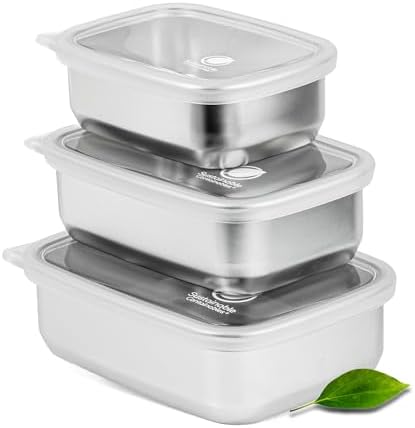
Start with the disqualifier: steel cannot go in a microwave, and for a lot of households that ends the conversation. If lunch is eaten cold, or a glass box in a rucksack is a disaster waiting to happen, the Sustainable Containables nested three-pack is the only unbreakable option here, at 36.99 dollars as of September 2026 for 20, 30 and 40 oz.
It is 18/8 stainless, the maker cites resistance to stains and odours, and the lids are clear platinum silicone that Sustainable Containables calls airtight and leakproof and states are plastic-free, BPA-free, BPS-free and phthalate-free. It is freezer, oven and dishwasher safe, it nests down to the size of the biggest tub, and it carries a two-year warranty against manufacturing defects.
Two more honest notes. It is opaque, so what is inside is a guess until you open it. And steel is not perfectly inert: Kamerud, Hobbie and Anderson reported in the Journal of Agricultural and Food Chemistry in 2013 that simmering tomato sauce in stainless steel raised nickel concentrations up to 26-fold and chromium up to 7-fold after six hours. That was hours of hot acidic cooking, not cold storage, and the paper's concern is the "approximately 10% of people" it says are afflicted by systemic dermatitis from nickel rather than the general population. Store cold food in steel and those conditions do not apply.
Magic Mill 24 Piece Set is the big set for a whole-cupboard swap
If you are replacing everything at once, the Magic Mill 24-piece set gives you twelve borosilicate containers and twelve lids for 36.99 dollars as of September 2026. The shapes are the argument: rectangles at 35, 21.5 and 12 oz, squares at 27, 17.5 and 11 oz and rounds at 32, 21 and 13.5 oz, all between 1.75 and 2.3 inches tall, shallow enough to line up across a shelf rather than stack. Magic Mill calls the snap-locking silicone-sealed lids airtight and leak-proof, rates the glass to 752F or 400C in the oven and microwave with the lids off, and says the set is freezer safe and BPA-free.
The trade-offs are the HOMBERKING's lid compromise plus a volume problem. These are plastic snap lids on glass bodies, so this set answers the quantity question, not the plastic-free one. And twelve containers is more than most households ever have full at once, so the per-piece price only counts if the 11 oz squares get used rather than colonising a drawer. Buy it for a meal-prep routine you already have, not one you are hoping to start.
VERDESSA Bamboo Rim is the fridge-to-table set, and not a lunchbox
The VERDESSA four-pack is the one you would carry to a table. Four 27 oz borosilicate containers, 3 inches high by 6.5 long by 4.7 wide, with a glass lid set into a bamboo frame, at 38.45 dollars as of September 2026 against a 44.99 list. VERDESSA describes the design as plastic-free, says the base withstands up to 400C and is microwave, oven, freezer and dishwasher safe with the lid removed first. With the Urban Green, it is one of only two sets here that keeps rigid plastic out of the closure.
Then read the small print, because the maker is unusually candid. VERDESSA says the lid does not lock or latch and is not designed for leakproof travel, and that it is hand wash only. This is a fridge-and-table container at a lunchbox price. Buy it if you serve from the fridge and care what the dish looks like on a table; buy the Urban Green if you need a glass lid that seals, or the steel if the container is going anywhere.
What we would not buy in food storage containers without plastic
A short list of things marketed into this category that should not be.
- Anything described only as "BPA-free." It names one absent monomer, not the polymer the lid is made of. It is a marketing answer to a question you did not ask.
- Bamboo-lidded sets with no statement about the seal. A bamboo frame looks plastic-free and still needs a gasket. If the listing will not say what the gasket is, assume silicone at best.
- Glass with a locking lid you intend to microwave shut. Urban Green is the only set here that sanctions a lid-on microwave, and only with the air vent open. Nothing else here carries that permission.
- Any set bought to replace containers that still work. Throwing out functioning plastic to buy glass is a purchase, not a reduction. Retire the plastic as it warps, stains or cracks, starting with the pieces you heat.
Two adjacent questions are not settled here. We compare glass versus stainless steel versus silicone separately, and the best reusable food storage bags are a different article: a bag solves the sandwich problem these rigid boxes handle badly.
The bottom line
Buy for the lid, then for the shape of your fridge. If you want the category's promise kept, the Urban Green is the only four-pack here with a glass lid that seals, at 42.99 dollars as of September 2026, and it is dearer per container than anything else on the page. If price decides, the HOMBERKING at 20.98 dollars gets glass under your food tonight and asks you to hand-wash plastic lids forever. If the container travels, the steel set is the only one that survives being dropped. If you are re-equipping a kitchen, the Magic Mill gives twelve bodies for 36.99 dollars. If it goes on the table, the VERDESSA is the handsome one that cannot be trusted in a bag.
And if none of that moves you, wash out four pasta sauce jars and see how far they get you. We earn nothing from that, it is the least wasteful option here, and all you lose is the ability to stack neatly. The rest of the swaps that pay off, and the ones that do not, are in our full plastic-free kitchen storage guide.
What we tested

The only glass lid here that actually seals shut
- Material
- Borosilicate Glass & 304 Steel
- Credentials
- Plastic-freeLid-checked
It is the only set on this page with a glass lid that actually seals. The lid is glass and silicone, it goes in the dishwasher with the container, and nothing rigid and plastic touches your food.
No major drawbacks noted in testing.
Four rectangular 35 oz borosilicate containers whose lids are semi-tempered glass with a silicone seal rather than plastic, at 42.99 dollars as of September 2026. Urban Green rates the container as oven safe but the glass lid is not, and says the set is microwave safe with the lid on provided you leave the air vent open. Containers and lids are both dishwasher safe, which no plastic-lidded set here can claim. It is also the dearest per container on this page, and the maker's own plastic-free claim only works if you count silicone as not-plastic.
The cheapest honest way to get glass under your leftovers
- Material
- Borosilicate Glass & 304 Steel
- Credentials
- Plastic-freeLid-checked
At roughly 2.60 dollars a container it is the least expensive route out of a cupboard full of plastic tubs, and the eight-size ladder means something actually fits the half onion rather than swallowing it.
No major drawbacks noted in testing.
Eight borosilicate containers in eight sizes, four rectangular at 6.8, 12.5, 21.6 and 35.2 oz and four square at 5, 10.8, 17.6 and 27.1 oz, for 20.98 dollars as of September 2026 against a 23.99 list. HOMBERKING rates the glass from minus 4F to 752F and calls it oven, microwave and freezer safe. The lids are the trade and they are plastic with a silicone gasket, and the maker says they are not dishwasher safe. This is glass where the food sits and plastic where the seal is.
The one that survives a dropped bag and a school run
- Material
- Borosilicate Glass & 304 Steel
- Credentials
- Plastic-freeLid-checked
Nothing else here can be dropped on a tiled floor by a nine-year-old and carry on working, and the three sizes nest down to the footprint of the largest when they are empty.
No major drawbacks noted in testing.
Three nesting 18/8 stainless steel containers at 20, 30 and 40 oz for 36.99 dollars as of September 2026, with clear platinum silicone lids the maker describes as airtight and leakproof and states are plastic-free, BPA-free, BPS-free and phthalate-free. Sustainable Containables cites resistance to stains and odours, calls the set freezer, oven and dishwasher safe, and backs it with a two-year warranty against manufacturing defects. Steel cannot go in a microwave, and you cannot see what is inside without opening the lid.

For replacing an entire cupboard of plastic tubs in one order
- Material
- Borosilicate Glass & 304 Steel
- Credentials
- Plastic-freeLid-checked
Twelve glass bodies in three shapes for 36.99 dollars is the cheapest per-container price here after the HOMBERKING, and the shallow 1.75 to 2.3 inch heights stack in a fridge door-to-back without wasting a shelf.
No major drawbacks noted in testing.
Twelve borosilicate containers and twelve matching lids for 36.99 dollars as of September 2026, in three shapes, rectangles at 35, 21.5 and 12 oz, squares at 27, 17.5 and 11 oz and rounds at 32, 21 and 13.5 oz, standing 1.75 to 2.3 inches tall. Magic Mill calls the snap-locking silicone-sealed lids airtight and leak-proof and rates the glass to 752F or 400C with the lids off. The lids are plastic, and twelve containers is more than most households will ever have full at once.

The set you are willing to put on the table and not in a bag
- Material
- Borosilicate Glass & 304 Steel
- Credentials
- Plastic-freeLid-checked
A glass-and-bamboo lid is the only one here you would happily carry to a table in front of guests, and at 27 oz each these hold a side dish rather than a portion of leftovers.
No major drawbacks noted in testing.
Four 27 oz borosilicate containers, 3 inches high by 6.5 long by 4.7 wide, with a glass lid set in a bamboo frame, at 38.45 dollars as of September 2026 against a 44.99 list. VERDESSA calls the design plastic-free, states the base withstands up to 400C and says the base is microwave, oven, freezer and dishwasher safe with the lid removed first. The lid is hand wash only, and the maker says plainly that it does not lock or latch and is not made for leakproof travel.
The top three, compared
| Spec | Best OverallUrban Green Glass Food Storage Containers with Glass Lids, 4 Pack, 35 oz | Best ValueHOMBERKING 8 Pack Glass Food Storage Containers with Snap Locking Lids | Best for Lunches and TravelSustainable Containables Stainless Steel Food Storage Containers, Nested 3 Pack, 20/30/40 oz |
|---|---|---|---|
| Verdict | Solid | Solid | Solid |
| Composite | 4.1/5 | 4.1/5 | 4.1/5 |
| Materials | 4.1 | 4.1 | 4.1 |
| Health | 4.4 | 4.4 | 4.4 |
| Durability | 4.3 | 4.3 | 4.3 |
| End-of-life | 3.2 | 3.2 | 3.2 |
| Price | — | — | — |
| Get it | Check price | Check price | Check price |
How we score
What it’s made of.
Chemistry you’ll touch.
How long it lasts.
Where it goes after.
Each pick scores 0–5 on the four axes above, weighted into the composite verdict at the top. Scores are derived from what a product is verifiably made of and certified as — not how green its label looks.
About the author
Ruth Lopez
I'm Ruth Lopez and I'm a lover of nature and the environment. I'm very passionate about finding eco friendly products that don't damage the environment and also support companies that have the same philosophy.