Beeswax Wraps and What They Actually Work On

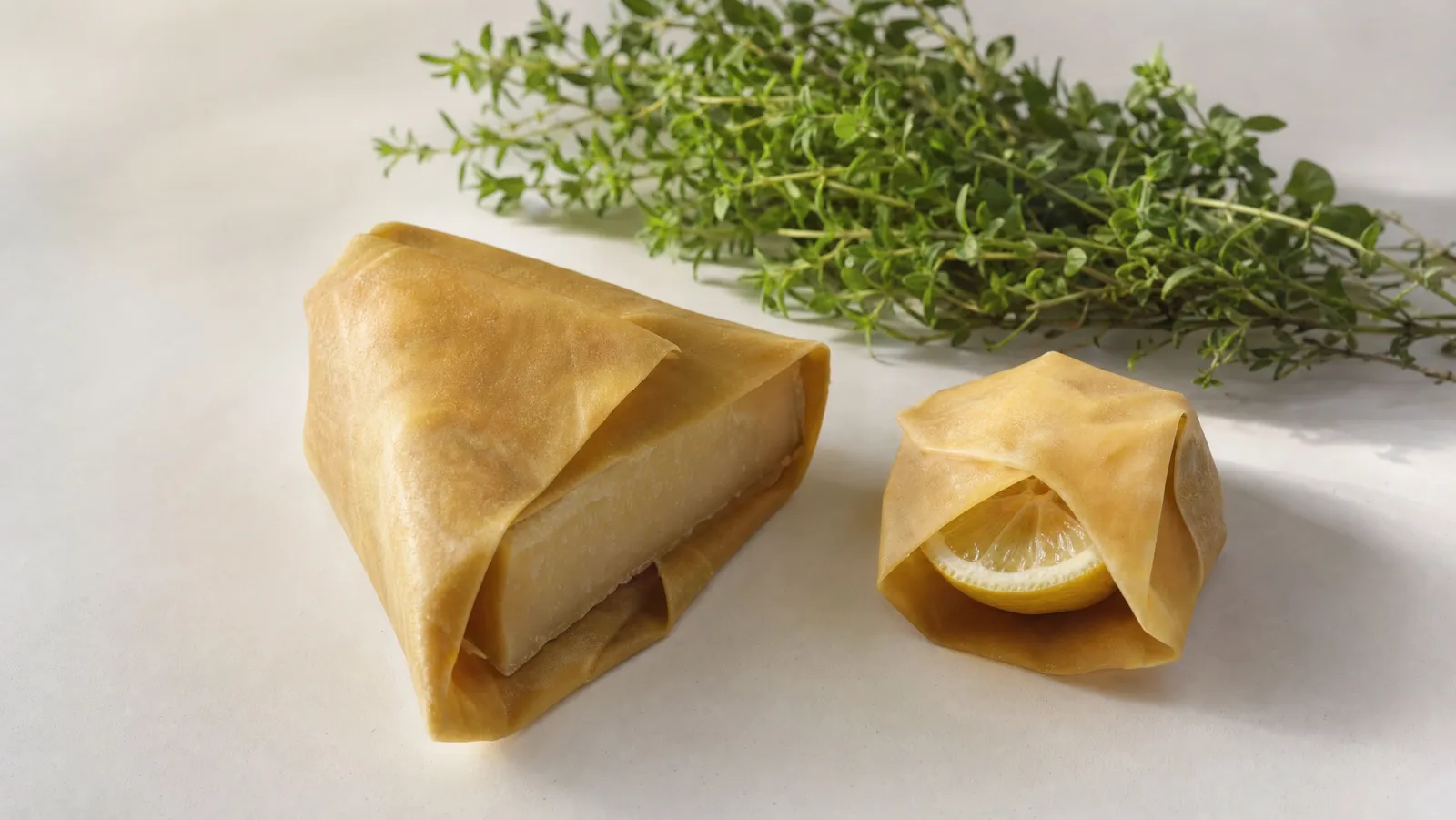
A beeswax wrap is sold as a replacement for cling film, and it is not one. It is a breathable cover, and breathable is not a virtue in itself — it is either the exact property a food needs or the property that spoils it. We may earn a commission when you buy through links on this page, at no cost to you. Split that way, beeswax wraps have a real and narrow job: hard cheese, a cut lemon, a bunch of herbs, a bowl, a loaf for a day or two. They fail at raw meat, anything liquid, anything hot and anything frozen — the material doing exactly what it is built to do.
Below is the food-by-food verdict, the limits the makers publish themselves, and which four wraps to buy if that narrow job is worth the money. It sits inside our wider guide to plastic-free food storage, where beeswax is the swap we are least enthusiastic about and still think has a place.
What a beeswax wrap actually is, and how the seal works
Bee's Wrap, the brand that built this category, states its wraps are made from "beeswax, organic cotton, organic plant oil, and tree resin." Akeeko lists cotton, jojoba oil, beeswax and tree resin. Neither contains adhesive.
The wrap sticks because you warm it. Bee's Wrap's instruction is to "place it over food or a bowl, then use the warmth of your hands to gently mold the wrap into place. As it cools, it creates a protective, breathable seal."
Jill Winkler-Moser and colleagues at the USDA Agricultural Research Service, writing in the Journal of the American Oil Chemists' Society in 2019, give the melting point of beeswax as 63.7 degrees C, roughly 147 F. Hand heat is nowhere near that — enough to make the coating tacky, no more. So a wrap taken from a cold drawer onto a cold worktop seals badly, and the same wrap warmed between your palms first seals well. If a wrap will not stick, it is usually cold rather than finished.
What beeswax wraps actually work on
The rule underneath every line: a wrap may help foods that spoil when you seal moisture against them, and hurts foods that spoil when you let air at them.
Bee's Wrap's own list of uses is "bread, cheese, fruits, vegetables, herbs, sandwiches, snacks, and leftovers." Read it as a specification, not a slogan: it is far shorter than the list of things cling film is used for.
- Cut citrus and cut vegetables. Half a lemon, half an onion, the cut face of a cabbage. The wrap takes the shape of a curved cut surface without needing a container to fit it — what a rigid box is worst at.
- Bunches of fresh herbs. A cover that slows drying without sealing water against the leaf is the right compromise.
- Covering a bowl. The nearest thing here to a like-for-like cling film substitution.
- Bread for a day or two. The makers' argument is that a sealed bag holds moisture at the crust and softens it. We found no controlled comparison confirming a wrap does better, and the one study we found points the other way.
- Hard cheese, the flagship claim for the category, which needs its own section.
Two adjacent jobs get their own articles rather than a hand-wave: how to keep produce fresh without plastic bags, and how to store bread without plastic.
The cheese case is the flagship claim and the evidence cuts both ways
Cheesemongers and every wrap maker say the same thing: hard cheese needs to breathe, and suffocating it in film makes it sweat. We could not find a controlled test establishing it, and US extension-service guidance says close to the opposite.
Clemson University's Home and Garden Information Center instructs the reverse: "If cheese is removed from its original packaging, wrap it tightly with plastic film wrap or foil to prevent air pockets." Its reason is the plain one — "mold requires oxygen to grow, so tightly rewrap the remaining cheese." Both can be partly right: Clemson optimises for mould, the cheesemonger for texture in a cheese eaten within a fortnight. Nobody appears to have published a side-by-side test at fridge temperature that measures both.
The one comparison we located does not flatter them. Dawn Beck, Kevin Lane, Christine Shiel and Karl Welke, in a March 2021 investigation for the University of Montana's Beekeeping Certificate Program, wrapped strawberry, bread and cheese specimens in beeswax-impregnated cotton cloth, wax paper or plastic bags and followed them for 15 days at 65 F. Their finding: "For most specimen/timepoint combinations (87%), we found no differences between storage methods. For the 13% of specimen/timepoint combinations where we did note a significant difference, beeswax wraps fared the worst."
Weigh that in both directions. It is a certificate-programme investigation rather than a peer-reviewed paper, and it ran at room temperature. But it is the only head-to-head we can point you at, and it found no freshness advantage. Buy a wrap because it is reusable, not because it preserves food better.
What beeswax wraps do not work on
Here the makers are unusually candid, and every failure is the same one in different clothes.
- Raw meat and fish. Bee's Wrap says to "avoid using them with raw meat or fish," and the San Joaquin Master Food Preservers, a University of California Agriculture and Natural Resources programme, wrote in January 2024 that "beeswax wraps are not recommended for use with raw meat or hot items, as the heat can melt the wax coating." A wrap you cannot scrub in hot water is the wrong surface for raw chicken.
- Anything hot, and anything microwaved or baked. The wax softens; see the limits below.
- Anything liquid or saucy. A hand-moulded wax seal is not a gasket, which is why we sent the sealed and liquid jobs to the best reusable food storage bags.
- Leftovers you intend to stack. A wrapped bundle neither stacks nor labels, which is rigid-container work; we went through that market in the best plastic-free food storage containers.
Then the freezer. A breathable cover cannot prevent freezer burn, because freezer burn is what air does to frozen food. Marlene Geiger, writing for Iowa State University Extension's AnswerLine in March 2024, puts it as simply as it can be put: "Freezer burn is simply the result of air coming into contact with food" — surface ice sublimating straight to vapour and leaving the outer layers dried out. Her guidance: use "bags, jars, paper and containers that are labeled for freezer use" because "these products are designed to keep air out." A product whose selling point is airflow is the wrong tool by definition, and the materials that work are in how to freeze food without plastic.
The limits, stated before you spend 13 to 21 dollars
All from the makers' own published instructions.
- No microwave, no oven, no dishwasher, no hot water. Bee's Wrap tells owners to "avoid hot water, microwaves, ovens, dishwashers, and other heat sources, as heat can soften the natural wax coating." Heat is the failure mode for the whole product.
- No raw meat or fish.
- Not airtight and not leakproof. Hand-moulded wax is a cover, not a closure.
- About a year of service. Bee's Wrap states that "with regular use and good care, Bee's Wrap typically lasts about a year."
- Not vegan. Beeswax is an animal product.
- It seals with your hands, so it seals worst when everything is cold — which is most of the time you want to wrap something.
Care, service life and the end of life
Bee's Wrap's care instruction is to "rinse with cool water and mild dish soap, then air dry," and to "avoid hot water and exposure to heat which will melt the wax." Retire a wrap when it stops sticking to itself, thins, or feels soft rather than tacky — the maker's own end-of-life test, at roughly a year of regular use.
The compost claim needs more care than it usually gets. Bee's Wrap says a finished wrap, cut into strips, can go "directly to your backyard compost pile." What is missing is verification: compostable here is a maker's claim, not a certified one. There is a standard for exactly this. TÜV Austria's OK compost HOME scheme tests biodegradation at ambient temperature, between 20 and 30 degrees C, and requires at least 90 percent of the material to degrade within 12 months. We could not find that mark, or any equivalent third-party home-compostability certification, for any wrap on this page. A cotton-and-wax sheet probably does break down in a warm active heap; nobody here has paid to prove it.
Are beeswax wraps food safe
Three questions hide inside that one, and the labels answer them unevenly. The wax itself is a cleared food ingredient. The US Food and Drug Administration affirms beeswax, yellow and white, as generally recognised as safe as a direct human food ingredient at 21 CFR 184.1973, and describes it there as "a secretory product of honey bees."
LFGB is German food-contact law, not a US approval. Akeeko states its wraps are certified to European LFGB — the Lebensmittel-, Bedarfsgegenstände- und Futtermittelgesetzbuch, Germany's Food and Feed Code. Its section 31(1) bars food-contact articles that fail the manufacturing requirements of Article 3(1) of Regulation (EC) No 1935/2004, the rule that materials must not "transfer their constituents to food in quantities which could endanger human health" or unacceptably change the food's composition, taste or smell. So an LFGB report is meaningful: a laboratory has measured migration and sensory transfer against a legal threshold. It is not an FDA clearance.
GOTS is a textile standard and says nothing about food. The Global Organic Textile Standard certifies fibre and processing: its labels require "at least 95% certified organic fibres" for organic and "at least 70%" for made with organic materials, and it covers chemical inputs, waste-water treatment and social criteria. Bee's Wrap says GOTS covers its fabric and printing. None of that says anything about what migrates into your cheese, and a listing offering GOTS as a food-safety credential is changing the subject.
One contradiction deserves naming. Akeeko claims its wraps "can create airtight seals" while every other maker — and Akeeko's own instruction to mould the wrap with the warmth of your hands — sells breathability as the working principle. Both cannot be true.
Bee's Wrap 3 Pack Assorted is the one to start with
The Bee's Wrap three-pack at 19.99 dollars as of September 2026 is our Best Overall for documentation rather than pattern. This is the brand whose published care and use instructions are the most specific in the category, and in a product whose failure modes are all user-controlled, that beats a nicer print. You get the small, medium and large ladder, which Bee's Wrap suggests as a snack bag, a sandwich or cheese wrap, and a produce wrap or bowl cover. The trade-off is arithmetic: at 19.99 dollars for three sheets this is the highest price per sheet on the page, about 6.66 dollars each, and the assortment gives you exactly one large — the size most people reach for to cover a bowl.
Bee's Wrap Bread Wrap is the only sheet that fits a loaf
The bread wrap is 17 by 23 inches for 14.78 dollars as of September 2026, and the size is the argument: it is the only wrap here that goes round a whole loaf or a baguette. Bee's Wrap says it holds sourdough, loaves, baguettes and homemade breads, and suggests dusting it with flour for proofing or resting dough. It is one sheet for 14.78 dollars doing one job: too large to be convenient for a sandwich, too specific as a first purchase unless you buy or bake whole loaves. And bread is where we would most like a controlled test, since the Montana comparison found beeswax-wrapped bread trending worst rather than best.
Bee's Wrap Roll is the answer for odd shapes
The Bee's Wrap roll is 14 by 53 inches at 21.00 dollars as of September 2026, against a 24.99 list price, a 16 percent reduction. You cut it to the food rather than choosing the nearest of three fixed sheets, the right answer for half a cabbage, an odd wedge of cheese, or a bowl no sheet quite covers. Three trade-offs: even at the reduced price it is the most expensive single item here, cutting wastes wax along the edges, and the cut is irreversible — once the roll is four medium squares it will never be a bowl cover again.
Akeeko 9 Pack is the cheapest way to test the idea
If you are not sure you will use wraps, do not spend 20 dollars finding out. The Akeeko nine-pack is 12.98 dollars as of September 2026, about 1.44 dollars a sheet against 6.66 for the premium three-pack, and it covers every size on this page, from 7 by 8 inches up to 14 by 15. Five of the nine sheets are small, so the sizes you will actually reach for are one each — the three-pack's problem at a fifth of the price. And its airtight-seal claim is not what a breathable wax-coated cotton sheet does.
Who should not buy beeswax wraps at all
- Vegans. Beeswax is an animal product, and no amount of jojoba oil changes that.
- Anyone whose leftovers get microwaved. The wrap cannot go in, so it adds a step.
- Anyone wanting a freezer solution, or storing wet food. Both need an air seal or a closure.
- Anyone hoping for better preservation. On the only comparison we found, wraps were no better than wax paper or a bag.
The cheapest answer earns us nothing: a plate on top of a bowl does the bowl-cover job for free, a clean jam jar handles the cut lemon, and the bag already in your drawer handles the sandwich. The strongest case for a wrap is that it makes a plastic-free habit pleasant enough to keep — a genuine reason to spend 13 dollars, and not a preservation claim.
The bottom line
Beeswax wraps are the most over-sold product in this category, and still worth owning for about five jobs. Buy them for cut fruit and vegetables, herbs, a bowl and a loaf, understanding that you are buying a reusable cover rather than a better one. Keep them away from heat, raw meat, liquid and the freezer, and expect about a year.
The three-pack at 19.99 dollars as of September 2026 is the one whose instructions we trust most; the Akeeko nine-pack at 12.98 dollars is the way to test the habit first. If neither moves you, that is a reasonable conclusion to reach from this page, and the rest of the swaps are ranked in every kitchen swap worth making.
What we tested

The size ladder from the maker whose own instructions are the most specific
- Material
- Beeswax, Cotton & Tree Resin
- Credentials
- CompostableBreathable
Bee's Wrap publishes the most specific care and use documentation in this category, which matters more here than the pattern on the sheet, and the three sizes cover the snack, the sandwich and the bowl in one purchase.
No major drawbacks noted in testing.
Three sheets in small, medium and large, made from beeswax, organic plant oils and natural tree resin, at 19.99 dollars as of September 2026. Bee's Wrap suggests the small as a snack bag, the medium as a sandwich wrap or for cheese storage, and the large as a produce wrap or bowl cover, and describes the wraps as breathable storage that helps food stay fresh longer by allowing airflow. It states they are made in the USA and can be hand washed, reused and composted. At 6.66 dollars a sheet this is the highest price per sheet here, and the assortment gives you exactly one large.

The only sheet here big enough to go round a whole loaf
- Material
- Beeswax, Cotton & Tree Resin
- Credentials
- CompostableBreathable
At 17 by 23 inches it is the only size on this page that actually goes round a whole loaf or a baguette, and bread is the food where the breathability argument is least contested.
No major drawbacks noted in testing.
One sheet at 17 by 23 inches in beeswax, organic plant oils and natural tree resin, honeycomb print, at 14.78 dollars as of September 2026. Bee's Wrap states it holds sourdough, loaves, baguettes and homemade breads, suggests lightly dusting it with flour and using it during proofing or resting dough, and describes it as breathable storage that helps breads stay fresh longer by allowing airflow. It is made in the USA, hand wash only and compostable at the end. It is one sheet for 14.78 dollars doing one job, too large for a sandwich and too specific as a first purchase if you do not buy or bake whole loaves.
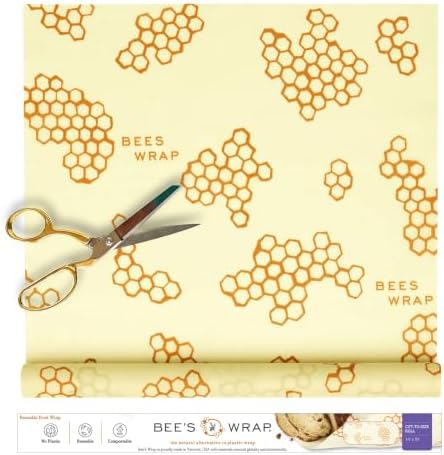
Cut to the food instead of chosen from three fixed sheets
- Material
- Beeswax, Cotton & Tree Resin
- Credentials
- CompostableBreathable
It is the right answer for half a cabbage, an odd wedge of cheese or a bowl that no fixed sheet quite covers, because you cut the wrap to the food rather than choosing the nearest size and hoping.
No major drawbacks noted in testing.
A 14 by 53 inch roll of beeswax, organic plant oils and natural tree resin at 21.00 dollars as of September 2026, against a 24.99 dollar list price, a 16 percent reduction. Bee's Wrap states the roll is cut to size and can be customised for bread wraps, sandwich wraps, bowl covers and produce wraps, describes it as breathable storage that helps food stay fresh longer by allowing airflow, and says it can be hand washed, reused and composted. Even discounted it is the most expensive single item here, cutting it wastes wax at the edges, and once cut you cannot go back to a larger sheet.

The cheap way to find out whether you will use wraps at all
- Material
- Beeswax, Cotton & Tree Resin
- Credentials
- CompostableBreathable
At about 1.44 dollars a sheet this is the honest way to learn whether wraps earn a place in your kitchen, rather than spending 20 dollars to find out, and it covers every size on this page.
No major drawbacks noted in testing.
Nine sheets in cotton, jojoba oil, ethically harvested beeswax and tree resin, at 12.98 dollars as of September 2026, about 1.44 dollars a sheet against 6.66 for the premium three-pack. The pack is five small at 7 by 8 inches, two medium at 10 by 11, one large at 13 by 14 and one extra-large at 14 by 15. Akeeko states the wraps are certified to European LFGB, the fabric is GOTS certified and the packaging is recycled paper. Five of the nine are small, so the useful large sizes are one each, and the maker also claims the wraps create airtight seals, which a breathable wax-coated sheet does not.
The top three, compared
| Spec | Best OverallBee's Wrap Beeswax Food Wraps, 3 Pack Assorted, Herb Garden | Best for BreadBee's Wrap Beeswax Bread Wrap, 17 x 23 in, Honeycomb | Best for Odd ShapesBee's Wrap Beeswax Wrap Roll, 14 x 53 in |
|---|---|---|---|
| Verdict | Fair | Fair | Fair |
| Composite | 3.3/5 | 3.3/5 | 3.3/5 |
| Materials | 3.0 | 3.0 | 3.0 |
| Health | 3.5 | 3.5 | 3.5 |
| Durability | 2.2 | 2.2 | 2.2 |
| End-of-life | 4.5 | 4.5 | 4.5 |
| Price | — | — | — |
| Get it | Check price | Check price | Check price |
How we score
What it’s made of.
Chemistry you’ll touch.
How long it lasts.
Where it goes after.
Each pick scores 0–5 on the four axes above, weighted into the composite verdict at the top. Scores are derived from what a product is verifiably made of and certified as — not how green its label looks.
About the author
Ruth Lopez
I'm Ruth Lopez and I'm a lover of nature and the environment. I'm very passionate about finding eco friendly products that don't damage the environment and also support companies that have the same philosophy.