How to Store Bread Without Plastic

Bread does not go hard because it dries out. It goes hard because the gelatinized starch in the crumb recrystallizes as the loaf sits, a process called retrogradation, and retrogradation runs fastest at refrigerator temperature. So the honest answer to how to store bread without plastic is the counter for two days, cut face down, and the freezer after that. We may earn a commission when you buy through links on this page, at no cost to you.
Everything follows from that mechanism: a breathable box cannot stop a starch process, and neither can an airtight jar. This is the last of four weeks on moving a kitchen off plastic storage, and bread is where plastic-free advice is most confidently wrong.
Bread hardens because its starch recrystallizes, not because it dries out
James BeMiller, emeritus professor of food science at Purdue University, gives the mechanism in Scientific American: "The most important event in the process of staling is when starch molecules crystallize." Baking gelatinizes the starch in the crumb; as the loaf sits, those molecules reorganize back toward crystalline order, and they need water to do it - "The starch molecules need water molecules to form their crystal structure." That water comes out of the gluten network, and the crumb goes rigid.
- Sealing a loaf does not stop it going hard. Retrogradation needs no evaporation: a sealed loaf still firms up.
- Heat partly undoes it. BeMiller: "stale bread can be freshened by warming it-as in toasting." The most useful fact here, and it is free.
The crust runs the other way. In a 2011 paper in the journal Starch/Stärke, Juan Francisco Aguirre and colleagues report that the crust draws moisture out of the crumb, which accelerates staling. So one loaf gets firmer in the middle and softer at the edge at once, and every storage decision trades a crisp crust against a soft crumb.
Why the fridge is the worst place for bread
The Quadram Institute, the UK food and health research institute, states it flatly: "At 3 to 5 °C, bread stales faster than in the freezer or at room temperature." Aguirre and colleagues, storing bread at 25, 4 and minus 18 degrees C, found that "at 4°C the rate of starch retrogradation is the highest for the studied conditions." A domestic refrigerator runs at or just below 40F / 4C. That is about as close as a kitchen gets to the worst available temperature for a loaf of bread.
The flat instruction "never refrigerate bread" is slightly too strong, because staling is not the only way a loaf dies. Quadram notes that the fridge also limits mold growth and moisture loss; it is the starch that changes faster there. In a hot humid kitchen in August, a soft loaf you cannot finish in three days may mold on the counter before it would have staled in the fridge. So the fridge is the wrong default and a defensible emergency. If you are refrigerating bread to buy time, the freezer does that job better and costs the same nothing.
The free method is a cut face, a board and a cloth
For a crusty loaf you will finish within two days, the best plastic-free bread storage is no container at all, and we earn nothing from that sentence. The opening move all four weeks of this series.
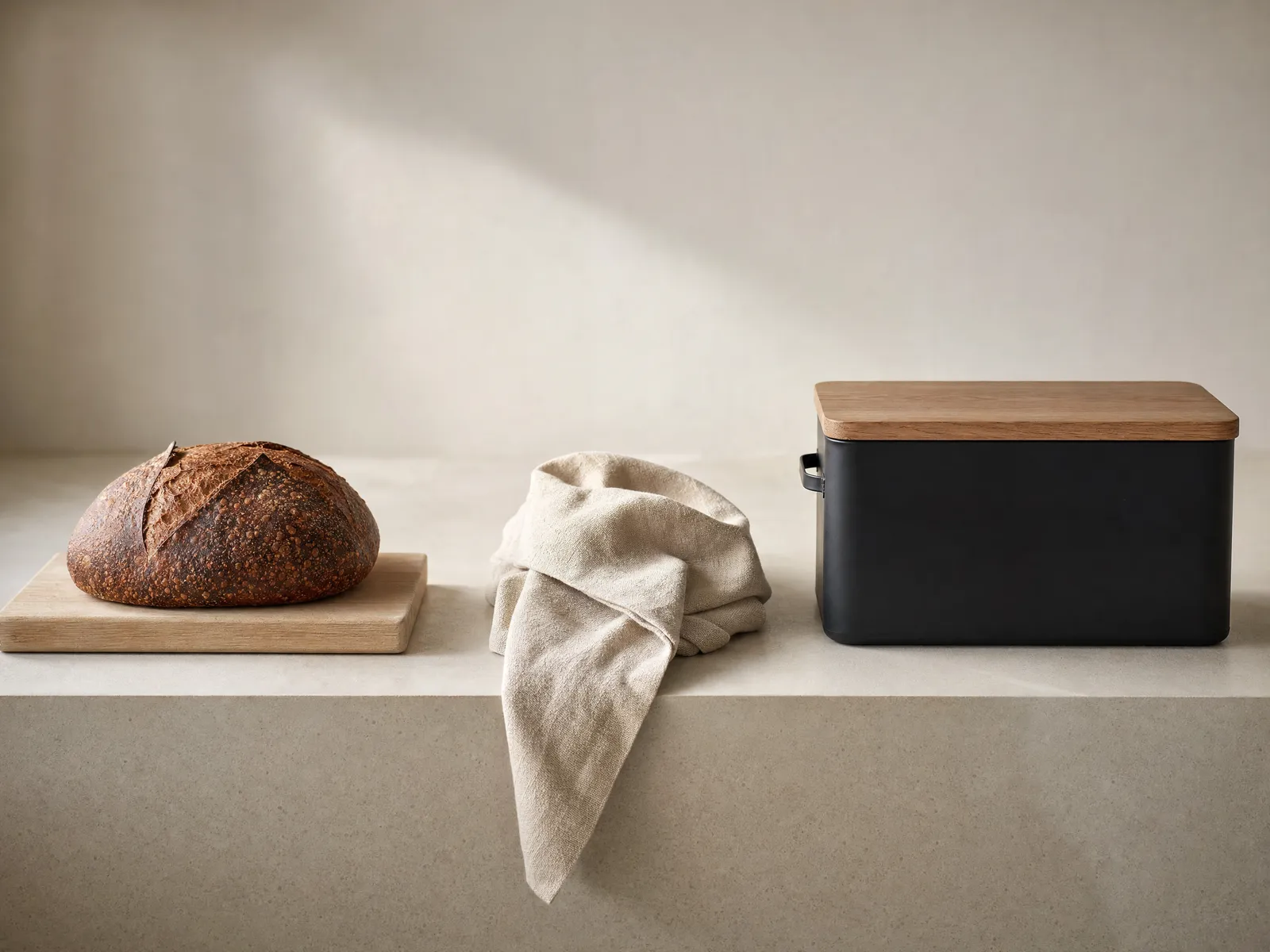
Cut the loaf across the middle, stand it on the cut face on a wooden board, and leave it on the counter, with a cotton cloth over it if your kitchen is dry. The crust is the loaf's own packaging, and the cut face is the only exposed crumb, so you press it against the board.
- A cloth or a paper bag slows the cut face going to leather. Neither stops the starch recrystallizing. Fabric manages moisture; retrogradation is starch.
- Do not seal a crusty loaf. A seal holds the crumb's water in the loaf, and since the crust pulls water from the crumb, it ends up in the crust: you trade a crisp crust for a marginally softer interior. This is why bread is the one dry good we keep out of the best pantry storage jars - an airtight seal does nothing about retrogradation, and it costs you the crust. In fairness to the other side: Quadram uses "staling" to cover moisture loss as well as starch, and on that basis lists "room temperature in an airtight container" as one of its two recommended options. Our objection to sealing a crusty loaf is about the crust, not the crumb.
- Two days is the limit. After that you have a bread pudding loaf.
That is the reverse of how to keep produce fresh without plastic bags, where the whole fight is holding near-saturated humidity against leaves: greens fail by losing water, bread fails by rearranging its starch.
The freezer is the actual answer, and it is already in your kitchen
Nothing on this page beats slicing a loaf and freezing it, and the freezer costs nothing. That sits above all four picks on purpose.
Quadram: "Freezer storage prolongs bread shelf life because it prevents moulds growing and stops excessive water loss from the bread." Aguirre's group supplies the mechanism: at minus 18 degrees C their loaves held water activity nearly constant for 23 days, and in the paper's own hedged wording only growth of existing starch crystals "appears to occur" there, rather than the formation of new ones seen at 25 and 4 degrees C. Two details do the work:
- Slice before you freeze. You cannot slice a frozen loaf, and you will not thaw a whole one for one sandwich.
- Toast straight from frozen. BeMiller's reversal in practice: warming re-softens retrograded starch, so a frozen slice dropped in the toaster lands closer to fresh than a three-day-old counter slice.
Quadram's caveat: freezing delays staling rather than abolishing it. Note what Quadram actually says about freezer burn - bread "going whitish and opaque" - which is that "you have waited too long, and your bread is now stale", a sign the loaf has staled in the freezer rather than a description of it drying out. Quadram gives no freezer-wrapping advice either way; wrapping a loaf is our own recommendation, and which wraps survive a freezer and which crack is handled in how to freeze food without plastic.
What a bread box actually does, and what it does not
A bread box is a humidity buffer. It holds a pocket of air around the loaf so the crust and cut face do not dry to the hardness of a cracker, while venting enough that the loaf is not sitting in its own condensation growing mold. BMOSU's own listing says the quiet part out loud: "it is recommended to keep the bread box in a ventilated place."
What a bread box does not do is keep bread fresh in the sense you mean by fresh. We looked for a controlled test and could not find one. What exists is single-batch kitchen comparisons: one loaf per method, unreplicated, unblinded, disagreeing with each other. Even Quadram's measurements were taken on bread in sealed plastic bags in a lab. So we will not tell you a box buys you days. Nobody has published that test.
What we will claim is narrower: a box is gentler than bare counter air, keeps the loaf out of the light and away from pests, and suits the one bread that wants enclosing.
Matching the method to the kind of loaf
- Crusty artisan loaves and sourdough. Counter, cut face down, one to two days, never sealed: a seal does the crust active harm, which makes a bag worse here than no bag at all.
- Soft sliced sandwich loaves. These want a closed bag, and the uncomfortable truth is that the plastic bag they come in suits them: that bread is engineered around a soft crust, so there is no crust to protect. A bread box or a wax-coated bag is the plastic-free substitute, and it trades away a little softness.
- Enriched breads: brioche, challah, milk bread. Fat slows the firming. Innograin, a cereals research blog hosted at Spain's University of Valladolid, notes that oils and fats also slow hardening and are "responsible for products with high fat content hardening less than those without fat". How much extra time that buys is not something we found quantified, so treat it as a direction rather than a number.
- Rye and high-hydration sourdough. More water in the crumb, and acidity on their side. Writing in the journal Foods in 2024, Ricardo H. Hernández-Figueroa and colleagues call sourdough "a natural preservation system that prolongs the mold-free shelf-life of bread", an effect the literature attributes mainly to the acetic and lactic acids its bacteria produce. That buys mold time, not staling time.
- Any loaf you will not finish in two days. Sliced, frozen, toasted from frozen. Type does not change that answer.
When a loaf molds, the loaf goes
The USDA's Food Safety and Inspection Service puts bread and baked goods in the discard column of its fact sheet "Molds on Food: Are They Dangerous?", not the cut-it-off column it allows for firm, low-moisture produce: on a porous food you see only part of the mold. UConn Extension says it plainer: "Discard any pieces of bread or baked goods with visible mold growth", and "Inspect adjacent pieces for signs of cross-contamination." And since "moisture promotes mold growth", in UConn's words, a sealed bag on a warm counter is the one case where a vented box genuinely beats the bag the loaf came in.
The P&P CHEF steel box is the pick if you buy one thing
The P&P CHEF bread box is 27.99 dollars as of October 2026 for a coated steel bin of 13 by 7.2 by 9.7 inches with a wooden lid, which the maker says holds "2+ loaves of bread". It ranks first for a material reason rather than a performance one: it is the only box here with no plastic and no acrylic in it anywhere. P&P CHEF calls it "food-graded coated steel and wood", and says the "wooden lid also can be used as a cutting bread broad" - a box whose lid is the board you cut on fits the cut-face-down method instead of fighting it.
Its costs, stated. A lift-off lid is looser than a hinged door or a roll top, so this is a weaker humidity buffer than the format implies, and its "fitting lid keeps food maximum freshness" is marketing, not a measurement. The listing also argues with itself about color: the title says Black, the first feature bullet describes a white box with BREAD printed on one side. We cannot tell which arrives, so we flag it rather than guess.
The ZENO beeswax bread bag is 9.99 dollars and one claim we cannot support
The ZENO two-pack is 9.99 dollars as of October 2026, the cheapest thing here, and it fixes the real complaint about flat beeswax sheets: these bags close with "a smooth, heavy-duty zipper" instead of needing to be warmed in your hands and folded. ZENO lists beeswax, organic jojoba oil and pine rosin in the coating, and sizes the two pouches for boules, baguettes and bagels.
Now the part you are entitled to. The listing claims the coating keeps bread from drying out or molding. The one head-to-head comparison we can locate points the other way. In a March 2021 investigation for the University of Montana's Beekeeping Certificate Program, Dawn Beck and colleagues stored strawberry, bread and cheese specimens in beeswax-impregnated cotton, wax paper or plastic bags for 15 days, and reported that in the 13 percent of specimen and timepoint combinations showing a significant difference, "beeswax wraps fared the worst". What it can and cannot carry is in what beeswax wraps actually work on: a certificate-programme investigation rather than peer-reviewed work, run at room temperature - and the only test anyone appears to have run.
That is not a reason to skip a 9.99 dollar product; it is a reason to buy it as a reusable bag, not a preservation device. Two further costs: "months" of coating life is ZENO's own estimate, not a tested figure, and the listing publishes no dimensions, so nobody knows what size loaf these take.
Organic Cotton Mart towels are barely a product, which is the point
The Organic Cotton Mart five-pack is 22.99 dollars as of October 2026 for five unbleached organic cotton muslin towels at 27 by 27 inches, about 4.60 dollars each. The maker states they are "made with Certified Organic Cotton", breathable, free of "harmful chemicals or dyes", machine-washable, and breathable enough that "the dough remains wet" when they cover proofing dough.
This is the free method with something to buy, and it ranks third because most readers do not need it. If there is already a large cotton tea towel in your drawer, that towel is this product, and we earn nothing from that sentence. What the set adds is breadth: five towels at 27 inches square cover the loaf wrap, the proofing cover and kitchen duty. A cloth is a breathable wrap and nothing more - it keeps the cut face from going to leather for a day or so, and does nothing about staling.
The BMOSU bamboo box has an acrylic door, and that is why it is fourth
The BMOSU double-layer bamboo corner box is 33.14 dollars as of October 2026 against a 34.95 dollar list price, a 5 percent reduction. It answers an objection money usually cannot: it is shaped for a corner rather than a run of open counter, two layers tall with a flat top BMOSU sells as usable countertop, holding what the maker calls "two loaves of bread as well as rolls, muffins and other baked goods".
Two things keep it last. First, the door is acrylic - the maker's own words are "acrylic door makes it easy to view food storage" - so this is not a plastic-free product, which is exactly why the 27.99 dollar steel-and-wood box outranks it. You may decide a window is worth it; decide it knowingly. Second, an oddity we report rather than resolve: BMOSU's feature text reads "the magnetic lock prevents the door from being tightly closed". A magnetic catch that prevents closure is self-contradictory, and we cannot tell from the listing whether that is a translation error or a door that does not shut. For a humidity buffer, that matters.
The bottom line
Store bread cut face down on the counter for two days and in the freezer after that, keep it out of the fridge unless mold is the more urgent threat, and accept that nothing you buy stops staling, because staling is starch recrystallizing rather than drying out. The valuable moves here are free: a board, a cut face, a cloth and the freezer you already own.
If you are buying:
- The P&P CHEF steel box at 27.99 dollars as of October 2026 if you want one bread box with no plastic in it. Looser closure than a hinged door, and the listing cannot agree with itself on color.
- The ZENO beeswax bag two-pack at 9.99 dollars as of October 2026 if you buy one loaf a week and want nothing permanent on the counter. A reusable bag, not the preservation device the listing describes.
- The Organic Cotton Mart towels at 22.99 dollars as of October 2026 only if you do not already own a big cotton tea towel. If you do, you own this already.
- The BMOSU bamboo corner box at 33.14 dollars as of October 2026 if counter space rather than money is your objection, and only if an acrylic door is acceptable.
The whole kitchen, swap by swap, is in the plastic-free food storage guide.
What we tested

Coated steel and wood with no plastic or acrylic panel anywhere
- Material
- Coated Steel, Bamboo & Linen
- Credentials
- No-buyStaling-led
The only pick here whose lid is also the board you cut on, which matters because cutting the loaf and standing it on the cut face is the method the rest of this article recommends.
No major drawbacks noted in testing.
27.99 dollars as of October 2026 for a coated steel bin of 13 by 7.2 by 9.7 inches with a wooden lid. P&P CHEF states the box and lid are "made from food-graded coated steel and wood without any toxic chemicals or harmful substances", that the "wooden lid also can be used as a cutting bread broad", that it takes "2+ loaves of bread, snacks, hamburger buns and tortillas, and potatoes", and that the carrying handles are welded on both sides. It is the cheapest format here that is all steel and wood, which is the whole reason it ranks first. Three costs: a lift-off lid is a looser closure than a hinged door or a roll top, the maker's "maximum freshness" wording is marketing rather than a measurement, and the listing contradicts itself on color - the title says Black while the first feature bullet describes a white box with BREAD printed on one side, and we cannot tell from the listing which arrives.
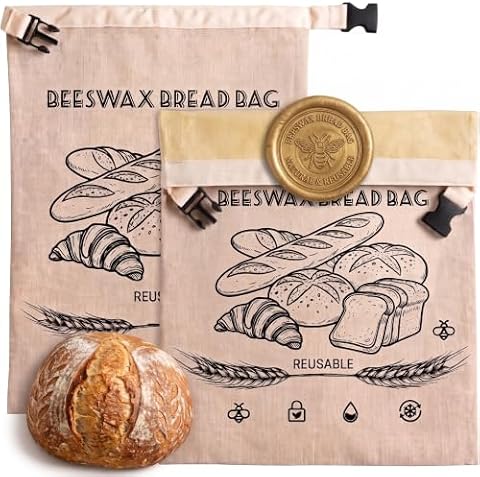
A zippered bag instead of a sheet you have to warm in your hands
- Material
- Coated Steel, Bamboo & Linen
- Credentials
- No-buyStaling-led
The only wrap format on this page with a zipper rather than a flat sheet you have to soften in your hands and fold around a loaf, which removes the most common complaint about wraps.
No major drawbacks noted in testing.
Two beeswax-coated cotton bags for 9.99 dollars as of October 2026, the cheapest line on this page. ZENO states the fabric is "infused with premium beeswax, organic jojoba oil, and natural pine rosin" creating "a naturally breathable barrier", that "unlike standard stiff wraps that require warming hands to fold or loose ties that let air slip in, our reusable storage bags feature a smooth, heavy-duty zipper closure", and that the set is two "generously sized fabric storage pouches" sized for "round artisan boules and long baguettes to fresh croissants, pastries, and leftover bagels". Care, per the maker: turn inside out, rinse in cool water with a drop of mild dish soap, air dry. Its costs are real. The maker's claim that the coating keeps bread from drying out or molding runs against the only head-to-head comparison we can cite, a 2021 University of Montana investigation in which beeswax wraps "fared the worst" with bread among the specimens. "Months" of coating life is the maker's own estimate. And the listing publishes no dimensions, so we cannot tell you what size loaf these fit.

Five tea towels which is the free method with something to buy
- Material
- Coated Steel, Bamboo & Linen
- Credentials
- No-buyStaling-led
The closest thing on the page to the free method, and the only pick that also covers proofing dough and ordinary kitchen work instead of occupying counter space as a single-purpose object.
No major drawbacks noted in testing.
Five unbleached organic cotton muslin towels at 27 by 27 inches for 22.99 dollars as of October 2026, which is about 4.60 dollars a towel. Organic Cotton Mart states they are "made with Certified Organic Cotton", that "the muslin weave on these towels is breathable", that they "do not contain any harmful chemicals or dyes", that they are "truly oversized" and come in sets of five, that the breathable texture "will ensure that the dough remains wet" for proofing, and that they are machine-washable and quick-drying. This is barely a bread product, and that is how we are positioning it. A cloth is a breathable wrap and nothing more: it slows the cut face going to leather for a day or so and does nothing at all about staling, which is a starch process rather than a moisture-loss one. If you already own a large cotton tea towel you do not need this, and we earn nothing from that sentence.

A corner footprint bought at the price of an acrylic door
- Material
- Coated Steel, Bamboo & Linen
- Credentials
- No-buyStaling-led
The only pick shaped for a corner rather than a run of open counter, which answers the one objection to a bread box that no amount of money otherwise fixes.
No major drawbacks noted in testing.
33.14 dollars as of October 2026 against a 34.95 dollar list price, a 5 percent reduction. BMOSU states it has "large capacity to hold two loaves of bread as well as rolls, muffins and other baked goods", that it comes in Large and Extra Large, that the "acrylic door makes it easy to view food storage", that "anti-slip pads make the product not easy to slide", and that "it is recommended to keep the bread box in a ventilated place". Two layers and a corner shape, with a flat top the maker sells as usable counter. It ranks fourth for a stated reason: the door is acrylic, so this is not a plastic-free product, and on this site that goes in the open rather than in the small print. Second oddity, unresolved: the maker's own feature text reads "the magnetic lock prevents the door from being tightly closed", which is self-contradictory, and we cannot tell from the listing whether it is a translation error or a description of a door that does not shut.
The top three, compared
| Spec | Best Bread BoxP&P CHEF Bread Box for Kitchen Counter, Metal Bread Storage Bin with Wooden Cutting Lid, 13 x 7.2 x 9.7 in, Black | Cheapest Way to Try the Wrap MethodZENO Beeswax Bread Bag, Reusable Food Storage Wrap with Zipper, 2 Pack | The Near-Free OptionOrganic Cotton Mart Bread Towels, 100% Organic Cotton, Unbleached, 27 x 27 in, 5 Pack |
|---|---|---|---|
| Verdict | Buy | Buy | Buy |
| Composite | 4.3/5 | 4.3/5 | 4.3/5 |
| Materials | 5.0 | 5.0 | 5.0 |
| Health | 3.7 | 3.7 | 3.7 |
| Durability | 5.0 | 5.0 | 5.0 |
| End-of-life | 3.2 | 3.2 | 3.2 |
| Price | — | — | — |
| Get it | Check price | Check price | Check price |
How we score
What it’s made of.
Chemistry you’ll touch.
How long it lasts.
Where it goes after.
Each pick scores 0–5 on the four axes above, weighted into the composite verdict at the top. Scores are derived from what a product is verifiably made of and certified as — not how green its label looks.
About the author
Ruth Lopez
I'm Ruth Lopez and I'm a lover of nature and the environment. I'm very passionate about finding eco friendly products that don't damage the environment and also support companies that have the same philosophy.