The Best Reusable Food Storage Bags for Ditching Ziploc

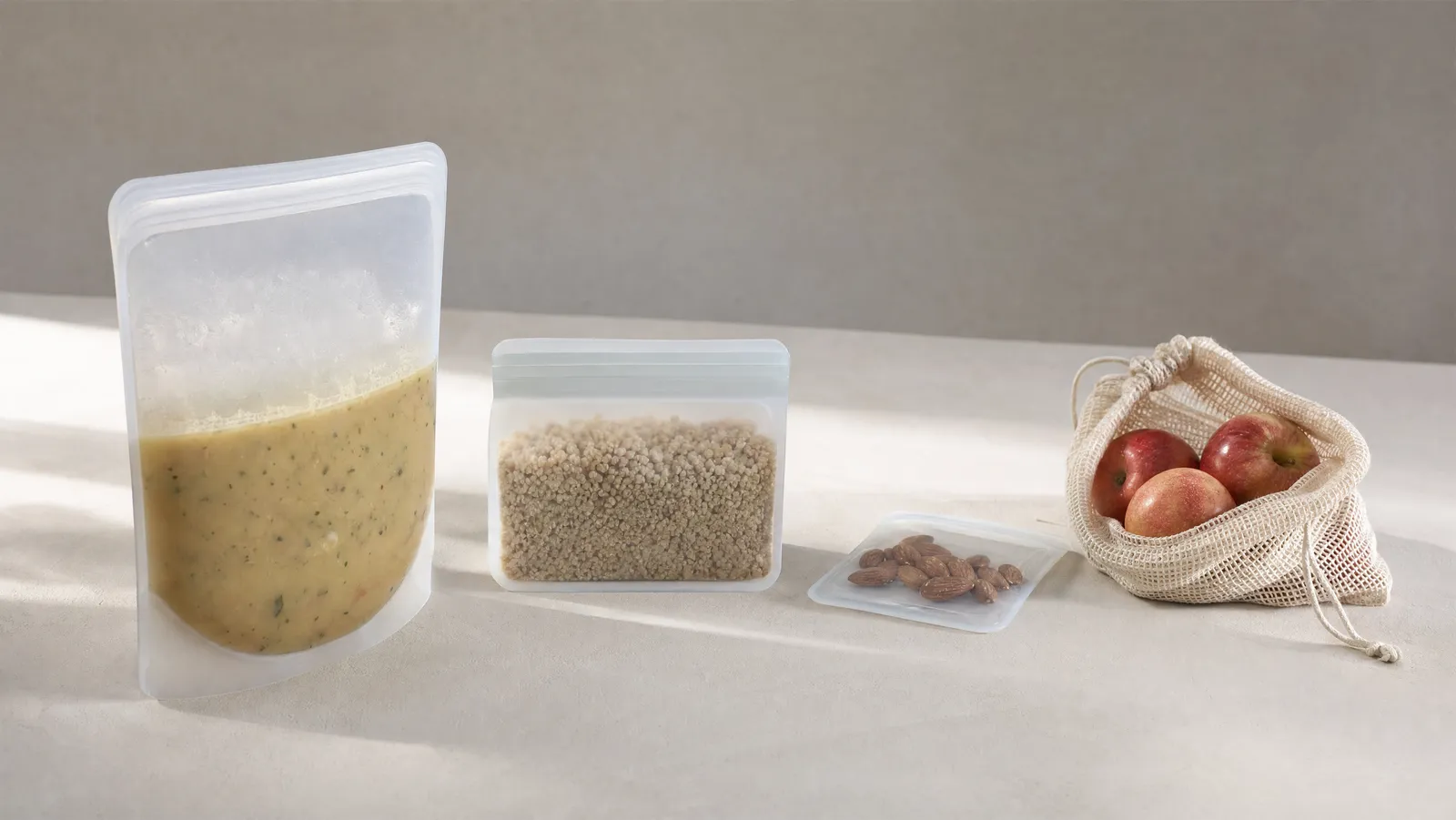
The best plastic free food storage bags are not one product category. They are two materials doing opposite jobs. Silicone is a sealed liquid and moisture barrier. Cloth and mesh are the deliberate absence of one. Almost every roundup on this phrase ranks them against each other as though they answered the same question, and they do not. We may earn a commission when you buy through links on this page, at no cost to you.
Get that wrong and the bag takes the blame for the article's mistake: a reader who buys mesh expecting freezer performance was failed by the writing, not the product. So the four picks below are sorted by job rather than ranked, and one of them cannot be frozen, cannot hold liquid and should not go in a lunchbox. The broader case for plastic-free food storage is made elsewhere; this page is about one drawer.
One number for scale. According to the US Environmental Protection Agency's Advancing Sustainable Materials Management: 2018 Tables and Figures, 4.2 million tons of plastic bags, sacks and wraps were generated in the United States in 2018, 420,000 tons of that was recycled — a rate of 10.0 percent — and 3.04 million tons went to landfill. That category is broader than kitchen zip-tops, so read it as context, not an indictment of your sandwiches. The point is not that one bag matters. It is that this is the plastic you buy again every month.
Silicone and mesh are not competitors, they are opposites
Answer one question before spending anything: is this food's enemy air, or is it moisture?
If the enemy is moisture loss — freezer burn, a marinade escaping across a shelf — you need a seal, and in bag form only silicone gives you one. One limit worth stating: the Food Packaging Forum notes that "silicones are generally water- and oil-repellent, gas-permeable, and insoluble in water, mineral oil and alcohols," so treat a silicone bag as a liquid and moisture barrier rather than an oxygen barrier of the kind a laminated film gives you. If the enemy is trapped moisture, the barrier is doing the damage, and mesh is not a cheaper silicone bag but the correct opposite tool.
University of Maine Cooperative Extension's storage bulletin makes the split concrete. Its table lists spinach and kale at 95 to 100 percent relative humidity, lettuce and mature carrots at 98 to 100 percent, while dry onions and garlic sit at 65 to 70 percent. Extension's summary of why that matters: "At high relative humidity, produce maintains salable weight, appearance, nutritional quality and flavor, while wilting, softening and juiciness are reduced."
Those are two shopping lists. Greens want to be sealed and damp; onions, garlic and anything stored dry want air moving past them, which is what mesh does and silicone prevents. The same logic makes a breathable cover a third tool rather than cheap cling film, and we set out what beeswax wraps actually work on separately.
The best reusable ziploc alternative is the bag already in your kitchen
Before any of the four products below: a used zip-top bag is washable, and we make no money from telling you so.
This is not only our position, it is the manufacturer's. SC Johnson, which makes Ziploc, told America's Test Kitchen that "Ziploc Food Storage Bags can be handwashed, rinsed and reused," and that the method is unremarkable: "We'd recommend washing with soap and water and letting air dry." Its representative advised against turning bags inside out, because you risk ripping the seams.
Then the limit, which matters more than the permission. SC Johnson is explicit that some bags should not be reused at all: "If the bag was used to store raw meat, fish, eggs or other allergy-triggering foods, we do not recommend reusing." On lifespan: "You can wash and reuse them up to 10 times, depending on how they're used."
So the free version of this article is short: wash the bags that held bread, cheese, vegetables, nuts or dry goods, bin the ones that held raw meat, fish, eggs or an allergen, and retire anything scratched, cloudy, cracked or torn, because a bag whose seal will not close is not storage.
Reusable is not automatically better, and the best study on it says so
Here is the finding this category does not print on its packaging.
Researchers at the University of Michigan's Center for Sustainable Systems, led by Shelie Miller, published a life-cycle assessment in the International Journal of Life Cycle Assessment in July 2021, Environmental payback periods of reusable alternatives to single-use plastic kitchenware products. They defined a payback period as the number of reuses needed for an alternative's impact per use to match the single-use product, and ran it across straws, sandwich bags and wraps, coffee cups and forks on three measures: global warming potential, water consumption and primary non-renewable energy use.
Reusable mugs and all three fork alternatives paid back. Silicone food storage bags, beeswax wrap and bamboo straws never reached the break-even point in any of the three categories. Miller's summary of the mechanism: "Our study showed that some reusable alternatives never break even because it takes more energy, and generates more greenhouse gas emissions, to wash them than it takes to make the single-use plastic item."
Now the caveat, and it is real. Those three categories do not include plastic waste, litter, landfill volume or marine debris — the study did not measure the thing most people buy a reusable bag to fix. The result is also driven by washing assumptions, and the coverage we can verify does not break out dishwasher against hand-washing for the bags. Our reading: a silicone bag is a strong answer to the landfill question and a weak one to the carbon-and-water question, and anyone selling you both at once has not read the paper. Wash it in a full dishwasher load, not under a running tap, and keep it for years.
Silicone food storage bags are still a polymer
If your reason for leaving plastic was the chemistry rather than the bin, silicone is a partial answer at best.
As the Food Packaging Forum sets out in its background article on silicones, "The backbone of any silicone is based on alternating silicon (Si) and oxygen (O) atoms," and "substances that may migrate from silicone-based materials into food include oligomers, additives, catalysts, and breakdown and reaction products." High fat content in the food, it adds, has been described as increasing migration.
The regulatory position is thinner than most shoppers assume. In the EU, the Forum states, silicone sits on the list of food contact materials for which specific measures shall be established, "but no harmonized legislation exists to date for silicone materials used as FCMs." In the US, silicones are generally regulated by the FDA as indirect food additives, and the route covering a reusable bag is 21 CFR 177.2600, on rubber articles intended for repeated use, which sets water and n-hexane extraction limits. On the question a reader actually wants answered, the Forum is blunt: data describing food-related exposure to silicones are scarce.
Two reference points. Almost all the migration work we could find is on bakeware at 150C and above, not a cold bag in a fridge, and cold, brief, low-fat contact appears to sit at the gentle end of the migration curves that have actually been measured. But absence of measurement is not evidence of inertness. A silicone bag removes a recurring plastic purchase from your kitchen. It does not remove polymer from contact with your food.
What separates reusable freezer bags from plastic free sandwich bags
Five things decide this, and the brand is none of them.
- The seal. The failure point of every bag ever made, in both designs: the pinch-style closure you run a finger along, and the zip-style you burp and press. Both fail the same way, by being closed almost all the way.
- Whether it takes liquid. Soup, stock, marinade, berries in syrup. Mesh and cloth are out at this step, which is most of what people get wrong.
- Whether it freezes. The National Center for Home Food Preservation lists what a freezer container has to be: "moisture vapor resistant", "durable and leakproof", "not become brittle and crack at low temperatures" and "easy to seal". Note its capacity rule too — "Do not freeze fruits and vegetables in containers with a capacity over one-half gallon" — which puts the largest bag here exactly at the ceiling. The rest of that case is in how to freeze food without plastic.
- Whether it stands up. A flat base helps you fill a bag one-handed and irritates you when it tips half full. If most of your storage stands up, buy the best plastic-free food storage containers and keep two bags for the freezer.
- How long it takes to dry. Silicone dries slowly, and an inverted bag dries fast — exactly the shortcut Stasher tells you not to take.
The payback maths on the best reusable food storage bags, done honestly
State the assumption first, because it does all the work. We are using 8 cents for a disposable bag, roughly a 4 dollar box of 50 — substitute whatever your shop charges. On that assumption, counting sticker price only:
- The 64 oz Stasher at 21.99 dollars as of September 2026 needs about 275 uses to break even.
- The Winrock three-pack at 13.06 dollars as of September 2026 is about 4.35 dollars a bag, so roughly 54 uses each.
- The Stasher pocket pair at 13.99 dollars as of September 2026 is about 7 dollars a bag, so roughly 87 uses each.
- The purifyou mesh set at 14.49 dollars as of September 2026 is about 1.61 dollars a bag, but it replaces the free roll at the supermarket, so its payback is a waste figure rather than a money one.
At the Michigan study's use rate of five uses a week, 275 uses is a little over a year. Stasher's marketing lands in the same place from the other direction, claiming one bag replaces 260 single-use plastic bags a year, which at five a week is 260 uses. That is the honest shape of it: real, slow and undramatic. And it ignores the water, detergent and energy in every wash — precisely the cost that sent the Michigan payback periods to infinity here.
Stasher Half Gallon is the best reusable freezer bag here
The Stasher 64 oz half-gallon bag is our Best Overall because it is the only format here that does a freezer bag's job at freezer-bag scale: it takes liquid, it seals, and at 64 oz it is the largest bag on this page. Stasher rates it for dishwasher, microwave and oven up to 425F, calls it freezer safe and suitable for sous vide, describes the material as platinum food-grade silicone free from lead, latex, phthalates, BPA and BPS, and backs it with a lifetime warranty. Against the National Center's freezer checklist above, it clears every line.
The trade-off has two parts. One 64 oz bag for 21.99 dollars as of September 2026 is the dearest per-bag price on this page, and it is slow to dry after washing. The obvious fix for that is the one Stasher rules out, in its own care instruction: "Avoid turning the bag inside out as it could cause the bag to rip." Buy one rather than six, and see whether the drying rack annoys you before scaling up.
Winrock 3 Pack is the value way into silicone food storage bags
The Winrock three-pack is 13.06 dollars as of September 2026 for three stand-up bags in graduated sizes with flat bases, against 21.99 dollars for the single premium half-gallon bag above. That is the whole argument: a household can test whether it will live with silicone bags without committing 21.99 dollars a bag. Winrock states 100 percent silicone free of BPA, lead, PVC, latex and phthalates, a zip-lock seal you burp and pinch closed, and that the bags are dishwasher safe including the bottom rack, freezer safe, microwave safe and boilable with food in.
Two honest marks against it. The listing contradicts itself on capacity — the product title gives 51, 34 and 17 oz while the maker's own bullet points give 53, 32 and 18 oz for the same three bags, so treat the sizes as approximate and do not plan a recipe around them. And the warranty is 36 months rather than lifetime, which matters more than it sounds in a category where the seal is what dies.
purifyou Mesh is the pick for produce and dry goods, and nothing else
The purifyou nine-pack is 14.49 dollars as of September 2026 for five large bags at 12 by 14 inches, two extra-large at 12 by 17 and two small at 12 by 8. Its job is narrow and real: it replaces the roll of thin produce bags at the supermarket and then carries the same food home into the fridge drawer. purifyou describes the mesh as heavy-duty and double-stitched, says the bags are machine washable and dishwasher safe, and puts a colour-coded tare tag on each that it states speeds up checkout weighing.
The trade-off is not a defect, it is the material. Mesh is the opposite of an air barrier, so it does nothing for moisture retention. Set that against the Maine Extension table and the boundary is obvious: mesh suits dry onions and garlic at 65 to 70 percent relative humidity and is the wrong container for kale that wants 95 to 100. It is useless for liquid, the freezer and a lunchbox. One food-safety note for any washable bag: the USDA advises washing reusable bags with hot water and soap, and keeping raw meat, poultry and seafood separate from produce.
Stasher Pocket Bags fill the small-portion gap nothing else here covers
The Stasher pocket two-pack is 13.99 dollars as of September 2026 against a 14.99 list, for two 4 fl oz bags, 4.5 inches wide by 3.5 high by 1 deep. It exists because the small-volume gap is the one nobody fills: the half-portion of nuts, the cut apple, the day's pills — where a half-gallon bag is absurd and cling film is what actually happens. Material and closure are identical to the big Stasher — platinum food-grade silicone, Pinch-Loc seal, rated for dishwasher, microwave and oven up to 425F, lifetime warranty.
The trade-off is arithmetic, and it is brutal. At 13.99 dollars as of September 2026 for two bags holding 4 fl oz each, this is by far the worst price per ounce of capacity on this page, and 4.5 by 3.5 inches fits almost nothing you would call a meal. Buy it as a deliberate second purchase for small portions, never as a first taste of the format.
What we would not buy
Four things sold hard here that we would leave on the shelf.
- Stand-up bags bought for the stand-up feature. A flat base helps you fill a bag; it does not stop it tipping when half empty. If standing upright is the requirement, that is a rigid container, not a bag. We compare glass versus stainless steel versus silicone separately.
- Any bag sold on an airtight claim its material cannot support. Cloth and mesh are not airtight and a drawstring does not make them so. If a listing uses that word about a woven fabric, treat the rest of it the same way.
- Bags whose only innovation is the closure. Novel seals are where this category fails, and a seal you cannot check with a finger is one you will get wrong at the worst moment.
- A set bought to replace bags that still work. Buying nine silicone bags while a drawer of zip-tops sits unused is a purchase, not a reduction, and the Michigan figures make it worse rather than better.
The bottom line
Buy for the material, then for the job, and do the free thing first. Wash the bags you already own, following SC Johnson's instructions and its limit on raw meat, fish, eggs and allergens, and retire them when they are scratched, cloudy or torn. We earn nothing from that paragraph and it is still the most valuable thing here.
When you do buy: one 64 oz Stasher at 21.99 dollars as of September 2026 if you need a bag that seals, freezes and takes liquid, accepting the price and slow drying. The Winrock three-pack at 13.06 dollars as of September 2026 to test the format cheaply, with approximate capacities and a 36-month warranty. The purifyou mesh nine-pack at 14.49 dollars as of September 2026 for produce and dry goods. The Stasher pocket pair at 13.99 dollars as of September 2026 only once you know you will use it.
And keep the evidence straight both ways. The landfill argument for these bags is solid; the carbon-and-water argument, on the best study available, is not. Buy few bags and keep them a decade. The rest of the kitchen, including the swaps we think are not worth the money, is in our full guide to plastic-free kitchen storage.
What we tested

The largest bag here and Stasher rates it to 425F
- Material
- Platinum Silicone & Cotton Mesh
- Credentials
- ReusableSeal-checked
Stasher's own documentation rates it to 425F in the oven, and at 64 oz it is the only bag here we would put soup, stock or a marinade into and then stand upright in a fridge door.
No major drawbacks noted in testing.
One 64 oz half-gallon bag at 21.99 dollars as of September 2026, and the one format on this page that genuinely replaces a freezer bag at freezer-bag scale. It takes liquid, it closes with Stasher's Pinch-Loc seal, and Stasher states it is safe for the dishwasher, microwave, freezer, sous vide and the oven up to 425F. The maker describes the material as platinum food-grade silicone, free from lead, latex, phthalates, BPA and BPS, and backs it with a lifetime warranty. It is also the dearest per bag here, it is slow to dry after washing, and Stasher warns against turning it inside out to speed that up.

Three graduated sizes for less than one premium bag costs
- Material
- Platinum Silicone & Cotton Mesh
- Credentials
- ReusableSeal-checked
Three sizes with flat bases for 13.06 dollars as of September 2026 lets a household find out whether it will actually use silicone bags before committing 21.99 dollars a bag to the format, which is the honest first question here.
No major drawbacks noted in testing.
Three stand-up silicone bags in graduated sizes for 13.06 dollars as of September 2026, against 21.99 for the single premium half-gallon bag above. Winrock states 100 percent silicone free of BPA, lead, PVC, latex and phthalates, a zip-lock seal you burp and pinch closed, and that the bags are dishwasher safe including the bottom rack, freezer safe, microwave safe and able to be boiled in water with food in them. Treat the capacities as approximate: the product title says 51, 34 and 17 oz while the maker's own bullets say 53, 32 and 18 oz for the same bags. The warranty is 36 months, not lifetime.

The supermarket produce roll deleted
- Material
- Platinum Silicone & Cotton Mesh
- Credentials
- ReusableSeal-checked
It replaces the roll of thin produce bags at the supermarket and then carries the same food home into the fridge drawer, which is a job no silicone bag on this page can do at all.
No major drawbacks noted in testing.
Nine drawstring mesh bags for 14.49 dollars as of September 2026 - five large at 12 by 14 inches, two extra-large at 12 by 17 and two small at 12 by 8. purifyou describes the mesh as heavy-duty and double-stitched, says the bags are machine washable and dishwasher safe, and fits each with a colour-coded tare tag it states speeds up weighing at the checkout. Mesh is the opposite of an air barrier and does nothing for moisture retention, so it is the wrong bag for anything you want to keep from drying out, and useless for liquid, the freezer or a lunchbox.

For the portions a half gallon bag makes absurd
- Material
- Platinum Silicone & Cotton Mesh
- Credentials
- ReusableSeal-checked
Nothing else here fills the small-volume gap - a half-portion of nuts, a cut apple, a day's pills - and a half-gallon bag wrapped round a handful of almonds is mostly air.
No major drawbacks noted in testing.
Two pocket bags, clear and aqua, each holding 4 fl oz and measuring 4.5 inches wide by 3.5 high by 1 deep, at 13.99 dollars as of September 2026 against a 14.99 list. Material and closure are the same as the half-gallon bag above: platinum food-grade silicone with a Pinch-Loc seal, stated free from lead, latex, phthalates, BPA and BPS, rated by Stasher for dishwasher, microwave and oven up to 425F, with a lifetime warranty. It is also by far the worst price per ounce of capacity here, and 4.5 by 3.5 in fits almost nothing you would call a meal.
The top three, compared
| Spec | Best OverallStasher Premium Silicone Reusable Food Storage Half Gallon Bag, 64 oz | Best ValueWinrock Reusable 100 Percent Silicone Food Storage Bags, Stand-Up, 3 Pack | Best for Produce and Dry Goodspurifyou Reusable Mesh Produce Bags with Drawstring, Set of 9 |
|---|---|---|---|
| Verdict | Fair | Fair | Fair |
| Composite | 3.1/5 | 3.1/5 | 3.1/5 |
| Materials | 3.0 | 3.0 | 3.0 |
| Health | 2.7 | 2.7 | 2.7 |
| Durability | 3.9 | 3.9 | 3.9 |
| End-of-life | 3.2 | 3.2 | 3.2 |
| Price | — | — | — |
| Get it | Check price | Check price | Check price |
How we score
What it’s made of.
Chemistry you’ll touch.
How long it lasts.
Where it goes after.
Each pick scores 0–5 on the four axes above, weighted into the composite verdict at the top. Scores are derived from what a product is verifiably made of and certified as — not how green its label looks.
About the author
Ruth Lopez
I'm Ruth Lopez and I'm a lover of nature and the environment. I'm very passionate about finding eco friendly products that don't damage the environment and also support companies that have the same philosophy.