How to Keep Produce Fresh Without Plastic Bags

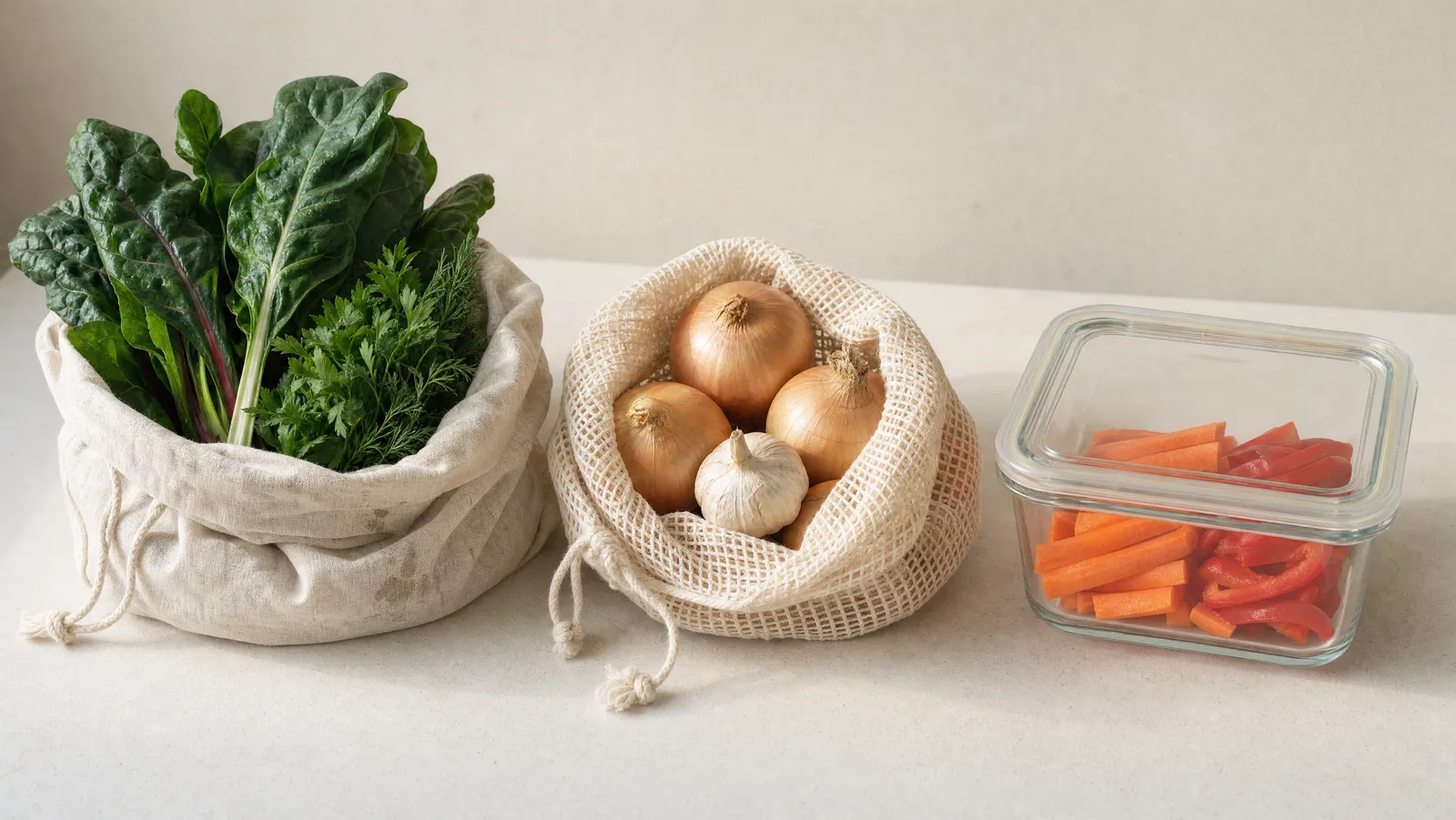
Produce does not spoil for one reason. It spoils for three: it loses water, it stews in its own moisture, or it gets gassed by the fruit next to it. To keep produce fresh without plastic, sort it by which of those three is going to kill it, because the fix for one is the opposite of the fix for another. We may earn a commission when you buy through links on this page, at no cost to you.
That is why no single bag works. A weave tight enough to stop spinach wilting is a weave that will rot an onion. The sorting is free, which makes this the cheapest chapter in getting plastic out of food storage: you are not replacing a material so much as learning which of three piles a thing belongs in.
You almost certainly do not need to buy anything
A damp tea towel, a glass of water, the crisper drawers you already own and keeping the apples away from the broccoli cover the large majority of this, and we earn nothing from that sentence. It goes above the products on purpose, as it did in weeks one and two of this series.
- Greens in a damp cloth, inside a closed crisper drawer. Humidity is the whole fight for leaves.
- Herb stems in water. Oregon State University Extension's Nicole Sanchez writes that parsley, cilantro, mint, oregano and sage "can last up to several weeks in the refrigerator" placed upright in a glass container of water, leaves below the water line stripped off, and warns that "cramming too many stems into the jar will cause premature decay."
- Onions, garlic and shallots in a bowl in a dark cupboard. Not a bag, and not the fridge.
- Fruit in one drawer, vegetables in the other. The highest-yield free move here, for reasons three sections down.
Which produce needs humidity
Leaves, stems and roots wilt because water leaves them, and the published numbers are extreme. Bulletin 4135 from the University of Maine Cooperative Extension puts mature carrots, lettuce and celery at 32F with 98 to 100 percent relative humidity, and broccoli and leafy greens at 32F with 95 to 100 percent. The University of Minnesota Extension calls the group "cold and moist," at 32 to 40 degrees Fahrenheit and 95 percent relative humidity.
Ninety-five percent relative humidity is close to fog. Nothing on an open fridge shelf gets near it, which is why greens in a loose cotton bag on a shelf can do worse than greens left in the bag they came in. The container has one job: holding a pocket of near-saturated air against the leaves.
This pile: all the leaves, the soft herbs, carrots, celery, beets, radishes, asparagus, green beans, broccoli, cauliflower, Brussels sprouts, cabbage, cucumbers, peppers and scallions.
Two of those want the humidity without the cold. Maine puts cucumbers at 50 to 55F and sweet peppers at 45 to 55F, and Purdue University Cooperative Extension warns cucumbers take "chilling injury" below 50F within days. Cucumbers and peppers belong in the damp group but not the coldest drawer.
Which produce needs airflow instead
Flip every number. Maine's bulletin lists dry onions and garlic at 32F with 65 to 70 percent relative humidity, and winter squash at 50F with 50 to 70 percent. Minnesota separates these out as "cold and dry (32 to 40 degrees Fahrenheit and 65 percent relative humidity)" for garlic and onions, and "cool and dry (50 to 60 degrees Fahrenheit and 60 percent relative humidity)" for winter squash.
Sixty-five percent is drier than your kitchen on a wet day: this pile fails by rotting, not wilting. Hold an onion damp and you have made compost. Mesh, a basket or an open bowl all work. Muslin does not.
Potatoes are the awkward case. Clemson Cooperative Extension's Home and Garden Information Center says to "store potatoes in a cool (45-50 degrees F.), humid (not wet), dark place with good ventilation," and that "if potatoes are stored at temperatures below 40 degrees F. or in the refrigerator, they develop a sweet taste and turn brown when cooked." Light, Clemson adds, makes them "turn green, produce a toxic substance, and develop a bitter flavor." Dark, ventilated, around 45 to 50F (roughly 7 to 10C), and not the refrigerator.
Which produce needs separating
Ethylene is a ripening hormone some produce emits and other produce is wrecked by, and in most households the two groups share a drawer. Clemson's list of emitters: "apples, apricots, avocados, ripening bananas, cantaloupes, figs, honeydew melons, nectarines, peaches, pears, persimmons, plantains, plums, prunes and tomatoes." The ATTRA postharvest handling technical note by Janet Bachmann and Richard Earles, published for the USDA's Rural Business-Cooperative Service, adds ripe kiwifruit and papayas, states that ethylene "producers" should not be stored with produce sensitive to it, and itemises the damage:
- "russet spotting of lettuce along the midrib of the leaves"
- "bitterness in carrots and parsnips"
- "yellowing and abscission of leaves in broccoli, cabbage, Chinese cabbage, and cauliflower"
- "accelerated softening of cucumbers, acorn and summer squash," "loss of green color in snap beans" and "sprouting of potatoes"
That is the apples-next-to-the-broccoli bill, and it is why a bitter carrot is a storage error rather than a bad carrot. The fix is free. Clemson: "Store fruits in a separate drawer from fresh vegetables." The University of California says the same in Publication 21590, by Adel Kader, Jim Thompson, Kathi Sylva and Linda Harris: "Separate fruits from vegetables (use one drawer for each group) to minimize the detrimental effects of ethylene produced by the fruits on the vegetables."
What the crisper drawer slider actually does
It is not a humidifier. Iowa State University Extension and Outreach's AnswerLine gives the mechanism in one sentence: "Low-humidity drawers introduce some airflow into the drawer while high-humidity drawers are enclosed." The slider opens and closes a vent, which makes the label the same sorting problem in miniature. Iowa State's rule: "Put fruits that tend to rot in the low-humidity drawer and produce that tends to wilt in the high-humidity drawer." Venting the fruit drawer also lets "some of the ethylene gas" out.
You already own the best high-humidity produce container in your kitchen, and it came with the fridge. Close the vegetable drawer, open the fruit drawer, keep the refrigerator at 40F or less as the University of Connecticut specifies. The UC authors put normal refrigerator temperatures at 38 to 42F (3.3 to 5.6C), above the 32F the tables want for greens; a domestic fridge is never a cold room.
What goes where, in a real kitchen
Counter, open or in a vented bowl: bananas, tomatoes, avocados, peaches, nectarines, plums, mangoes, pears, melons until ripe. The UC authors are blunt about the two common mistakes: in the refrigerator "bananas develop black skin and do not gain good sweetness," and "even red tomatoes kept in the refrigerator lose their flavor." That second one has peer-reviewed backing. In a 2016 PNAS study, Zhang and colleagues found that production of the volatiles which make a tomato taste like a tomato is sensitive to temperatures below 12C (about 54F), while sugars and acids are not significantly affected by cold storage.
Dark cupboard, ventilated, mesh or no bag: onions, garlic, shallots, potatoes, sweet potatoes, winter squash.
Fridge, high-humidity drawer, closed, damp cloth: everything in the humidity pile above except cucumbers and peppers, which want 45 to 55F.
Fridge, low-humidity drawer, vented: anything ripe off the counter, plus Clemson's list of fruit that will not ripen further after picking, which is "apples, cherries, grapefruit, grapes, oranges, pineapple, strawberries, tangerines and watermelon."
Basil is the exception. Oregon State's refrigerator method names parsley, cilantro, mint, oregano and sage and leaves it out; the ATTRA note lists basil among the crops "highly sensitive to chilling injury," though without a threshold temperature, so treat the counter-and-a-glass-of-water habit as well-founded in direction but not in degree.
Wash later, not now
Washing produce before storing it undoes a good system, because you have added free water to an arrangement whose whole job is managing water. The University of Connecticut is flat about it: "Never wash berries until you are ready to eat them." If you do wash first, Hirsch says, "be sure to thoroughly dry fruits and vegetables with a clean paper towel." The UC authors say to wash whole fruits and vegetables "just before preparation for eating," under running water, because "soaking them in water increases the opportunity for cross-contamination and is not recommended."
Store dry, wash at the point of use. A damp cloth against the outside of a bundle of greens is humidity. Standing water inside the bag is rot.
Why a plastic bag is the wrong container, honestly stated
The honest version is narrower than the usual one, because the extension services do not tell you to stop using plastic bags for produce. The UC authors recommend them: "Refrigerated fruits and vegetables should be kept in perforated plastic bags in the produce drawers of the refrigerator," and if yours are not perforated, make "about 20 pin holes per medium-size bag."
The operative word is perforated; what fails is the sealed bag. UC's countertop guidance says not to put produce in sealed plastic bags "because this slows ripening and may increase off-odors and decay due to accumulation of carbon dioxide and depletion of oxygen inside the sealed bag." Oregon State says it of herbs: "Keeping herbs enclosed in a plastic bag like those found at the grocery traps moisture in and causes decay."
So the real indictment of the supermarket produce bag is not that it performs badly. It is that the science asks for a breathable bag you can reuse and you are handed a sealed one you throw away. If you want a bag that genuinely seals, that is a different job: see the best reusable food storage bags.
Simple Ecology muslin is the pick for leafy greens
The Simple Ecology muslin six-pack is 19.95 dollars as of October 2026 for two large, two medium and two small organic cotton muslin bags. The weave is why it is here: tight enough to slow evaporation off a bunch of spinach, open enough not to seal. Simple Ecology states the fabric lets ethylene escape where plastic traps it, that cotton is completely natural and sheds no microplastic particles onto produce unlike polyester and nylon bags, that each bag carries an exterior tare weight tag, and that the set ships in recycled Kraft paper. We have not tested those claims, and the microplastic line is marketing rather than a finding we can point to.
A dry muslin bag on an open fridge shelf will not get near the 95 to 100 percent relative humidity Maine lists for leafy greens, so this works damp and inside a closed drawer or not at all. It is opaque, so you will not see the slimy leaf until you open it; cotton needs washing and drying between uses; and 19.95 dollars is more than the tea towel that does the same job.
Organic Cotton Mart mesh is the pick for airflow vegetables
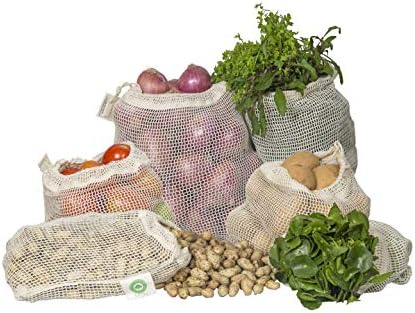
Most roundups treat muslin and mesh as one product in two textures. They are opposites. The Organic Cotton Mart mesh six-pack is 18.99 dollars as of October 2026 for two bags each at 12 by 15 inches, 10 by 12 inches and 8 by 10 inches, and its virtue is that it barely contains anything: open knit, drawstring, air straight through. That is what the 65 to 70 percent group wants, which is onions, garlic, shallots, citrus and apples. Organic Cotton Mart states the fabric is 100 percent organic cotton knit carrying a certification for ecology and social responsibility, that tare weights are printed on the labels, and that the refined breathable mesh protects delicate produce from bruising and safely stores it for up to a week. The week is the maker's number, not ours.
Buy this for the cupboard, not the crisper. Put greens in it on a shelf and they will wilt, exactly as designed. At a dollar less than the muslin set the temptation to buy one set for everything is strong; resist it.
Urban Green glass is the pick for cut produce
The moment you cut produce, every bag on this page becomes the wrong container, and Clemson raises the stakes: "All produce that is purchased pre-cut or peeled should be refrigerated within two hours to maintain both quality and safety." The Urban Green four-pack is 49.99 dollars as of October 2026 for four 35 oz containers with glass lids. Urban Green states the body is borosilicate glass and the lid semi-tempered glass with premium silicone only, markets the set as No Plastic, Not Plastic, Plastic Free, and describes a leak-proof air vent lid you close, press and lock. Per the maker the containers are microwave and oven safe, the glass lid is not for the oven, microwaving needs the air vent left open, and both parts take the dishwasher.
At 49.99 dollars this is by a wide margin the most expensive line on the page, and most readers do not need it. Half a cucumber keeps fine in any lidded box you own, or under what beeswax wraps actually work on if the cut face is flat. Two more costs: silicone is a polymer, so plastic free is the maker's framing of the gasket rather than a material fact, and 35 oz is a big box for a cut pepper. It is the same set we recommend in the best plastic-free food storage containers. If you are deciding what to buy rather than how to store it, we put glass vs stainless steel vs silicone for food storage head to head.
The bottom line
Keeping produce fresh without plastic is a sorting problem rather than a shopping problem: three piles, three opposite containers, and the most valuable moves here cost nothing. Leaves in a damp cloth in a closed crisper drawer, onions in a dark cupboard, fruit in a different drawer from the vegetables, and wash at the point of use. If you are buying, buy for the pile:
- The muslin set at 19.95 dollars as of October 2026 if greens and soft herbs are what you lose. Must be damp and in a drawer, and it is opaque.
- The mesh set at 18.99 dollars as of October 2026 if onions, garlic and citrus are what you lose. Hopeless for greens, and the one-week figure is the maker's.
- The glass four-pack at 49.99 dollars as of October 2026 only if you cut produce in advance regularly. The dearest thing here and the easiest to skip.
The failure modes pull against each other, which is why one bag cannot do this: too little moisture and your spinach is paper, too much and your onion is soup. The rest of the kitchen is in the plastic-free food storage guide.
What we tested

Tight woven cotton for the half of the produce problem that is about water
- Material
- Organic Cotton Muslin & Mesh
- Credentials
- No-buyHumidity-led
The only pick here with a weave tight enough to slow water loss from a bunch of spinach, which is the single most common way produce gets thrown away in a home kitchen.
No major drawbacks noted in testing.
Six organic cotton muslin bags, two large, two medium and two small, for 19.95 dollars as of October 2026. Simple Ecology states that the breathable fabric allows ethylene gas to escape where plastic bags trap it, that cotton is completely natural and sheds no microplastic particles onto produce unlike polyester and nylon bags, that each bag carries an exterior tare weight tag in pounds, ounces and grams, and that the set ships in recycled Kraft paper envelopes with no plastic. The job here is water: a tight weave slows the moisture loss that wilts greens and herbs. The costs are real. Muslin is opaque, so you cannot see what is going off; cotton has to be washed and dried between uses; a dry bag on an open shelf holds nothing like the 95 to 100 percent relative humidity the University of Maine Cooperative Extension lists for leafy greens, so it needs to be damp and inside a closed crisper drawer to do its job; and it is the wrong bag for an onion.
Open knit mesh doing the exact opposite job to the muslin above
- Material
- Organic Cotton Muslin & Mesh
- Credentials
- No-buyHumidity-led
This is the only pick on the page that is deliberately leaky, and leaky is exactly what the onion, garlic and shallot group needs.
No major drawbacks noted in testing.
Six cotton mesh bags at 18.99 dollars as of October 2026, two each at 12 by 15 inches, 10 by 12 inches and 8 by 10 inches. Organic Cotton Mart states the fabric is 100 percent organic cotton knit carrying a certification for ecology and social responsibility, that the refined breathable mesh protects delicate fruits and vegetables from bruising and safely stores produce for up to a week, that the drawstring closures are reinforced with double stitching, and that each label carries a tare weight. The maker says to wash cold and air dry. Its costs: the open knit that makes this right for onions, garlic, shallots, citrus and apples makes it useless for greens, which will wilt in it on an open shelf, and the up-to-a-week figure is the maker's claim rather than a tested result.

The rigid box for the moment produce stops being whole
- Material
- Organic Cotton Muslin & Mesh
- Credentials
- No-buyHumidity-led
Cut produce is the one job on this page a bag cannot do, and this is the only pick that seals, washes clean in a dishwasher and goes back in the fridge without plastic against the food.
No major drawbacks noted in testing.
Four 35 oz containers with glass lids at 49.99 dollars as of October 2026 - by a wide margin the most expensive line on this page, and the one most readers can skip. Urban Green states the body is borosilicate glass and the lid is semi-tempered glass with premium silicone only, and markets the set as No Plastic, Not Plastic, Plastic Free. The lid has a leak-proof air vent you close, press and lock. The maker states the containers are microwave and oven safe, that the glass lid is not for the oven, that microwaving with the lid on requires the air vent left open, and that both containers and lids take the dishwasher and the refrigerator. Three costs: 49.99 dollars for four works out at about 12.50 dollars a box; silicone is a polymer, so plastic free is the maker's framing of the gasket rather than a material fact; and 35 oz is a lot more container than half a cucumber needs.
Compared, side by side
| Spec | Best for Leafy GreensSimple Ecology Reusable Organic Cotton Muslin Produce and Storage Bags, Set of 6 | Best for Airflow VegetablesOrganic Cotton Mart Reusable Cotton Mesh Produce Bags, Set of 6 | Best for Cut ProduceUrban Green Glass Food Storage Containers with Glass Lids, 4 Pack, 35 oz |
|---|---|---|---|
| Verdict | Solid | Solid | Solid |
| Composite | 3.6/5 | 3.6/5 | 4.1/5 |
| Materials | 4.3 | 4.3 | 5.0 |
| Health | 3.7 | 3.7 | 3.7 |
| Durability | 3.0 | 3.0 | 4.3 |
| End-of-life | 2.8 | 2.8 | 3.2 |
| Price | — | — | — |
| Get it | Check price | Check price | Check price |
How we score
What it’s made of.
Chemistry you’ll touch.
How long it lasts.
Where it goes after.
Each pick scores 0–5 on the four axes above, weighted into the composite verdict at the top. Scores are derived from what a product is verifiably made of and certified as — not how green its label looks.
About the author
Ruth Lopez
I'm Ruth Lopez and I'm a lover of nature and the environment. I'm very passionate about finding eco friendly products that don't damage the environment and also support companies that have the same philosophy.