Kitchen Composting and Every Food Scrap Swap Worth Making

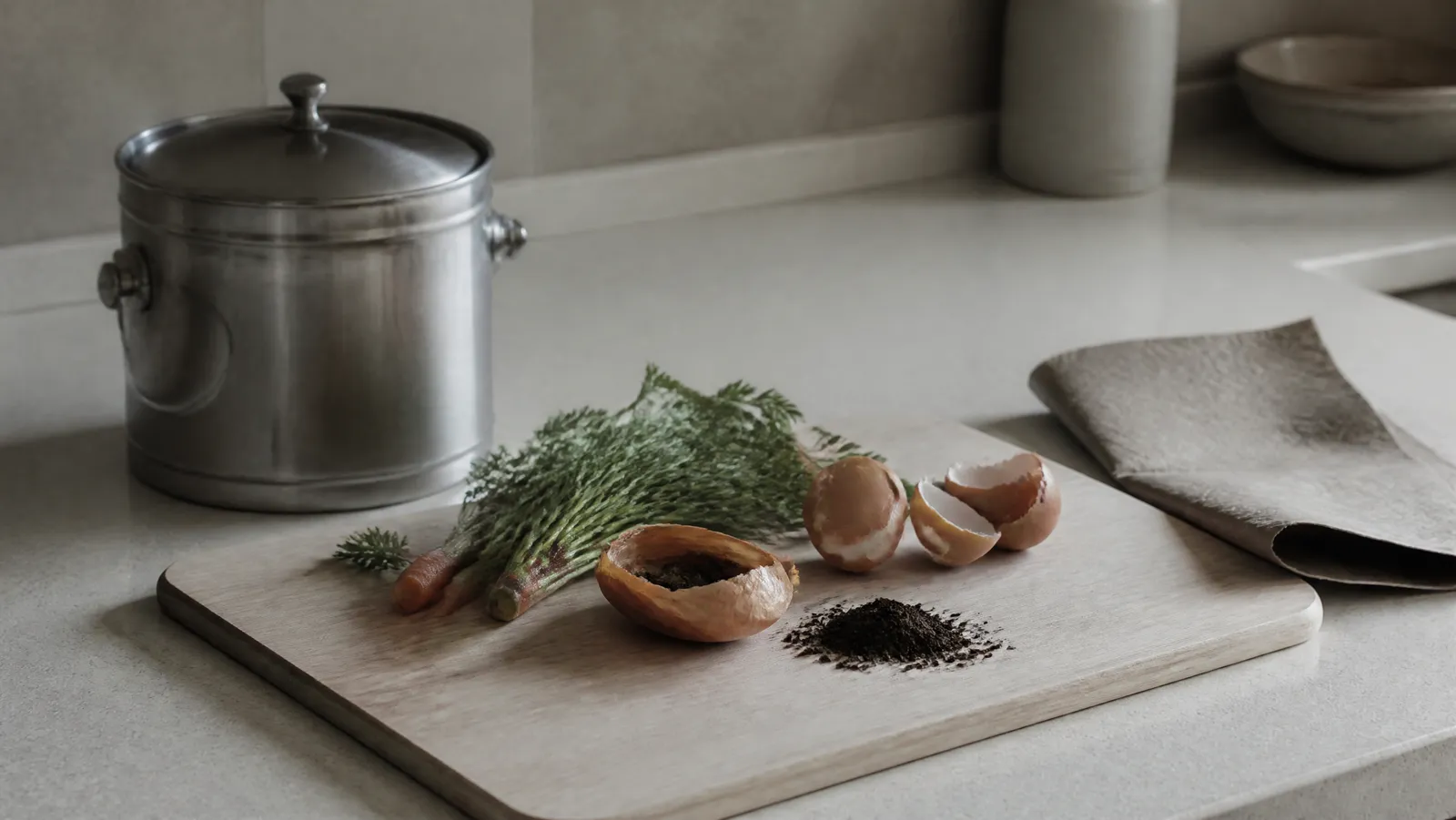
A banana peel in a backyard pile and a banana peel in a landfill are not running the same reaction. In the pile, air reaches the microbes, they respire, and the peel ends as carbon dioxide, water, heat and dark crumbly solids. Compacted under a landfill and its daily cover, the oxygen runs out, different organisms finish the job, and what they exhale is methane. So the honest case for kitchen composting is a landfill-emissions case rather than a gardening one, which means "do I have a garden" is the wrong first question.
Two more things belong at the top rather than buried. Most people who try this appear to quit for the same two reasons - it smells, and it breeds fruit flies - and both are mechanical problems with free fixes. And most people do not need to make compost at all. They need the scraps out of the landfill, and a drop-off bin at a farmers market does that as completely as a tumbler in a yard does.
This is week one of ten on composting a kitchen. This page is the map, and each section below gets its own article as the series publishes.
Why Composting Kitchen Waste at Home Is a Climate Argument and Not a Gardening One
Start with how much of the bin is organic. In the US Environmental Protection Agency's Facts and Figures data for 2018, food waste was "estimated at 63.1 million tons or 21.6 percent of total generation", and yard trimmings another "35.4 million tons, or 12.1 percent of total generation". Between them, a third of everything the country throws out is material that rots. EPA puts the food composting rate for that year at "4.1 percent (2.6 million tons)". Of the 146.1 million tons that went to landfill, EPA records food as "the largest component at about 24 percent".
The climate part is the mechanism, not the tonnage. EPA describes landfill methane as "resulting from the decaying of organic waste over time under anaerobic conditions" - decomposition without oxygen. In its October 2023 report Quantifying Methane Emissions from Landfilled Food Waste, the agency estimates that 58 percent of the fugitive methane emissions from municipal solid waste landfills come from landfilled food waste, from a material that is only about a quarter of what gets landfilled. The reason that ratio is so lopsided is timing: EPA notes that "wasted food breaks down quickly, generating methane before landfill gas collection systems are in place."
That is the whole case, and the older version of it on this site, why food scraps do not belong in a landfill, still holds up.
Now the part composting advocates skip. Composting is not the top of EPA's own hierarchy. On the agency's Wasted Food Scale, prevention "is the most environmentally beneficial option", because it avoids the resources that went into producing, processing and distributing the food in the first place. Composting sits in the middle of that scale - better than landfill or the drain, below donation, upcycling and animal feed. The uncomfortable implication is that keeping produce fresh for longer beats composting the spinach you let go to liquid. A compost bin is a treatment for a problem you would rather not have generated.
The Free Version of Composting Kitchen Scraps
Before anything in this series asks you to spend money: there is a version of this that costs zero dollars, works in any apartment, produces no smell and attracts no flies, and we earn nothing from it.
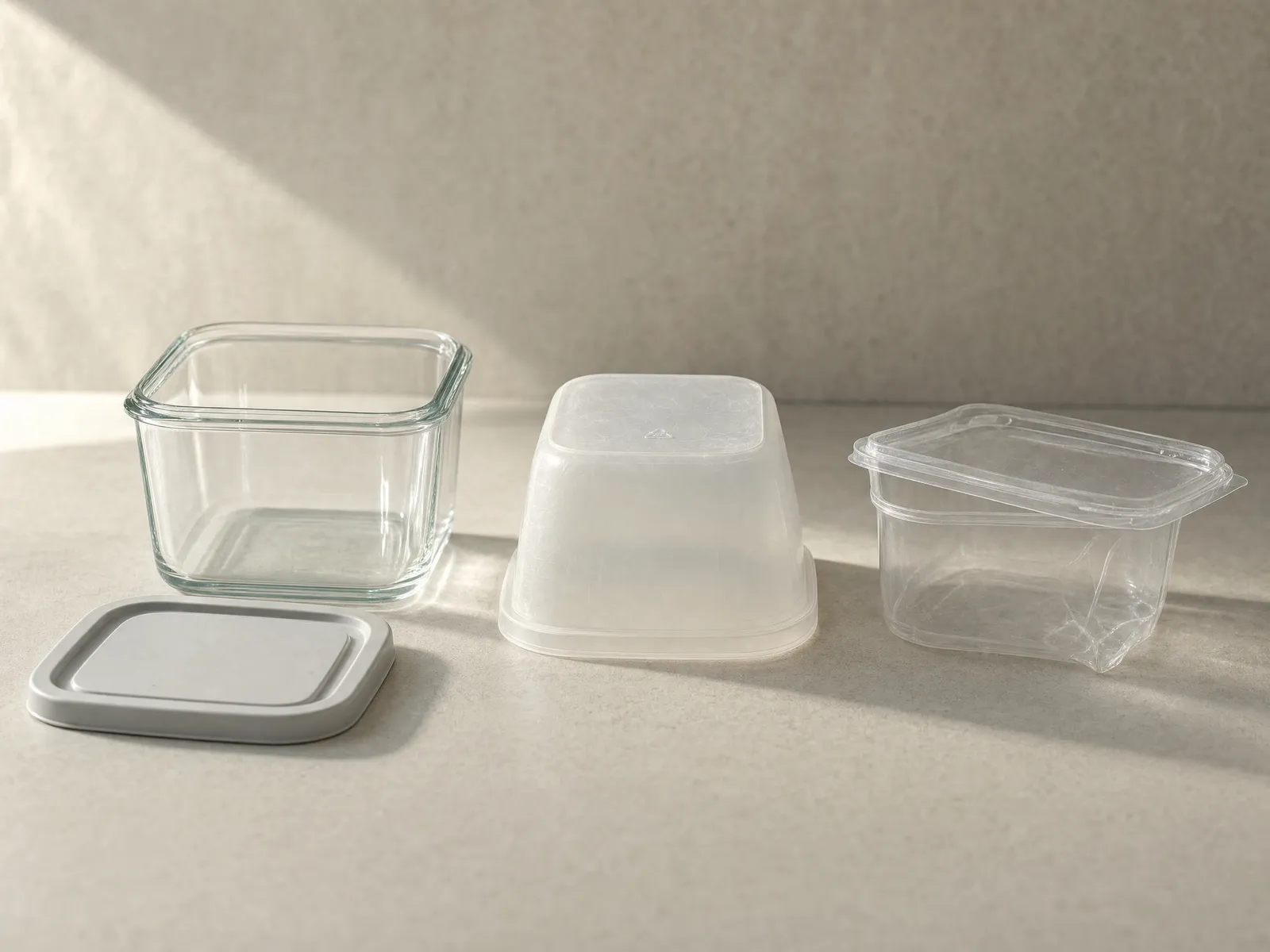
Keep a lidded container in the freezer. Any container - a yoghurt tub, a takeaway box, a bread bag. Scrape peels, cores, coffee grounds and trimmings into it as you cook. Frozen scraps do not decompose, so they do not smell, and fruit flies cannot develop in them because development requires a moist, fermenting, above-freezing medium. When it is full, take it to wherever your scraps are going.
The freezer outperforms every countertop bin we will review in this series on the two failure modes that make people quit, and it is already in your kitchen. That sentence sits above every pick on purpose, the same way it did through our series on plastic-free food storage.
What the freezer does not do is make compost. It is a holding strategy, and it only works if the scraps have a destination. So the free version has two halves, and the second one is the one people skip:
- Find the destination first. A municipal curbside organics cart, a drop-off bin, a community garden, a neighbour with a pile, a corner of your own yard.
- Then choose the container. Not the other way around. Buying a handsome counter pail before you know where its contents go is how a counter pail becomes a smell problem.
If you have outdoor space, the free version extends further: a heap of food scraps buried under a heap of dry leaves, in a corner, is a compost pile. It is slow and it is ugly and it works.
Countertop Bins and What Sits Out All Week
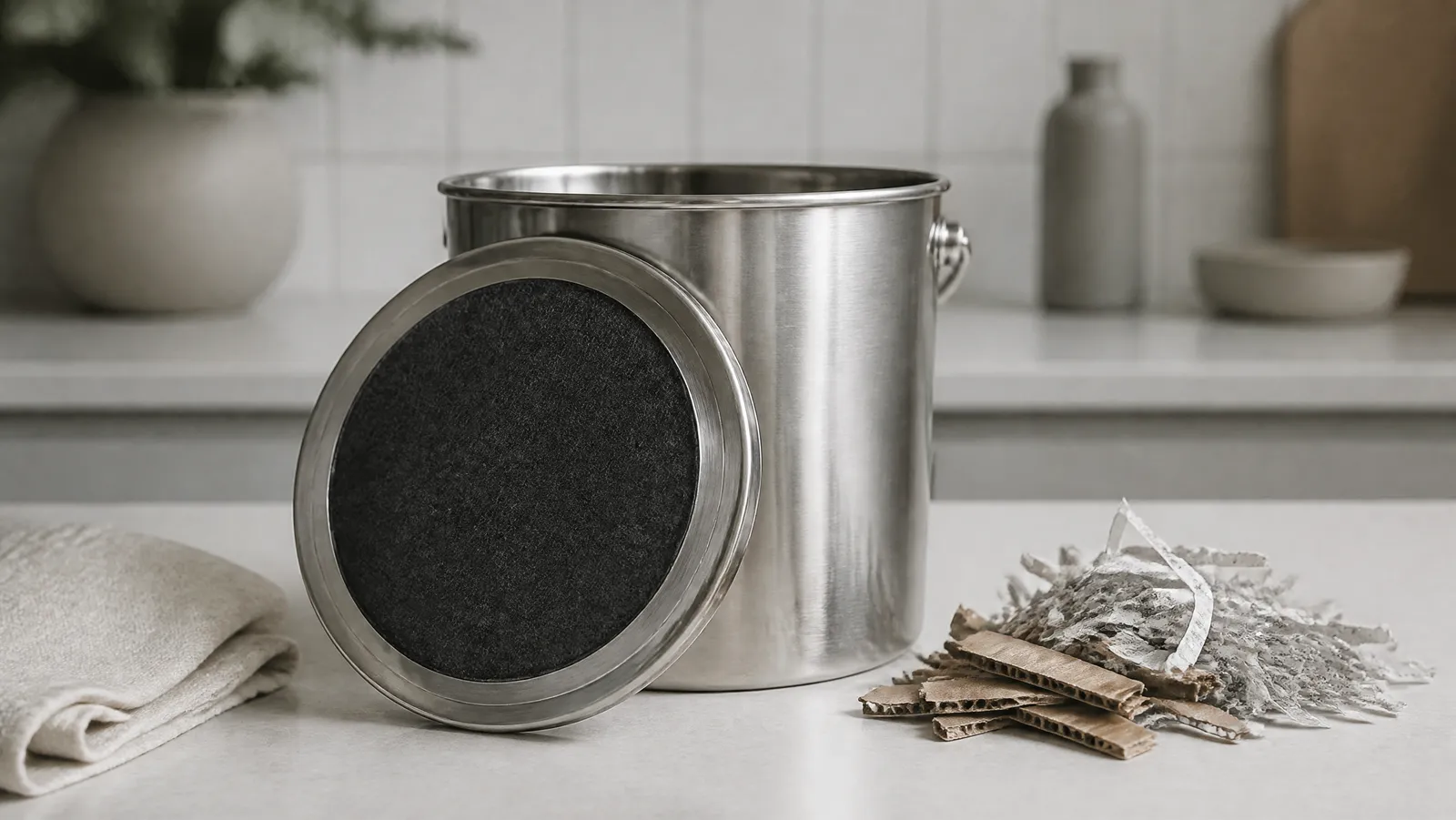
A countertop bin does not compost anything. Nothing meaningfully decomposes in a one-gallon pail over five days; what happens in there is the beginning of fermentation, which is to say the beginning of the smell. The bin is a holding vessel, and it should be judged as one: does the lid seal, is the body something you can get a brush into, and will you actually carry it to the destination.
That last criterion matters more than the materials debate. A bin that is awkward to empty gets emptied less often, and the single variable driving both odour and flies is how long scraps sit. We tested the best countertop compost bins against that standard rather than against their marketing.
Two features deserve scepticism. Charcoal filters adsorb odour compounds rather than preventing them, and they saturate, so a filtered bin that smells is usually a bin with an expired filter and an owner who was never told it was a consumable. And a larger capacity is not an upgrade. A bigger pail is a longer residence time, and residence time is the problem.
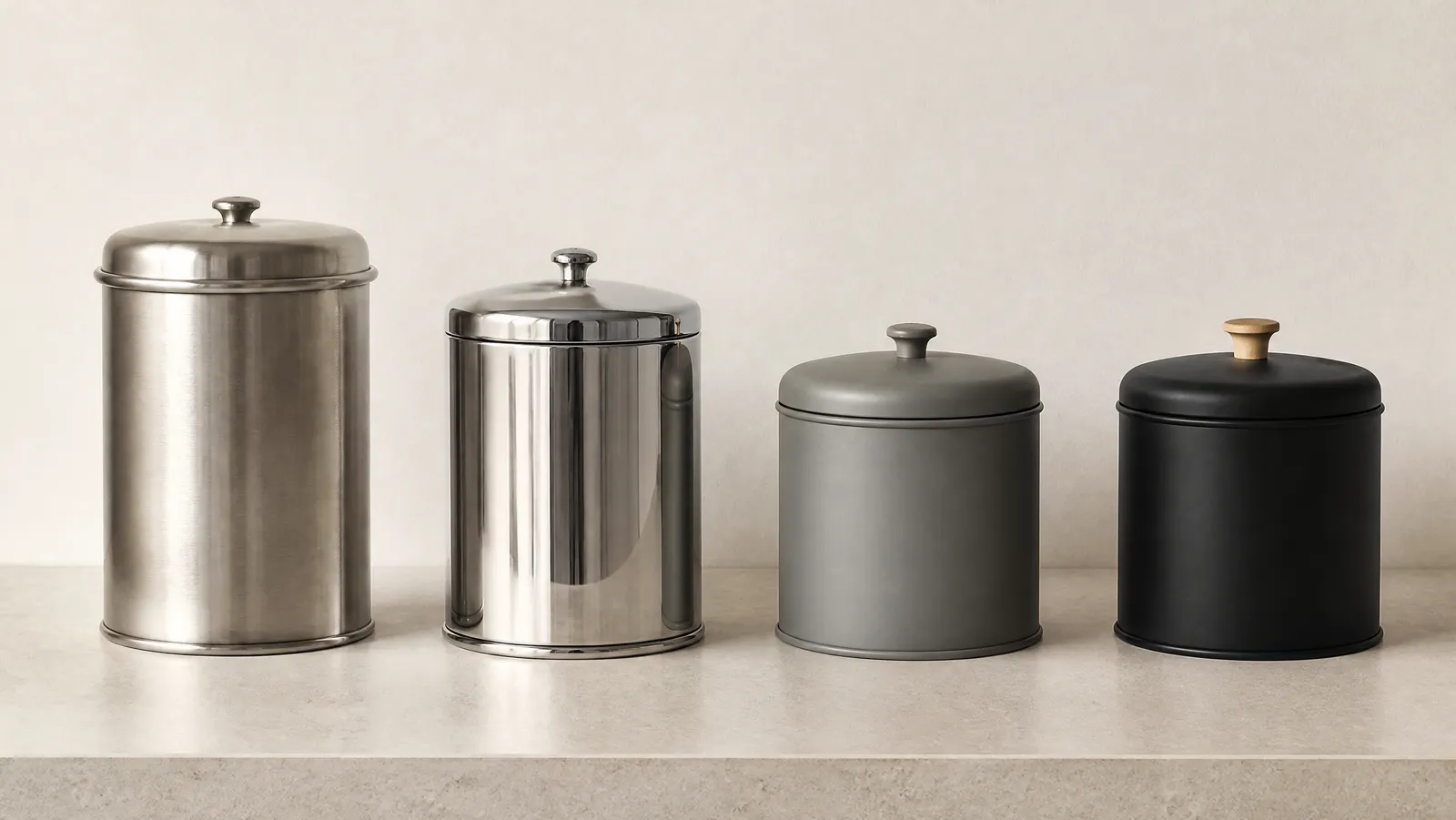
One format comparison worth making in prose, because it decides most purchases. A sealed pail with a gasket contains smell well and goes anaerobic fast, so the contents are genuinely unpleasant on opening day seven. A vented pail with a filter lets air in, which keeps the contents closer to aerobic and milder, and gives fruit flies a route. A stainless or ceramic body cleans properly; a plastic body stains and holds odour in the surface. There is no format that wins on everything, and anyone who tells you otherwise is selling one of them.
Smell and Fruit Flies and Why People Quit
Both failures have the same cause, and it is not that composting is inherently gross.
Smell is an oxygen problem. The Cornell Waste Management Institute puts the threshold at roughly 10 percent: when oxygen in the large pores of a pile falls below about that, parts of the pile go anaerobic. Cornell notes that excess moisture is the most common cause, because water slows oxygen diffusion, and that the rotten-egg smell is hydrogen sulfide. Methane itself is odourless, which is the quiet irony of the landfill argument - the gas doing the climate damage is the one you cannot smell. Ammonia, Cornell notes, can form under both aerobic and anaerobic conditions, so a sharp ammonia smell usually means too much nitrogen rather than too little air.
Flies are a timing problem. Oklahoma State University Extension states that complete development from egg to adult, under summer conditions, "may be completed in 8 to 10 days". A bin emptied weekly in July is running a photo finish against an insect's entire life cycle. Texas A&M's extension entomologists put the fastest cycle at as few as 8 days.
The fix is not a trap. The University of Kentucky entomology fact sheet on fruit flies is blunt that control depends on removing the breeding site, and the department's list of breeding sites runs well past the compost pail - drains, garbage disposals, empty bottles and cans, trash containers, mops and cleaning rags. A moist film of fermenting material is enough. So a spotless bin in a kitchen with a dirty disposal will still have flies, and the bin will get the blame.
The question of whether kitchen compost bins smell is therefore a question about your emptying interval, your moisture and your drain, and we take all three apart in their own article. The free answers: freeze the scraps, keep a layer of dry material over the top of any pile, rinse the pail every time you empty it, and clean the drain.
What Goes In and What Never Does
EPA's home composting guidance splits feedstock into greens and browns - nitrogen-rich and carbon-rich - and the ratio is the part most people get wrong. The agency's instruction is to "add at least two to three times the volume of browns (such as dry leaves) to the volume of greens", or "two to three parts carbon-rich material (browns) to one part nitrogen-rich material (greens)". A kitchen produces almost entirely greens. A pile fed only on kitchen scraps is a wet nitrogen heap, which is the recipe for the anaerobic smell in the previous section, so sourcing browns is not an optional refinement.
EPA's own do-not-add list for backyard piles carries two footnoted reasons, and conflating them causes confusion. Four entries carry both marks at once - "Meat, fish, and bones", "Cheese and dairy products", "Fats, oils, and grease" and "Cooked food (small amounts are fine)" are each flagged both because "These foods can attract animals" and because "Backyard composting piles generally do not reach high enough temperatures to fully decompose these materials". One entry carries only the temperature mark: "Compostable foodservice ware and compostable bags".
Then a miscellany with its own logic: pet waste and cat litter, herbicide-treated plants and grass, aggressive weeds and weeds with seeds, diseased and pest-infested plants, treated or painted wood, dryer lint, glossy paper, and produce stickers.
The asymmetry worth understanding is that the meat and dairy rule is about your pile, not about the material. A municipal facility, an industrial digester and a bokashi bucket all take meat. The list of what you can and cannot compost therefore has a different answer for every destination, which is why we treat it as its own article rather than a universal list.
Starting From Nothing This Week
The order of operations is the whole thing, and it is the opposite of the order most people use.
- Day one: find the destination. Search your city or county website for "organics", "food scraps" or "yard waste", and check whether your curbside yard-waste cart accepts food. Failing that, look for a drop-off at a farmers market, a community garden, or a transfer station. If you have a yard, the destination is a corner of it.
- Day two: start the freezer container. Anything with a lid. This costs nothing and it begins diverting immediately, before you have bought or built a thing.
- Day three: secure browns. A paper sack of dry leaves, shredded corrugated cardboard with the tape removed, or torn-up paper egg cartons, kept beside wherever the pile is. If your destination is a drop-off or a curbside cart, skip this entirely - the facility supplies its own carbon.
- Week two: buy the counter bin, if you still want one. By now you know your volume and your emptying interval, which are the only two numbers that should pick it.
Nothing in that sequence requires a purchase in the first week, and some households will find at step one that they never need one. A full walkthrough of how to start composting kitchen scraps follows in its own article, including what to do when your city's web page is years out of date.
Liners and Bags and the Part That Usually Lies
This is the category where the label and the outcome are furthest apart, and there is a peer-reviewed number for it.
In 2022, Danielle Purkiss and colleagues at University College London published the results of the Big Compost Experiment in the journal Frontiers in Sustainability - a citizen-science study with 9,701 UK participants, 1,648 of whom ran home composting trials. Among items that carried home-compostable certification, 60 percent did not fully disintegrate in home composting conditions, and the authors concluded that home composting is an ineffective method of disposal for this packaging. The same study found that 46 percent of the packaging people sampled carried no compostable certification at all, which tells you how much of the confusion is upstream of the compost bin.
Industrial facilities are a different story, and it would be dishonest to merge them. The Composting Consortium, convened by Closed Loop Partners, published field results in April 2024 from more than 23,000 units across ten US composting facilities, reporting that compostable plastic packaging averaged 98 percent disintegration by surface area, above the 90 percent threshold the industry uses. EPA's home guidance says the same thing from the other end: compostable bags are on its do-not-add list for backyard piles because those piles do not get hot enough.
So compostable bin liners are two products wearing one name. The honest position: if your municipal programme requires certified bags, buy the ones it specifies. If the destination is your own pile, a liner is a convenience for carrying the pail and nothing more - and a sheet of newspaper does that job for nothing.
Electric Composters and the Several Hundred Dollar Question
The most useful published assessment we found is by Ron Alexander, a horticulturist with more than forty years in compost and recycled organics, writing in BioCycle in September 2023. He describes what the machines do: dehydrate and grind, using an external heat source at roughly 165 to 275 degrees F for four to twenty hours, reducing volume by up to 90 percent and leaving the output under 10 percent moisture.
Then he had the output analysed. Alexander reports poor stability and maturity ratings; DNA sequencing that found "no measurable (microbial) DNA", meaning the material is not biologically stabilised; electrical conductivity that is high, with sodium and chloride two to three times higher than most of the yard trimmings and food waste based composts he has evaluated; and a low pH. In his own trials, rye grass did not germinate in a 25 percent blend of the dehydrated material, mould covered the samples within five days, and the material attracted flies. He also cites a Universiti Brunei study finding that phytotoxins remained after four weeks of curing.
On the published evidence, what comes out of these machines is a dried, ground feedstock, not finished compost, and putting it straight on plants can hurt them. Buried in a garden bed or added to a real pile, it continues decomposing and becomes useful.
In fairness to the category, it solves the two problems in this article completely: a sealed, heated, ground output does not smell and cannot breed flies, and it is shelf-stable, which matters if your drop-off is monthly. That is a real convenience, bought at several hundred dollars plus electricity. Whether electric kitchen composters are worth that is a separate article, and the answer depends almost entirely on whether you have somewhere to put the output.
Composting With No Yard and No Balcony
Four methods work in a flat, and the constraint is never the input. It is the output.
A worm bin fits under a sink and runs at room temperature. A bokashi bucket fits in a closet and takes meat and dairy, which no other home method does. An electric unit takes up counter space and a plug. A freezer container plus a drop-off takes up a shelf and nothing else.
Three of those four leave you holding material you then have to find soil for, and the fourth does not - which is why the honest default for most apartments is the freezer and the drop-off. A worm bin generates castings and leachate. A bokashi bucket generates fermentate that must go into soil. An electric unit generates the immature material described above. If you have window boxes and a few houseplants, that is a feature; if you have neither, you have replaced a waste problem with a storage problem.
Two apartment-specific constraints worth planning around. Temperature: a worm bin on an unheated balcony in winter or a hot one in August is a bin of dead worms, and we give the published ranges below. And lease terms: some buildings prohibit livestock in a way that a landlord may read as covering a thousand worms, which is worth checking before rather than after. The question of how to compost in an apartment, method by method and with the failure modes of each, gets its own article in this series.
Where the Scraps Go If You Do Not Compost Them
Access is improving and is still a minority of households. BioCycle's 2023 nationwide survey counted about 14.9 million US households with access to municipally supported food waste collection - curbside and drop-off together - up 49 percent from roughly 10.0 million in 2021. The important caveat is in the methodology: BioCycle counts only programmes run by local government or by private haulers under contract to it, so private subscription services, farmers-market bins and community gardens are outside that number. Your actual options are probably better than the survey implies.
The ranked list, for the landfill-methane argument specifically:
- A municipal curbside organics cart. Nothing beats it: no equipment, no maintenance, and the material goes to a facility that reaches temperatures a backyard pile cannot.
- A drop-off bin. Farmers markets, transfer stations, community gardens, some grocery chains. Pair it with the freezer and the trip becomes fortnightly rather than daily.
- A private subscription hauler. Costs money, works everywhere, and in many cities is the only option.
- A neighbour with a pile. Informal, free, and the method most likely to actually stick, because it has a person attached to it.
For the argument this article opened with, a drop-off bin is a complete answer, and it is also the cheapest thing on this page. You do not need to own the process to divert the material. The question of where to take food scraps, and how to find a programme your city has not advertised, is covered separately.
Bokashi and Fermenting Instead of Rotting
Bokashi is not composting, and the distinction is the point. It is an anaerobic fermentation - the thing every other method on this page is trying to avoid - run deliberately, in a sealed bucket, with inoculated bran. North Carolina State Extension's Beaufort County office describes that bran as carrying lactic acid bacteria, yeasts and phototrophic bacteria.
Washington State University Extension gives the timings and the honest limitation: fermentation takes roughly 10 to 14 days once the bucket is full, and what comes out is a nutrient-dense pre-compost that must be buried in soil or finished in another composting system before the breakdown is complete. WSU also notes that the high acidity of the process suppresses pathogens and weed seeds, which is the mechanism behind bokashi's one genuine advantage over every other home method: it takes meat, fish, dairy and cooked food, the exact categories EPA tells you to keep out of a backyard pile.
The costs are real and specific. You are buying bran as a consumable, indefinitely. The bucket produces a liquid that has to be drained every few days or the ferment goes wrong. And the end product is not a soil amendment yet - it is acidic, visibly recognisable as food, and needs weeks in soil before anything should be planted into it. In short, bokashi composting suits a household with meat scraps and a garden bed, and suits a household with neither very badly.
Worm Bins and What They Really Ask of You
A worm bin is livestock, and that framing avoids most of the disappointment. The species is Eisenia fetida, the red wiggler, not earthworms from the garden.
The published numbers set expectations better than any sales page. The University of Florida IFAS Extension fact sheet for Leon County recommends roughly one pound of worms - about 1,000 individuals - per square foot of bin surface, and reports that an established pound of worms eats about a third of a pound of food per day. The Institute for Local Self-Reliance suggests one to two pounds per square foot and roughly one square foot of surface area per pound of food scraps per week. ILSR also gives the operating window: keep the bin between 55 and 80 degrees F.
Do the arithmetic before you buy. A household producing four pounds of scraps a week needs something like four square feet of bin surface and, at those published stocking rates, four to eight pounds of worms, which is a larger object than the stacking trays sold for the job usually are.
Overfeeding is the characteristic failure, and it presents as exactly the two symptoms this article started with: food the worms cannot process in time ferments, the bin goes anaerobic and sour, and fruit flies arrive. The other constraints are ordinary animal husbandry - the bin cannot freeze or cook, so an unheated garage or a summer balcony will kill it, and a three-week holiday needs a plan. What indoor worm bins actually ask of you, and the setups that survive year two, gets its own article.
The bottom line for the whole series: get the scraps out of the landfill first, by whatever route is nearest, and decide later whether you want to make compost - because the methane argument is settled and the gardening argument is optional. Freeze the scraps, find the destination, and buy equipment last.
Explore the full series
- The Best Countertop Compost Bins We Tested — Five bins that live on a counter all week, and the filter cost nobody puts on the box.
- Do Kitchen Compost Bins Smell and How to Stop Fruit Flies — The two reasons people quit composting indoors, and the fixes that cost nothing.
How we score
What it’s made of.
Chemistry you’ll touch.
How long it lasts.
Where it goes after.
Each pick scores 0–5 on the four axes above, weighted into the composite verdict at the top. Scores are derived from what a product is verifiably made of and certified as — not how green its label looks.
About the author
Ruth Lopez
I'm Ruth Lopez and I'm a lover of nature and the environment. I'm very passionate about finding eco friendly products that don't damage the environment and also support companies that have the same philosophy.