The Best Countertop Compost Bins We Tested

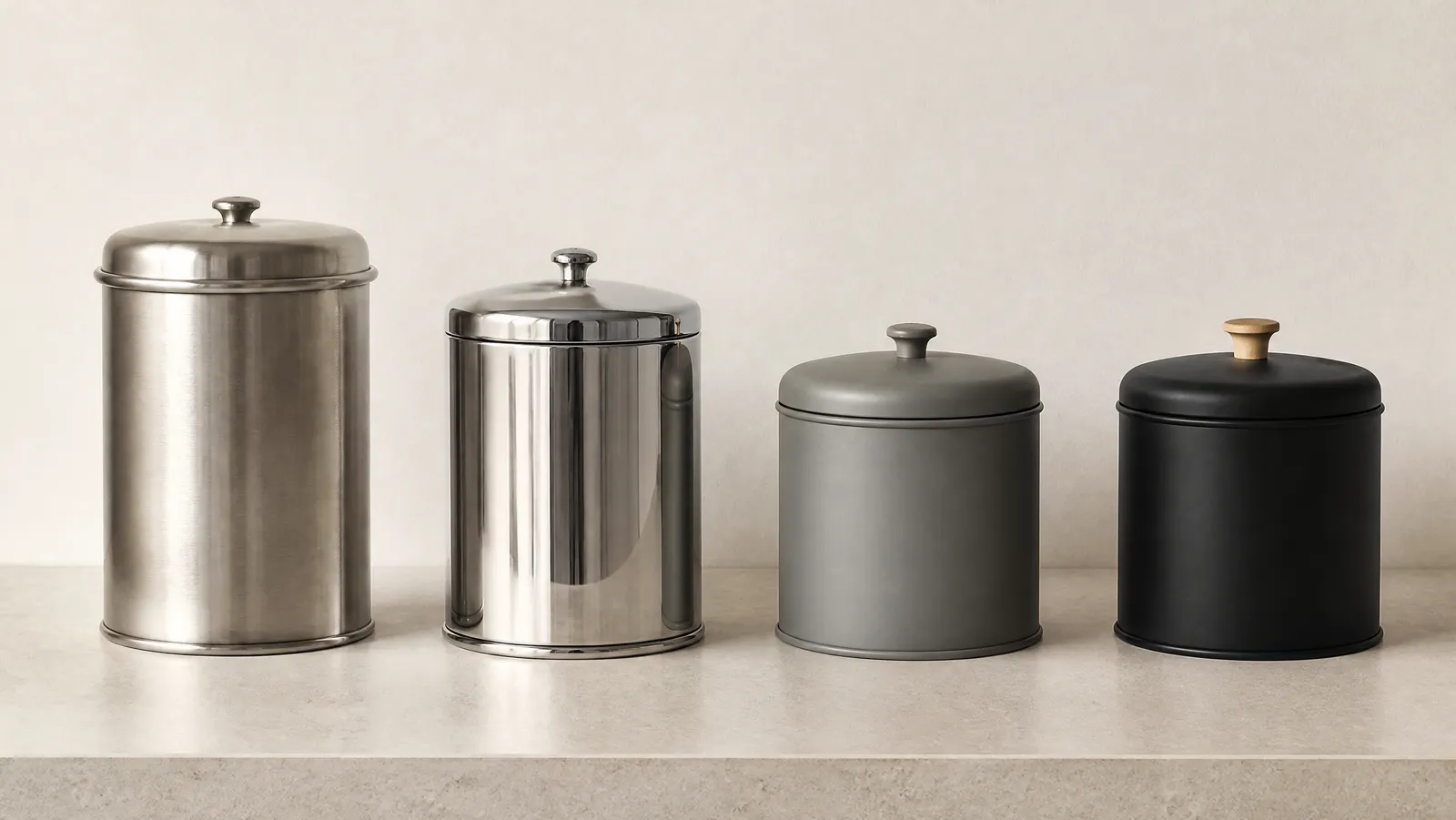
Nothing composts on your counter. The US Environmental Protection Agency defines composting as the managed, aerobic decomposition of organic material by microorganisms, and a 1.3-gallon pail packed with a week of coffee grounds is the opposite of aerobic. So the best countertop compost bin is not the one that decomposes anything: it is the one whose lid fits, whose filter you can replace, and whose body you can scrub. We may earn a commission when you buy through links on this page, at no cost to you.
This is the equipment review in our series on kitchen composting, and it is the part of the subject where the equipment matters least. Below are five bins, ranked by what they are made of before anything else, and above them is the method that costs nothing and works better than four of the five.
A countertop compost bucket is a holding container, not a composter
The EPA's home composting guidance calls composting "the managed, aerobic (oxygen-required) biological decomposition of organic materials by microorganisms". Managed means someone turns it. Aerobic means air reaches the middle. A lidded pail on a kitchen counter is neither, and what develops inside it over a week is the beginning of anaerobic fermentation - which is also, precisely, the thing that smells.
Tom Richard, writing in Cornell Cooperative Extension's composting Operator's Fact Sheets for the people who run municipal sites, gives the threshold: "if the oxygen level falls below 10 percent in the large pores, parts of the compost pile can become anaerobic", and anaerobic decomposition yields methane and hydrogen sulfide. Cornell University's Waste Management Institute, in its odor-management material, lists reduced sulfur compounds, volatile fatty acids, aromatics and amines as the characteristic anaerobic odorants, and notes that ammonia forms under both aerobic and anaerobic conditions.
Three of these five listings sell their lid holes as ventilation or aeration. We read those holes as a vent so moisture and pressure can escape and the filter has a path to outside air, not as a feature that makes a packed pail aerobic, and no listing here publishes a measured result for them. Machines that genuinely dry and grind scraps do exist - electric kitchen composters - and they are a different product at a different price from anything on this page.
Why bother holding scraps at all: in its 2023 report Quantifying Methane Emissions from Landfilled Food Waste, the US EPA estimates that food is about 24 percent of what goes into municipal solid waste landfills but accounts for roughly 58 percent of their fugitive methane emissions. The EPA's 2019 Wasted Food Report puts US wasted food across retail, food service and homes at 66.2 million tons, with households responsible for about 40 percent of it. The pail is a logistics problem in service of that. It is not itself a climate device.
What makes a kitchen compost bin smell and what keeps fruit flies out
Two different failures, two different fixes, and most listings blur them.
Smell is the chemistry above. A sealed warm bucket goes anaerobic within days, and the compounds Cornell lists are what you open the lid into. A charcoal filter adsorbs some of them on the way out. Nothing in the lid stops them forming.
Fruit flies are a timing problem. University of Maryland Extension puts the complete life cycle of the common fruit fly at 8 to 10 days, with larvae feeding for 5 to 6 days before crawling somewhere drier to pupate. Penn State Extension says the cycle can finish in as little as eight days at 85 degrees F. That is the real argument for emptying a bin weekly: a seven-day cycle sits just inside the window where eggs laid on day one have not yet become adults.
Extension entomologists are blunt about what works. Penn State: "elimination of fly breeding sites is paramount", and insecticidal sprays kill adults while the larvae keep developing. Ohio State University Extension recommends 16-mesh screens because these flies pass straight through ordinary house-fly screening, which tells you how little a loose lid is worth. University of New Hampshire Extension says trapping is "nowhere near as effective as practicing good kitchen sanitation". Whether a filter and a lid are enough on their own is the subject of its own piece on whether compost bins really smell.
The free method beats every kitchen compost container on this page
A lidded container you already own does this job for nothing, and a bag of scraps in the freezer does it better than anything here, including the bins we are about to sell you. We earn nothing from this section.
Any jar, yogurt tub or stockpot with a lid is a holding container. It has no charcoal filter, so you empty it more often. That is the entire difference.
The freezer version removes both failure modes rather than managing them. A standard home freezer runs at 0 degrees F, which is minus 18 C. The USDA's Food Safety and Inspection Service states that freezing to 0 degrees F inactivates the microbes present in food - bacteria, yeasts and molds - and that they resume activity on thawing. Inactive microbes produce no volatile fatty acids and no hydrogen sulfide, so a frozen bag of scraps does not smell. It also does not host fruit flies: a 1990 paper in the Journal of Experimental Biology reports that adult Drosophila melanogaster did not survive two hours at minus 5 degrees C, that larvae did not survive the same exposure, and that two hours at minus 8 degrees C was lethal to pupae. A freezer runs about 10 degrees C below that.
- Start here if you are not sure you will keep it up. Scraps in a bag in the freezer, emptied when the bag is full. If you are still doing it in a month, buy a bin.
- The cost is freezer space, which in a small kitchen is exactly why countertop bins exist.
- Which bags and wraps survive a freezer without cracking is covered in freezing food without plastic.
How we ranked these kitchen composting bins for countertop use: material first
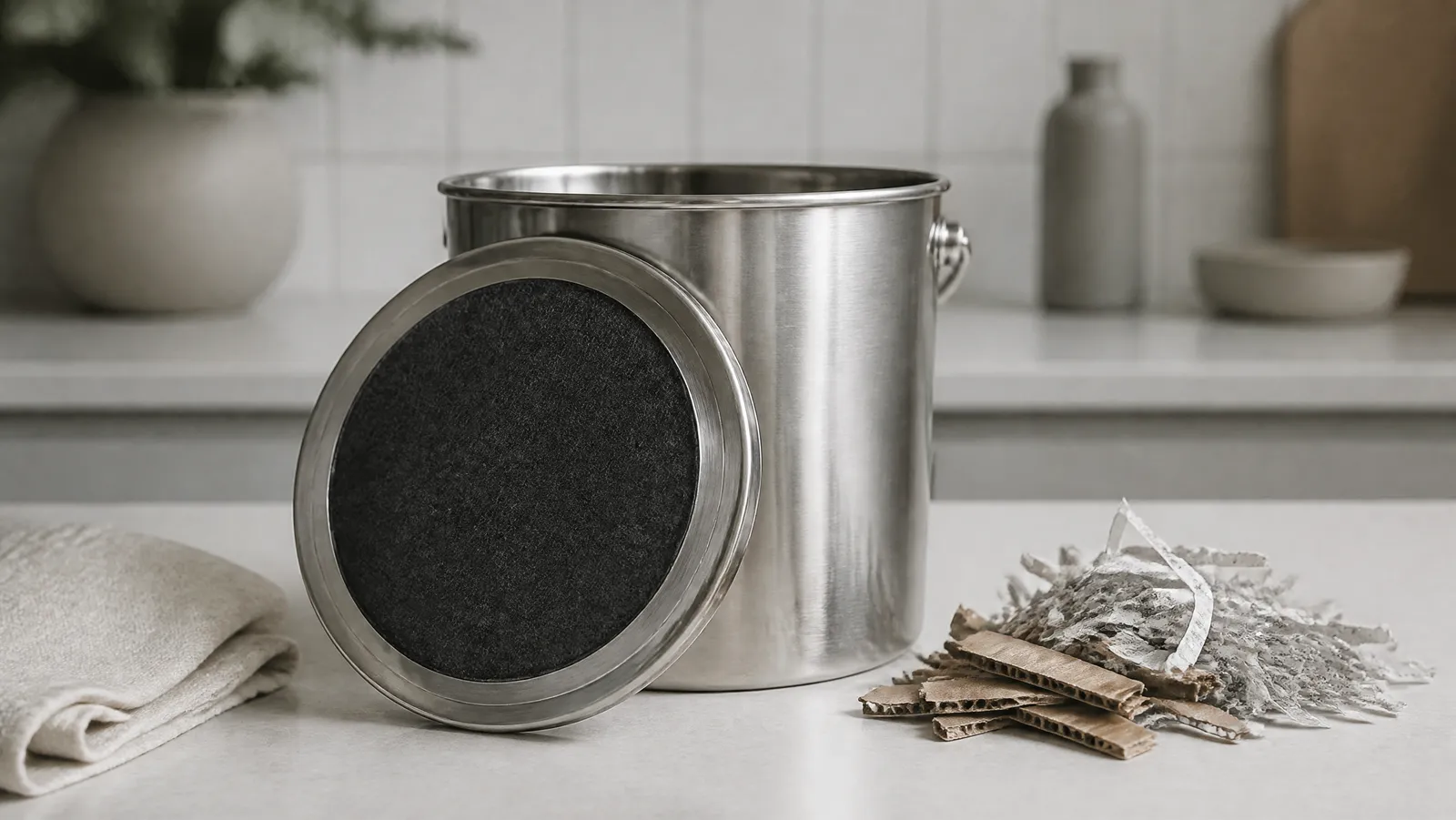
Every bin here is a 1.1 or 1.3 gallon metal pail with a filter in the lid. The listings differ on almost nothing except what the metal is, so that is the ranking.
Three of these five listings describe a stainless steel body: Epica says "premium stainless steel", Utopia Kitchen says "Made with stainless steel", RED FACTOR says a "durable stainless-steel body". Two describe a coating over a different metal: Holismo says "high quality galvanized iron" with an "epoxy resin coating", and KIBAGA says "rust-free, powder-coated carbon steel".
That distinction is structural rather than cosmetic. The Informationsstelle Edelstahl Rostfrei, the German stainless steel information centre, describes the protection as self-repairing: "Stainless steel surfaces have a unique self-healing surface protection system. The transparent passive layer quickly reforms if damaged, provided there is sufficient oxygen in the surroundings." A coating has no such property. It is a wear surface, and the inside of a compost bin is the worst wear environment in a kitchen - acidic, wet, scrubbed weekly, scraped with whatever is nearest. Chip an epoxy or powder coat and what is underneath is iron or carbon steel.
We are not claiming the coated bins fail. We are claiming the failure mode is different and that it is worth about 3 dollars, which is the gap between the Holismo and the Utopia Kitchen bin. On that basis: stainless first, cheapest stainless above most expensive stainless, coated last except where a specific constraint - counter height, counter size - overrides it.
What a charcoal filter does and when it stops doing it
Activated carbon works by adsorption: odour molecules stick to an enormous internal pore surface until that surface is occupied. The capacity is finite, which is why every bin here uses a replaceable filter rather than a permanent one. Two of the five makers publish a figure: Epica states 3 to 6 months with regular use, and Holismo states 3 to 4 months per cartridge. Those are the makers' own figures, not measurements, and they are the recurring cost that decides what a bin actually costs over three years.
Moisture is the variable nobody on a product listing mentions. A 1996 study of removing volatile organic compounds from humidified gas streams with activated carbon cloth, published in Gas Separation and Purification by researchers at the University of Illinois and indexed in the US Geological Survey publications warehouse, found the effect depends sharply on the compound: acetone adsorption was barely affected even at 90 percent relative humidity, while benzene capacity fell away above about 65 percent. That is a laboratory sorbent and a different set of molecules from a kitchen lid filter, so treat it as a direction rather than a number - but the direction is that a saturated, dripping bin is working its filter hardest in the conditions least suited to it.
Epica is the only maker here that gives you a way to extend filter life rather than only a date to replace it: rinse and air dry, and "Do not saturate the charcoal filters- gentle rinsing is enough".
The one line in these listings worth more than any feature
It is in the Utopia Kitchen listing, and it is a care instruction: "Line the bottom with newspaper or cardboard to absorb liquid, and drain excess moisture from food scraps before adding them."
That is the actual fix for a bin that leaks and stinks, and it applies to every bin on this page and to the free yogurt tub as well. Liquid at the bottom of a pail is the anaerobic layer; it is what runs out of the seam, what soaks the filter from inside, and what you are scrubbing off on Sunday. Newspaper in the base absorbs it. Draining a wet scrap over the sink before it goes in means less of it to absorb.
- Line the base. Newspaper, a cereal box panel, a paper towel.
- Drain wet scraps first. Melon rind and coffee grounds are mostly water.
- Rinse weekly. Utopia Kitchen suggests water, mild soap or vinegar; Epica says its bin is "easy to hand-wash with warm water", and RED FACTOR states explicitly that its bin is "Not machine washable". Neither coated pick publishes a washing instruction we can quote.
- Compostable bin liners are a separate question, and which ones actually break down in a given municipal programme varies enough that we will not generalise here.
Epica 1.3 Gallon: the best countertop compost bin if you buy one thing
The Epica bin is 29.98 dollars as of October 2026 against a 39.95 dollar list price, a 25 percent reduction. Epica measures it at 7.16 inches in diameter by 11 inches high, states it has an "airtight lid and a replaceable activated-charcoal filter to help reduce odors", and says it is "Crafted from premium stainless steel".
It ranks first on documentation rather than on hardware. Every bin here has a lid and a filter. Epica is the only maker that explains how to keep the filter working - rinse, air dry, do not saturate - and the one that claims the longest filter life, 3 to 6 months against the 3 to 4 months Holismo states.
Its costs, stated. The same listing calls the bin both "one-piece molded design" and "premium stainless steel", and we cannot resolve that from the listing, so we do not repeat "molded" as a material fact. "FEATURED IN BON APPETIT & FORBES" is promotion, not a test. And the honest problem with ranking it first is directly below it.
Utopia Kitchen 1.3 Gallon: the same bin for nearly 8 dollars less
The Utopia Kitchen bin is 22.22 dollars as of October 2026 against a 25.99 dollar list price, a 15 percent reduction. Utopia Kitchen measures it at 7.2 inches wide and 11.2 inches high, and states it is "Made with stainless steel" and therefore "resists scratching, cracking, and chipping".
Set the two listings side by side and the differences are fractions of an inch: 7.2 wide against 7.16, 11.2 high against 11.0, the same 1.3 gallons, the same stated metal, and a charcoal filter in the lid on both. The price difference is 7.76 dollars. If you are buying on specification rather than on the maker's care advice, this is the bin, and we would not argue with a reader who put it first.
Its costs. "Food scraps can build up for a full week" is Utopia Kitchen's claim and not a measurement - the extension-entomology timing above is the reason we think a week is the right emptying interval, not this sentence. It is the tallest bin here at 11.2 inches. And the listing never says how many filters are in the box, which matters more than it sounds when the filter is the running cost.
Holismo: the cheapest kitchen compost container that still seals
The Holismo bin is 19.37 dollars as of October 2026 against a 20.39 dollar list price, a 5 percent reduction. Holismo states it is 1.3 gallons at 7.08 by 7.08 by 8.66 inches, with an "activated charcoal filter in the lid compartment".
This is the cheapest bin here and it is cheapest for a stated reason: Holismo describes it as "made of high quality galvanized iron" with an "epoxy resin coating", not as stainless steel. The coating is the corrosion protection, and a coating is a wear surface. That is the whole of our objection, and it is worth about 3 dollars against the Utopia Kitchen bin.
What it buys you instead is height. At 8.66 inches it is more than an inch and a half shorter than anything else here, which is the dimension that decides whether a bin lives under a wall cabinet. Second cost: Holismo's filter claim, "Each charcoal cartridge lasts for 3-4 months", is shorter than Epica's 3 to 6, so the cheapest bin may also have the fastest consumable.
RED FACTOR: two filters, spare filters, and the highest price here
The RED FACTOR bin is 39.99 dollars as of October 2026, with no list price shown - the most expensive pick on this page. RED FACTOR sizes it at 10.8 by 8.7 by 7.3 inches and 1.3 gallons, and states it has a "durable stainless-steel body" made with "Single sheet manufacturing technology" that "ensures seamless form with no joints", which is a real point on an object whose job is to not leak at a seam.
Its differentiator is countable: two filters rather than one, plus spares in the box. "Innovative dual-filter technology" is a description of there being two filters, and we have no test showing two outperform one - but spare filters in the box are a genuine saving against the one consumable every bin here shares. Before buying, price the refill filters for the Epica or Utopia bins and see whether the spares close a 17.77 dollar gap.
Its costs. "Neutralizing bad smells even in hot summer days" is maker copy, not a measurement. RED FACTOR states it is "Easy to clean with soapy water. Not machine washable", so 40 dollars does not buy you out of hand-washing. And at 8.7 inches across its second dimension it is the one pick here whose footprint is not roughly 7 inches square.
KIBAGA: the best kitchen compost bin for a counter with no room
The KIBAGA bin is 27.99 dollars as of October 2026 against a 29.99 dollar list price, a 7 percent reduction. KIBAGA states "the 10.2x7 inch composting bin boasts a 1.1-gallon volume", with "two filter included" and a wooden handle.
It is the only pick under 1.3 gallons, and that is the reason to buy it: a smaller bin fills sooner, and a bin that fills sooner gets emptied sooner, which is the only fruit-fly control that extension entomologists actually endorse. It also matches the RED FACTOR's two filters for 12 dollars less.
Its costs are material and they keep it fifth. KIBAGA's own description of the body is "rust-free, powder-coated carbon steel" - a coating over carbon steel, with the same chip exposure as the Holismo, on the surface that takes the most abuse. The wooden handle is attractive and is a part that does not want to be soaked on a bin you should be rinsing weekly. And 1.1 gallons against 1.3 is a real loss of about 15 percent of the volume if counter space was not your constraint.
The bottom line
Put a lidded container you already own on the counter tonight, or a bag in the freezer if you have the space, and buy a bin only once you know you will keep it up. The freezer is the only method on this page that removes the smell and the flies rather than managing them, and it costs nothing.
If you are buying, buy on metal and then on height:
- The Epica bin at 29.98 dollars as of October 2026 if you want the maker that documents its filters. The listing cannot decide whether the bin is molded or stainless, and we report that rather than resolve it.
- The Utopia Kitchen bin at 22.22 dollars as of October 2026 if you are buying on specification. Near-identical dimensions and stated material for 7.76 dollars less, and the best care instruction on the page.
- The Holismo bin at 19.37 dollars as of October 2026 if the bin has to fit under a cabinet. Galvanized iron with an epoxy coating, in Holismo's own words, which is a wear surface rather than an alloy.
- The RED FACTOR bin at 39.99 dollars as of October 2026 only if spare filters and a seamless body are worth 17.77 dollars over the Utopia Kitchen bin. Hand-wash only.
- The KIBAGA bin at 27.99 dollars as of October 2026 if your counter cannot take a 1.3 gallon pail. Powder-coated carbon steel by KIBAGA's own description, and a wooden handle to keep dry.
Whichever you choose, line the base with newspaper, drain wet scraps before they go in, and empty it inside a week. What goes in the bin, where it goes next, and whether your municipality takes it is in setting up kitchen composting, and the rest of the kitchen is in plastic-free food storage.
What we tested

Stainless steel by Epica s description and the longest filter life any maker here commits to
- Material
- Stainless & Coated Steel
- Credentials
- ReusableFilter-served
The only maker here that tells you how to extend a filter's life rather than only when to throw it away, which is the recurring cost that decides what one of these bins really costs you.
No major drawbacks noted in testing.
29.98 dollars as of October 2026 against a 39.95 dollar list price, a 25 percent reduction, for a bin Epica measures at 7.16 inches in diameter by 11 inches high. Epica states it has an "airtight lid and a replaceable activated-charcoal filter to help reduce odors", a "one-piece molded design that resists rust and leaks", that it is "Crafted from premium stainless steel", and that it is "easy to hand-wash with warm water". Its filter guidance is the most specific on this page: rinse the filters and air dry them to extend their life, "Do not saturate the charcoal filters- gentle rinsing is enough", and expect "3-6 mo. with regular use". Three costs. The listing describes the same object as both "one-piece molded" and "premium stainless steel", and we cannot resolve that from the listing, so we do not repeat "molded" as a material fact. "FEATURED IN BON APPETIT & FORBES" is promotion rather than a test result. And it is nearly 8 dollars more than the Utopia Kitchen bin at the same stated capacity and the same stated material.

The same stated material and the same capacity for nearly 8 dollars less
- Material
- Stainless & Coated Steel
- Credentials
- ReusableFilter-served
The cheapest bin here whose listing claims a stainless steel body, within fractions of an inch of the Best Overall pick on every dimension the two listings publish.
No major drawbacks noted in testing.
22.22 dollars as of October 2026 against a 25.99 dollar list price, a 15 percent reduction, for a bin Utopia Kitchen measures at 7.2 inches wide and 11.2 inches high. Utopia Kitchen states it is "Made with stainless steel" and so "resists scratching, cracking, and chipping", and that the included charcoal filters "trap odors naturally, so food scraps can build up for a full week". The listing also carries the single most useful sentence on this page, which is a care instruction rather than a feature: "Line the bottom with newspaper or cardboard to absorb liquid, and drain excess moisture from food scraps before adding them", followed by "A quick weekly rinse with water, mild soap, or vinegar keeps things smelling fresh". Costs: the full-week claim is the maker's own and not a measurement we can check, it is the tallest bin here at 11.2 inches which is the dimension that decides whether a lid clears a wall cabinet, and the listing does not say how many filters are in the box.

Galvanized iron under an epoxy coating in Holismo s own description
- Material
- Stainless & Coated Steel
- Credentials
- ReusableFilter-served
At 8.66 inches it is the shortest bin on the page by more than an inch and a half, which is the pick we would expect to leave the most headroom under a wall cabinet when the lid comes off.
No major drawbacks noted in testing.
19.37 dollars as of October 2026 against a 20.39 dollar list price, a 5 percent reduction, and the lowest price on this page. Holismo states the bin is "made of high quality galvanized iron", that "The epoxy resin coating provides additional protection", that there is an "activated charcoal filter in the lid compartment", that the lid "has ventilation holes to promote air circulation", and that it holds 1.3 gallons at 7.08 by 7.08 by 8.66 inches. Costs, and the first is the reason it ranks third: this is coated iron rather than stainless steel, so its corrosion protection is a surface layer that can chip rather than a property of the metal underneath. Holismo's own filter figure, "Each charcoal cartridge lasts for 3-4 months", is shorter than Epica's 3 to 6. And the ventilation holes are sold as promoting air circulation, which is not the same as a tested result.

Two filters and spares in the box at the highest price here
- Material
- Stainless & Coated Steel
- Credentials
- ReusableFilter-served
The only pick whose listing says spare filters are in the box, which is the one recurring cost every bin on this page otherwise leaves you to buy again every few months.
No major drawbacks noted in testing.
39.99 dollars as of October 2026, the most expensive pick on this page, with no list price shown. RED FACTOR states it uses "innovative dual-filter technology with active carbon ingredient and a lid with holes for proper ventilation", that it has a "durable stainless-steel body that is resistant to rust, cracks and chips" built by "Single sheet manufacturing technology" that "ensures seamless form with no joints", that it is "Perfectly sized at 1.3 Gallons (10.8-inch x 8.7-inch x 7.3-inch)", that it has a "soft grip handle", and that it "Includes Spare Filters". Costs: "innovative dual-filter technology" is a description of having two filters rather than one, and no test we can cite shows two outperforming one; "neutralizing bad smells even in hot summer days" is maker copy rather than a measurement; and RED FACTOR states it is "Easy to clean with soapy water. Not machine washable", so at 40 dollars this is still a hand-wash object.

The only sub 1 3 gallon bin here with a coating rather than an alloy
- Material
- Stainless & Coated Steel
- Credentials
- ReusableFilter-served
Two filters in the box for 12 dollars less than the other two-filter pick, and the only bin here that admits a kitchen counter has a size limit.
No major drawbacks noted in testing.
27.99 dollars as of October 2026 against a 29.99 dollar list price, a 7 percent reduction, for the only bin on this page under 1.3 gallons. KIBAGA states "the 10.2x7 inch composting bin boasts a 1.1-gallon volume", with a "built-in charcoal filter compartment", "lid air holes providing necessary aeration", "two filter included", a "wooden handle" and a "timeless black design". Costs: KIBAGA's own words for the body are "rust-free, powder-coated carbon steel", which is a coating over carbon steel rather than stainless, and carries the same chip risk we flag on the Holismo. The smaller capacity means emptying it sooner, which is the point of buying it and also the compromise. And a wooden handle is a part that does not want to be soaked, on a bin you should be rinsing weekly.
The top three, compared
| Spec | Best OverallEpica Kitchen Compost Bin for Kitchen Countertops, 1.3 Gallon - Silver | Best ValueUtopia Kitchen Countertop Compost Bin 1.3 Gallon, Stainless Steel, Silver | Cheapest That Still SealsHolismo Kitchen Countertop Compost Bin, Gray |
|---|---|---|---|
| Verdict | Buy | Buy | Buy |
| Composite | 4.2/5 | 4.2/5 | 4.2/5 |
| Materials | 3.7 | 3.7 | 3.7 |
| Health | 3.7 | 3.7 | 3.7 |
| Durability | 5.0 | 5.0 | 5.0 |
| End-of-life | 5.0 | 5.0 | 5.0 |
| Price | — | — | — |
| Get it | Check price | Check price | Check price |
How we score
What it’s made of.
Chemistry you’ll touch.
How long it lasts.
Where it goes after.
Each pick scores 0–5 on the four axes above, weighted into the composite verdict at the top. Scores are derived from what a product is verifiably made of and certified as — not how green its label looks.
About the author
Ruth Lopez
I'm Ruth Lopez and I'm a lover of nature and the environment. I'm very passionate about finding eco friendly products that don't damage the environment and also support companies that have the same philosophy.