What You Can and Cannot Compost From a Kitchen

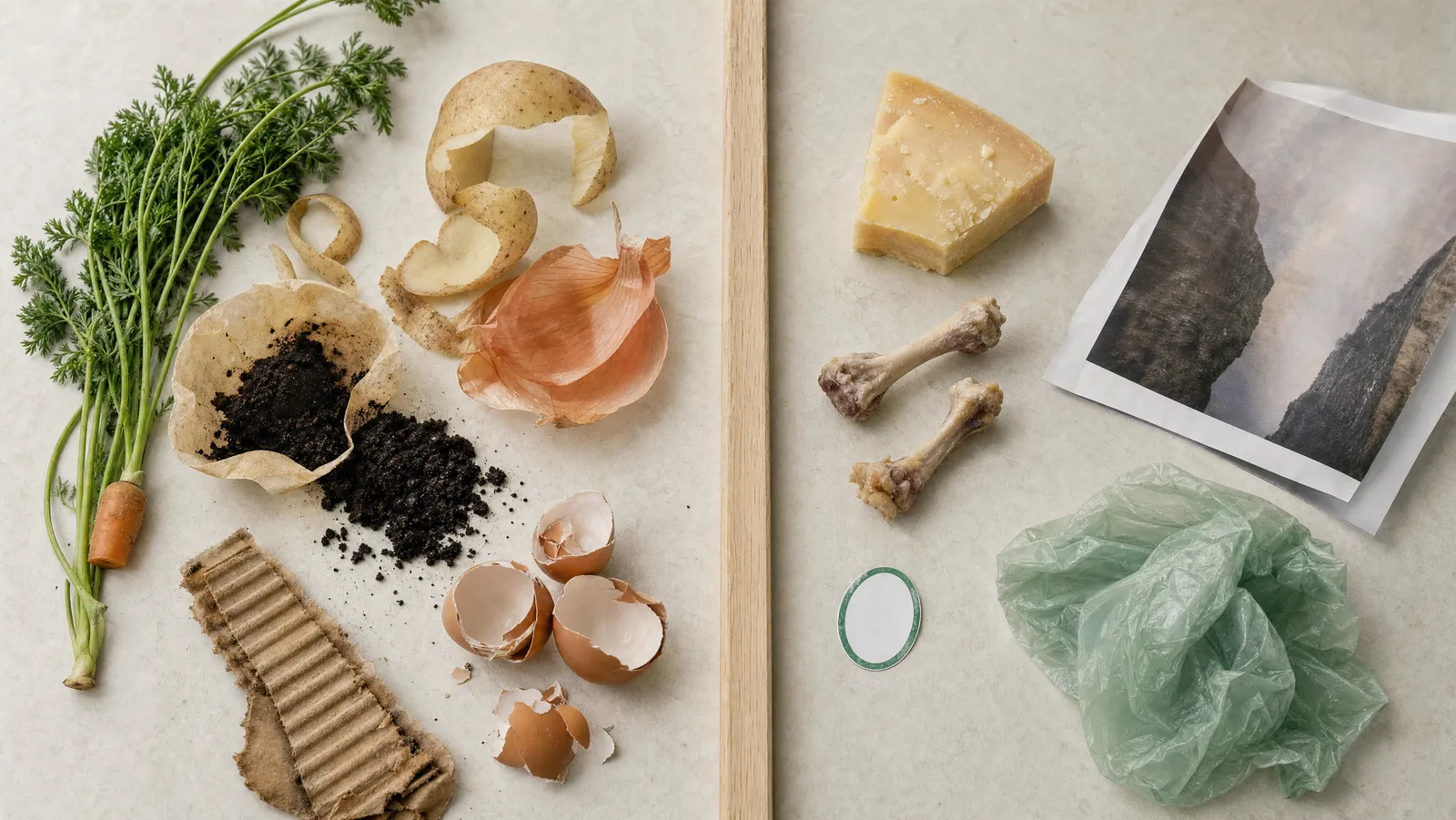
Composting is a temperature-and-oxygen process run by microbes, and in one system by worms, so what a system digests follows from how hot it runs and what lives inside it. Which means what kitchen scraps you can compost has no single answer. It has one answer per destination. Meat is banned from a backyard pile and taken by a commercial facility and a bokashi bucket. Citrus is absent from EPA's backyard do-not-add list and a problem in a worm bin. Packaging stamped "compostable" is usually certified for industrial conditions, and even the home-certified kind mostly fails at home.
So the list everyone searches for is the second thing you need. The first is knowing where the scraps go, so if that is unsettled, read how to start composting kitchen scraps first. This is the exclusions chapter of our week on kitchen composting, and it decides whether you keep going or go back to sending food scraps to the landfill. It sells nothing and there is nothing to buy to act on it.
The two reasons something lands on the do-not-compost list
The most useful piece of composting guidance we have found is not a list but a pair of footnotes. The US Environmental Protection Agency's composting-at-home guidance marks the entries in its avoid-adding column with two different symbols. The first footnote reads: "These foods can attract animals." The second reads: "Backyard composting piles generally do not reach high enough temperatures to fully decompose these materials."
Those are unrelated problems wearing the same label, and nearly every roundup online collapses them.
- Attracting animals is a behavioural problem with your pile, not a decomposition problem. The material would rot perfectly well. The objection is rats, flies and the neighbours, the same family of objection behind whether compost bins smell.
- Not getting hot enough is a thermal problem. The material sits there, or breaks down so incompletely that it is still recognisable when you want the compost.
Four entries carry both marks at once: "Meat, fish, and bones", "Cheese and dairy products", "Fats, oils, and grease" and "Cooked food (small amounts are fine)". Compostable foodservice ware and compostable bags carry only the temperature mark: nothing is coming over the fence for a compostable cup.
Learn which reason applies and you can work out the answer for the thing we did not list. If the objection is animals, a sealed or buried system solves it. If it is heat, only a hotter destination does.
What you can compost in a backyard pile
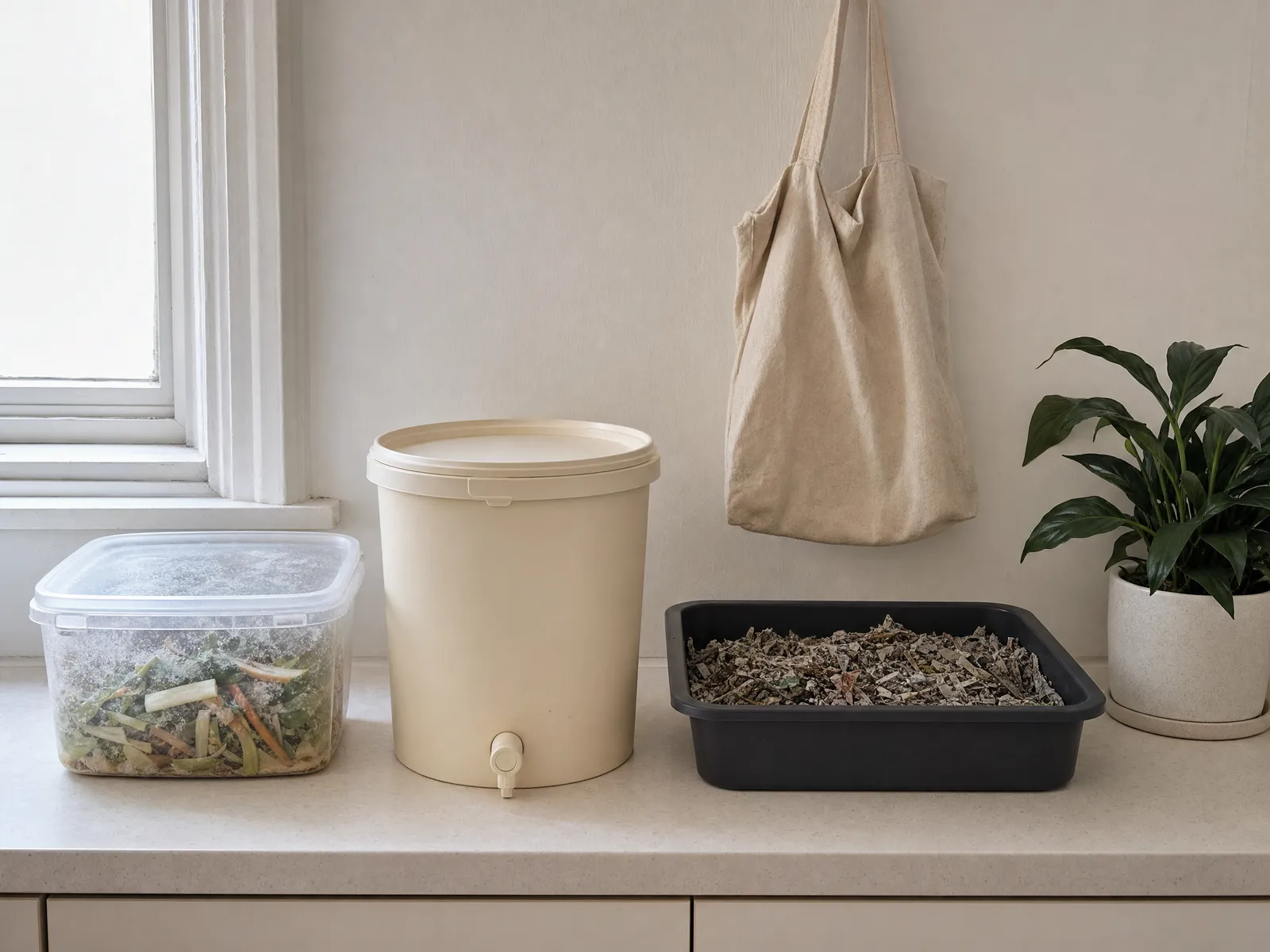
An open pile or a tumbler is the narrowest destination here. The kitchen half of EPA's yes-list is short enough to quote in full: fruit and vegetable scraps, "Coffee grounds and paper filters", "Shredded paper (non-glossy, uncolored) and shredded brown bags", "Paper tea bags (no staples)", "Shredded cardboard (no wax coating, tape, or glue)" and "Eggshells (crushed)". Read the parentheses. Every one is doing work, and most of this article is what they exclude.
The temperature story is better than the usual version. EPA states that "A backyard pile, if well maintained, can reach temperatures of 130° to 160° F", and on its page explaining the types of composting it gives the optimal range for compost microorganisms as "131 to 160 degrees Fahrenheit". So a good pile can reach the right band, and EPA's footnote still says backyard piles generally do not get hot enough for meat and dairy. Our reading, offered as a reading: touching that temperature at the core is not the same as holding it through the mass for days. EPA's line on a passive static pile says the quiet part out loud. "This method usually does not get the pile hot enough to break down materials such as meat, bones, and dairy products." A pile that sometimes peaks at 140 degrees is not the same machine as one that holds 131 everywhere.
Four items on EPA's avoid list come out of a kitchen but are not food at all: "Dryer lint", "Glossy paper", "Produce stickers" and "Compostable foodservice ware and compostable bags". Stickers are adhesive film, glossy stock is coated, and lint from a synthetic wash is plastic fibre by definition. The question for this group is not whether it rots but whether you want to pick it out of the finished compost with tweezers.
Can you compost meat and dairy and what changes at a commercial facility
In a backyard pile, no. EPA's instruction has no qualifier: "Do not add meat, dairy, or greasy foods to your pile." Bones, fish, cheese, cooking fat, the grease in the roasting tin, all out for both reasons at once.
In a municipal or commercial programme, usually yes, and the same footnote says why: "These materials can be composted at commercial composting facilities." Then it adds the sentence we cannot improve on: "Check first to make sure your specific facility accepts them."
That is where we stop being useful. Acceptance is set by your city, hauler or facility permit, so any list we printed would be wrong somewhere. We cannot tell you whether your programme takes meat, bones or certified compostable packaging. Your programme can, on one page of its own site, and that page outranks everything here.
What a facility buys you is process control: in-vessel systems, aerated static piles and turned windrows are run and monitored to hold the temperatures EPA describes. A bin behind the shed is not. It is also why cooked food, the entry with a parenthetical, is a matter of degree at home. A plate of leftover rice is not a crisis. Every dinner scraped in is.
What a worm bin cannot take and the reason underneath
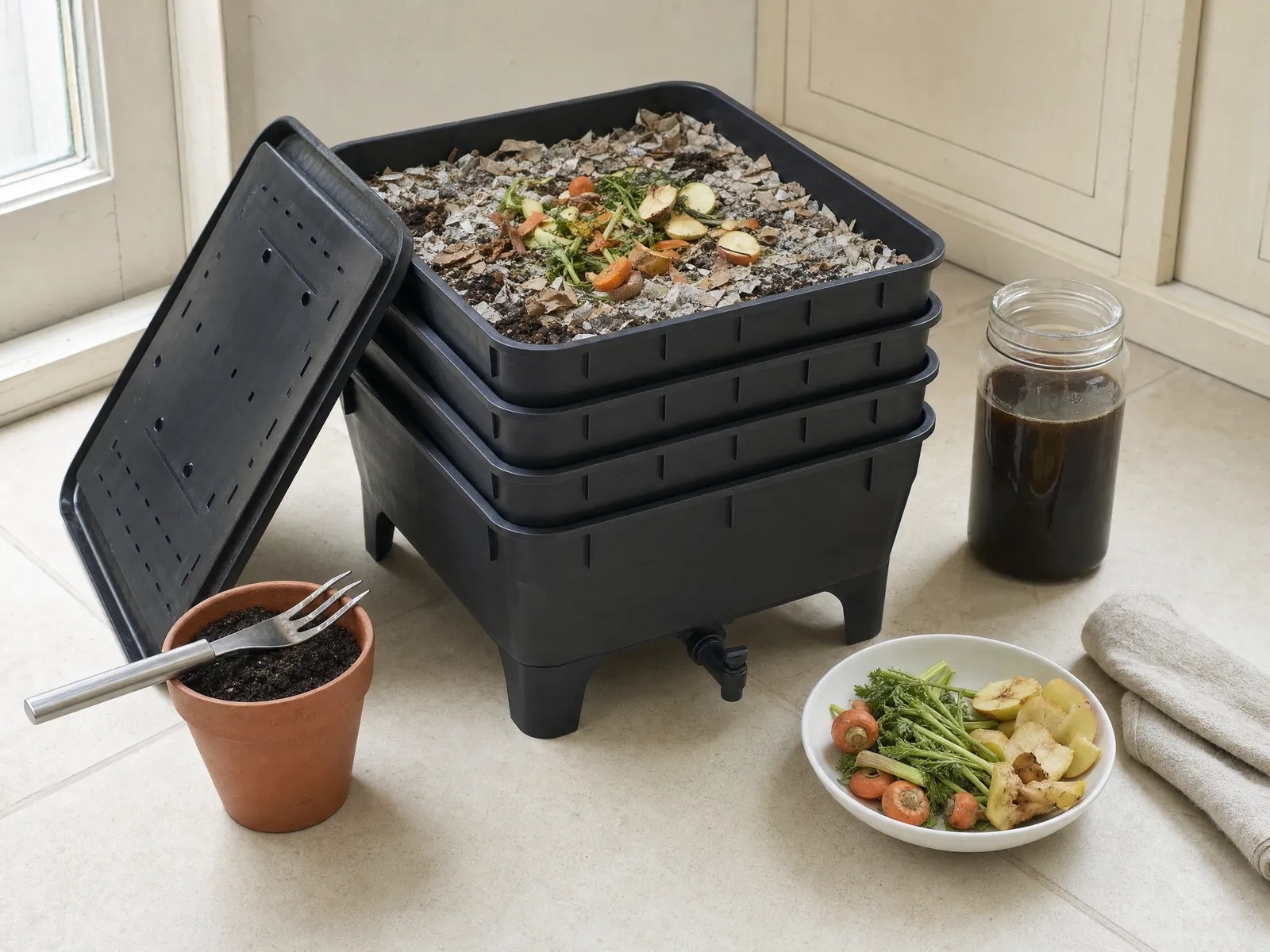
A worm bin is not a small compost pile. It is a livestock enclosure, and the limit is what the animals tolerate, not what the chemistry allows. The temperature gives it away: EPA puts the target at 59 to 77 degrees Fahrenheit, and its composting-types page gives the ideal vermicomposting range as 55 to 80. The coolest destination here is also the one with the longest exclusion list.
EPA's vermicomposting line: "Avoid citrus fruits, odorous foods like onions and garlic, meat, dairy products, greasy foods, bones, and pet waste." The vermicomposting fact sheet from UF/IFAS Extension, the University of Florida's Institute of Food and Agricultural Sciences, prints the same prohibitions and adds a middle category: coffee grounds and filter, plain grains and pasta, potatoes and crushed eggshells are fed "in moderation" rather than freely. A worm bin takes less of your kitchen than a backyard pile, not more.
Can you compost citrus and onion or is the prohibition folklore
Here the folklore has outrun the evidence, and the direction it ran matters. The strongest version we can source is about worms, with named mechanisms. The UF/IFAS fact sheet states that "Citrus fruits contain citric acid and limonene, which can be toxic to worms" and that while "small amounts may be tolerated in larger systems, it is advisable to avoid adding citrus to home worm bins." On alliums it says they "contain sulfur compounds that can be harmful to worms", then concedes what the folk version never does: "the papery skin of onions and garlic is generally considered safe in worm bins."
Now the part nobody repeats. Citrus and onion appear nowhere on EPA's list of things to avoid adding to a backyard compost pile. They appear only in its vermicomposting section. The prohibition most people have absorbed as a law of composting is, in the guidance we read, a worm-keeping instruction.
We looked for a controlled study showing citrus or onion harms a hot aerobic pile and did not find one, so we will not tell you citrus is fine with the confidence the internet tells you it is forbidden. Worm bins have a mechanism-level reason to exclude citrus flesh and alliums; backyard piles have no such entry. Peel is slow and waxy in a cool pile, and chopping it is the remedy.
What a bokashi bucket takes that a backyard pile will not
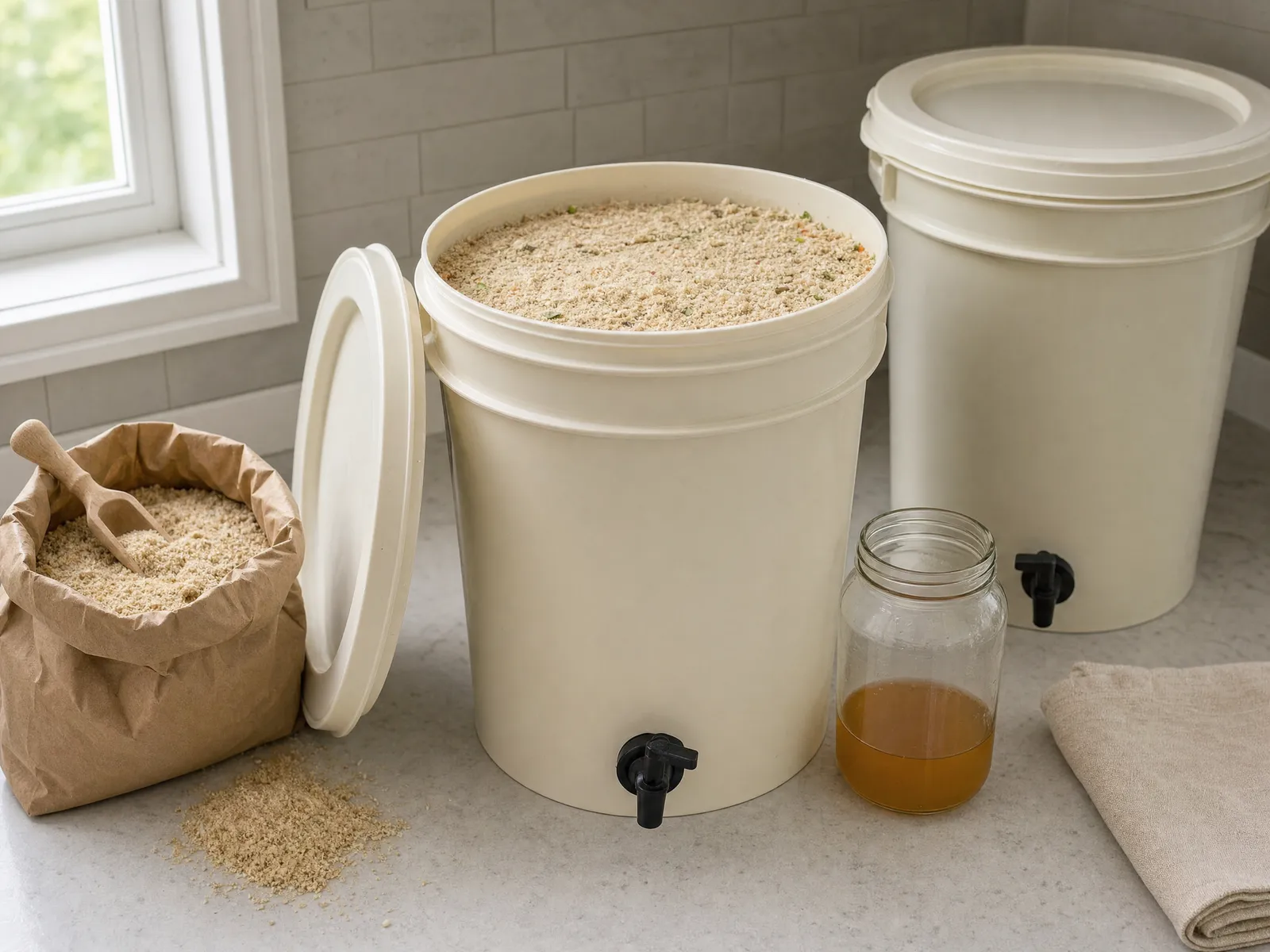
Bokashi breaks the pattern: it is not composting. Washington State University Extension's Kitsap County programme puts it plainly: "Bokashi ferments food scraps, preserving nutrients while preventing rot and harmful emissions", and "Bokashi is fermentation, not decomposition." A sealed bucket, inoculated bran, no oxygen, no heat. WSU Extension says the closed process "safely processes materials typically excluded from other systems, including meat, dairy, and cooked foods." Sealing defeats the animal problem and fermenting defeats the temperature problem, so the categories carrying both of EPA's marks are the ones it handles.
The catch is that bokashi finishes nothing. WSU Extension states the output "must be buried in soil or finished in another compost system to complete breakdown." With nowhere to bury a bucket of acidic pre-compost every fortnight, bokashi has not solved your problem but moved it.
What an electric countertop unit actually makes
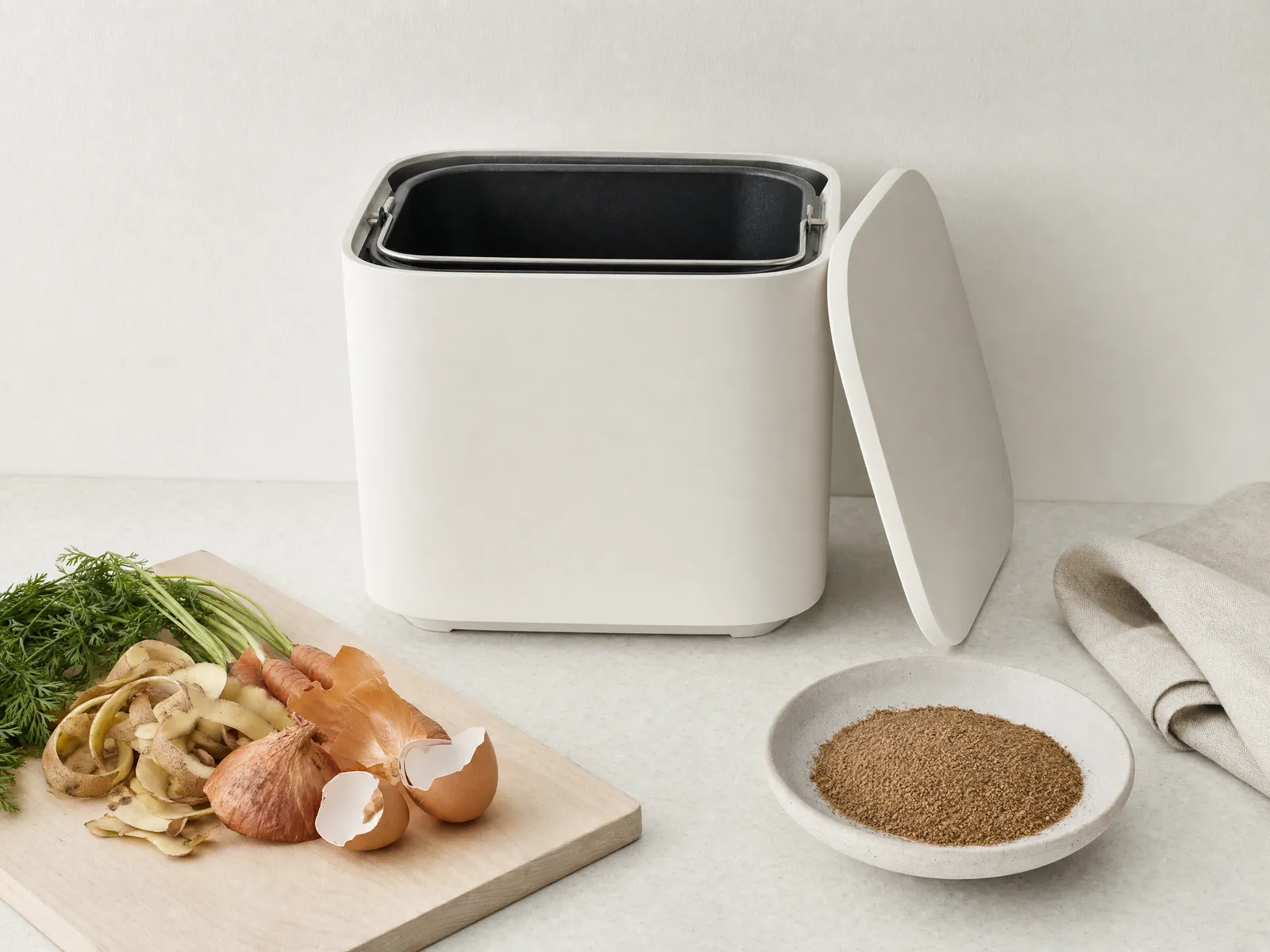
Electric units are sold as composters and mostly are not. Ron Alexander, a horticulturist with about 40 years in compost product development, wrote in the trade journal BioCycle in September 2023 that these appliances are "often incorrectly referred to as 'composters'" and that the dried material "realistically requires further processing and significant curing" before use. So the output is an input to a compost process rather than the end of one: send it to a pile, a bin or a collection programme, not a seedbed.
Can you compost paper towels napkins and coffee filters
Yes, with one exception, and they count as a brown rather than a green. EPA lists "Coffee grounds and paper filters" outright, so the filter goes in with the grounds, and towels and napkins follow the "Shredded paper (non-glossy, uncolored) and shredded brown bags" entry: plain uncoated cellulose, nothing printed in colour. The exception is what the towel was used for. One that wiped up cooking grease is fats, oils and grease arriving by another route, an entry carrying both warning marks; one used with a cleaning product carries a biocide into a system that runs on microbes. Compost the towel that dried your hands. Bin the one that mopped up bacon fat.
Tea bags are the trap
EPA's yes-list says "Paper tea bags (no staples)", and the parenthetical is only half the problem.
The bag to worry about is the one that is not paper. Laura Hernandez, Nathalie Tufenkji and colleagues at McGill University, publishing in the American Chemical Society journal Environmental Science and Technology in 2019, steeped mesh tea bags of nylon and polyethylene terephthalate at 95 degrees Celsius for five minutes and estimated that one bag released roughly 11.6 billion microplastic and 3.1 billion nanoplastic particles into a cup. Loose leaf from the same brands released no detectable particles. That study is about your drink rather than a heap, and we cite it for one purpose: a "silken" pyramid bag is plastic mesh, and plastic mesh does not compost.
Paper-looking bags have their own version, the heat seal. Trade coverage of a 2018 UK campaign identified polypropylene as the thermoplastic used to heat seal tea bags, and it is what survives a compost bin as a ghostly rectangle of mesh. World Tea News covered the petition against PG Tips that March and, in April, the British brands announcing plastic-free bags in response. Some moved to plant-based sealants, and where those are polylactic acid they are a bioplastic, which lands them in the section below rather than outside it. We could not establish current sealant materials brand by brand, so take a free workaround: compost the leaves and bin the bag, or buy loose leaf.
Eggshells are a yes and they are not fertiliser
EPA lists "Eggshells (crushed)". The parenthesis is the instruction, because uncrushed shells barely break down.
Christopher Enroth, writing for the University of Illinois Extension's Good Growing blog in March 2018, describes what home composters see: "there will still be hunks of eggshells visible in the finished compost", and draws the conclusion that matters. "The bulk of the calcium remains locked in the eggshell and is not available to plants." His remedy is particle size: "The smaller the particle size, the better."
So eggshells are a legitimate thing to compost and a poor thing to expect anything from. We have seen no measurement of what a household's shells actually deliver. Dry them, crush them towards a powder, expect nothing further.
Compostable packaging in a home compost pile mostly does not work
This is where label and destination are furthest apart, and there is a number for it. Danielle Purkiss and colleagues at University College London, writing in Frontiers in Sustainability in 2022, ran the Big Compost Experiment: 9,701 UK citizens took an attitudes survey and 1,648 ran home composting trials on real packaging. Their finding, verbatim from the abstract: "Of the biodegradable and compostable plastics tested under different home composting conditions, the majority did not fully disintegrate, including 60% of those that were certified 'home compostable.'" In their randomised sample of item images, "14% of sampled plastic packaging items tested were certified 'industrial compostable' only and 46% had no compostable certification."
Six in ten items carrying home-composting certification failed under home composting conditions. That is the certified group, not the mislabelled one. EPA agrees from the other direction, listing "Compostable foodservice ware and compostable bags" among things to avoid in a backyard pile, with the temperature footnote attached.
So: if a label does not name home composting, such as the TUV OK Compost Home certification the UCL team assessed, assume the item needs an industrial facility that accepts it. If it does, treat that as a claim with a published failure rate. The same applies to the caddy liner, which we take apart in compostable bin liners.
The bottom line
Carry a rule rather than a list. Three questions get you there:
- Was it alive, and was it a plant? It goes in anywhere, with the exception the worm bin insists on: EPA's vermicomposting guidance excludes citrus, onions and garlic, and UF/IFAS names citric acid, limonene and allium sulfur compounds as the mechanisms. In a backyard pile, neither is on EPA's avoid list.
- Was it an animal, or did it come out of a pan? It needs a destination that gets hot or stays sealed: a commercial facility, if yours accepts it, or a bokashi bucket you can bury. Not an open pile, where EPA flags meat, dairy, fats and cooked food for both reasons.
- Was it manufactured to look compostable? Assume industrial unless the label names home composting, and treat even that as a claim with a 60 percent published failure rate.
Two closing notes, both free. The scrap you never generate beats the scrap you compost beautifully, which is why keeping produce fresh longer belongs in this conversation. And the best five minutes you can spend is on your own municipality's accepted-materials page, the only authority on the destination that might take the hard half of your kitchen.
The whole system, from caddy to garden bed, is in our full kitchen composting guide.
How we score
What it’s made of.
Chemistry you’ll touch.
How long it lasts.
Where it goes after.
Each pick scores 0–5 on the four axes above, weighted into the composite verdict at the top. Scores are derived from what a product is verifiably made of and certified as — not how green its label looks.
About the author
Ruth Lopez
I'm Ruth Lopez and I'm a lover of nature and the environment. I'm very passionate about finding eco friendly products that don't damage the environment and also support companies that have the same philosophy.