Where to Take Food Scraps If You Do Not Compost at Home

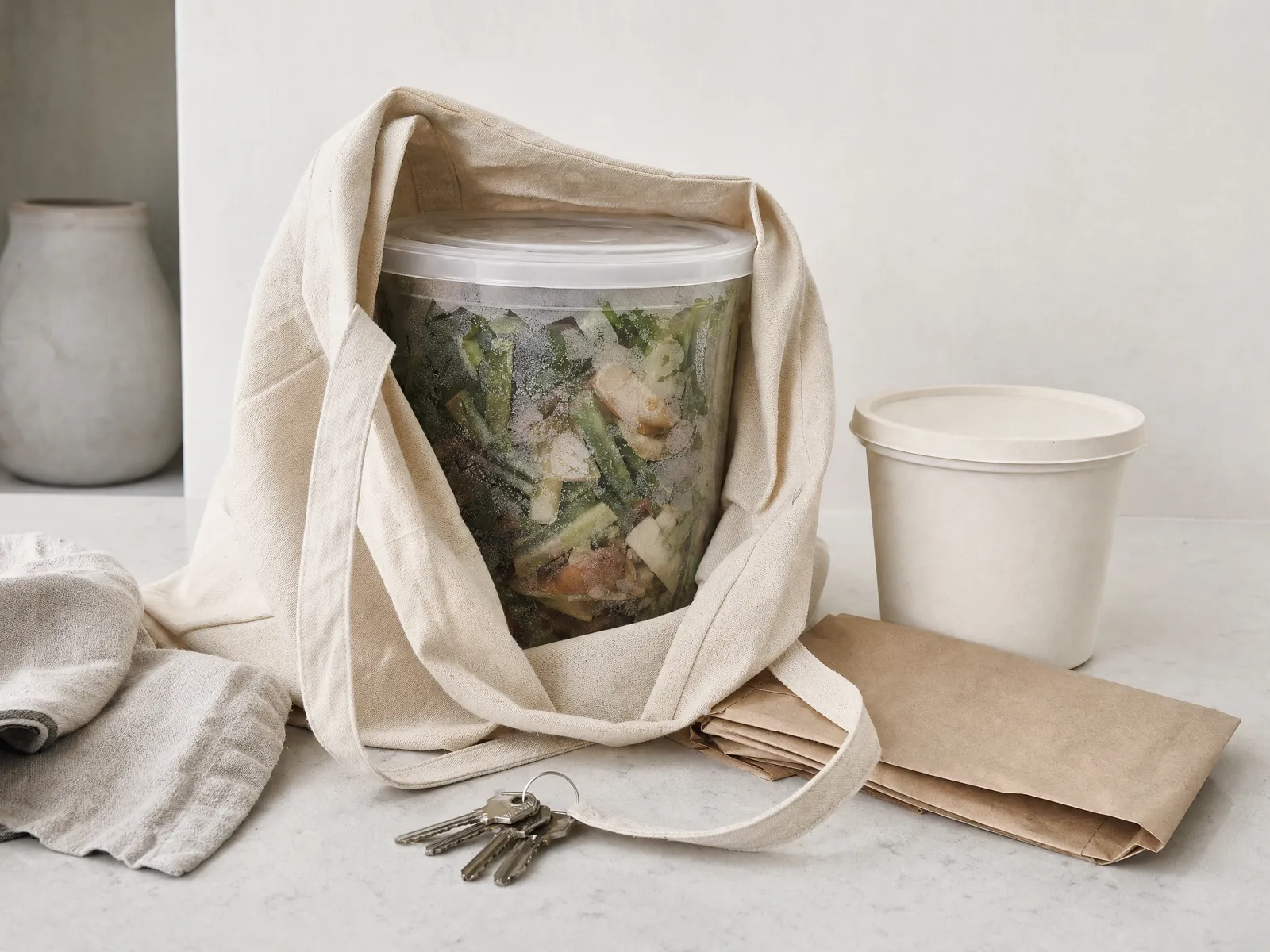
Industrial composting is infrastructure, not a hobby. A commercial windrow or an in-vessel tunnel runs hot, gets turned on a schedule and digests material a garden heap cannot, and in a growing minority of the country one is already running near your address with or without you. So the useful question for a reader with no yard is not how to build a pile but where to take food scraps - and that question has a research answer, not a shopping answer.
The one thing nobody can do for you is look up your own address. There is no national food scrap programme in the United States, no single list and no app covering every county. What there often is, badly advertised, is a municipal cart, a drop-off bin or a hauler already collecting nearby. Twenty minutes on your city or county solid-waste website - the page with your recycling calendar - settles it for most readers.
This is the destination instalment of our series on kitchen composting, and the one article in it with nothing to sell. Every step below is free, and we earn nothing from any of them.
On why the trip is worth taking, the US Environmental Protection Agency's October 2023 report Quantifying Methane Emissions from Landfilled Food Waste (EPA-600-R-23-064) states that "Food waste comprises about 24 percent of municipal solid waste disposed of in landfills" and that "An estimated 58 percent of the fugitive methane emissions" from those landfills come from that food waste. Because it decays quickly, EPA concludes, "food waste in landfills is contributing to more methane emissions than any other landfilled materials". A quarter of the material, most of the methane.
How likely is it that a programme already serves you
The best published count is the BioCycle nationwide survey of residential food waste collection access, published on 11 September 2023 by Nora Goldstein, Paula Luu and Stephanie Motta in BioCycle and funded in part by the Composting Consortium at Closed Loop Partners. It identified 400 programmes across 710 communities reaching 14.9 million US households - up from 10.0 million in 2021, a 49 percent increase in two years. The split matters more than the total:
- Curbside only: 230 programmes, 321 communities, 8.2 million households.
- Drop-off only: 139 programmes, 357 communities, 5.1 million households.
- Both routes: 31 programmes, 32 communities, 1.8 million households.
Two years on, BioCycle reported in October 2025 on Sustainable Packaging Coalition figures presented that month: "35.9% of the sampled U.S. population now has collection access", against 27 percent in the Coalition's 2020 findings. Population shares rather than household counts, so they do not slot into the 14.9 million figure - but both sources agree on the direction.
Your own odds are better than any of those numbers imply, because of what the survey deliberately leaves out. BioCycle counts programmes "offered by local governments directly or by private haulers under local government contract or agreement". Of the subscription services run by companies, nonprofits and worker-owned cooperatives, the authors write plainly: "The 2023 survey does not include those enterprises." A nonprofit's farmers-market bin, a community garden's heap and the hauler who would collect from your curb for a fee are all real destinations no national figure tracks. A survey is not a verdict on your street.
Start with a municipal curbside organics cart
The best outcome available and the only one that asks nothing of you: no equipment, no maintenance, no trip, and a facility that reaches temperatures a backyard pile does not. Where a cart exists, every other option here is a worse version of it.
Where to look: the city or county solid-waste or public-works page, same section as the recycling calendar. If a private company collects your rubbish under municipal contract, check its site too - BioCycle's counting rule is a reminder that many public programmes are run by contractors.
Establish two things first. One, whether the cart is open to your building: Boston's curbside food waste collection page states that "The City is expanding access to this program to Boston residents with buildings that are 6 units or less", a common shape for these programmes that leaves out most large blocks. If you are in a flat, our companion piece on composting in an apartment without a yard takes the problem from the other end. Two, what the cart accepts - and that is not a matter of preference.
The destination sets the accepted-materials list, never your preference
Two live programmes, two opposite rules, each correct for its own facility.
The City of Madison's Streets Division drop-off sites, which began accepting food scraps on 1 June 2026, tell residents "You can bring coffee grounds, eggshells, raw fruits, raw vegetables, and other similar scraps" and exclude meat, bones, baked goods, dairy, grease, compostable plastics and paper products. Black Earth Compost, a private hauler in New England, advertises the reverse on its home pickup page: its bins take "Items not typically accepted in a backyard pile, like meat, bones, dairy, certified compostable packaging and more."
Same material, same country, incompatible instructions - because the receiving facility differs, and the facility writes the list. The EPA's composting-at-home guidance gives the rule in one sentence: "Check first to make sure your specific facility accepts them." EPA is writing about commercial plants taking what a backyard pile cannot, and it applies to every route below.
Read your programme's own list before your first drop, and read it again in a year. The materials question in full is in what you can and cannot compost from a kitchen.
Second: a drop-off bin, paired with a frozen tub
Drop-off is the route most readers without a cart probably end up using, and on BioCycle's numbers it reaches more communities than curbside. Sites turn up at farmers markets, transfer stations, community gardens, some grocery stores and some libraries. Usually free. Almost always on a schedule.
The schedule is the problem, and the fix is not a better bin. Freeze the scraps and the trip becomes fortnightly or monthly rather than daily, which is the single change that makes this route survive past week three. The EPA's home guidance permits it outright: it tells readers to "Collect and store your fruit and vegetable scraps in a closed container on your kitchen counter, under your sink" and names the fridge or freezer as alternatives. Cold stops the biology, so a frozen tub neither smells nor breeds fruit flies while it waits. The case for the freezer, and what to use as the container, is step two of how to start composting kitchen scraps - and the container should be something you already own.
Check two details at the site itself. Whether it is seasonal: Madison's May 2026 announcement counts "10 different free drop-off options for food scraps through this fall", a sentence with an end date inside it. And whether the bin is monitored - Madison notes that "Staff at the drop-off sites need to check the food scraps carts for mistakes". Some programmes require a certified compostable bag and others reject bags entirely; which logo means what is in compostable bin liners.
Third: price a private subscription hauler
If there is no public programme, somebody may collect from your curb for money - the only route here with a monthly fee, and the one that asks least of you. Two companies' own live pricing pages, November 2026:
- Compost Crew, serving the Washington DC area, states that "Convenient residential collection service starts at $32 per month" and that "Many neighborhoods have discounted rates due to the number of people already composting!" Its members-only drop-off bins are cheaper: "24/7 food scrap drop off is available for only $10 per month!"
- Black Earth Compost, serving New England, displays weekly pickup at 15.99 dollars a month and every-other-week pickup at 12.99 dollars a month on its home pickup page, with the caveat that "Price and plans vary by location." Its selector wants your address before it will show a price at all, which tells you how local this market is.
So roughly 13 to 32 dollars a month before any neighbourhood discount. Neither page itemises what the fee covers - Black Earth sells its plans as a starter kit, and Compost Crew says only that "your supplies will be dropped off at your home" - so confirm whether a bin comes with it before you sign up.
What you are paying for is acceptance, not convenience. A hauler feeding a commercial facility takes the meat, bones and dairy your own heap should not, which is the honest reason a subscription can be worth 20 dollars a month to a household that would otherwise divert nothing.
Fourth: ask a community garden, or a neighbour with a pile
This destination is invisible to search, because it is published nowhere. A community garden with a three-bay bin, an allotment, a neighbour with a tumbler and more carbon than nitrogen: none appear on a municipal page, and many have spare capacity.
It is also the route most likely to stick, for a reason unrelated to composting: it has a person attached to it. A bin behind a fence does not notice whether you turn up; a gardener you have met does.
How to ask:
- Go on a work day and ask whoever is holding a fork whether they take kitchen scraps, and in what form.
- Offer something specific. A tub a week, chopped, no meat or dairy unless they say otherwise, plus a bag of dry leaves in autumn - carbon is what a garden heap is short of.
- Ask what they do not want first, write it down, and post the question in your building or street group - one neighbour with a pile is all this takes.
A community garden heap is a backyard pile with a committee, so it runs under backyard rules - which is to say the restrictive ones, not the commercial ones.
And the long tail: farms, zoos, campuses and workplaces
Worth one phone call. Some farms take vegetable trimmings, some zoos and botanical gardens run compost operations, and plenty of universities compost dining-hall waste. We have found no national list of any of them and will not imply one exists: you find this category by asking a named person at a specific place. If you work or study somewhere with a canteen, start there.
How to search for a food scrap drop-off near you
This is the part of any such article that dates fastest, so treat it as a method first and a tool list second. Every tool named here we loaded in November 2026 before naming it.
- Go to the municipal page, not a search engine. Your city or county solid-waste or public-works department, then its recycling or organics section. A search engine hands you a listicle; the department has the calendar.
- Search the city name with several words, separately. Organics, food scraps, compost and food waste all name the same thing and no two jurisdictions agree: Madison calls its service food scraps recycling, Boston calls its curbside food waste collection, Black Earth Compost heads its own page curbside food scrap pickup. Some places fold food into an existing yard-waste cart, so try that too. Searching one phrase and concluding there is nothing is the commonest way to miss a programme.
- Then the state environment agency's organics page, which often lists facilities a city page does not.
- Litterless publishes a state-by-state guide, titled "Where to Compost: A State-by-State Guide", covering all 50 states plus Washington DC and Puerto Rico. Privately run, and the fastest single starting point we found.
- Better Earth's compost drop-off database, built by a compostable-packaging company, reports "611 composting facilities that accept food waste", "563 hauling companies supporting their efforts" and "1349 compost drop-off sites". BioCycle covered it in August 2024 at between a third and a half of those counts (319 facilities, 265 haulers, over 500 drop-off sites); the page warns that some sites in New York, California and Vermont are missing.
- The Institute for Local Self-Reliance's Composting for Community Map, which ILSR says "provides an interactive illustration of how communities pursue locally based composting capacity and enterprises", plots community composters by type: community gardens, bike haulers, urban farms, cooperatives. The unlisted category above, partly listed.
- The EPA's Excess Food Opportunities Map, which the agency says displays "over 15,000 potential recipients of excess food" including composting facilities, and to which "EPA added community composting sites using data provided by the Institute for Local Self-Reliance". Borrow it carefully: it is built for businesses and planners, so a pin means a facility exists, not that it takes tubs from households.
- Ask a person at the farmers market information desk. Market staff know which bin is the compost bin and which stallholder takes scraps, and none of it is written down.
- Check the end date. A site running through the autumn is not a year-round site, and seasonality is the commonest unpleasant surprise here.
One warning. BioCycle's August 2024 write-up pointed readers to FindAComposter.com, "a locator portal developed by BioCycle and managed by BPI". When we loaded that domain in November 2026 it returned a blank placeholder rather than a working locator. A dead locator is worse than no locator, so check the date on any list of tools, this one included.
What goes wrong: waitlists, caps and cancellations
Three failure modes, none in your control.
- A waitlist. Boston's page states that "In Fall 2026, we will begin onboarding residents who are already on the waitlist" and that "After the waitlist has been cleared, the program will return to open enrollment." Join the list anyway; a name on a list costs nothing.
- A programme that pauses or is cut. Municipal organics collection is a discretionary budget line and a subscription hauler is a business. Neither is permanent, and a survey is a snapshot. Confirm a site still operates before you drive to it.
- Contamination rules tightening. A monitored site that keeps finding plastic bags gets stricter, not looser. Sort as though someone is looking, because somewhere someone is.
None of this is a reason to wait. A monthly trip to a bin you found in twenty minutes diverts more than a perfect system you never start.
The bottom line
If you cannot compost at home, the answer is almost never a purchase: check your city or county solid-waste page for a curbside organics cart, then a drop-off site, then price a subscription hauler, and ask a community garden in parallel. The EPA tells readers with no space of their own much the same, recommending a local municipal or community composting programme, which may "collect your food scraps or offer a designated location where you can drop them off".
The free option, which is also the first move, is a lidded tub you already own, in the freezer, tonight. It costs nothing, buys the fortnight you need to finish the research, and works whichever answer you land on. If the search comes up genuinely empty, the EPA's remaining advice is to "consider starting a composting program or advocating for one in your community or municipality". The case for bothering is in why food scraps should not go to landfill, and the rest of the system is in our series on composting kitchen waste.
How we score
What it’s made of.
Chemistry you’ll touch.
How long it lasts.
Where it goes after.
Each pick scores 0–5 on the four axes above, weighted into the composite verdict at the top. Scores are derived from what a product is verifiably made of and certified as — not how green its label looks.
About the author
Ruth Lopez
I'm Ruth Lopez and I'm a lover of nature and the environment. I'm very passionate about finding eco friendly products that don't damage the environment and also support companies that have the same philosophy.