Do Kitchen Compost Bins Smell and How to Stop Fruit Flies

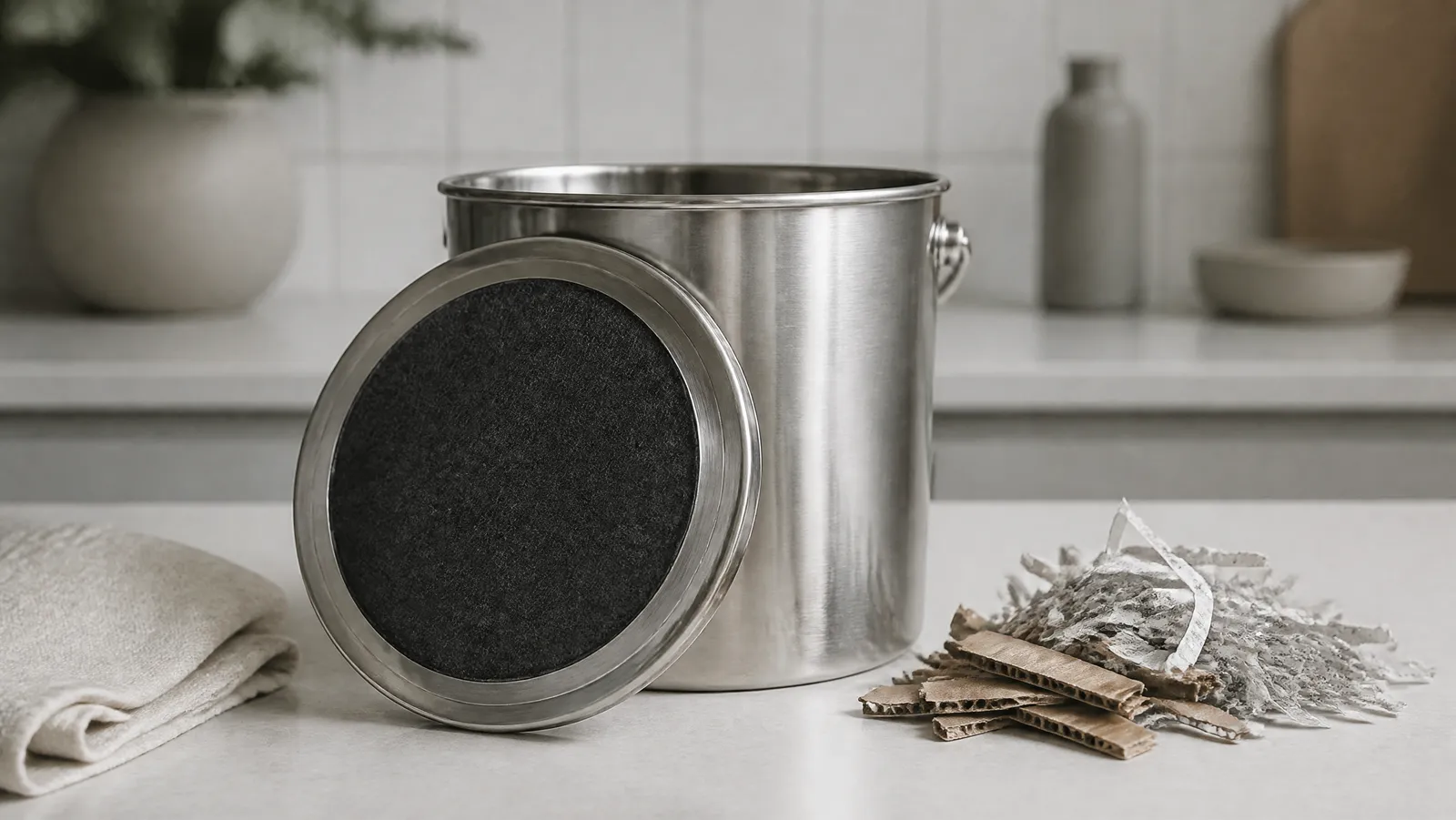
A kitchen compost bin that smells is not composting badly. It is composting in a different direction. Given air, the organisms breaking down your peelings work quietly; let the scraps pack down into a wet mass, the oxygen runs out, and a different set takes over. Those are the ones you can smell. So the honest answer to do kitchen compost bins smell is that a working one should not, and when one does the cause is oxygen, moisture or time - all free to fix. We may earn a commission when you buy through links on this page, at no cost to you.
This is the odour and insect chapter of our week on composting kitchen scraps, the article that decides whether a bin survives its first August. Almost everything below costs nothing. One consumable is worth buying, and it comes last.
Why a compost bin smells bad is really a question about oxygen
Tom Richard, writing for Cornell Cooperative Extension in Operator's Fact Sheet #4 of its composting series, puts the threshold in numbers: "Compost organisms can survive with as little as 5 percent oxygen. However, if the oxygen level falls below 10 percent in the large pores, parts of the compost pile can become anaerobic." What follows is the smell. "As anaerobic organisms decompose wastes, they produce methane gas, which is an odorless gas, and hydrogen sulfide, which smells like rotten eggs."
Richard is describing municipal yard-waste piles six to eight feet tall, not a two-litre pail, so we are borrowing the mechanism and not the measurements. It is easier to trigger in a pail, though, not harder: wet scraps compact under their own weight, and there is no chimney effect in a container the size of a kettle.
A rotten-egg smell means the scraps have run out of air. Fragrance does not fix that, and neither does a filter.
The other complaint people describe - sour, vinegary, bready - is fermentation rather than sulphur chemistry, and we found no published measurement of what a countertop caddy emits. Both smells point the same way: too wet, too packed, left too long.
The US EPA's home composting guidance gives the fix in one line - "If the pile has a bad odor, it may be too wet or need more air circulation" - and the remedy is to "Add more browns/dry material to the pile and turn the pile." EPA asks for "at least two to three times the volume of browns (such as dry leaves) to the volume of greens", and sets the moisture target with the most useful image here: "ensure your combined materials have the consistency of a wrung-out sponge." Nobody runs a caddy at three-to-one, but a handful of shredded newspaper over each day's scraps is the pail-sized version.
Fruit flies do not find your bin - they arrive on the groceries
If your bin has fruit flies, the eggs were in the kitchen before the bin was. Do compost bins attract bugs? A bin does not summon fruit flies from outdoors so much as give the ones that rode in on your fruit a warm, wet, undisturbed place to breed. That distinction is why every fix below works.
Michael F. Potter, extension entomologist at the University of Kentucky College of Agriculture, writes in the university's Entfact-621 that "Infestations can originate from over-ripened fruits or vegetables that were previously infested and brought into the home", and that the flies "lay their eggs near the surface of fermenting foods or other moist, organic materials". Beaufort County, South Carolina's solid waste and recycling department says it more bluntly in its tip sheet Managing Fruit Flies in Your Kitchen Compost Bin: "Often when you purchase fresh fruits and vegetables, fruit fly eggs travel into your home ON that produce."
Then the clock starts, and the clock is the key fact on this page. Potter: "The entire lifecycle from egg to adult can be completed in about a week." A University of Wisconsin-Madison extension publication, Fruit Flies in the Home, puts the full cycle at eight to 10 days. Potter adds that, given the opportunity, fruit flies "will lay about 500 eggs".
Eight days is why "empty it weekly" is an instruction rather than a tip. A bin emptied on a fixed day is far less likely to host a generation to completion.
Temperature does the rest, and it is why the freezer below is not a gimmick. The University of California Statewide IPM Program's vinegar fly guideline states that "Ideal temperatures for development of this insect are in the low 80°F (27° to 30°C)" and that "The flies do not lay eggs at temperatures below 54°F (12°C) or above 91°F (33°C)." A kitchen in August will often sit in that ideal band. That guideline is written for field strawberries, so read it as physiology rather than a household measurement.
The freezer ends the argument, and it costs nothing
Keep the scrap container in the freezer and you solve both problems at once, and we earn nothing from that sentence. Nothing below beats it.
Beaufort County gives the instruction and the reason together: "store food scraps temporarily in the freezer in between visits to the drop sites. The cold temperature will kill any fruit fly eggs." It adds that some kitchen compost bins are built to sit in the freezer, on the door, rather than on the counter.
In fairness, that is county guidance rather than a controlled result, and we found no published test of domestic freezing against Drosophila melanogaster eggs. The narrower claim we are confident in is UC IPM's: below 54°F these flies do not lay eggs. Frozen scraps also do not ferment, which removes the odour mechanism in the same move. Any lidded box works, with the container logic of freezing food without plastic - leave headroom, and carry it out rather than letting it thaw on the counter.
Five more free moves, in rough order of how much they do
- Empty on a fixed day, not when it looks full. Beaufort County is stricter than weekly: "Hold only one to two days' worth of food scraps in your kitchen bin. Less volume equals fewer flies." We would call a week the ceiling, and twice a week the sensible summer setting.
- Put something dry over every addition. Shredded newspaper, torn cardboard, a used paper towel, a piece of brown paper bag. Beaufort County's version: "Food rots more slowly when there is no liquid", and the browns "soak up moisture and keep odor at bay".
- Drain the wet things first. Spent coffee grounds, melon rind and tea bags tend to compact into an airless layer soonest. Tip the liquid out, and line the base with dry paper.
- Rinse the bin every time you empty it, then dry it. Beaufort County: "Rinse empty bins regularly with hot, soapy water between collections to get any eggs out that have been laid." A bin emptied but never washed keeps a film of fermenting residue, which is a breeding substrate on its own.
- Seat the lid, and stop feeding the rest of the kitchen. Beaufort County calls a good secure lid "the most important thing you can do to prevent a fruit fly infestation", then adds the parts people skip: clear the sink of dirty dishes, wipe up juice spills, and run and clean the garbage disposal, where flies also breed.
One exclusion causes more foul caddies than anything else. EPA is flat: "Do not add meat, dairy, or greasy foods to your pile." The full list of what you can and cannot compost is a separate piece, but if your bin smells worse than vinegar, check what went in.
When the flies are already in the kitchen
Traps are the second step, not the first. Potter is explicit that "The best way to avoid problems with fruit flies is to eliminate sources of attraction" and that "all potential breeding areas must be located and eliminated" - a trap catches adults in the air while the next generation keeps developing.
Once the breeding sites are gone, Beaufort County's trap is free: a cup a quarter to half full with equal parts water and vinegar, apple cider or balsamic, then "Add three drops of dish soap on top and gently swirl". The soap does real work - it "cuts the surface tension of the vinegar" so the flies sink rather than stand on it.
Bin choice matters less than lid fit
A bin cannot make scraps aerobic. What it can do is close properly, hold a filter, and survive being washed several times a week, which is why the ranking in the countertop bins we tested turns on lid fit rather than capacity or looks. Measure the recess in the lid you already own before buying any filter, because filters are sold in fixed diameters. Compostable bin liners are a separate question for a later article; for odour they do one useful thing and one unhelpful one, keeping the bin clean while also tending to hold moisture against the scraps.
What a charcoal filter actually does, and when it stops
A charcoal filter is an adsorption pad, not a deodoriser. Penn State Extension, writing about hydrogen sulphide in drinking water, gives the mechanism: "Activated carbon removes a variety of water contaminants, including hydrogen sulfide, by adsorbing the gas on the surface area of the carbon particles." Odour molecules stick to the carbon's internal surface; nothing is neutralised or destroyed.
So the pad fills up. University of Nebraska-Lincoln Extension's guide to activated carbon filtration describes the end state: once the adsorption sites are occupied the carbon is saturated, the contaminant breaks through, and - the line worth keeping - "Saturation and breakthrough can occur long before a pressure change occurs." You get no warning, and UNL's practical signal is the only one a household has: replace it when the odour changes.
Both are drinking-water publications, and a filter in a bin lid is passive air with no measured flow, so the principle transfers and the numbers do not. We looked for an independent test of compost-bin lid filters and found none. Treat a filter as a consumable with an unknown service life, treat every service-life figure on a listing as the seller's estimate, and remember it cannot re-oxygenate a compacted mass or do anything whatever about fruit flies.
MOWPOG is the cheapest way to keep a current filter in the lid
The MOWPOG six-pack is 7.99 dollars as of October 2026, about 1.33 dollars a filter. MOWPOG states they measure 6.7 inches in diameter and 0.2 inches in thickness, that they fit "most standard sized trash cans and compost bins with round lids", and that they use a "high-density layer of activated charcoal". It ranks first for a behavioural reason rather than a performance one: at 1.33 dollars each you will actually change them, and a fresh thin pad beats a saturated thick one.
The costs are real. That 0.2 inch charcoal layer is half the thickness its rival claims, and thickness is the only published difference between the two products. The listing gives no service life, so "Regular filter replacement ensures fresh air in your kitchen" is an instruction rather than a measurement. And the listing describes a fixed 6.7 inch round and mentions no cutting template, so an odd-sized lid is a problem you discover after delivery.
Simply Carbon is twice as thick, and its packaging claim needs a footnote
The Simply Carbon set of six is 21.95 dollars as of October 2026, about 3.66 dollars a filter. Simply Carbon states the charcoal layer is 0.4 inches thick with "a leading 20-micron particle size", that the set is "Suitable for 99% of kitchen compost bins in the US", that the out-of-the-box size is 7.25 inches round with "round and square cutting templates included to cut your filters to the exact shape", and that "It is recommended to replace your filter only every 4 months". The templates are the honest reason to pay the difference: this is the set to order when you do not know your lid's diameter.
Credit where it is owed, because it is rare. Simply Carbon prints a warning against its own category, telling buyers to use "Caution buying filters that claim odor protection beyond 2 years as even the purest Activated Charcoal loses efficacy over time after the manufacturing date". Nobody has published a test showing double thickness means double service life, so the four-month interval remains the maker's own figure.
Now the part that needs checking. Simply Carbon says the set is "Packaged in a secure, biodegradable, resealable bag" and that "Using d2w technology, the bag is 100% biodegradable". We are not repeating that as fact. d2w is the trade name for a pro-oxidant additive sold by Symphony Environmental, and additives of that type place a plastic in the oxo-degradable family, which the EU defines as plastic containing additives that through oxidation lead to fragmentation into micro-fragments. Article 5 of EU Directive 2019/904 requires member states to "prohibit the placing on the market" of products made from oxo-degradable plastic, and the European Commission's 2021 guidelines state that the ban covers all such products, single-use or not, and "makes no distinction between oxo-degradable plastic that is biodegradable and oxo-degradable plastic that is not biodegradable". The directive's stated reasoning is that this plastic does not properly biodegrade, adds to microplastic pollution and is not compostable.
Symphony disputes the categorisation, arguing d2w is oxo-biodegradable rather than oxo-degradable; the General Court dismissed its damages claim against the Commission on 31 January 2024. An earlier Commission report found no evidence that oxo-degradable plastic "will subsequently fully biodegrade in a reasonable time in the open environment, on landfills or in the marine environment". Buy this set for the charcoal and the templates, keep the bag out of your compost, and read "100% biodegradable" on it as a contested marketing claim rather than a disposal instruction.
The bottom line
A kitchen compost bin should not smell, and the three habits that stop the smell are the same three that stop fruit flies breeding: keep the scraps cold or covered, keep something dry on top, and empty on a fixed day inside the roughly week-long life cycle. Freeze the scraps and most of the problem disappears, for zero dollars, using an appliance you already own.
If you are buying, buy a filter and nothing else:
- The MOWPOG six-pack at 7.99 dollars as of October 2026 if your lid takes a 6.7 inch round and you want the price low enough that you change filters on schedule. Half the claimed charcoal thickness of the other set, and no stated service life.
- The Simply Carbon set of six at 21.95 dollars as of October 2026 if you need the cutting templates or want the thicker pad. Nobody has tested whether double thickness buys double the life, and the bag is not something to compost.
The whole system - what goes in, which caddy, where it ends up - is in our full kitchen composting guide.
What we tested

Six round filters at about 1 33 dollars each with half the charcoal of the thick set
- Material
- Activated Charcoal & Newsprint
- Credentials
- No-buyAerobic-led
The only pick here cheap enough to treat a filter as the consumable it actually is: at about 1.33 dollars each, swapping one early costs less than a bag of coffee, which is the behaviour this whole page is arguing for.
No major drawbacks noted in testing.
7.99 dollars as of October 2026 for six filters, about 1.33 dollars each, which is the cheapest way we found to keep a bin's filter current rather than leaving a saturated one in the lid. MOWPOG states the filters measure 6.7 inches in diameter and 0.2 inches in thickness, that they fit "most standard sized trash cans and compost bins with round lids", and that they use a "high-density layer of activated charcoal". Three costs, stated plainly. The 0.2 inch charcoal layer is half the thickness Simply Carbon claims for its set, and thickness is the only published difference between the two. The listing gives no service life at all, so "Regular filter replacement ensures fresh air in your kitchen" is an instruction rather than a measurement. And the listing shows a fixed 6.7 inch round and mentions no cutting template, so measure the recess in your lid before ordering.

Twice the claimed charcoal thickness and a packaging claim worth reading twice
- Material
- Activated Charcoal & Newsprint
- Credentials
- No-buyAerobic-led
The only filter set here whose maker says it ships cutting templates, which is what makes it the safer order when you do not know the exact diameter of the recess in your bin lid.
No major drawbacks noted in testing.
21.95 dollars as of October 2026 for six filters, about 3.66 dollars each, which is close to three times the MOWPOG price for twice the claimed charcoal. Simply Carbon states the charcoal layer is 0.4 inches thick with "a leading 20-micron particle size", that the set is "Suitable for 99% of kitchen compost bins in the US", that the out-of-the-box size is 7.25 inches round with "round and square cutting templates included to cut your filters to the exact shape", and that "It is recommended to replace your filter only every 4 months". Credit where it is owed: the maker also prints a warning against its own category, telling buyers to use "Caution buying filters that claim odor protection beyond 2 years as even the purest Activated Charcoal loses efficacy over time after the manufacturing date". Two costs. Nobody has published a test showing that double thickness means double service life, so the 4-month interval is the maker's own figure. And the packaging claim needs a footnote: Simply Carbon says the bag is "Packaged in a secure, biodegradable, resealable bag" and that "Using d2w technology, the bag is 100% biodegradable", but d2w is a pro-oxidant additive in the oxo-degradable family, and EU Directive 2019/904 requires member states to prohibit the placing on the market of products made from oxo-degradable plastic.
Compared, side by side
| Spec | Cheapest RefillMOWPOG 6 Pack 6.7 Inch Charcoal Filters for Kitchen Compost Bin | Longest LastingSimply Carbon 2 Years Supply Extra Thick Filters for Kitchen Compost Bins, Set of 6 |
|---|---|---|
| Verdict | Solid | Solid |
| Composite | 3.4/5 | 3.4/5 |
| Materials | 3.0 | 3.0 |
| Health | 3.2 | 3.2 |
| Durability | 3.6 | 3.6 |
| End-of-life | 4.0 | 4.0 |
| Price | — | — |
| Get it | Check price | Check price |
How we score
What it’s made of.
Chemistry you’ll touch.
How long it lasts.
Where it goes after.
Each pick scores 0–5 on the four axes above, weighted into the composite verdict at the top. Scores are derived from what a product is verifiably made of and certified as — not how green its label looks.
About the author
Ruth Lopez
I'm Ruth Lopez and I'm a lover of nature and the environment. I'm very passionate about finding eco friendly products that don't damage the environment and also support companies that have the same philosophy.