How to Start Composting Kitchen Scraps

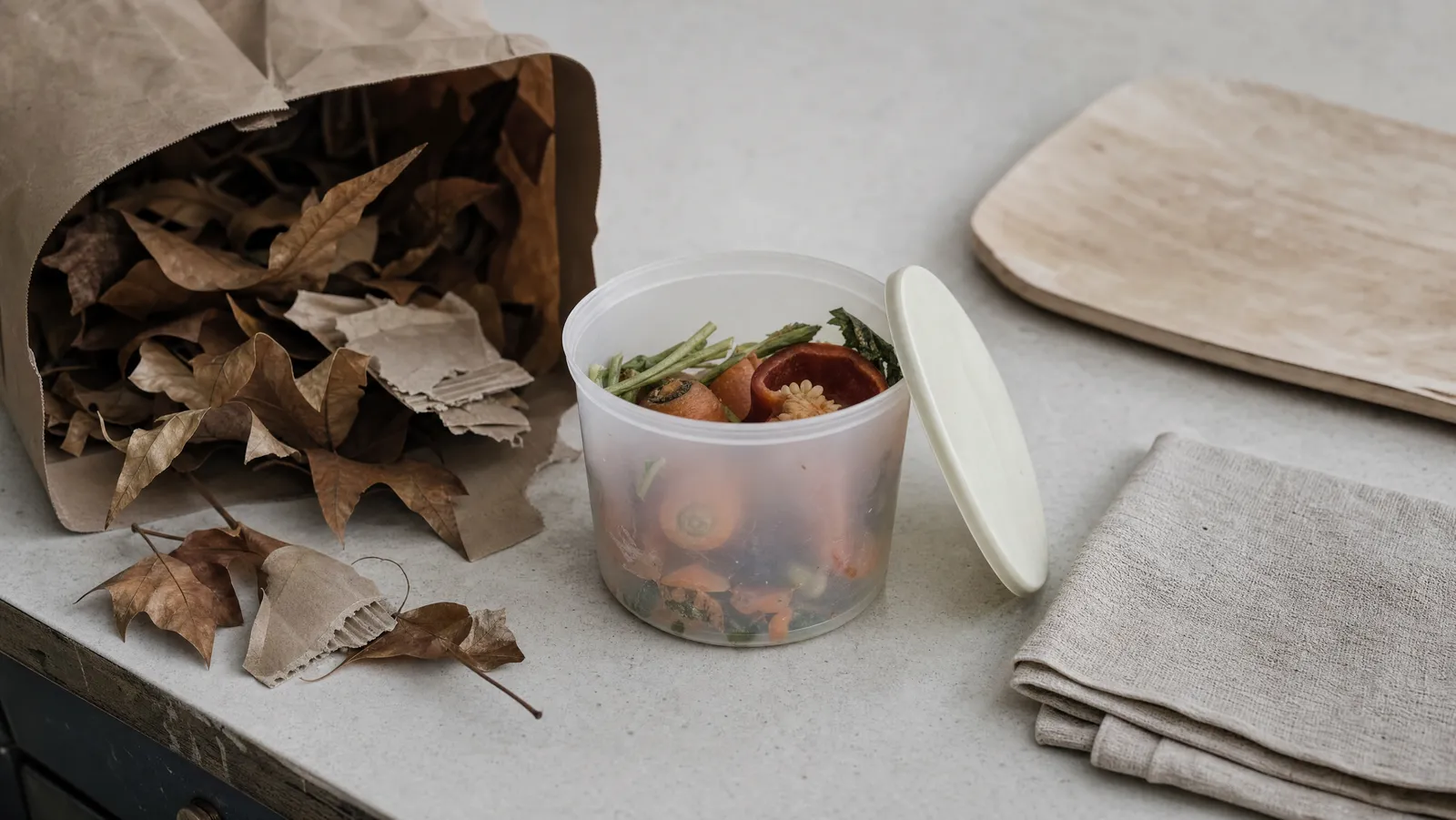
Composting is aerobic microbial digestion. Bacteria and fungi eat your peelings in the presence of oxygen, and to do it they need three inputs: carbon, nitrogen and oxygen. A kitchen supplies the nitrogen in quantity and almost none of the other two. So the honest answer to how to start composting kitchen waste is that the setup is a logistics problem rather than an equipment problem, and you can begin today with a lidded container you already own.
Almost everyone does it backwards. The first move is usually a counter bin, and a counter bin is the fourth decision, not the first. That is why so many of them end up at the back of a cupboard: the bin was bought before the owner knew where the scraps were going, and where the scraps are going is the only decision that determines whether the habit survives a month.
This is the setup chapter of our week on composting food scraps at home. Every step in this article is free, and we earn nothing from any of them.
For scale on why the diversion is worth the trouble at all: the US Environmental Protection Agency's October 2023 report Quantifying Methane Emissions from Landfilled Food Waste, summarised on the agency's own research pages, finds that "Food waste comprises about 24 percent of municipal solid waste in landfills" and that "An estimated 58 percent of the fugitive methane emissions" from those landfills comes from that food waste. EPA's conclusion is that "food waste in landfills contributes to more methane emissions than any other landfilled materials."
Why the order of operations is the whole thing
The mechanism dictates the sequence. Carbon, nitrogen, oxygen, water - and a kitchen scrap bowl is a nitrogen stream with water already in it.
The EPA's composting-at-home guidance is specific about the balance. It tells home composters to "add at least two to three times the volume of browns (such as dry leaves) to the volume of greens", and its rodent-prevention section restates the same thing as "two to three parts carbon-rich material (browns) to one part nitrogen-rich material (greens)." On moisture it gives the most useful image in the whole document: "To maintain moisture in your pile, ensure your combined materials have the consistency of a wrung-out sponge." Oxygen is a maintenance job rather than an ingredient - "Turning and mixing your pile from time to time will help speed up the decomposition process and aerate the pile."
Read that as a shopping list and you buy the wrong things. Read it as a logistics brief and the correct order falls out:
- Find the destination. Where do the scraps physically end up?
- Start the freezer container. Today, with something you own.
- Secure a source of browns - only if the destination is your own pile.
- Then, and only then, consider a counter bin.
The destination is the decision everything else hangs off, because it sets both what you are allowed to put in and how often you must empty. Those two facts pick the bin. The bin picks nothing.
Step one: find the destination before you buy anything
There are four realistic answers, and this is a research task rather than a purchase. Twenty minutes on your city or county solid-waste website usually settles it.
- A curbside organics cart. The easiest outcome: your scraps leave with the rubbish.
- A municipal or farmers-market drop-off. You carry a tub somewhere on a schedule.
- A community garden or a neighbour's pile. Often unlisted. Ask.
- A pile or bin in your own yard. The only option that makes you the operator.
Access is real and uneven. In the BioCycle nationwide survey of residential food waste collection access, published in September 2023 by Nora Goldstein, Paula Luu and Stephanie Motta and supported by the Composting Consortium at Closed Loop Partners, the authors write: "We identified a total of 400 programs, encompassing 710 communities." Of those programs, 230 were curbside only and 139 drop-off only, with 31 offering both. The survey put 14.9 million US households within reach of municipally supported food waste collection, up from 10.0 million two years earlier - "The number of households in the U.S. with access to food waste collection has increased by 49% since 2021." That is fast growth over a base that does not cover the country, which is precisely why nobody can tell you your own answer. Look it up.
The EPA says the same thing to readers without space of their own: "consider participating in a local municipal or community composting program", which "may collect your food scraps or offer a designated location where you can drop them off."
Now the part that makes this step unskippable. The destination, not your preference, decides the accepted-materials list. The EPA's backyard guidance tells home composters to avoid meat, fish and bones, cheese and dairy, fats, oils and grease, cooked food in any quantity beyond small amounts, and compostable foodservice ware and compostable bags. It footnotes two separate reasons, and they are worth separating because they fail differently. The first: "These foods can attract animals." The second: "Backyard composting piles generally do not reach high enough temperatures to fully decompose these materials." The agency then notes that those same materials "can be composted at commercial composting facilities" - and adds the instruction readers skip, which is to "Check first" whether yours accepts them. Do not assume a municipal cart takes meat and compostable packaging because an industrial facility can process them in principle. The full breakdown is in what you can and cannot compost.
Write down the answer to this step before you read the next one, because half of what follows does not apply to you if your scraps leave in a cart.
Step two: start the freezer container today
This is the step that gets you composting before you own any composting equipment, and it is the highest-leverage move available.
The EPA's own instruction allows it explicitly: "Collect and store your fruit and vegetable scraps in a closed container on your kitchen counter, under your sink, or in your fridge or freezer." We would narrow that to the freezer, for a mechanical reason. Cold stops the biology. The US Department of Agriculture's Food Safety and Inspection Service, in its freezing and food safety guidance, states that "Freezing to 0 °F inactivates any microbes - bacteria, yeasts and molds - present in food." Scraps that are not being digested are not fermenting, and scraps that are not fermenting do not smell.
Two honest qualifications. FSIS is writing about food you intend to eat, so we are borrowing the microbiology rather than a compost measurement. And FSIS is equally clear that the effect reverses: "Once thawed, however, these microbes can again become active, multiplying under the right conditions." Frozen scraps are paused, not sterilised. Carry the tub out rather than letting it thaw on the counter.
The second thing the freezer does is take the insect clock off the wall. Michael F. Potter, extension entomologist at the University of Kentucky College of Agriculture, writes in the university's Entfact-621 that for fruit flies "The entire lifecycle from egg to adult can be completed in about a week", and that a female will lay about 500 eggs given the chance. A warm, moist, undisturbed container of fermenting peel is where that happens. A frozen one is not.
Use what you have: a yoghurt tub, a takeaway box, a lidded jar, a bread bag, an ice-cream carton. The same headroom and sealing logic that governs freezing food without plastic applies, with the stakes removed, since nobody is going to eat this. You do not need a liner for a container you can rinse, and whether a liner belongs in a counter pail at all is a separate question we take up in compostable bin liners.
Doing this one thing, with a tub from your own cupboard, diverts scraps today and costs nothing.
Step three: secure a source of browns - and only if the pile is yours
Skip this step entirely if your destination is a cart or a drop-off. A municipal or commercial facility manages its own carbon balance; you are supplying a feedstock, not running a process.
If the pile is yours, this is the step that decides whether it works. A kitchen produces nitrogen-rich greens almost exclusively - the EPA's greens column is fruit and vegetable scraps, grass clippings, coffee grounds and paper filters, paper tea bags without staples, and crushed eggshells. Feed a pile on kitchen scraps alone and you have built a wet nitrogen heap at roughly the inverse of the two-to-three-parts-browns ratio the EPA asks for. The anaerobic stink that people blame on composting itself is usually this: a pile with no carbon in it.
Browns are free, and they are seasonal, which is the part worth planning. The EPA's carbon-rich list is dry leaves, plant stalks and twigs, shredded non-glossy uncoloured paper and shredded brown bags, shredded cardboard with "no wax coating, tape, or glue", and untreated wood chips. In practice:
- Bag dry leaves in autumn and keep them somewhere dry. This is the only free bulk carbon most households get all year.
- Tear down corrugated cardboard and pull the tape off first. The tape does not break down and the EPA's list excludes it by name.
- Keep a paper bag of shredded newsprint, paper egg cartons and used paper towel by the bin. A handful over each addition is the pail-sized version of the ratio.
Then expect the timeline the agency actually publishes, which is slower than most beginners are told: "Compost in a well-maintained pile will be finished and ready for use in about three to five months", while "Left untended, a pile may take a year to decompose." The EPA also asks you to "allow your pile to cure, or finish, for at least four weeks" before using it.
Step four: only now consider a counter bin
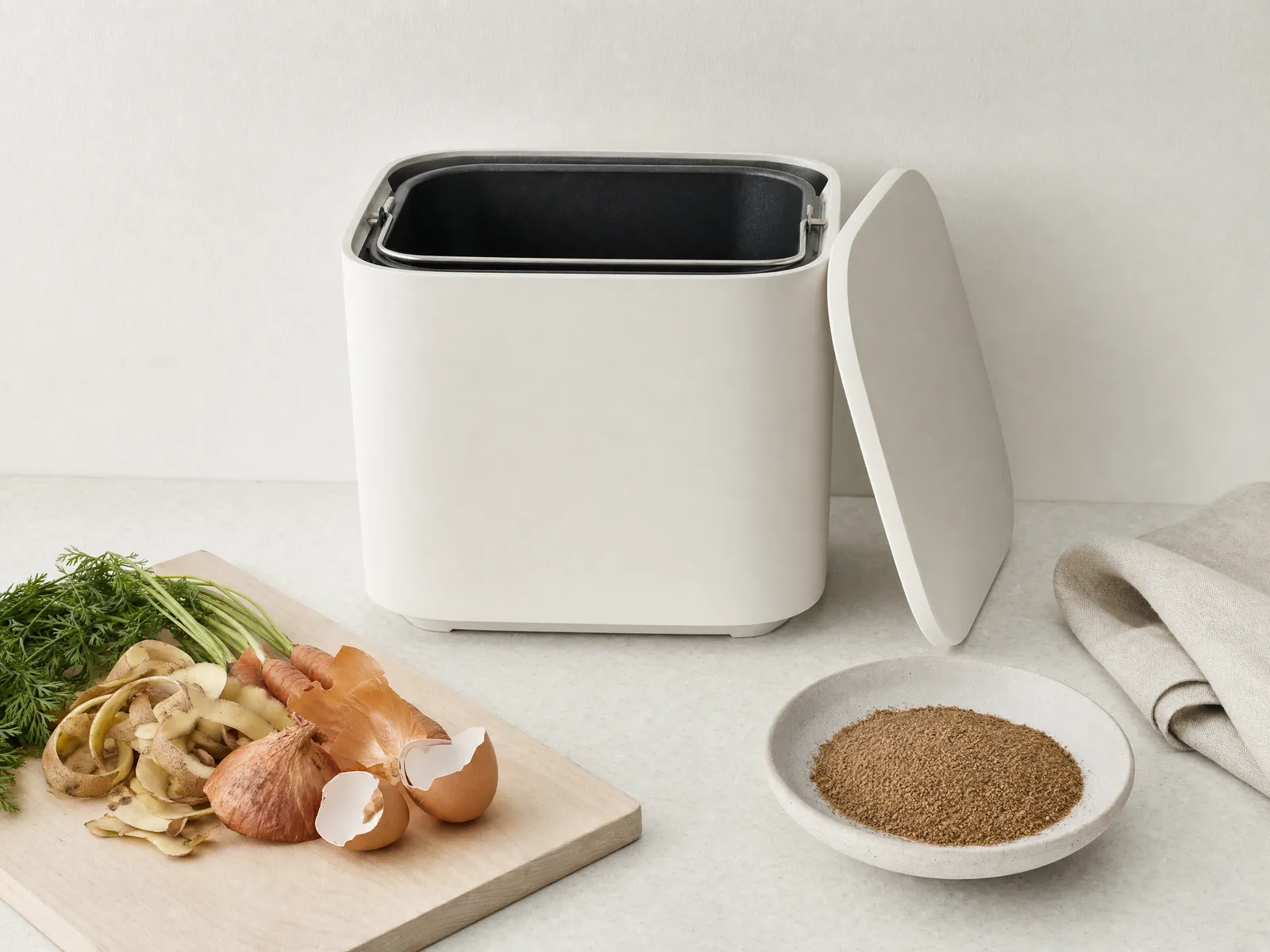
By the end of week two of freezing scraps, you know the only two numbers that should pick a pail: how much your household actually generates in a day, and how often you are actually willing to walk it out. Guess those before you have the habit and you buy a bin that is too big to keep on the counter or too small to reach collection day.
Buy the bin that fits your emptying interval, not the one that fits your kitchen's colour scheme. What we would check, in order: that the lid seats properly, since a loose lid is the failure that ruins every other decision; that the whole thing fits in a sink for washing several times a week; that the filter recess, if there is one, matches a filter diameter you can buy. Our ranking of the countertop bins we tested turns on lid fit rather than capacity for that reason.
And a sentence we will keep repeating: a pail is a holding vessel. No counter bin composts anything. It stores scraps for a few days on their way to the place where the actual digestion happens, which is why it is the last decision and the smallest one.
The first month fails in four ways and each one tells you what to change
What separates people who are still composting in week six from people who are not is usually a single unexplained symptom. Here is the diagnostic, in the EPA's own words where it has them. Note that its troubleshooting is written for a yard pile rather than a two-litre caddy, so read the direction and not the scale.
- It smells sour, sulphurous or like a drain. "If the pile has a bad odor, it may be too wet or need more air circulation." Too wet, too compacted, or left too long. Add dry browns and turn it; in a pail, empty it and put paper in the base.
- Fruit flies. The cycle Potter describes completed in your kitchen - roughly a week of warm, moist, undisturbed scraps. Freezing or a fixed emptying day removes the window.
- Nothing is happening at all. Two causes with opposite fixes. "If the pile is too dry, activity in the pile will slow or cease", and separately, "If the pile is not heating up, mix in greens and turn the pile." Cold weather and coarse, unchopped material slow it down too.
- A soggy airless mat at the bottom. Coffee grounds, melon rind and tea bags compact first. That is a structure problem: the wrung-out-sponge test is failing on the wet side and there is nothing bulky holding pore space open.
The full treatment of the odour and insect side, including what a charcoal filter does and does not do, is in stopping smells and fruit flies. We will not re-run it here.
When the answer is do not compost at home
Sometimes it is. If you have no yard, no balcony, no curbside organics cart and no drop-off within reasonable reach, the correct recommendation is not a purchase. Freeze the scraps, keep looking for a destination, and buy nothing until you have one. We cannot tell you that a device on your counter substitutes for a destination, and we are not going to imply it by selling you one.
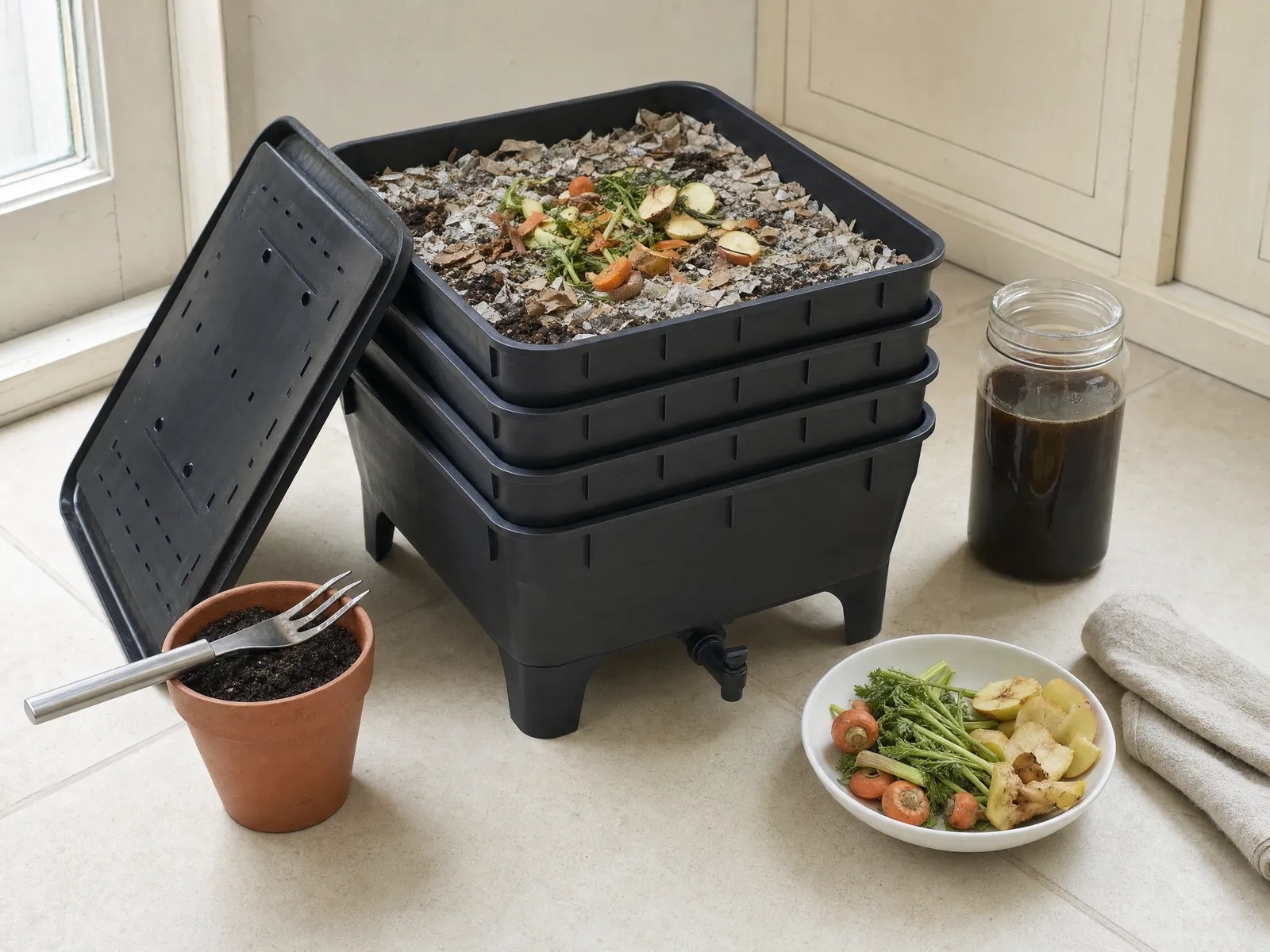
For small spaces specifically, the EPA's own suggestion for composting for beginners indoors is worms rather than hardware: vermicomposting "takes up little space, the materials are simple and inexpensive, and it can be done indoors or outdoors", and "You can keep your worm bin indoors (e.g., under a sink, in a closet or basement)." It is a real option for a flat, and it is a bigger commitment than a frozen tub, so it belongs after you have proved the habit rather than before. Where no local option exists at all, the agency's remaining advice is to consider "starting a composting program" or advocating for one.
The bottom line
Find the destination, freeze the scraps today in a container you already own, secure browns only if the pile is yours, and buy a counter bin last - in that order, because the destination sets the rules and the volume, and those are the only inputs that should pick equipment. Everything that makes this work in month one is free, and the single most effective move in the whole sequence is a lidded tub in a freezer you are already paying to run.
If you are two weeks in and the scraps are leaving the house on a schedule, you have already done the hard part. The rest of the system - what goes in, which caddy, liners, odour, and where it all ends up - is in our kitchen composting series.
How we score
What it’s made of.
Chemistry you’ll touch.
How long it lasts.
Where it goes after.
Each pick scores 0–5 on the four axes above, weighted into the composite verdict at the top. Scores are derived from what a product is verifiably made of and certified as — not how green its label looks.
About the author
Ruth Lopez
I'm Ruth Lopez and I'm a lover of nature and the environment. I'm very passionate about finding eco friendly products that don't damage the environment and also support companies that have the same philosophy.