Compostable Bin Liners and Which Ones Actually Break Down

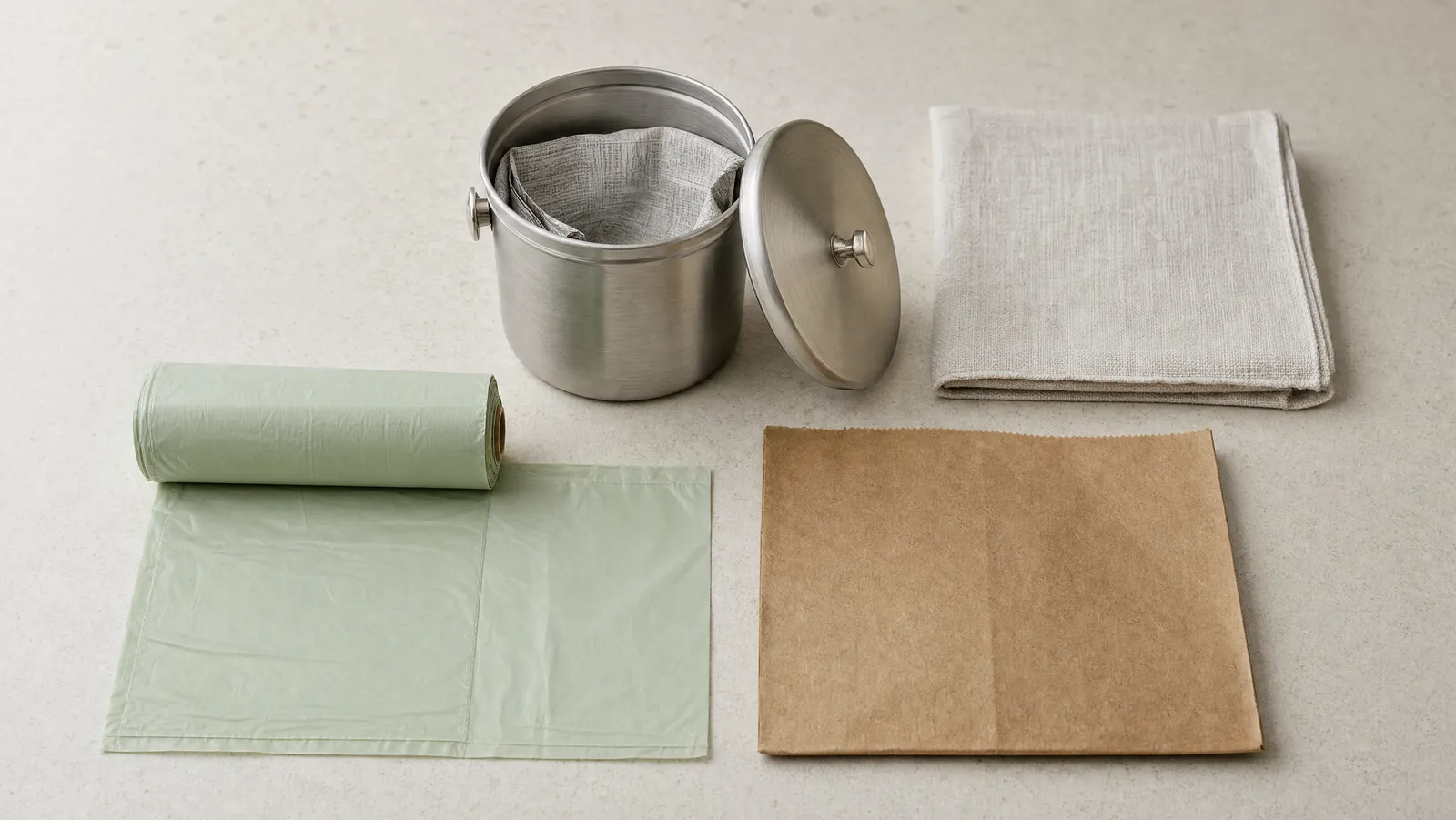
Disintegration is not a property of a material. It is a function of temperature, moisture and time, and a compostability certification is a pass mark under one specified set of those three. That is why the same compostable bin liner can all but vanish in a commercial facility and still be a recognisable bag in your garden heap. We may earn a commission when you buy through links on this page, at no cost to you.
The short answer. Liners certified OK compost HOME are the ones with a test of home conditions behind them; BPI and ASTM D6400 certify municipal and industrial facilities, not gardens. If your scraps go to your own pile, newspaper does everything a liner does, for nothing.
This is the liner instalment of our series on kitchen composting, and the one article in it that spends its first third arguing against its own category. Two large studies disagree completely about whether these bags work. Both are right, because they tested two different destinations.
The study that says compostable bin liners do not break down at home
Danielle Purkiss, Ayse Lisa Allison, Fabiana Lorencatto, Susan Michie and Mark Miodownik of the UCL Plastic Waste Innovation Hub and the UCL Centre for Behaviour Change published the Big Compost Experiment in Frontiers in Sustainability on 3 November 2022. The team "engaged with 9,701 UK citizens geographically spread across the UK", and of that cohort "1,648 citizens performed home compost experiments" with real packaging in their own bins.
The finding for items that already carried a home-compostable certification: "the majority did not fully disintegrate, including 60% of those that were certified 'home compostable'". The paper's results describe that 60 percent as items whose remains were "still clearly visible" when participants reported back. The authors' conclusion is not hedged: "home composting is not an effective or environmentally beneficial waste processing method" for biodegradable or compostable packaging in the UK.
The same study looked at what people were putting in their bins in the first place: in a randomised sample of 50 item images submitted by participants, 46 percent "had no compostable certification" at all.
So the single most common failure is not a bag that underperforms its certification. It is a bag with no certification being composted anyway.
The study that says the same material hits 98 percent in a facility
Leaving this half out would be dishonest. The Composting Consortium, convened by Closed Loop Partners, published Breaking It Down: The Realities of Compostable Packaging Disintegration in Composting Systems in April 2024 - an 18-month field project covering more than 23,000 units of 31 fibre and compostable-plastic products at ten US commercial composting facilities.
Compostable plastic packaging and products averaged 98 percent disintegration by surface area across five composting methods, above the 90 percent threshold industry groups use. Fibre products averaged 83 percent, above their 80 percent threshold. The Consortium is careful to say the study was not designed to pass or fail any specific product.
Hold both numbers at once: 60 percent of certified home-compostable items still clearly visible in home bins, and 98 percent average disintegration for compostable plastics in commercial plants. Same category of material. Two destinations. Opposite outcomes. The certification is not the variable that moved. The destination is.
What BPI certified compost bags and OK compost HOME actually test
Almost every liner box blurs this. Each scheme is a test under one set of conditions, and the conditions are the logo's whole meaning.
- BPI and ASTM D6400 - industrial, by name. ASTM International's scope for D6400 covers plastics designed to break down in aerobic composting where high temperatures are reached in large municipal or industrial facilities. The Biodegradable Products Institute, whose programme is administered by NSF, requires testing to D6400 or D6868 at an approved laboratory and names three tests: biodegradation over a 180-day period, extendable to 365 days for slower materials; disintegration, with no more than 10 percent of the original dry weight remaining on a 2.0 mm sieve; and an ecotoxicity test on the resulting compost. Nothing in that describes a garden.
- OK compost HOME from TUV AUSTRIA - the home-conditions test. TUV AUSTRIA says "OK compost HOME refers to products that also compost at lower temperatures, so they can go into the compost heap in your garden at home", and states the reason a separate scheme is needed: "the temperature in a garden compost heap is clearly lower and less constant than in an industrial composting environment". Products holding only OK compost INDUSTRIAL compost "only in industrial composting facilities (at temperatures between 55 to 60°C)". TUV AUSTRIA adds that OK compost HOME "is not based on a standard but is the basis for several standards", naming Australia's AS 5810 (2010) for home composting, France's NF T 51800 (2015) and Europe's EN 17427 (2022).
- CMA - field testing in real plants. Waste360 reported that the Compost Manufacturing Alliance programme grew out of a field test Cedar Grove Composting in Seattle built for itself after lab-passing food packaging failed to break down in its covered aerated static pile system, and that CMA extended it across open aerated static piles, turned windrows, mass beds and agitated continuous-flow tunnel systems. It answers a narrower question than a lab standard: did this item disintegrate in this kind of operating plant.
- Australian AS 4736-2006 - industrial, despite the seedling. The City of Greater Geelong's labelling guidance states that packages marked AS 4736 can only be composted in special industrial or commercial facilities. The Australian home standard is AS 5810:2010, which South Australian waste guidance describes as certifying that the material can be composted in your home compost bin.
- An unqualified claim is not a home claim. "100% compostable", "biodegradable", or "OK Compost" with no HOME after it tells you nothing about a backyard pile. The Big Compost Experiment's 46 percent is what that looks like at national scale.
The word that changes the meaning of a liner box is HOME. Without it, the logo is a statement about a facility you may not have access to.
Why the EPA puts compostable bags on the do-not-add list
The US Environmental Protection Agency's composting-at-home guidance carries a section headed What to Avoid Adding to a Backyard Compost Pile. One line in it reads "Compostable foodservice ware and compostable bags", with a footnote giving the reason: "Backyard composting piles generally do not reach high enough temperatures to fully decompose these materials." The same footnote notes these materials "can be composted at commercial composting facilities", and advises checking first whether a particular facility accepts them.
That list is otherwise occupied by meat, bones, dairy, fats, treated wood and pet waste. The full version, and what does belong in a pile, is in what you can and cannot compost.
The EPA defines the process as "the managed, aerobic (oxygen-required) biological decomposition of organic materials by microorganisms". A home heap is managed by whoever remembers, at whatever temperature the week delivers.
If your scraps end in your own pile, no bag on this page is doing chemistry for you. It is carrying the pail.
Work out your destination before you buy a box of compostable trash bags
Three destinations, three different right answers, and none of them is a shopping decision.
- A municipal or commercial organics programme that specifies certified bags. This is the one case where a compostable liner does real work, and the programme decides which one. Ann Arbor, Michigan publishes a list of accepted compostable products and accepts only items certified CMA-W, short for Compost Manufacturing Alliance - Windrow, made of fibre. Check your programme's list before a product page.
- Your own backyard pile. The EPA footnote above applies. A liner is a convenience for carrying the pail, nothing more.
- The trash. If the scraps go to landfill, a compostable bag is just a dearer bag; the certification has no destination to work in.
Deciding which of the three you are is step one in how to start composting kitchen scraps, and it is worth doing before you spend 20 dollars on bags your hauler may not take.
The free method beats every bag on this page and we earn nothing from it
A sheet of newspaper, folded into the bottom of the pail. That is the method.
It does the one job a pail liner has: absorbing the liquid that collects at the bottom and letting you lift the contents out in one movement. Newsprint is also a carbon-rich brown, so if the destination is your own pile it goes in with the scraps and does a second job there. A paper grocery bag works the same way at a larger size, as does no liner at all plus a rinse.
- Line the base with newspaper. It is already in your house and we make nothing from saying so.
- Or skip the liner question entirely by freezing scraps instead, which removes the smell and the fruit flies rather than managing them.
On the EPA's own reasoning, for a backyard pile the newspaper is not the budget option. It is the better one. Everything below this line is for the reader whose destination requires a bag.
How we ranked these compostable bin liners
Certification set first, because it is the only thing on the box that is a test result rather than a sentence someone wrote. Then cost per bag, then thickness, then size.
Cost per bag is the comparison that matters here, because box counts run from 30 to 100 and box prices do not:
- About 13.6 cents a bag: the UNNI 2.6 gallon roll, 100 bags, 13.59 dollars as of October 2026.
- About 18 cents a bag: the UNNI 4 gallon roll, 100 bags, 17.98 dollars as of October 2026.
- About 21 cents a bag: the ANECO 3 gallon, 100 bags, 20.95 dollars as of October 2026.
- About 40 cents a bag: the UNNI 13 gallon, 50 bags, 19.98 dollars as of October 2026.
- About 90 cents a bag: the Bag to Earth paper liner, 30 bags, 26.95 dollars as of October 2026.
Box price spans barely twice over, from 13.59 to 26.95 dollars, while cost per bag spans nearly seven times over. That gap is the whole argument for ignoring the shelf price.
On size: most of the pails in the countertop bins we tested hold 1.1 to 1.3 gallons, so a 2.6 or 3 gallon bag has slack to fold over the rim, which stops it sliding in under wet scraps. A 13 gallon bag is for a tall bin or a curbside cart.
UNNI 4 Gallon - the best compostable bin liners if you buy one box
The UNNI 4 gallon roll is 17.98 dollars as of October 2026 for 100 bags, about 18 cents each, at 4 gallons or 15 liters and 0.75 mil.
It leads on one thing. UNNI states the bags are "Independently certified by BPI (U.S., to ASTM D6400), CMA (field-tested in operating facilities), and OK compost HOME by TUV AUSTRIA (home/backyard)". That triple covers the industrial lab standard, field disintegration in operating plants, and the one scheme that tests ambient home conditions. No bag can promise your particular heap, but this is the most a box can honestly claim about one.
Its costs. UNNI puts a shelf life on its own product - "Store in a cool, dry place; use within 9 months for best performance" - which is unusual to print on a bag and worth knowing when the box holds 100. UNNI also prints that "Commercial composting may not be available in all areas—check local availability", the maker telling you its best-tested destination may not exist where you live. And it costs a third more per bag than the smaller roll below.
UNNI 2.6 Gallon - the cheapest compostable bin liners for a countertop bin
The UNNI 2.6 gallon roll is 13.59 dollars as of October 2026 for 100 bags, about 13.6 cents each - the cheapest bag on this page. UNNI lists it at 2.6 gallon or 9.84 liter and 0.71 mil, with the same BPI, CMA and OK compost HOME set.
Same certifications, smaller bag, lowest price per unit on the page: if a programme requires a certified liner for a counter pail, this is the one we would buy.
Its costs. At 0.71 mil it is the thinnest bag here, under the 0.75 mil of the UNNI 4 gallon and the ANECO, and thickness is what you notice lifting a wet bag by its gathered top. The 9-month shelf-life instruction applies here too, and 100 bags is more than a one-person kitchen gets through in nine months. And UNNI calls the same roll 10 liter in the title and 9.84 liter in the specifications.
ANECO 3 Gallon - the thickest small liner and the listing that argues with itself
The ANECO 3 gallon bags are 20.95 dollars as of October 2026 for 100 bags, about 21 cents each, at 0.75 mil. ANECO says they are "Made from compostable ingredients such as corn starch and bio-based materials" and "can carry weights up to 15 pounds", and that the recommended bin "has a height below 13.6 inch with a capacity under 3 gallon".
It is the only pick that names its feedstock and the only one citing a third scheme: "BPI (US Standard ASTM D6400), OK Compost HOME (EU Standard) and Seeding Logo (Australian Standard 4736-2006)". The home claim there rests on OK Compost HOME, because AS 4736-2006 is the Australian industrial standard, not the home one.
Three things in this listing undercut it, and we would rather you heard them here. ANECO instructs that "It is recommend that you should change the trash bags every two days to ensure hygiene", which argues against a 100-count box and against the weekly emptying the rest of this series recommends. Its claim that the bags "can certifiably decompose into humus, CO2 and water within 6 - 12 months once composted (even as being buried in home garden)" is ANECO's own, and burial in a garden is not a composting condition. And its stated compliance "with all labeling requirements set forth by California law, including SB 1383" concerns what the bag may legally say, not how quickly it disappears.
UNNI 13 Gallon - compostable trash bags for a curbside organics cart
The UNNI 13 gallon roll is 19.98 dollars as of October 2026 for 50 bags, about 40 cents each, at 13 gallon or 49.2 liter and what UNNI calls a "Reinforced 0.9 Mil" - the thickest bag on this page. It carries the same BPI, CMA and OK compost HOME set as the small rolls.
This pick exists for exactly one reader: the person whose city runs an organics cart and specifies certified bags. Half the count of the small rolls at a comparable box price makes it the dearest bioplastic bag here per unit, roughly three times the 2.6 gallon roll, and the extra 0.15 mil is what a bag holding a week of scraps needs.
Its costs mirror its use case. If your destination is a backyard pile, skip it outright - a 13 gallon bioplastic bag in a garden heap is precisely the scenario the EPA's footnote describes.
Bag to Earth - the paper liner closest to the free method
The Bag to Earth paper liners are 26.95 dollars as of October 2026 for 30 bags, about 90 cents a bag. Bag to Earth describes a "%100 Paper Cellulose Liner" with a "Leak-Resistant Natural Fiber Lining", and calls the bag "%100 Compostable, Made From Renewable Resources" and "Plastic Free (Natural Fiber Liner)".
It is here because it is not a bioplastic. Paper with a natural-fibre lining is the same material category as the newspaper above, in a tidier form, and for a reader who wants that from a box this is the pick.
Two facts have to travel with it. At about 90 cents a bag it is roughly six times the cheapest bioplastic bag on this page, and the listing names no certification scheme at all. No BPI, no ASTM D6400, no OK compost HOME, no AS 5810 - only the unqualified phrase "%100 Compostable", the kind of claim that made up the Big Compost Experiment's uncertified 46 percent. Paper is a material a backyard heap handles well, so the claim is plausible on its materials in a way a bioplastic claim is not. It is still uncertified, and you are paying the most on this page for it. The copy also writes its percentages backwards and repeats its plastic-free sentence twice.
The bottom line
If your scraps go to your own pile, fold a sheet of newspaper into the pail tonight and buy nothing. That is what the EPA's do-not-add footnote and the UCL team's 60 percent point to, and we earn nothing from it.
If a programme requires a certified bag, buy on cost per bag and on the size the cart takes:
- UNNI 2.6 gallon, 13.59 dollars as of October 2026. For a counter pail. About 13.6 cents a bag, 0.71 mil.
- UNNI 4 gallon, 17.98 dollars as of October 2026. More room, same certifications. About 18 cents a bag.
- ANECO 3 gallon, 20.95 dollars as of October 2026. Named corn starch, 0.75 mil, about 21 cents a bag, and a two-day change instruction to ignore.
- UNNI 13 gallon, 19.98 dollars as of October 2026. Curbside carts only. About 40 cents a bag, 0.9 mil.
- Bag to Earth paper, 26.95 dollars as of October 2026. About 90 cents a bag, and no certification scheme named.
Whichever you choose, the destination decides whether a liner is a disposal route or a carrying handle. For most readers it is the handle. What goes in the pail and where it goes next is in composting kitchen waste.
What we tested

The one certification set that speaks to a backyard pile as well as a facility
- Material
- PLA Bioplastic & Kraft Paper
- Credentials
- CompostableCertification-checked
This exists for the reader who has to buy a bag because a programme requires one, and it is the general-purpose size whose certification set covers both destinations rather than only the industrial one.
No major drawbacks noted in testing.
17.98 dollars as of October 2026 for 100 bags on a roll, which is about 18 cents a bag, at 4 gallons or 15 liters, 17.7 by 19.7 inches and 0.75 mil. UNNI states the bags are "Independently certified by BPI (U.S., to ASTM D6400), CMA (field-tested in operating facilities), and OK compost HOME by TUV AUSTRIA (home/backyard)" and "Made with Plant-Based Materials". Three costs. UNNI prints a shelf life on its own product - "Store in a cool, dry place; use within 9 months for best performance" - which is worth knowing when the box holds 100 bags. UNNI also prints the caveat that "Commercial composting may not be available in all areas—check local availability", which is the destination its industrial certification was tested for. And at about 18 cents a bag it is roughly a third dearer per bag than the 2.6 gallon roll from the same maker.

The cheapest bag per unit here and the size that fits a countertop pail
- Material
- PLA Bioplastic & Kraft Paper
- Credentials
- CompostableCertification-checked
The cheapest bag per unit on the page and the one size with enough slack to fold over the rim of the 1.1 to 1.3 gallon pails in our countertop bins roundup.
No major drawbacks noted in testing.
13.59 dollars as of October 2026 for 100 bags, about 13.6 cents a bag, the cheapest per bag on this page. UNNI gives the size as 2.6 gallon or 9.84 liter at 16.3 by 16.5 inches and 0.71 mil, and states the same certification set as the 4 gallon roll, "Independently certified by BPI (U.S., to ASTM D6400), CMA (field-tested in operating facilities), and OK compost HOME by TUV AUSTRIA (home/backyard)". Three costs. At 0.71 mil it is the thinnest bag here, under the 0.75 mil of both the 4 gallon roll and the ANECO. The same shelf-life instruction applies - "Store in a cool, dry place; use within 9 months for best performance" - on a 100-count roll a one-person kitchen may not finish inside nine months. And UNNI's own listing calls this roll 10 liter in the title and 9.84 liter in the specifications, a small inconsistency on a box that is otherwise the most precisely documented on this page.

The thickest bag at the small end and the listing that argues with itself
- Material
- PLA Bioplastic & Kraft Paper
- Credentials
- CompostableCertification-checked
The only pick whose listing names its feedstock, corn starch, and the thickest bag at the small end, which is the one that matters when a wet pail liner gets lifted out by its gathered top.
No major drawbacks noted in testing.
20.95 dollars as of October 2026 for 100 bags, about 21 cents a bag, at 0.75 mil and a listed 17.7 by 16.9 by 5.3 inches for a 3 gallon bag. ANECO says the "recommended trash can size has a height below 13.6 inch with a capacity under 3 gallon" and that the bag "can carry weights up to 15 pounds", that the bags are "Made from compostable ingredients such as corn starch and bio-based materials", and that they carry "BPI (US Standard ASTM D6400), OK Compost HOME (EU Standard) and Seeding Logo (Australian Standard 4736-2006)". Three costs, and the listing supplies all three itself. It instructs that "It is recommend that you should change the trash bags every two days to ensure hygiene", which undercuts a 100-count box and contradicts the weekly emptying the rest of this series advises. Its claim that the bags "can certifiably decompose into humus, CO2 and water within 6 - 12 months once composted (even as being buried in home garden)" is ANECO's claim about burial, and burial is not a composting condition. And its stated compliance "with all labeling requirements set forth by California law, including SB 1383" is a statement about what the bag may legally say, not about how fast it breaks down.

The only size here that fits a curbside organics cart
- Material
- PLA Bioplastic & Kraft Paper
- Credentials
- CompostableCertification-checked
The only size here that lines a tall kitchen bin or a municipal organics cart, which is the one destination where a certified bag does work a sheet of newspaper cannot.
No major drawbacks noted in testing.
19.98 dollars as of October 2026 for 50 bags, about 40 cents a bag, the dearest per bag of the four bioplastic picks. UNNI gives 13 gallon or 49.2 liter at 23.75 by 31.49 inches and a "Reinforced 0.9 Mil", the thickest bag on this page, and states the roll is "Independently certified by BPI (U.S., to ASTM D6400), CMA (field-tested in operating facilities), and OK compost HOME by TUV AUSTRIA (home/backyard)". Three costs. Half the bag count of the small rolls at a similar box price, so about 40 cents a bag against 13.6 cents for the 2.6 gallon. It makes sense for one reader only, the one whose city runs an organics cart and specifies certified liners. And if your scraps go to your own backyard pile, this is the pick to skip outright, because a bag this size in a garden heap is precisely the case the EPA's do-not-add footnote covers.

Paper rather than bioplastic and no certification scheme named anywhere
- Material
- PLA Bioplastic & Kraft Paper
- Credentials
- CompostableCertification-checked
The only pick here that is not a bioplastic, which makes it the closest bought product to the newspaper method this page recommends first - at about 90 cents a bag against nothing for a newspaper sheet you already own.
No major drawbacks noted in testing.
26.95 dollars as of October 2026 for 30 bags, which is about 90 cents a bag and roughly six times the cheapest bioplastic bag on this page. Bag to Earth describes a "%100 Paper Cellulose Liner" with a "Leak-Resistant Natural Fiber Lining" that "Keeps Your Bins Clean", and states the bag is "%100 Compostable, Made From Renewable Resources", "Odour-Free When Sealed" and "Plastic Free (Natural Fiber Liner)". Three costs. It is the most expensive liner here by a wide margin, and a folded sheet of newspaper does the same job for nothing. Unlike every other pick, this listing names no certification scheme at all - no BPI, no ASTM D6400, no OK compost HOME - only the unqualified phrase "%100 Compostable", and an uncertified claim stays uncertified even when the material makes it plausible. And the copy writes its percentages backwards and repeats its plastic-free sentence twice, which is not a fault in the bag but is a measure of how much scrutiny the claims have had.
The top three, compared
| Spec | Best OverallUNNI 4 Gallon Compostable Bags, 100 Count, 15 Liter, Extra Thick 0.75 Mil | Best for Countertop PailsUNNI 2.6 Gallon Compostable Bags, 100 Count, 10 Liter, Extra Thick 0.71 Mil | Best Thick LinerANECO 100% Compostable Food Waste Bags 3 Gallon, 100 Count |
|---|---|---|---|
| Verdict | Fair | Fair | Fair |
| Composite | 3.0/5 | 3.0/5 | 3.0/5 |
| Materials | 2.3 | 2.3 | 2.3 |
| Health | 3.0 | 3.0 | 3.0 |
| Durability | 2.2 | 2.2 | 2.2 |
| End-of-life | 5.0 | 5.0 | 5.0 |
| Price | — | — | — |
| Get it | Check price | Check price | Check price |
How we score
What it’s made of.
Chemistry you’ll touch.
How long it lasts.
Where it goes after.
Each pick scores 0–5 on the four axes above, weighted into the composite verdict at the top. Scores are derived from what a product is verifiably made of and certified as — not how green its label looks.
About the author
Ruth Lopez
I'm Ruth Lopez and I'm a lover of nature and the environment. I'm very passionate about finding eco friendly products that don't damage the environment and also support companies that have the same philosophy.