Do Toothpaste Tablets Actually Work and Are They Worth It

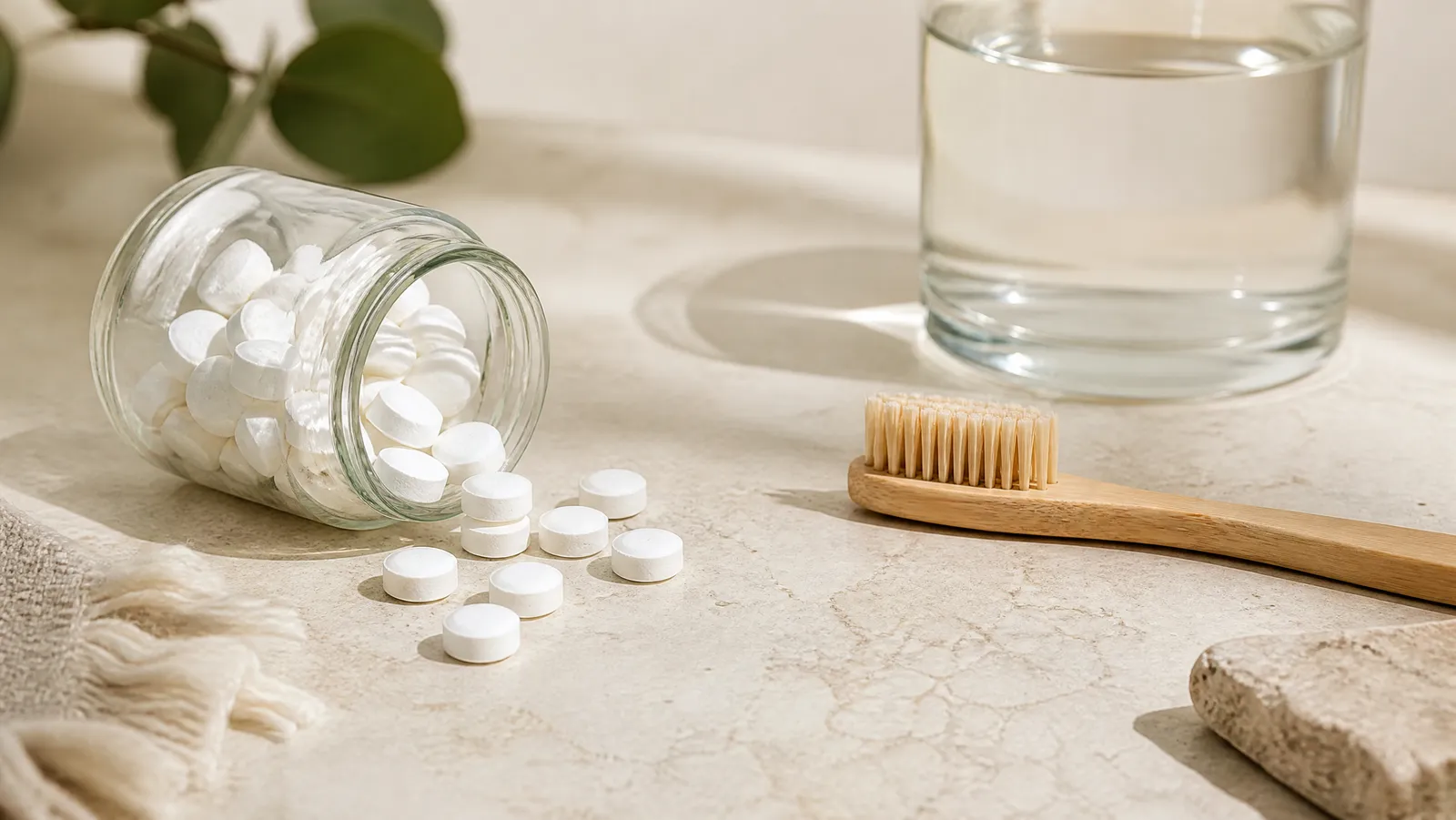
Toothpaste tablets do work: chew one, brush with a wet toothbrush, and it cleans your teeth the same way paste does — the abrasives, the active ingredients and two minutes of brushing do the job, not the tube. Whether they are worth it comes down to two questions: does your tablet contain fluoride, and will you pay more per brush for a jar than a tube?
That nuance is why we wrote a full explainer instead of a one-line answer. Toothpaste tablets are one of the most-recommended swaps for anyone building a lower-waste bathroom, and the waste case for them is genuinely strong — toothpaste tubes remain one of the hardest household items to recycle. But the category has a fluoride problem that most breathless reviews skip past, and the per-brush math is not as flattering as the marketing suggests. Here is what we found when we dug into how tablets are made, what the dental establishment says about them, and what they actually cost.
What Toothpaste Tablets Are and How They Work
A toothpaste tablet is toothpaste with the water removed: a small compressed disc of the same basic components — mild abrasives, binders, flavor, a foaming agent, and sometimes an active ingredient like fluoride or nano-hydroxyapatite — pressed into a pill and sold in a glass jar or a compostable pouch instead of a plastic tube.
The routine is simple:
- Chew the tablet for a few seconds until it crumbles into a gritty powder.
- Wet your toothbrush and brush as normal; saliva and water turn the powder into a paste that foams lightly.
- Brush for two minutes, spit, and you are done. No tube, no cap, no goo on the counter.
The chemistry is closer to conventional paste than you might expect. According to reporting in Chemical and Engineering News, tablet makers generally swap out sodium lauryl sulfate — the dominant foaming surfactant in regular toothpaste, which works best in liquid formulas — for cocamidopropyl betaine, a mild, plant-derived surfactant common across personal care products. That is why tablets foam less than the paste you grew up with. Less foam feels strange for the first week, but foam is a texture cue, not a cleaning mechanism; the scrubbing is done by the abrasives and your brush.
Do Toothpaste Tablets Work as Well as Regular Paste?
Mechanically, yes. Cleaning performance comes from the formulation — the abrasives that polish plaque off enamel and the actives that protect it — plus your technique. The tablet format changes how the toothpaste gets into your mouth, not what it does once it is there. If a tablet contains the same abrasives and the same active ingredient at the same strength as a paste, there is no obvious reason it would clean differently, and we noticed no difference in how clean our teeth felt when we ran tablets through our own morning-and-night routine for several weeks.
Clinically, the honest answer is that tablets are less documented. According to oral-care maker NOBS, no toothpaste tablet currently carries the American Dental Association's Seal of Acceptance, largely because the clinical data the Seal requires has not been produced for the format. That does not mean tablets fail — it means most tablet brands are small companies that have not run the trials, and some could not qualify anyway for the reason we cover next. In our view, this is the single most important caveat missing from the average toothpaste tablets review.
Toothpaste Tablets With Fluoride vs. Fluoride-Free
This is the spine of the whole question, so we will be precise about it.
The American Dental Association's home-care guidance recommends brushing twice a day, for two minutes, with a fluoride toothpaste to prevent cavities. And according to the ADA's own toothpaste guidance, any toothpaste carrying its Seal of Acceptance with a cavity-protection claim must contain fluoride. Fluoride is the one toothpaste ingredient with decades of evidence behind it, and it is the reason your dentist is largely indifferent to which brand of paste you buy — as long as it has fluoride in it.
Here is the catch: many of the best-known toothpaste tablets are fluoride-free. According to Bite, its fluoride-free Toothpaste Bits swap fluoride for nano-hydroxyapatite — and the company sells a separate fluoride version of the same tablet. Unpaste, per its retail listings, sells both a fluoride and a fluoride-free version of the same tablet. Other brands in the category — Huppy, Hux, Georganics and a long tail of zero-waste shops' house brands — split the same way. The fluoride-free skew is partly regulatory (fluoride toothpaste is regulated as an over-the-counter drug in the US, which raises the bar for small brands) and partly marketing, since the tablets sell to an audience that often prefers "natural" formulas.
We are not going to tell you what to put in your mouth — that is a conversation for you and your dentist, especially if you are cavity-prone, pregnant, or shopping for kids. But the trade-off should be stated plainly: switching from a fluoride paste to a fluoride-free tablet is not a like-for-like swap. You are changing your active ingredient, not just your packaging. If you want the packaging win without the formulation change, toothpaste tablets with fluoride exist — you just have to read the jar, because within a single brand the two versions often look nearly identical.
What About Nano-Hydroxyapatite?
Nano-hydroxyapatite (often written n-Ha) is the ingredient most fluoride-free tablets lean on. It is a synthetic version of the mineral your enamel is already made of, and the idea is that the particles bind to teeth and help remineralize early damage.
The research is genuinely promising, and genuinely young. A 2022 randomized clinical trial published in an NIH-indexed journal pitted a hydroxyapatite toothpaste against a fluoride one on white-spot lesions — the earliest, still-reversible stage of decay — and found the hydroxyapatite paste actually reduced sensitivity more than the fluoride paste, though neither produced measurable remineralization in the trial's three-month window. And as GoodRx's medical reviewers note, the hydroxyapatite evidence base is much smaller and shorter-term than fluoride's. Much of the research, that trial included, also measures proxies like sensitivity and lesion changes rather than the outcome that matters: fewer cavities over years of use.
So our careful phrasing is this: early studies suggest n-Ha can remineralize enamel, and it may prove to be a credible fluoride alternative — but "may" is doing real work in that sentence. Fluoride has a half-century head start. A fluoride-free tablet with n-Ha is a reasonable, researched choice; it is not yet an equivalently proven one.
The Waste Case: Why Tubes Are a Real Problem
If the fluoride section made tablets sound like a compromise, this is the section where they earn their keep.
Conventional toothpaste tubes are built from layered plastic, and often aluminum, laminated together — a structure that most recycling systems cannot pull apart. According to Tom's of Maine, some twenty billion toothpaste tubes are manufactured worldwide every year, and most recycling systems cannot process them. Colgate's share alone, per Bloomberg reporting, runs to roughly nine billion tubes a year — tubes that, with most sorting facilities rejecting them outright, overwhelmingly still end up in the trash.
The industry knows this. Colgate launched a first-of-its-kind recyclable tube made from HDPE — the same No. 2 plastic as milk jugs — across the US in 2022, and shared the design with competitors. But "technically recyclable" and "actually recycled" are different claims: according to Packaging Dive, Colgate now faces a lawsuit arguing the recyclable label is misleading because few real-world facilities accept toothpaste tubes at all, regardless of material.
Tablets sidestep the whole mess. A glass jar is reusable and widely recyclable; refill pouches from the major tablet brands are typically paper-based or compostable. We will be honest about scale — a few tubes a year is a small slice of any household's plastic footprint, and this swap will not transform your bin the way quitting bottled water might. But it is a slice with no good end-of-life today, and this is one of the rare swaps where the alternative is not a downgrade in daily use. Pair the jar with one of the best bamboo toothbrushes and your entire brushing routine generates almost no plastic at all.
What Toothpaste Tablets Cost per Brush
Here is the arithmetic, using real prices we checked in July 2026.
- Unpaste: a pouch of 125 tablets — about a two-month supply brushing twice a day — runs 12.99 dollars at Dental Lace's US shop. That works out to about 10 cents per brush.
- Bite: a four-month subscription supply, shipped in a refillable glass jar, costs 32 dollars, according to the company. At twice a day, that is roughly 240 brushes, or about 13 cents per brush.
- Conventional paste: the C2ER Cost of Living Index put the average price of a tube at 3.92 dollars in late 2023. How long a tube lasts depends entirely on how hard you squeeze: per OutletPicks, a standard four-ounce tube lasts about a month for one adult brushing twice a day (roughly 6 to 7 cents per brush at that average price) — heavy squeezers can empty the same tube in a week or two, while strict pea-sized dosing stretches it to roughly 450 brushings, under a penny each.
So tablets cost roughly two to more than ten times as much per brush as paste, depending on your squeezing habits. In absolute terms the premium is small — somewhere between 2.50 and 7.50 dollars a month per person — but it is real, and it compounds for a family of four. Anyone telling you tablets save money is comparing them against very expensive paste.
The Adjustment Period, and Who Tablets Suit
A few practical notes from our weeks of use, hedged where they should be:
- The first chew is weird. The chalky, fizzy crumble takes some getting used to; for us the strangeness faded within a week, and some users report never fully warming to it. Try a small pouch before committing to a subscription.
- Less foam, same clean. Expect a thinner lather. Your teeth still get that squeaky-clean feel; your mouth just looks less rabid in the mirror.
- Travel is where tablets shine. They are solid, so there is no tube to burst in a bag and nothing to cram into the liquids pouch, and they are trivially easy to count out for a trip.
- Dosing is fixed. One tablet is one brush — no over-squeezing, no half-empty tube wrestling. This is quietly why the per-brush cost, while higher, is at least predictable.
- Storage matters. Tablets are pressed powder; makers advise keeping the jar dry, and a splash of shower water may soften or crumble them.
Who are they for? Frequent travelers, anyone committed to cutting bathroom plastic, and households that will actually read the label and choose their active ingredient deliberately. Who should skip them? Anyone whose dentist has them on a prescription-strength fluoride paste, and anyone unwilling to pay a dime a brush for packaging they feel better about.
Our Verdict: They Work — Worth It Comes With One Condition
Do toothpaste tablets actually work? Yes. The format cleans teeth exactly as well as its formulation allows, the routine is painless, and the packaging win over the un-recyclable tube is genuine, not greenwash.
Are they worth it? Worth it, on one condition: choose the active ingredient on purpose. If you want the swap with no clinical asterisk, pick toothpaste tablets with fluoride and you have changed nothing but the packaging — at a premium of a few dollars a month. If you choose a fluoride-free n-Ha tablet, do it knowingly, ideally after a word with your dentist, understanding that the research is early rather than settled. The tablets that top the lists of best toothpaste tablets are not always the ones that clear that bar.
This is the same test we apply to every swap on this site, from shampoo bars to zero waste bathroom cleaning: the green option has to actually do the job first. Tablets pass — read the jar before you buy. And if this is your first swap rather than your fifth, our full zero waste bathroom guide walks the whole room, one worn-out product at a time.
How we score
What it’s made of.
Chemistry you’ll touch.
How long it lasts.
Where it goes after.
Each pick scores 0–5 on the four axes above, weighted into the composite verdict at the top. Scores are derived from what a product is verifiably made of and certified as — not how green its label looks.
About the author
Ruth Lopez
I'm Ruth Lopez and I'm a lover of nature and the environment. I'm very passionate about finding eco friendly products that don't damage the environment and also support companies that have the same philosophy.