The Best Bidet Attachments to Cut Your Toilet Paper Use

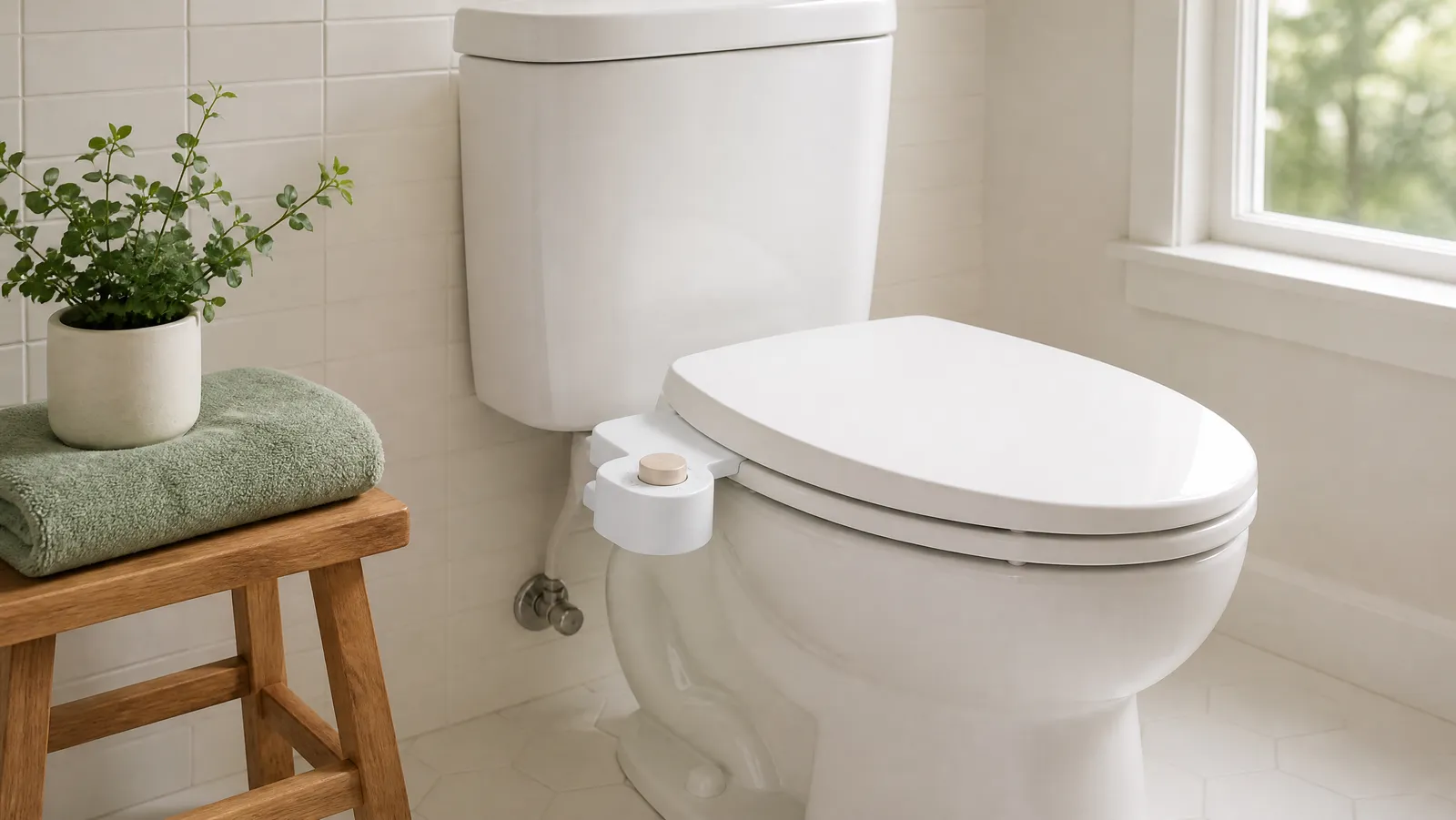
The best bidet attachment for most bathrooms is the LUXE Bidet NEO 185 — dual nozzles, metal valve cores, and, as of July 2026, around $50. We installed five non-electric bidets across our test bathrooms to find the ones actually worth living with, and which ones you should skip. Eco-Friendly Review is reader-supported, so if you buy through our links we may earn a small commission, at no extra cost to you.
Let's be honest about why this category exists on an eco site at all. A bidet attachment is a plastic-and-metal gadget, and buying gadgets is not, by itself, an environmental act. The eco case is what it displaces: toilet paper, and a lot of it. According to the NRDC, the average American goes through nearly three rolls of toilet paper a week, and the biggest brands still make their at-home rolls from virgin forest fiber. Cut that habit substantially and a small one-time gadget starts to look like one of the highest-leverage swaps in our zero waste bathroom guide.
Below are the five we recommend, why each earned its slot, and — because this is us — the honest adjustment period nobody puts in the product photos.
Bidet vs Toilet Paper: What the Numbers Actually Say
The counterargument we hear most is "but bidets use water." True, and the math is not close. According to Scientific American, manufacturing a single roll of toilet paper takes about 37 gallons of water, 1.3 kilowatt-hours of electricity, and roughly 1.5 pounds of wood — while a typical bidet wash uses about an eighth of a gallon. You would need a lot of washes to approach the water footprint of the paper they replace.
Then there is the forest side. NRDC's "Issue with Tissue" reporting found that Procter & Gamble, Kimberly-Clark, and Georgia-Pacific use zero recycled content in their major at-home toilet paper brands, relying instead on fiber from the Canadian boreal forest — and NRDC reports about one million acres of that boreal forest are clearcut every year, with tissue pulp among the products driving the logging.
A bidet does not take your paper use to zero — most people still pat dry, and guests will keep doing what guests do. But washing first means each visit uses a fraction of the paper, and in our households the roll on the holder went from a weekly purchase to something we replace so rarely we forget which store aisle it lives in. That is the whole eco pitch: not a magic gadget, just dramatically less of a throwaway product you currently buy every week.
One more honesty checkpoint: every product on this list is itself mostly plastic or metal that had to be manufactured. We are comfortable with that trade because it is a one-time object displacing a weekly disposable — the same logic as a safety razor or a refillable bottle.
How We Tested These Non-Electric Bidet Attachments
This is a bidet attachment review, so here is what we actually did. We installed each unit on a standard two-piece toilet, timed the install with the tools in the box, then lived with it: daily use, pressure control at the low end (where cheap valves sputter or blast), checking the connections for weeping leaks after the first week, and wiping down the nozzles and guard gates to see what stays clean on its own.
What separates the keepers from the returns, in our experience:
- Valve quality. Cheap all-plastic valves are why bidet attachments have a flaky reputation. Metal-ceramic cores hold a gentle setting precisely and do not creep toward firehose.
- Nozzle hygiene. Nozzles should retract behind a guard when not in use, so they are shielded from, well, everything else that happens in a toilet bowl.
- Hose and fittings. Braided steel beats plastic tube. Most leaks we have seen come from over-tightened plastic T-adapters, so follow the paper instructions, not your instincts.
- Fit. Attachments suit standard two-piece toilets; one-piece and skirted designs can be awkward. Replacement seats are shape-specific — round versus elongated matters.
None of these picks needs an outlet. Non-electric bidets run on your existing water pressure, which is why they cost tens of dollars instead of hundreds — the trade-off is that most of them spray water at whatever temperature your cold line happens to be. More on that below, because it is the single biggest reason people quit.
Best Overall: LUXE Bidet NEO 185
The LUXE Bidet NEO 185 is the attachment we would bolt onto most toilets, and as of July 2026 it runs around $50. You get two wash modes — a stronger rear wash and a softer front wash — and both nozzles sit behind a guard gate, retracting out of the way after each use so they stay clean without you thinking about it.
The reason it wins is under the knob. LUXE puts metal-ceramic cores in the pressure valves and a braided steel hose in the box, where most rivals at this price use plastic on both counts. In practice that means the low end of the pressure dial is actually usable — you can find a gentle setting and it stays put — and the connections feel like plumbing rather than a pool toy. LUXE says it installs on standard two-piece toilets with the included tools, and our install matched that claim: it is a wrench-and-ten-patient-minutes job, not a plumber job.
Who should buy it: anyone who wants the mainstream, proven pick and expects more than one person to use it. The dual nozzles make it the right call for couples and families. If you already know only one wash mode will ever get used, keep reading — LUXE sells the answer for less.
Best Value: LUXE Bidet NEO 120
The LUXE Bidet NEO 120 is the quiet bargain of this roundup: the same metal-ceramic valve cores, the same braided steel hose, the same retracting guard-gate design — minus the front-wash nozzle — for around $40 as of July 2026.
That is the entire trade. We compared the two side by side and could not find anywhere else LUXE cheapened the 120; it is genuinely the 185 with one fewer nozzle, not a lesser product wearing the same badge. LUXE says it installs in minutes on standard two-piece toilets with all parts and tools included, and ours went on as quickly as the 185 did.
Who should buy it: solo users, households outfitting a second bathroom, or anyone who wants the cheapest possible entry into bidet life without accepting the creaky all-plastic hardware that usually lives at this price. If the front wash matters to anyone in your house, spend the extra ten dollars on the 185. If it does not, this is the best bidet for the money on this list, full stop.
Best Warm-Water Upgrade: LUXE Bidet NEO 320
Here is the truth about cold-water bidets: in July, the water from your cold line is pleasant. In February, depending on where you live, it is a wake-up call. Cold washes are the number-one reason we see people abandon cheap attachments, and the LUXE Bidet NEO 320 — around $60 as of July 2026 — exists to solve exactly that.
It is the same core recipe as the 185 (dual wash modes, retracting guard-gate nozzles) plus an adjustable temperature control. The warm water has to come from somewhere, and this is the fit fact you must check before ordering: the NEO 320 draws hot water from your bathroom sink's supply line, which means running an included hose from under the sink to the toilet. It is still a DIY job, but it is a longer one, and your sink needs to be close enough for the hose to reach. Renters should also think about how visible that hose run will be.
Two more things to know. The temperature dial sits within easy reach and mixes smoothly rather than lurching between extremes — in winter that turns the bidet from a dare into something you genuinely prefer. And this particular listing is the gold-trim colorway, so if your bathroom hardware is all chrome, know what you are ordering.
Who should buy it: cold-climate households, and anyone who tried a cold-water bidet once, yelped, and gave up.
Best Full-Seat Upgrade: Brondell Swash Ecoseat
Every attachment above bolts under your existing seat, which works fine but always looks bolted-on and raises the seat a bit. The Brondell Swash Ecoseat takes the other route: it replaces the entire toilet seat with one that has dual wash nozzles built in — no electricity, no batteries, around $90 as of July 2026.
The result is the cleanest look in this roundup. The nozzles are integrated into the seat, the lines match the toilet, and nothing appears aftermarket. Brondell also includes small comforts the bolt-ons cannot: a gentle-closing seat that will not slam at 2 a.m., and a lid you can actually sit on. Water comes through at ambient temperature, same as the NEO 185 and 120, and Brondell rates it as a self-install.
The critical fit fact: this variant fits elongated toilets only. Elongated bowls are the longer oval ones; rounder, shorter bowls need a different model. Measure before you order — a seat is not an adapt-anywhere gadget the way an attachment is.
Who should buy it: homeowners who care how the bathroom looks, anyone replacing a tired toilet seat anyway (the upgrade math gets very easy when you were already spending on a seat), and households that want bidet function without one more visible gadget.
Best Budget Handheld: Vayzluiy Bidet Sprayer
The handheld sprayer is the route much of the world takes, and the Vayzluiy Handheld Bidet Sprayer makes the case at around $19 as of July 2026 — less than many families spend on paper products in a month. Instead of a fixed nozzle under the seat, you get a trigger sprayer on a hose, docked to the toilet or wall, that you aim yourself.
For under twenty dollars, the materials are the surprise: a solid brass valve body, a 304 stainless steel sprayer head, and a braided stainless hose, where competitors at this price are plastic throughout. Pressure is adjustable at the valve, and Vayzluiy says no special tools are needed to install it. The fit fact to check: it connects to a 7/8-inch toilet supply connection, which is the standard U.S. fitting — but confirm yours before ordering, especially in older houses.
The manual aim is either the feature or the flaw depending on your household. It means one sprayer serves every user, any toilet shape, and a few bonus jobs — it doubles as a cloth-diaper sprayer and a bowl cleaner, which is why parents of small kids often pick this route. It also means there is a small learning curve, and nothing retracts or self-shields the way the guard-gate nozzles above do; you are the hygiene system.
Who should buy it: budget-first switchers, cloth-diapering households, and anyone whose toilet will not cooperate with a bolt-on attachment.
The Adjustment Factor, Honestly
We would rather lose a sale than pretend this part does not exist. Switching from paper to water involves about a week of "this is strange," and a few real logistics:
- The first-week weirdness is universal. Everyone we know who switched describes the same arc — skeptical, startled, then quietly evangelical by week two. Give it seven days before you judge.
- Cold water is seasonal reality. On the NEO 185, 120, Ecoseat, and any handheld, wash temperature equals your cold-line temperature. Fine in summer, brisk in winter. If that will end the experiment for you, spend up on the NEO 320.
- Renters, check your shutoff valve first. Every install here starts at the little valve behind the toilet. If yours is painted over, seized, or buried behind the bowl, budget extra time and a gentle touch — cracking a stuck valve is the one way a ten-minute job becomes a landlord phone call. The good news is that all five picks are removable and leave the toilet exactly as found, which makes them rare renter-friendly upgrades.
- You will still buy some paper. Most people pat dry, and drying with a designated towel is the zero-waste endgame but not everyone's first move. Expect to cut paper use dramatically, not eliminate it.
- Who should skip these: households with one-piece or heavily skirted toilets (measure and check fit notes first), anyone unwilling to touch a water connection at all, and — for the Ecoseat specifically — anyone with a round bowl.
Best Bidet for the Money: The Payback Math
Here is the arithmetic, with sources, because "bidets pay for themselves" gets repeated more often than it gets shown. A survey of 2,000 Americans reported by StudyFinds — commissioned, we should note, by bidet maker TUSHY, so season to taste — found the average respondent spends about $182 a year on toilet paper, roughly $11,198 over a lifetime. Take that $182 figure and assume the conservative case, where a bidet only cuts your paper spending in half: that is $91 a year saved. The $40 NEO 120 pays for itself in around five months, the $50 NEO 185 in under seven, and the $19 handheld in under three. Cut paper use harder than half — which matches our experience — and the payback windows shrink accordingly. Even the $90 Ecoseat clears break-even inside a year at that conservative rate.
That makes a bidet one of the few bathroom swaps that is cheaper than the disposable habit it replaces, which is exactly the logic behind how to build a zero waste bathroom on a budget: prioritize the swaps that pay you back, then let the savings fund the rest.
And for the reduced amount of paper you will still buy, the bamboo versus recycled toilet paper question is worth a few minutes of label reading — NRDC's scorecard work gives recycled-content paper the strongest marks, reporting that recycled toilet paper carries about one-third the carbon footprint of paper made from virgin forest fiber. Washing first and choosing better paper for the remainder compound nicely.
The Readout: Which Bidet Attachment Should You Buy?
Our recommendations, compressed:
- Most people: LUXE Bidet NEO 185. Dual nozzles, metal valves, proven. Around $50.
- Tightest budget with real hardware: LUXE Bidet NEO 120 at around $40, or the Vayzluiy handheld at around $19 if you want flexibility and do not mind aiming.
- Cold climates: LUXE Bidet NEO 320, around $60 — and confirm your sink's hot line is reachable.
- Cleanest look: Brondell Swash Ecoseat, around $90 — elongated bowls only.
Whichever you pick, the environmental win is the same: a one-time object that replaces a three-rolls-a-week habit tied to clearcut boreal forest and 37 gallons of manufacturing water per roll. It is the rare eco swap that costs less, works better, and asks for one slightly strange week in exchange. If this is your first move toward cutting bathroom waste, it is the one we would make first — start with the toilet you use most, give it a full week, and let the unused rolls pile up as the proof.
What we tested

The dual nozzle standard bearer that made bidet attachments mainstream
- Material
- Metal-Valve Attachments
- Credentials
- Cuts paper useReusable
Solid pressure control, hygienic retracting nozzles, and hardware that feels built for years of daily use.
No major drawbacks noted in testing.
The NEO 185 is the attachment we would put on most toilets. It pairs a stronger rear wash with a softer front wash, and both nozzles retract behind a guard gate after every use. The valves use metal-ceramic cores and the hose is braided steel, which is rare in a category full of creaky all-plastic internals.

The single nozzle version of the same hardware for ten dollars less
- Material
- Metal-Valve Attachments
- Credentials
- Cuts paper useReusable
Identical build quality where it counts, and the simplest way onto the bidet ladder without feeling cheap.
No major drawbacks noted in testing.
Skip the front-wash nozzle and the NEO 120 gives you the same metal-ceramic valve cores, steel hose, and guard-gate hygiene design as the 185 for less. It installs in minutes on standard two-piece toilets with everything included in the box. The rational pick if one nozzle is all you will use.

The warm water upgrade that taps your sink s hot line
- Material
- Metal-Valve Attachments
- Credentials
- Cuts paper useReusable
Warm water makes winter use genuinely pleasant, and the temperature dial is easy to reach.
No major drawbacks noted in testing.
Cold-water washes are the number-one reason people give up on cheap bidets, and the NEO 320 fixes that by borrowing hot water from your sink's supply line — an extra install step, but a worthwhile one. You get the same dual wash modes and retracting guard-gate nozzles as the 185, plus an adjustable temperature dial. Note that this listing is the gold-trim colorway.

A full replacement seat with built in bidet no bolt on look no electricity
- Material
- Metal-Valve Attachments
- Credentials
- Cuts paper useReusable
Cleaner integrated look than any attachment, and the soft-close seat is a quality-of-life bonus.
No major drawbacks noted in testing.
The Ecoseat replaces your entire toilet seat, so the dual nozzles are integrated into the seat itself rather than bolted underneath. You also get a gentle-closing seat and a sittable lid, with no electricity or batteries required. This variant fits elongated toilets only, so measure before you buy.

The under 20 handheld sprayer route brass valve stainless head
- Material
- Metal-Valve Attachments
- Credentials
- Cuts paper useReusable
Metal where it matters for the price of plastic competitors, and the manual aim suits households that share one toilet.
No major drawbacks noted in testing.
A handheld sprayer is the cheapest and most flexible way into bidet life. This one gets you a solid brass valve body, a 304 stainless steel sprayer head, and a braided stainless hose with adjustable pressure, and it doubles as a cloth-diaper sprayer or toilet cleaner. It connects to a 7/8-inch toilet supply line, so check your fitting first.
The top three, compared
| Spec | Best OverallLUXE Bidet NEO 185 (White) | Best ValueLUXE Bidet NEO 120 (White) | Best Warm-WaterLUXE Bidet NEO 320 (Gold trim) |
|---|---|---|---|
| Verdict | Solid | Solid | Solid |
| Composite | 3.4/5 | 3.4/5 | 3.4/5 |
| Materials | 3.0 | 3.0 | 3.0 |
| Health | 3.2 | 3.2 | 3.2 |
| Durability | 3.9 | 3.9 | 3.9 |
| End-of-life | 3.6 | 3.6 | 3.6 |
| Price | — | — | — |
| Get it | Check price | Check price | Check price |
How we score
What it’s made of.
Chemistry you’ll touch.
How long it lasts.
Where it goes after.
Each pick scores 0–5 on the four axes above, weighted into the composite verdict at the top. Scores are derived from what a product is verifiably made of and certified as — not how green its label looks.
About the author
Ruth Lopez
I'm Ruth Lopez and I'm a lover of nature and the environment. I'm very passionate about finding eco friendly products that don't damage the environment and also support companies that have the same philosophy.