How to Build a Zero Waste Bathroom on a Budget

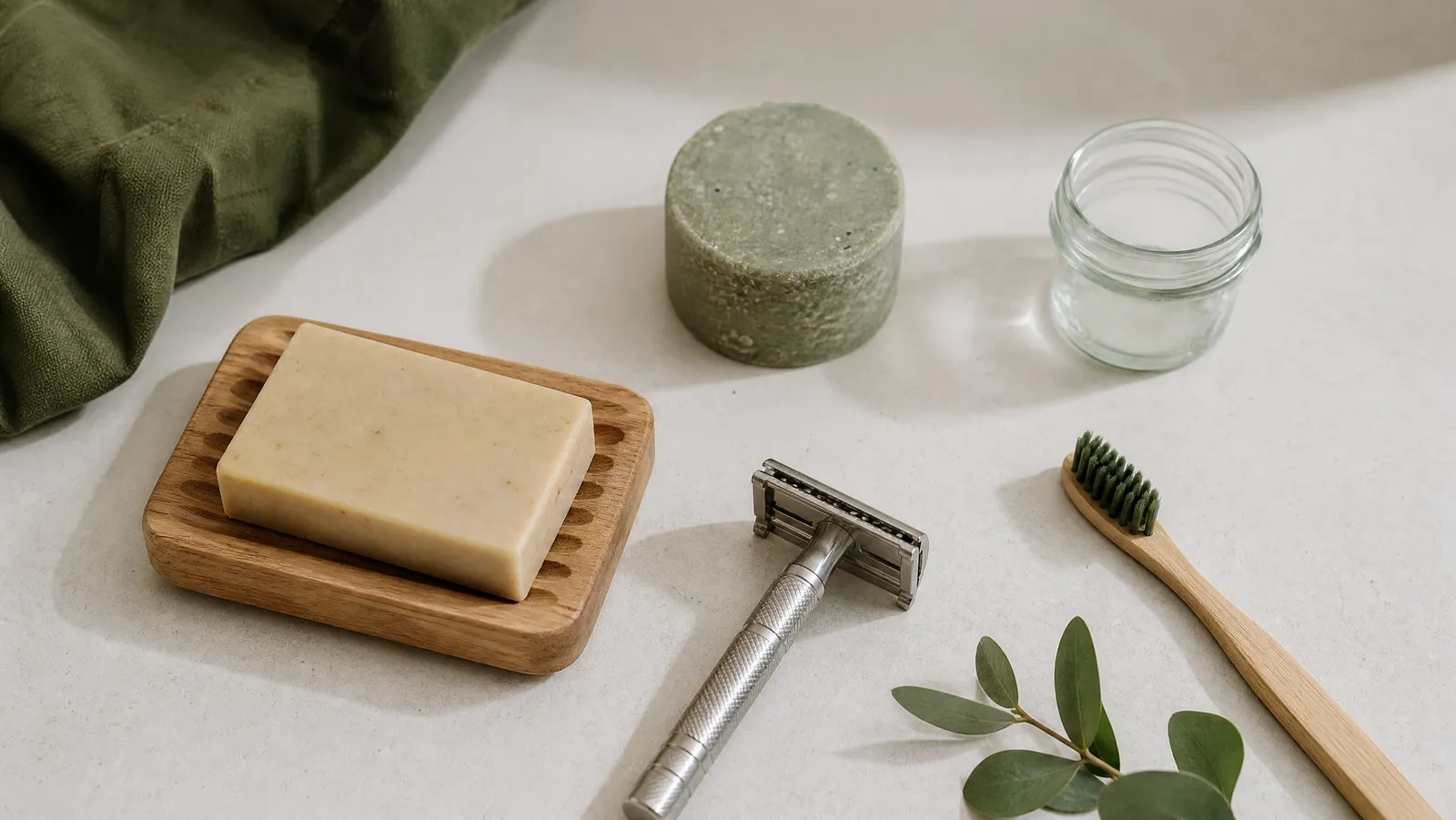
Building a zero waste bathroom on a budget comes down to sequence, not shopping. Use up what you already own, make the free and near-free swaps first — a bar of soap, rags cut from a dying towel — then replace each disposable with a durable version as it runs out, starting with the swaps that pay for themselves fastest.
We are saying this up front because zero waste marketing has a spending problem. Search the topic and you will be shown bamboo organizers, matching amber jars, and "starter kits" that cost more than most people spend on their bathroom in six months. None of that is zero waste. It is redecorating. The cheapest zero-waste move available to you tonight is finishing the half-used bottles you already paid for, and the second cheapest is a bar of soap.
This guide is the budget route through our full zero waste bathroom map. Same destination, but we rank every swap by payback — how fast it returns the money it costs — instead of by how it looks on a shelf. We will also be honest about the popular swaps that are not worth it when money is tight, because a few of the internet's favorites quietly cost more than the disposables they replace.
The bathroom earns this attention. Industry estimates put the number of shampoo bottles headed to U.S. landfills each year in the hundreds of millions, and according to Earth911, much personal-care packaging is too small for recycling sorters to capture, so even the "recyclable" bits often head straight to landfill. The fix, conveniently, is also the frugal option: buy fewer disposable things.
Step One: Use Up What You Own — the Only Free Swap
The fastest way to fail at a cheap zero waste bathroom is a purge. Binning half-used bottles to replace them with bars and jars in one weekend is not lower waste — it is faster waste, plus a credit card bill. This is not just our opinion: the U.S. EPA's waste management hierarchy ranks source reduction and reuse above recycling — the most environmentally preferred move is not creating waste in the first place, and products should only be recycled when they cannot be reduced or reused. Using up a product you already own is the purest version of that.
So step one costs nothing:
- Pull everything out of the cabinet. Most bathrooms are storing three open bottles of the same thing. Consolidate duplicates and line them up front and center.
- Declare a buy-nothing rule. Nothing new enters the bathroom until its predecessor is empty. This single rule does more for your budget than any product in this article.
- Rehome, don't bin. Sealed products you will genuinely never use can go to a friend, a shelter, or a community fridge with a toiletries shelf — not the trash.
While the queue burns down, you have weeks to research the replacement for each item. That is the whole system: every empty becomes a decision point, and the rest of this guide tells you what to decide.
Step Two: Near-Free Swaps for a Cheap Zero Waste Bathroom
Two swaps cost so little that you can make them this week without waiting for an empty.
A bar of soap instead of bottled body wash and hand soap. This is the best value in the entire zero-waste world, and the science backs the switch. A life-cycle study from the Swiss Federal Institute of Technology in Zurich, reported by Anthropocene Magazine, found that liquid soaps require about five times more energy for raw-material production and nearly 20 times more energy for packaging than bar soap, giving liquids a carbon footprint roughly 25 percent larger per wash. The budget half of the story is even better: according to Grist's coverage of the same research, people use about seven times more liquid soap by weight per wash — roughly 2.3 grams versus 0.35 grams of bar soap, per Scientific American's report on the same study. You are paying for water in a plastic bottle and pumping out far more of it per use. A plain bar, stored on a dish that drains, stretches a dollar further than any pump bottle in the store.
One honest caveat from the same research: bar-soap users tend to run about 30 percent more heated water per wash, which claws back some of the advantage. Do not leave the tap running while you lather and you keep the win.
Rags and washcloths cut from a retired towel. One dead bath towel yields a stack of face cloths, makeup-remover cloths, and cleaning rags. This replaces disposable wipes and most bathroom paper for the cost of five minutes with scissors. Hem them if you like; we do not bother.
That is the near-free tier. Notice what it did: it removed three repeat purchases — body wash, hand soap, wipes — for roughly the price of one bar of soap.
Step Three: Swap as Each Bottle Runs Out
Now the queue system takes over. As each disposable empties, its replacement is one of the true zero waste bathroom essentials — and the essentials list is much shorter than the internet suggests.
Shampoo: switch to a bar when the bottle dies. Solid shampoo looks expensive at the register — a good bar often costs more than a budget bottle — which is why it belongs in this tier, not the near-free one. The math works because of longevity. According to Ethique, the New Zealand maker that popularized the format, one shampoo bar lasts as long as three 350 mL bottles of liquid shampoo — over 80 washes — because liquid shampoo is 70 to 80 percent water and a bar is the concentrated remainder. Judge a bar by cost per wash, not sticker price, and the decent ones beat mid-shelf bottled shampoo comfortably.
Two honest caveats. First, bars vary wildly — a bad one will leave your hair waxy and put you off the format for years, so pick from tested options; our roundup of the best shampoo bars covers which bars suit which hair types. Second, expect an adjustment week or two, especially coming off silicone-heavy products, and keep the bar on a draining dish so your investment does not dissolve into a puddle.
Toothbrush: go bamboo at your normal replacement time. You already replace your brush every few months, so there is zero extra cost in making the next one bamboo — prices are comparable to a decent plastic brush. No need to rush it; the greenest brush is the one currently in the cup.
Step Four: Affordable Zero Waste Swaps That Pay Back in Months
This tier asks for money up front and hands it back within the year. There is one clear champion.
The safety razor. A metal handle costs more than a plastic disposable, and that stops budget shoppers — wrongly, because the blades are where razor companies make their money. As of July 2026, bulk 100-packs of double-edge blades list for roughly 10 to 20 dollars at specialty retailers like The Razor Company, with Rockwell selling a 100-pack of its Swedish stainless blades for 18 dollars — call it 10 to 20 cents per blade. Cartridge heads commonly run 2 to 5 dollars each at U.S. retailers depending on brand and pack size — shaving maker Mühle points to Gillette's four-pack of Fusion ProGlide heads at about 20 dollars, or 5 dollars a cartridge.
Run the arithmetic with ordinary assumptions — one fresh double-edge blade a week versus one cartridge every two weeks:
- Safety razor: 52 blades a year at 10–20 cents is about 5 to 10 dollars a year.
- Cartridges: 26 heads a year at 2–5 dollars is about 52 to 130 dollars a year.
Even after buying a modest handle, the swap typically pays for itself within months, and every year after that is nearly free shaving. The honest caveats: there is a genuine learning curve — a lighter, slower hand than a pivoting cartridge — and blade preference is personal, so start with a cheap sampler pack rather than 100 of one brand. Our guide to the best safety razors compares handles by weight, balance, and beginner-friendliness.
Step Five: The Two Worth Saving Up For
Two swaps cost real money up front and still earn a place in a budget eco bathroom, because each one retires a purchase you make constantly.
A bidet attachment. It bolts under your existing seat and cuts your toilet-paper use — the one bathroom disposable no bar or jar can replace. Simple cold-water models are the budget pick: no electricity, renter-friendly, and installation is a wrench and ten minutes. Save toward it rather than charging it; the payback comes from every roll you do not buy afterward, and unlike most eco purchases it also just makes the bathroom nicer to use.
A menstrual cup or reusable pads, if you menstruate. This is the rare swap that converts a guaranteed monthly purchase into a one-time one, which is why it makes our short list despite the up-front price. Honest caveats: finding a cup that fits can take a purchase or two, so budget for the possibility, and follow the manufacturer's cleaning instructions exactly — this is a hygiene product, not a place to improvise.
Neither of these is urgent. The queue system keeps working while you save.
The Popular Swaps We'd Skip on a Tight Budget
Being plain about this is the point of the article, so: several beloved zero-waste products fail the payback test.
- Toothpaste tablets. They solve a tube-packaging problem, and some people love them — but we have yet to price a tablet brand that beats an ordinary tube on cost per brush. On a tight budget, keep the tube for now; this swap can wait.
- Zero-waste starter kits. You pay a bundling markup for items you could buy separately, and half of every kit duplicates something you already own. Build your kit one empty at a time instead.
- Matching jars and dispensers. Decanting a product into amber glass changes how it photographs, not how much waste it makes. Skip entirely.
- "Unpaper towel" rolls and boutique reusable rounds. These are hemmed rags at a twenty-dollar markup. You made better ones in Step Two with scissors and a dead towel.
- Conditioner bars for thick or curly hair. Format honesty: they work well on fine hair, but in our testing thick and curly hair often needs more slip than a bar delivers. If that is you, a bottled conditioner used to the last drop beats a bar you abandon.
If a product's main promise is how it will look on your shelf, it is decor. Nothing wrong with decor — just do not file it under savings.
Your Budget Eco Bathroom, One Empty at a Time
The whole plan fits on an index card: finish what you own, switch to bar soap and cut-up towels now, replace each empty with a bar or a refillable, put the razor money aside first because it pays back fastest, and save toward a bidet and a cup. We will not pretend to total up what "the whole bathroom" saves — that depends on what you shave, wash, and buy today — but every swap above either costs nothing or shows you its own arithmetic.
Start with the audit tonight. It is free, it takes twenty minutes, and it turns a vague intention into a queue of small, cheap decisions. When you are ready to go deeper than the budget route — deodorant, floss, cotton swabs, and the rest — our complete guide to plastic-free bathroom swaps maps every category, including the ones worth skipping. The bathroom you end up with will not be photogenic. It will be paid for, and it will make almost no trash. That is the better brag.
How we score
What it’s made of.
Chemistry you’ll touch.
How long it lasts.
Where it goes after.
Each pick scores 0–5 on the four axes above, weighted into the composite verdict at the top. Scores are derived from what a product is verifiably made of and certified as — not how green its label looks.
About the author
Ruth Lopez
I'm Ruth Lopez and I'm a lover of nature and the environment. I'm very passionate about finding eco friendly products that don't damage the environment and also support companies that have the same philosophy.